Gesamtpreis (1 Artikel Artikel):
Versandziel:

govert bidloo (103 Ergebnisse)
Direkt zu den wichtigsten Suchergebnissen
Suchfilter
Produktart
- Alle Product Types
- Bücher (22)
- Magazine & Zeitschriften (Keine weiteren Ergebnisse entsprechen dieser Verfeinerung)
- Comics (Keine weiteren Ergebnisse entsprechen dieser Verfeinerung)
- Noten (Keine weiteren Ergebnisse entsprechen dieser Verfeinerung)
- Kunst, Grafik & Poster (81)
- Fotografien (Keine weiteren Ergebnisse entsprechen dieser Verfeinerung)
- Karten (Keine weiteren Ergebnisse entsprechen dieser Verfeinerung)
- Manuskripte & Papierantiquitäten (Keine weiteren Ergebnisse entsprechen dieser Verfeinerung)
Zustand Mehr dazu
- Neu (Keine weiteren Ergebnisse entsprechen dieser Verfeinerung)
- Wie Neu, Sehr Gut oder Gut Bis Sehr Gut (1)
- Gut oder Befriedigend (Keine weiteren Ergebnisse entsprechen dieser Verfeinerung)
- Ausreichend oder Schlecht (Keine weiteren Ergebnisse entsprechen dieser Verfeinerung)
- Wie beschrieben (102)
Einband
- alle Einbände
- Hardcover (3)
- Softcover (Keine weiteren Ergebnisse entsprechen dieser Verfeinerung)
Weitere Eigenschaften
- Erstausgabe (5)
- Signiert (Keine weiteren Ergebnisse entsprechen dieser Verfeinerung)
- Schutzumschlag (Keine weiteren Ergebnisse entsprechen dieser Verfeinerung)
- Angebotsfoto (87)
Sprache (2)
Gratisversand
- Kostenloser Versand nach USA (Keine weiteren Ergebnisse entsprechen dieser Verfeinerung)
Land des Verkäufers
Verkäuferbewertung
-

Letter from G.Bidloo to Antony van Leeuwenhoek about the animals which are sometimes found in the liver of sheep and other beasts.
Anbieter: Antiquariaat A. Kok & Zn. B.V., Amsterdam, Niederlande
Verkäuferbewertung 5 von 5 Sternen

Delft, 1698. [Reprint Nieuwkoop 1972]. 61,34 pp. Ills. Boards. (Dutch Classics in Hist. of Science XVIII).
-
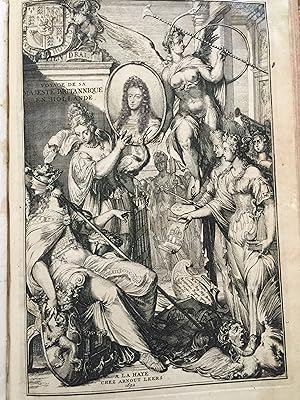
RELATION DU VOYAGE DE SA MAJESTE BRITANNIQUE EN HOLLANDE, ET DE LA RECEPTION QUI LUY A ETE FAITE. ENRICHE DE PLANCHES TRE-CURIEUSES ET DE LA RECEPTION QUI LUY A ETE FAITE. ENRICHE DE PLANCHES TRE-CURIEUSES
Verlag: Chez Arnout Leer, The Hague, 1692
Anbieter: L'Estampe Originale ABAA/ILAB-LILA, Saratoga, CA, USA
Verkäuferbewertung 5 von 5 Sternen
Erstausgabe
Original marbled boards. Zustand des Schutzumschlags: None. de Hooghe and Bidloo (illustrator). 1st French. The Hague., Chez Arnout Leers., 1692. Folio. Original marbled calf binding. There are 16 single and double page engraved illustrations including the title page. Landwehr, R. de Hooghe, 80; Vinet 752, Hoefer 147, Landwehr, Splendid Ceremonies, 147. The account of the arrival of King William III and the reception in the Hague gives the impression that the author's text closely followed the illustrations by de Hooghe. (Landwehr). All of the bibliographies concur that this work is one of the chefs d'oeuvre of de Hooghe. "One of his best books" (Hofer, Baroque Book illustration, 47) and is concurred by Didot, 951. This book represents a height of festivities begun by the Italians at Mantua more than a century before in the triumphant new era which began with the abdication of James II in favor of William of Orange. After the Battle of the Boyne William traveled to Holland to seek the safety of an alliance against the French and this book celebrates that visit. The Dutch text was issued in 1691, a French text in 1692. In this French edition the plates were printed at the same time as the Dutch therefore they are first state. A very fine copy with beautiful impressions of all the plates in the original calf binding. One of the most beautiful Dutch baroque festival books, superbly illustrated with 15 plates by Romeyn de Hooghe, the great chronicler of his age. The frontispiece was commissioned for this reception. This edition, after the Dutch edition, has the introduction of Jean Tronchin de Breuil. There are unnoticeable water contractions on the verso of some of the illustrations not affecting the image. Could have been the expert removal of a collector's stamp.
-

Kupfertafel 62. Pathologie bei einem Knaben.
Verlag: Kupferstich aus Antomia Humani corporis, centum & quinque Tabulis., 1685
Anbieter: Aegis Buch- und Kunstantiquariat, Laichingen, Deutschland
Verkäuferbewertung 4 von 5 Sternen

39,5 x 27,5 cm. Möglicherweise nicht ganz appetitliche, aber dennoch eine grandiose kupferstecherische Leistung.
-
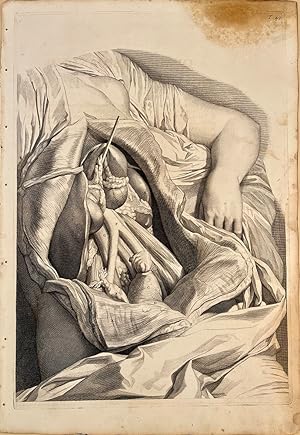
Plate 49 from Anatomia humani corporis. 522 x 358 mm. First edition. Stains in upper right corner and center of right edge of image, but otherwise very good
Verlag: Amsterdam, 1685
Anbieter: Jeremy Norman's historyofscience, Novato, CA, USA
Verkäuferbewertung 4 von 5 Sternen
This large folio by Dutch physician, anatomist, poet, and playwright Govert Bidloo contains 105 plates engraved after Gérard de Lairesse, probably by Bloteling and Peter and Philip van Gunst. Lairesse displayed his figures with everyday realism and sensuality, contrasting the raw dissected parts of the body with the full, soft surfaces of undissected flesh surrounding them; placing flayed, bound figures in ordinary nightclothes or bedding; setting objects such as a book, a jar, a crawling fly in the same space as a dissected limb or torso. He thus brought the qualities of Dutch still-life painting into anatomical illustration, and gave a new, darker expression to the significance of dissection. De Lairesse's images of dissected pregnancies and premature infants also reflect compassion-a quality unusual in art that was intended primarily to be scientific.
-
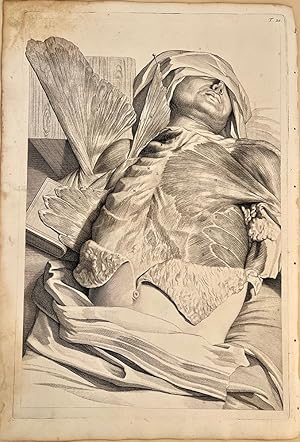
Plate 20 from Anatomia humani corporis. 522 x 358 mm. First edition. Stains in upper left corner, but otherwise very good
Verlag: Amsterdam, 1685
Anbieter: Jeremy Norman's historyofscience, Novato, CA, USA
Verkäuferbewertung 4 von 5 Sternen
This large folio by Dutch physician, anatomist, poet, and playwright Govert Bidloo contains 105 plates engraved after Gérard de Lairesse, probably by Bloteling and Peter and Philip van Gunst. Lairesse displayed his figures with everyday realism and sensuality, contrasting the raw dissected parts of the body with the full, soft surfaces of undissected flesh surrounding them; placing flayed, bound figures in ordinary nightclothes or bedding; setting objects such as a book, a jar, a crawling fly in the same space as a dissected limb or torso. He thus brought the qualities of Dutch still-life painting into anatomical illustration, and gave a new, darker expression to the significance of dissection. De Lairesse's images of dissected pregnancies and premature infants also reflect compassion-a quality unusual in art that was intended primarily to be scientific.
-
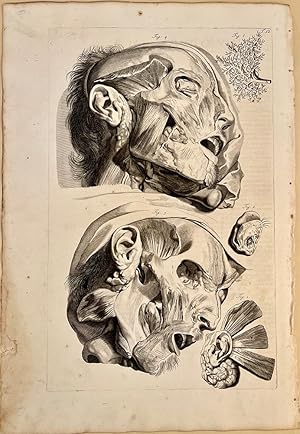
Plate 12 from Anatomia humani corporis. 522 x 358 mm. First edition. Minor stains in left margin, but otherwise very good
Verlag: Amsterdam, 1685
Anbieter: Jeremy Norman's historyofscience, Novato, CA, USA
Verkäuferbewertung 4 von 5 Sternen
This large folio by Dutch physician, anatomist, poet, and playwright Govert Bidloo contains 105 plates engraved after Gérard de Lairesse, probably by Bloteling and Peter and Philip van Gunst. Lairesse displayed his figures with everyday realism and sensuality, contrasting the raw dissected parts of the body with the full, soft surfaces of undissected flesh surrounding them; placing flayed, bound figures in ordinary nightclothes or bedding; setting objects such as a book, a jar, a crawling fly in the same space as a dissected limb or torso. He thus brought the qualities of Dutch still-life painting into anatomical illustration, and gave a new, darker expression to the significance of dissection. De Lairesse's images of dissected pregnancies and premature infants also reflect compassion-a quality unusual in art that was intended primarily to be scientific.
-
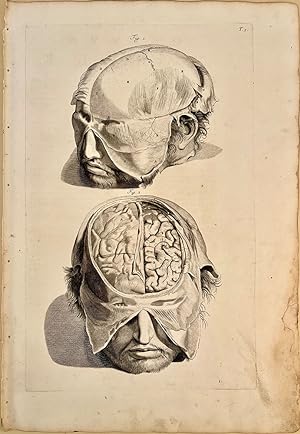
Plate 5 from Anatomia humani corporis. 522 x 358 mm. First edition. Minor stains in outer right margin, but otherwise very good
Verlag: Amsterdam, 1685
Anbieter: Jeremy Norman's historyofscience, Novato, CA, USA
Verkäuferbewertung 4 von 5 Sternen
This large folio by Dutch physician, anatomist, poet, and playwright Govert Bidloo contains 105 plates engraved after Gérard de Lairesse, probably by Bloteling and Peter and Philip van Gunst. Lairesse displayed his figures with everyday realism and sensuality, contrasting the raw dissected parts of the body with the full, soft surfaces of undissected flesh surrounding them; placing flayed, bound figures in ordinary nightclothes or bedding; setting objects such as a book, a jar, a crawling fly in the same space as a dissected limb or torso. He thus brought the qualities of Dutch still-life painting into anatomical illustration, and gave a new, darker expression to the significance of dissection. De Lairesse's images of dissected pregnancies and premature infants also reflect compassion-a quality unusual in art that was intended primarily to be scientific.
-
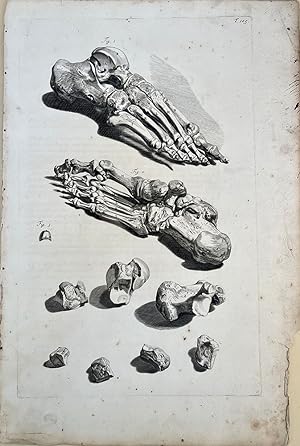
Plate 105 from Anatomia humani corporis. 522 x 358 mm. First edition. Minor worm holes blank lower portion of plate, but otherwise very good
Verlag: Amsterdam, 1685
Anbieter: Jeremy Norman's historyofscience, Novato, CA, USA
Verkäuferbewertung 4 von 5 Sternen
This large folio by Dutch physician, anatomist, poet, and playwright Govert Bidloo contains 105 plates engraved after Gérard de Lairesse, probably by Bloteling and Peter and Philip van Gunst. Lairesse displayed his figures with everyday realism and sensuality, contrasting the raw dissected parts of the body with the full, soft surfaces of undissected flesh surrounding them; placing flayed, bound figures in ordinary nightclothes or bedding; setting objects such as a book, a jar, a crawling fly in the same space as a dissected limb or torso. He thus brought the qualities of Dutch still-life painting into anatomical illustration, and gave a new, darker expression to the significance of dissection. De Lairesse's images of dissected pregnancies and premature infants also reflect compassion-a quality unusual in art that was intended primarily to be scientific.
-

Plate 103 from Anatomia humani corporis. 522 x 358 mm. First edition. Repair to outer right margin,minor worm holes in lower blank part of image but otherwise very good
Verlag: Amsterdam, 1685
Anbieter: Jeremy Norman's historyofscience, Novato, CA, USA
Verkäuferbewertung 4 von 5 Sternen
This large folio by Dutch physician, anatomist, poet, and playwright Govert Bidloo contains 105 plates engraved after Gérard de Lairesse, probably by Bloteling and Peter and Philip van Gunst. Lairesse displayed his figures with everyday realism and sensuality, contrasting the raw dissected parts of the body with the full, soft surfaces of undissected flesh surrounding them; placing flayed, bound figures in ordinary nightclothes or bedding; setting objects such as a book, a jar, a crawling fly in the same space as a dissected limb or torso. He thus brought the qualities of Dutch still-life painting into anatomical illustration, and gave a new, darker expression to the significance of dissection. De Lairesse's images of dissected pregnancies and premature infants also reflect compassion-a quality unusual in art that was intended primarily to be scientific.
-
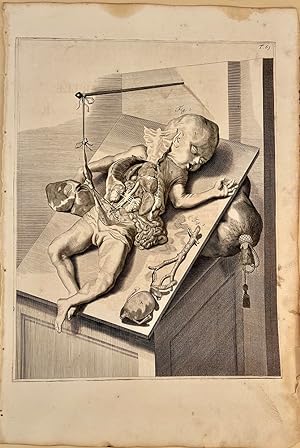
Plate 63 from Anatomia humani corporis. 522 x 358 mm. First edition. Minor stains in upper margin, but otherwise very good
Verlag: Amsterdam, 1685
Anbieter: Jeremy Norman's historyofscience, Novato, CA, USA
Verkäuferbewertung 4 von 5 Sternen
This large folio by Dutch physician, anatomist, poet, and playwright Govert Bidloo contains 105 plates engraved after Gérard de Lairesse, probably by Bloteling and Peter and Philip van Gunst. Lairesse displayed his figures with everyday realism and sensuality, contrasting the raw dissected parts of the body with the full, soft surfaces of undissected flesh surrounding them; placing flayed, bound figures in ordinary nightclothes or bedding; setting objects such as a book, a jar, a crawling fly in the same space as a dissected limb or torso. He thus brought the qualities of Dutch still-life painting into anatomical illustration, and gave a new, darker expression to the significance of dissection. De Lairesse's images of dissected pregnancies and premature infants also reflect compassion-a quality unusual in art that was intended primarily to be scientific.
-
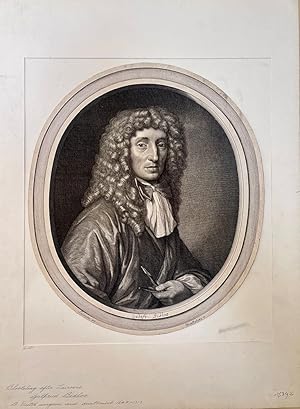
Portrait of Bidloo, cropped around oval, used as frontispiece for his large anatomy. Engraved by Blooteling after the painting by Gerard de Lairesse
Verlag: Amsterdam
Anbieter: Jeremy Norman's historyofscience, Novato, CA, USA
Verkäuferbewertung 4 von 5 Sternen
-
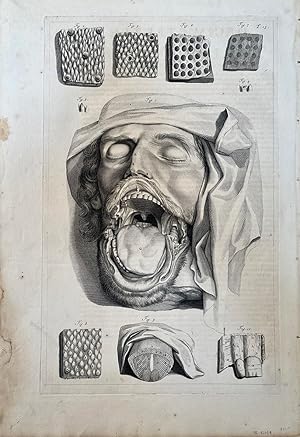
Plate 13 (head w/dissected jaw & tongue) from Anatomia humani corporis. 44x27.5cm (image size) First edition
Verlag: Amsterdam, 1685
Anbieter: Jeremy Norman's historyofscience, Novato, CA, USA
Verkäuferbewertung 4 von 5 Sternen
Llight stains in margin, one small wormhole within the platemark barely affecting the image, two small marginal tears, faint offsetting. This large folio by Dutch physician, anatomist, poet, and playwright Govert Bidloo contains 105 engraved plates after Gerard de Lairesse, probably by Bloteling and Peter and Philip van Gunst. Lairesse displayed his figures with everyday realism and sensuality, contrasting the raw dissected parts of the body with the full, soft surfaces of undissected flesh surrounding them; placing flayed, bound figures in ordinary nightclothes or bedding; setting objects such as a book, a jar, a crawling fly in the same space as a dissected limb or torso. He thus brought the qualities of Dutch still-life painting into anatomical illustration, and gave a new, darker expression to the significance of dissection. De Lairesse's images of dissected pregnancies and premature infants also reflect compassion-a quality unusual in art that was intended primarily to be scientific.
-
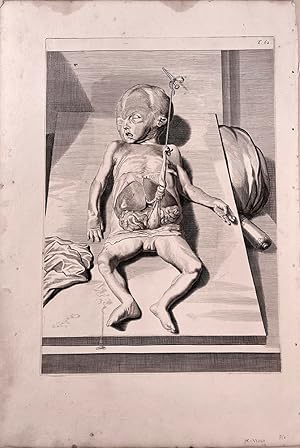
Plate 62 (dissected fetus) from Anatomia humani corporis. 40 x 27.5cm (image size) in a trim of 51 x 35.5 cm
Verlag: Amsterdam, 1685
Anbieter: Jeremy Norman's historyofscience, Novato, CA, USA
Verkäuferbewertung 4 von 5 Sternen
Erstausgabe
slightly dampstained around edges, otherwise very good. First edition. This large folio by Dutch physician, anatomist, poet, and playwright Govert Bidloo contains 105 engraved plates after Gerard de Lairesse, probably by Bloteling and Peter and Philip van Gunst. Lairesse displayed his figures with everyday realism and sensuality, contrasting the raw dissected parts of the body with the full, soft surfaces of undissected flesh surrounding them; placing flayed, bound figures in ordinary nightclothes or bedding; setting objects such as a book, a jar, a crawling fly in the same space as a dissected limb or torso. He thus brought the qualities of Dutch still-life painting into anatomical illustration, and gave a new, darker expression to the significance of dissection. De Lairesse's images of dissected pregnancies and premature infants also reflect compassion-a quality unusual in art that was intended primarily to be scientific.
-
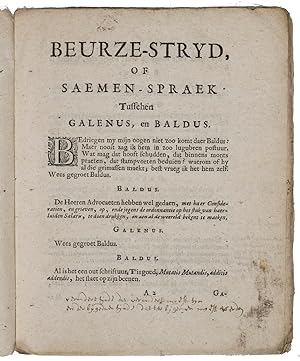
Beurze-Stryd, of Saemen-Spraek tusschen Galenus, en Baldus.
Verlag: Meyndert Uytwerf?],, [The Hague,, 1692
Anbieter: ASHER Rare Books, T Goy Houten, Niederlande
Verkäuferbewertung 5 von 5 Sternen
One of variant issues of this satirical pamphlet supposedly written by the famous physician (he became a few years later the personal physician of Stadholder/King William III), anatomist, poet and playwright and above all colorful Govert Bidloo (1649-1717).In February 1692 the Hoge Raed (Supreme Court) of the Dutch Republic had renewed their ordinance of 1652, 't Reglement op het stuck van het salaris van Advocaeten en Procureurs, to protect those who seek legal assistance from the sometimes exceedingly overcharging barristers and solicitors. Considering this as an infringement on their honor, the furious barristers reacted with a fierce account entitled Consideratien ende Grieven by de heeren Advocaten gemaeckt op ende jegens de Ordonnatie op het stuckvan haer luyden salaris (1692; Knuttel , 13806): meat and drink for Bidloo who immediately wrote this razor-sharp satire, anonymously printed without the name of the printer/publisher (probably it was he publisher/bookseller Meyndert Uytwerf at The Hague), in the form of a dialogue of a physician (Galanus) and a totally upset lawyer (barrister; Baldus).With many contemporary marginal annotations, the Latin nicknames have been identified and the names of the actual barristers are written in the margins by a contemporary hand (as in more copies), f.e. 'Arminius Lanicutis Albus' = Mr. Pieter Schaep; 'Pub. Acrimonius Voetianus' = Mr. Surendonck; 'Pentadomus' = Procureur Vijfhuysen, etc. Also the Latin sentences and motto's are translated and the author is named on the title-page: 'auctor bedloo M.D.'.l Knuttel, 13808 (copy with manuscript annotations); Knuttel, Verboden boeken, 57; Knuttel, 'Govert Bidloo voor het gerecht', in: De Ned. Spectator, 17.6.1899, pp. 193-195; NNBW, 8, cols. 104-108; R. Krul, Rapport van de Commissie voor de gesch. Der geneesk. in Ned. Het Haagsche Chirurgijns-Gilde (1891), p. 416. Bound on two modern chords. With a woodcut title vignette. Pages: [8], 9-24 pp.
-

Plate 57 from Anatomia humani corporis. 522 x 358 mm. First edition. Stains in upper margin, but otherwise very good
Verlag: Amsterdam, 1685
Anbieter: Jeremy Norman's historyofscience, Novato, CA, USA
Verkäuferbewertung 4 von 5 Sternen
This large folio by Dutch physician, anatomist, poet, and playwright Govert Bidloo contains 105 plates engraved after Gérard de Lairesse, probably by Bloteling and Peter and Philip van Gunst. Lairesse displayed his figures with everyday realism and sensuality, contrasting the raw dissected parts of the body with the full, soft surfaces of undissected flesh surrounding them; placing flayed, bound figures in ordinary nightclothes or bedding; setting objects such as a book, a jar, a crawling fly in the same space as a dissected limb or torso. He thus brought the qualities of Dutch still-life painting into anatomical illustration, and gave a new, darker expression to the significance of dissection. De Lairesse's images of dissected pregnancies and premature infants also reflect compassion-a quality unusual in art that was intended primarily to be scientific.
-

Komste van Zyne Majesteit WILLEM III. Koning van Groot Britanje, enz. in HOLLAND ofte omstandelyke beschryving van alles, het welke op des zelfs komste en geduurende zyn verblyf, in's Graavenhaage en elders, ten teeken van vreugde en eere, is opgerecht e
Verlag: Arnoud Leers, 1691
Anbieter: Tiré à Part, Marseille, Frankreich
Verkäuferbewertung 5 von 5 Sternen
In-folio ( 395 X 265 mm ) de 127 pages, pleine basane tabac, dos à nerfs orné de caissons richement dorés, tranches mouchetées de rouge ( Reliure de l'époque ). Frontispice allégorique par Romeyn De HOOGHE ( "Qui ne serait point indigne de RUBENS" écrit VINET ), page de titre typographique portant la marque d'imprimeur gravée sur bois avec la devise de LEERS, et 15 planches hors-texte gravées de Romeyn De HOOGHE, dont 11 à double-page, 3 planches à simple page et un portrait du roi par Pieter Van GUNST d'après John BRANDON. PREMIÈRE ÉDITION de l'un des plus beaux livres de fête hollandais de la période baroque. Il célèbre la joyeuse entrée à La Haye de GUILLAUME III en tant que roi de Grande-Bretagne. Les gravures de Romeyn De HOOGHE montrent la procession, les arcs de triomphe, le Vyverberg et le Binnenhof, les décorations spécialement élaborées pour l'évènement, y compris la peinture et la sculpture, et un spectaculaire feu d'artifice. Coiffes absentes, coins usés, très bel état intérieur, les planches sont très fraîches.Berlin Kat. 2952 Landwehr, Cérémonies splendides 146 Ruggieri 1095 Vinet 752 Hollstein, Dutch and Flemish, IX, 168-85. Histoire Gravure Hollande Fête.
-
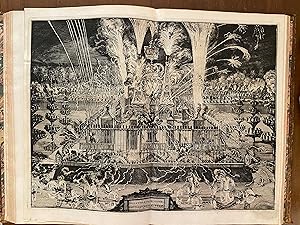
Komste van Zyne Majesteit Willem III. Koning van Groot Britanje, enz. in Holland; ofte omstandelyke beschryving van alles, het welke op des zelfs komste en geduurende zyn verblyf, in 's Graavenhaage en elders, ten teeken van vreugde en eere, is opgerecht en voorgevallen [.].
Verlag: The Hague, Arnoud Leers, 1691., 1691
Anbieter: Antiquariat INLIBRIS Gilhofer Nfg. GmbH, Vienna, A, Österreich
Verbandsmitglied: ILAB VDA VDAO
Verkäuferbewertung 5 von 5 Sternen
Erstausgabe
Folio (ca. 268 x 395 mm). (10), 127, (1) pp. With engraved title-page, 14 (instead of 15) engraved plates (11 of which double-page sized), and woodcut printer's device to title-page. Contemporary giltstamped full calf with title label to spine. First edition. Lavishly illustrated account of the 1691 entrance of William of Orange, King William III of England and stadtholder of Holland, to The Hague, the place of his birth. The splendid plates by the Dutch artist Romeyn de Hooghe (1645-1713) show the ceremonial architecture erected in William's honour as well as parades, grand fireworks, and the King's route, including his arrival at Honslerdyk castle, his passing Westend bridge with several windmills in the background, and the triumphal arches with their allegorical designs. - Wants the engraved portrait of William by Philipp van Gunst. Binding somewhat rubbed, spine-ends chipped, hinges starting, corners repaired. A few leaves show marginal tears, barely affecting text or image. A good, wide-margined copy of this sumptuous work of monarchical representation. - Lipperheide 2667. Kat der Ornamentstichsammlung Berlin 2952. Ruggieri 1095. Vinet 752. Graesse I, 419. Landwehr, Splendid Ceremonies 146. Landwehr, R. de Hooghe as book illustrator 79. Printmaking in the Age of Rembrandt, cat. Museum of Fine Arts Boston, 209. Lotz, Das Feuerwerk 105. Sievernich, Feuerwerkskunst 6/36.
-
Komste van zyne Majesteit Willem III. Koning van Groot Britanje, enz. in Holland; ofte omstandelyke beschryving van alles, het welke op des zelfs komste en geduurende zyn verblyf, in 's Graavenhaage en elders, ten teeken van vreugde en eere, is opgerecht en voorgevallen.
Verlag: Arnoud Leers,, The Hague,, 1691
Anbieter: ASHER Rare Books, T Goy Houten, Niederlande
Verkäuferbewertung 5 von 5 Sternen
EUR 5.850,00
EUR 25,00 Versand
Versand von Niederlande nach USAAnzahl: 1 verfügbar
In den WarenkorbFirst edition of a beautifully illustrated commemoration of the triumphal entry of William III into the Hague, it was "the costliest and most elaborate public display ever held on Dutch soil" (Nierop) and the first time of a triumphal entry since the rebellion against Spain. The two directors of the festivities were Govert Bidloo (1649-1713), personal physician to William, and Romeyn de Hooghe (1645-1708), one of the greatest artists to come out of the late Dutch Golden Age. The project served as De Hooghe's rehabilitation after he fell from grace the year before, when he got caught in a feud between William III and the city of Amsterdam. The Orangist leadership now thought that De Hooghe had suffered unjustly for their cause. He not only participated in the planning and design, but also made the splendid plates for the present commemorative volume. A slightly altered French edition followed a year later.From 1672 onwards, William governed as Stadtholder Willem III of Orange over most provinces of the Dutch Republic. In addition, from 1689 onward, he reigned as King William III over England and Ireland, and as King William II over Scotland. After dealing with the last remnants of the rebellion in Ireland, William finally found time to return to Holland in 1691.Binding slightly rubbed along the extremities, but otherwise in very good condition.l Berlin Kat. 2925; Landwehr, Splendid ceremonies 146; Muller, Historieplaten 2827; Nierop, The life of Romeyn de Hooghe (2018), pp. 364-372. Contemporary calf, gold-tooled spine and board edges. With an engraved title-page by Romeyn de Hooghe, a letterpress title-page with Leer's woodcut device, a portrait of King William III by Van Gunst and 14 engraved plates (11 double-page) by Romeyn de Hooghe, showing his triumphal entry into the Hague, the ceremonies, the triumphal arches, their paintings and sculptures, the nightly illumination of the town hall, the fireworks, etc. Further with an extra added engraved plate of King William's tomb by Daniel Marot. Pages: [12, incl. frontispiece], 127, [1 blank] pp.
-
RELATION DU VOYAGE DE SA MAJESTE BRITANNIQUE EN HOLLANDE, ET DE LA RECEPTION QUI LUY A ETE FAITE. ENRICHE DE PLANCHES TRE-CURIEUSES
Verlag: Arnout Leers, The Hague, 1692
Anbieter: L'Estampe Originale ABAA/ILAB-LILA, Saratoga, CA, USA
Verkäuferbewertung 5 von 5 Sternen
Erstausgabe
original calf binding. Zustand: Near Fine. Zustand des Schutzumschlags: no DJ. ROMEYN DE HOOGHE (illustrator). 1st. ( DE HOOGHE, ROMEYN). GOVERT BIDLOO.The Hague., Chez Arnout Leers., 1692. Folio. Original marbled calf binding. There are 16 single and double page engraved illustrations including the title page. Landwehr, R. de Hooghe, 80; Vinet 752, Hoefer 147, Landwehr, Splendid Ceremonies, 147. Ex Library. The account of the arrival of King William III and the reception in the Hague gives the impression that the author's text closely followed the illustrations by de Hooghe. (Landwehr). All of the bibliographies concur that this work is one of the chefs d'oeuvre of de Hooghe. "One of his best books" (Hofer, Baroque Book illustration, 47) and is concurred by Didot, 951. This book represents a height of festivities begun by the Italians at Mantua more than a century before in the triumphant new era which began with the abdication of James II in favor of William of Orange. After the Battle of the Boyne William traveled to Holland to seek the safety of an alliance against the French and this book celebrates that visit. The Dutch text was issued in 1691, a French text in 1692. In this French edition the plates were printed at the same time as the Dutch therefore they are first state. A very fine copy with beautiful impressions of all the plates in the original calf binding. One of the most beautiful Dutch baroque festival books, superbly illustrated with 15 plates by Romeyn de Hooghe, the great chronicler of his age. The frontispiece was commissioned for this reception. Romeyn de Hooghe (Amsterdam 1645â"1708 Haarlem) produced a world of art in many forms, including paintings, sculpture, medallic art, and temporary decorations for royal events. Above all, however, De Hooghe is known for his etchings, and he completed a staggering four thousandâ"plus plates in his lifetime. Active at a time when the smallâ"but wealthy and powerfulâ"Dutch Republic was engaged in a host of interactions, warlike and otherwise, with its European neighbors and far-flung colonial interests, This edition, after the Dutch edition, has the introduction of Jean Tronchin de Breuil. There are unnoticeable water contractions on the verso of some of the illustrations not affecting the image. Could have been the expert removal of a collector's stamp.
-
Anat. corp. human., 67.-71.Tab.: Anatomy of the Hand.
Erscheinungsdatum: 1698
Anbieter: Antiq. F.-D. Söhn - Medicusbooks.Com, Marburg, Deutschland
Verkäuferbewertung 5 von 5 Sternen
Kunst / Grafik / Poster
EUR 2.360,00
EUR 36,45 Versand
Versand von Deutschland nach USAAnzahl: 1 verfügbar
In den WarenkorbOxford/London 1698 (or 1737) The Anatomy of human bodies, 2° , 5 Kupferstichtafeln, 35 x 50 cm; Tafelerklärungen beigelegt. 67.: Some of the Muscles Employ'd Bending the Fingers and Carpus. 68.: The Muiscles Bending the Fingers, Thumb, Carpus, &c. Rais'd from their Originations and left at their Infections. 69.: Presents the External Muscles lying on the Cubit, imploy'd in Extending the Fingers, Thumb and Carpus. The Skin with the Parts annex'd , Rais'd. 70.: Divers Muscles, which Extend the Carpus, Fingers, and Thumb; somewhat Separated from each other Rais'd. 71.: Shews the Muscles Employ'd in Extending the Carpus, and Fingers, Rais'd and left at their Infertions. Diese Tafeln der Hand gehören zu den berühmtesten und schönsten barocken anatomischen Abbildungen der Hand, insbesondere die Abbildung der Beugeseite gilt als unerreicht. Nach Haller sind die Stiche von Van Gunst ausgeführt. These plates of Govard Bidloo (1649-1713) "must take their place amongst the canon of great anatomical illustrations, and this is in no small measure due to the artist employed, Gerard de Lairesse (1640-1711). Roberts & Tomlinson, The Fabric of the Body.
-
Brieven der gemartelde Apostelen.
Sprache: Deutsch
Verlag: Amsterdam, Sweerts,, 1675
Anbieter: Antiquariat Bernhard Schäfer, Bad Karlshafen, Deutschland
Verbandsmitglied: BOEV ILAB VDA
Verkäuferbewertung 3 von 5 Sternen

Erstausgabe
7 Bll., 84 S. mit gest. Titel, gest. Titelvign. und 13 Textkupfern von R. de Hoogh. Erste Ausgabe. Govert Bidloo (16491713) war nicht nur Dichter, sondern auch Chirurg und später Anatomieprofessor in Leiden, Leibarzt von König-Stadthalter Wilhelm III. und wie der Illustrator Romeyn de Hooghe ein glühender Anhänger des Prinzen von Oranien und Verfechter seiner antifranzösischen Politik. Die erbaulichen Briefe der Märtyrerapostel" gehören obwohl ausschließlich von Männern zur Gattung der Heldinnenbriefe, poetische Texte in Briefform berühmter Frauen, die an eine geliebte oder vertraute Person gerichtet sind. Gerne können Sie Bilder anfordern oder mit mir über Ihre Preisvorstellung sprechen Sprache: Deutsch Gewicht in Gramm: 550 Gr.-8°. Pergamentband d. Zt. (leicht fleckig).
-
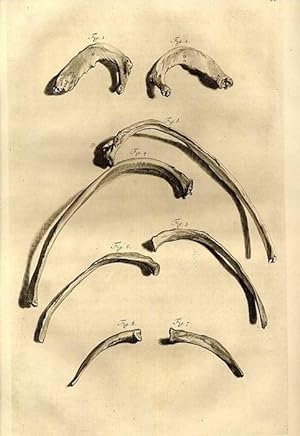
Anat. corp. human., 94.Tab.: The Ribs.
Erscheinungsdatum: 1698
Anbieter: Antiq. F.-D. Söhn - Medicusbooks.Com, Marburg, Deutschland
Verkäuferbewertung 5 von 5 Sternen
Kunst / Grafik / Poster
Oxford/London 1698 (or 1737) The Anatomy of human bodies, 2° , 1 Kupferstichtafel 35 x 50 cm; Tafelerklärungen beigelegt.
-
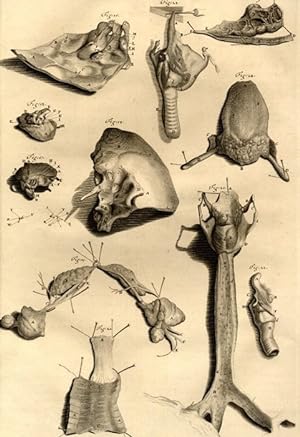
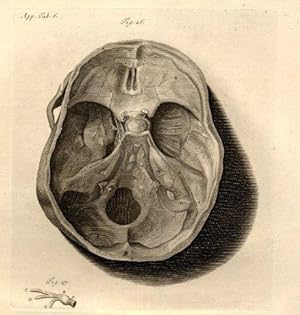
Anat. corp. human.: App., 5.Tab.: Divers Parts of the Organ of hearing of a Man; The External Surface of the Ostempoum on the Right Side; Os Temporum; Salvial Glands; Larynx; Tongue; .
Erscheinungsdatum: 1698
Anbieter: Antiq. F.-D. Söhn - Medicusbooks.Com, Marburg, Deutschland
Verkäuferbewertung 5 von 5 Sternen
Kunst / Grafik / Poster
Oxford/London 1698 (or 1737) The Anatomy of human bodies, 2° , 1 Kupferstichtafel 56 x 35 cm; Tafelerklärungen beigelegt.
-
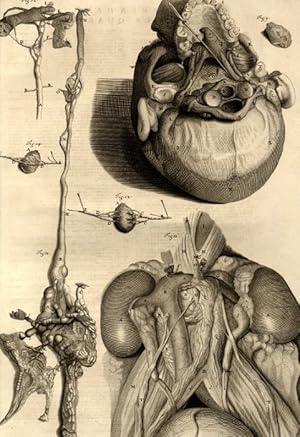
Anat. corp. human.: App., 4.Tab.: Bais of the Skull with First Vertebra of the Neck remaining on it, together with divers Muscles and other Parts; The Thoracick Duct; The Receptaculum Chyli Fill'd. .
Erscheinungsdatum: 1698
Anbieter: Antiq. F.-D. Söhn - Medicusbooks.Com, Marburg, Deutschland
Verkäuferbewertung 5 von 5 Sternen
Kunst / Grafik / Poster
Oxford/London 1698 (or 1737) The Anatomy of human bodies, 2° , 1 Kupferstichtafel 56 x 35 cm; Tafelerklärungen beigelegt.
-
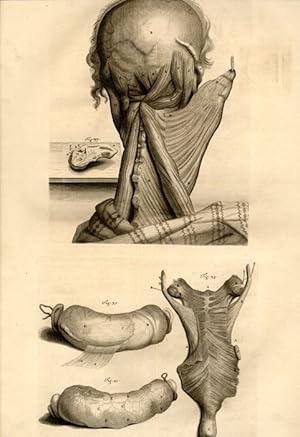
Anat. corp. human.: App., 9.Tab.: Shews divers Muscles Employ'd in the Motions of the Head and Vertebrae of the Neck, which Appear onm the Back-Part; .
Erscheinungsdatum: 1698
Anbieter: Antiq. F.-D. Söhn - Medicusbooks.Com, Marburg, Deutschland
Verkäuferbewertung 5 von 5 Sternen
Kunst / Grafik / Poster
Oxford/London 1698 (or 1737) The Anatomy of human bodies, 2° , 1 Kupferstichtafel 56 x 35 cm; Tafelerklärungen beigelegt.
-
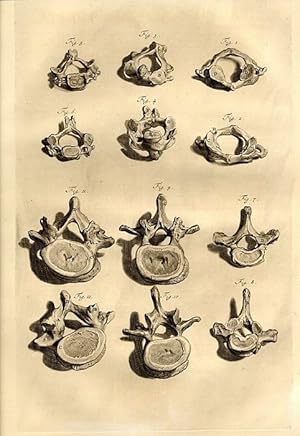
Anat. corp. human., 93.Tab.: The Bones of the Vertebrae.
Erscheinungsdatum: 1698
Anbieter: Antiq. F.-D. Söhn - Medicusbooks.Com, Marburg, Deutschland
Verkäuferbewertung 5 von 5 Sternen
Kunst / Grafik / Poster
Oxford/London 1698 (or 1737) The Anatomy of human bodies, 2° , 1 Kupferstichtafel 35 x 5= cm; Tafelerklärungen beigelegt.
-
Anat. corp. human.: App., 6.Tab.: Represnets the Internal Surface of the Basis of the Cranium, with the Inferior Part of the Dura Mater remaining on it; .
Erscheinungsdatum: 1698
Anbieter: Antiq. F.-D. Söhn - Medicusbooks.Com, Marburg, Deutschland
Verkäuferbewertung 5 von 5 Sternen
Kunst / Grafik / Poster
Oxford/London 1698 (or 1737) The Anatomy of human bodies, 2° , 1 Kupferstichtafel 56 x 35 cm; Tafelerklärungen beigelegt.
-
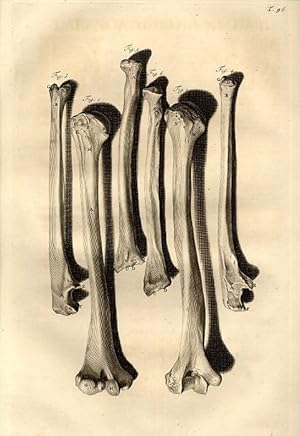
Anat. corp. human., 96.Tab.: Presents the Bones of the Arms, together with the Two Bones of the Cubit.
Erscheinungsdatum: 1698
Anbieter: Antiq. F.-D. Söhn - Medicusbooks.Com, Marburg, Deutschland
Verkäuferbewertung 5 von 5 Sternen
Kunst / Grafik / Poster
Oxford/London 1698 (or 1737) The Anatomy of human bodies, 2° , 1 Kupferstichtafel 35 x 50 cm; Tafelerklärungen beigelegt.
-
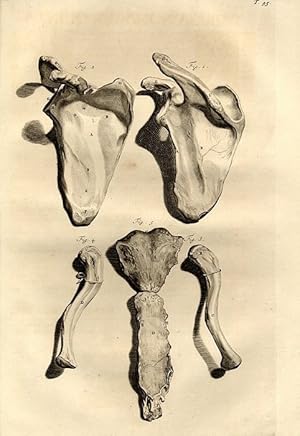
Anat. corp. human., 95.Tab.: Presents the Scapulae, Claviculae and Os Pectoris, or Sternum.
Erscheinungsdatum: 1698
Anbieter: Antiq. F.-D. Söhn - Medicusbooks.Com, Marburg, Deutschland
Verkäuferbewertung 5 von 5 Sternen
Kunst / Grafik / Poster
Oxford/London 1698 (or 1737) The Anatomy of human bodies, 2° , 1 Kupferstichtafel 35 x 50 cm; Tafelerklärungen beigelegt.
-
Anat. corp. human., 79.Tab.:
Erscheinungsdatum: 1698
Anbieter: Antiq. F.-D. Söhn - Medicusbooks.Com, Marburg, Deutschland
Verkäuferbewertung 5 von 5 Sternen
Kunst / Grafik / Poster
Oxford/London 1698 (or 1737) The Anatomy of human bodies, 2° , 1 Kupferstichtafel 35 x 50 cm; Tafelerklärungen beigelegt.



![Bild des Verkäufers für Komste van Zyne Majesteit Willem III. Koning van Groot Britanje, enz. in Holland; ofte omstandelyke beschryving van alles, het welke op des zelfs komste en geduurende zyn verblyf, in 's Graavenhaage en elders, ten teeken van vreugde en eere, is opgerecht en voorgevallen [.]. zum Verkauf von Antiquariat INLIBRIS Gilhofer Nfg. GmbH](https://pictures.abebooks.com/inventory/md/md30930315917.jpg)