

Gesamtpreis (1 Artikel Artikel):
Versandziel:

giovanni antolini (11 Ergebnisse)
Direkt zu den wichtigsten Suchergebnissen
Suchfilter
Produktart
- Alle Product Types
- Bücher (11)
- Magazine & Zeitschriften (Keine weiteren Ergebnisse entsprechen dieser Verfeinerung)
- Comics (Keine weiteren Ergebnisse entsprechen dieser Verfeinerung)
- Noten (Keine weiteren Ergebnisse entsprechen dieser Verfeinerung)
- Kunst, Grafik & Poster (Keine weiteren Ergebnisse entsprechen dieser Verfeinerung)
- Fotografien (Keine weiteren Ergebnisse entsprechen dieser Verfeinerung)
- Karten (Keine weiteren Ergebnisse entsprechen dieser Verfeinerung)
- Manuskripte & Papierantiquitäten (Keine weiteren Ergebnisse entsprechen dieser Verfeinerung)
Zustand Mehr dazu
- Neu (3)
- Wie Neu, Sehr Gut oder Gut Bis Sehr Gut (Keine weiteren Ergebnisse entsprechen dieser Verfeinerung)
- Gut oder Befriedigend (2)
- Ausreichend oder Schlecht (Keine weiteren Ergebnisse entsprechen dieser Verfeinerung)
- Wie beschrieben (6)
Einband
Weitere Eigenschaften
- Erstausgabe (1)
- Signiert (Keine weiteren Ergebnisse entsprechen dieser Verfeinerung)
- Schutzumschlag (Keine weiteren Ergebnisse entsprechen dieser Verfeinerung)
- Angebotsfoto (6)
Sprache (2)
Gratisversand
Land des Verkäufers
Verkäuferbewertung
-

Il Tempio Di Minerva in Assisi
Anbieter: PBShop.store US, Wood Dale, IL, USA
Verkäuferbewertung 5 von 5 Sternen

PAP. Zustand: New. New Book. Shipped from UK. Established seller since 2000.
-
Il Tempio Di Minerva in Assisi 1
Anbieter: PBShop.store UK, Fairford, GLOS, Vereinigtes Königreich
Verkäuferbewertung 4 von 5 Sternen

EUR 15,40
EUR 3,80 Versand
Versand von Vereinigtes Königreich nach USAAnzahl: 15 verfügbar
In den WarenkorbPAP. Zustand: New. New Book. Shipped from UK. Established seller since 2000.
-

EUR 18,51
EUR 48,99 Versand
Versand von Deutschland nach USAAnzahl: Mehr als 20 verfügbar
In den WarenkorbZustand: New. KlappentextrnrnThis is a reproduction of the original artefact. Generally these books are created from careful scans of the original. This allows us to preserve the book accurately and present it in the way the author intended. Since the origina.
-
Idee elementari di architettura civile per le scuole del disegno di Giovanni Antolini Architetto di S.M. Imperiale e Reale [.]
Verlag: Bologna, nella tipografia di Jacopo Marsigli a San Salvatore n. 1240, Bologna, 1813
Anbieter: Govi Rare Books LLC, Woodside, New York City, NY, USA
Verkäuferbewertung 4 von 5 Sternen
Zustand: Buono (Good). Folio (454x329 mm). 40, [2] pp. and XXIV engraved plates. Etched vignette on title page. Contemporary half vellum (rubbed and worn, spine edges missing). Some foxing and occasional marginal staining, all in all a good, wide-margined copy.First edition published in conjuction with the brothers Masi, whose name appears in certain copies instead of that of Marsigli. A second, enlarged edition was issued soon after in the same year at the author's expenses. A third edition was printed in Milan in 1829. It is a manual of civil architetcture conceived as a teaching tool for the students of architectural drawing.Giovanni Antonio Antolini was professor of civil and military architecture, hydraulics, and practical geometry at the University of Bologna between 1803 and 1815, then he moved to Milan to teach at the Brera Academy until his death. He is the author of several theoretical works. His major project was the urban plan, presented to Napoleon in 1801, for the area around the Sforza Castle in Milan, which was given the name ?Foro Bonaparte?.?La critica ha veduto nell'Antolini più il teorico, il professore, lo studioso degli antichi monumenti che non l'architetto e l'urbanista: la sua meritoria e complessa attività di studioso e insegnante non deve tuttavia farci dimenticare il significato almeno del suo progetto per il Foro Bonaparte, espressione non solo nei singoli edifici del gusto neoclassico, al quale egli pure partecipa, ma anche di quelle aspirazioni ad un rigido funzionalismo e razionalismo che avevano trovato in Italia un sostenitore in Carlo Lodoli e in Francia più diretta applicazione nell'opera degli architetti ?illuministi' e ?rivoluzionari', in particolare in E.-L. Boullée e C.-N. Ledoux? (M. Pepe, Antolini, Giovanni Antonio, in: ?Dizionario Biografico degli Italiani?, vol. 3, 1961, s.v.).Italian Union Catalogue, IT\ICCU\MILE\002663. Book.
-

Idee elementari di Architettura Civile per le Scuole del Disegno.,
Verlag: Tipografia di Iacopo Marsigli, Bologna, 1813
Anbieter: Libreria Antiquaria Prandi, Reggio Emilia, RE, Italien
Verkäuferbewertung 5 von 5 Sternen
In folio, pp. 40 non num 2, seguono XXIV tav. f.testo incise; bella vignetta incisa da rame al frontespizio. Ril. m.pelle coeva con fregi in oro al dorso, segni di usura al piatto anteriore e alla cuffia superiore, ma solido. Lievi bruniture in alcune pagine che non pregiudicano il testo e le tavole; buon esemplare. L'Autore (1753-1841) fu insegnante alla Reale Accademia di Belle Arti di Bologna e all'Accademia di Brera; architetto, urbanista e docente, esponente di spicco del Neoclassicismo italiano. Rara prima edizione di quest'opera didattica ristampata nel 1829. Cfr. Brunet I; Graesse I.Num. catalogo: 267.
-
Il Tempio di Minerva in Assisi confrontato colle tavole di Andrea Palladio architetto di Vicenza
Verlag: dalla Stamperia di G.G. Destefanis s.d. (ma 1803), Milano, 1803
Anbieter: Libreria Ex Libris ALAI-ILAB/LILA member, Roma, RM, Italien
Verkäuferbewertung 4 von 5 Sternen
Erstausgabe
Bross. muta coeva (mancanze al ds.). Scritta di antica mano al verso del frontis. Una tavola leggermente brunita, ma ottimo esemplare. La data presunta di pubblicazione si ricava dalla Dedicatoria e dall Avviso. Raro. Edizione originale. Cicognara, 3938; Lozzi, 210. Folio (cm. 34), 28 pp., 3 cc.nn. (due tavv. di iscrizioni e la Nota degli Associati ) con 10 tavv. incise su rame f.t. in maggior parte firmate da Ferdinando Albertolli. Bella vignetta calcografica al frontis.
-

Idee Elementari Di Architettura Civile Per Le Scuole Del DisegnoEdizione Seconda Accresciuta Di Un Appendice.
Verlag: Milan: Dalla Società Tipog. De Classici Italiani, 1829., 1829
Anbieter: D & E LAKE LTD. (ABAC/ILAB), Toronto, ON, Kanada
Verkäuferbewertung 3 von 5 Sternen

Hardcover. Zustand: Very Good. folio. pp. 39, [1]blank, xvii, [3]. engraved frontis. portrait of Antolini by A.Marchi after Maria Antolini & 24 engraved plates. large engraved title vignette. modern half calf (some light foxing). Second Edition, with appendix. Originally published at Bologna in 1813. "Ouvrage rempli de bons principes." (Brunet) "Ouvrage estimé". (Graesse) The Milanese architect executed few significant buildings but left a number of theoretical works and unexecuted building plans. Among the latter were designs for a large forum which Napoleon hoped to build at Milan. Brunet I 325.
-
L'Ordine Dorico ossia il Tempio d'Ercole nella Città di Cori
Sprache: Italienisch
Verlag: Pagliarini, Rome, 1785
Hardcover. Zustand: Very Good. In folio, 23 pp, 4 engraved plates. Original terracotta-red boards with blind ruled border, yellow endpapers, Italian library shelf label (binding somewhat dusted and sunned, small tear to the front free endpaper). First edition of this uncommon neoclassical architectural monograph by the Milanese architect Giovanni Antonio Antolini (1753-1841). Dedicated to Pope Pius VI, it presents a detailed scholarly study of the Doric prostyle temple at Cori (ancient Cora, Latium), then attributed to Hercules. The text discusses the temple's proportions, columns, frieze, cornice, and inscriptions. It draws on prior observations by Winckelmann, Piranesi, and Raphael, who had earlier made drawings of the temple. The theoretical sections engage extensively with questions of Doric proportion, architectural beauty, and the relationship between ancient and modern practice. Illustrated with four engraved plates, including a fine elevation of the temple façade, a plan, details of the Doric order, and a plate reproducing the Latin inscription from the temple frieze alongside that from the urn of Scipio Barbatus. An important work for the study of neoclassical architecture and ancient Roman temples.
-
Giovanni Antonio Antolini (1753-1841). Architettura e Urbanistica in Età Neoclassica. Atti del I Convegno di Studi Antoliniani.
Anbieter: Antiquariaat A. Kok & Zn. B.V., Amsterdam, Niederlande
Verkäuferbewertung 5 von 5 Sternen
Faenza, 2003. 414 pp. B./w. ills. Softcover.
-
Progetto sul Foro Bonaparte che doveva Eseguirsi in Milano in 24 Gran Tavole.
Erscheinungsdatum: 1814
Anbieter: Ursus Rare Books, New York, NY, USA
Verkäuferbewertung 2 von 5 Sternen

ANTOLINI, Giovanni Antonio. Progetto sul Foro Bonaparte che doveva Eseguirsi in Milano in 24 Gran Tavole. Title-page and suite of twenty-four plates, comprising 14 magnificent double-page aquatint views printed in shades of sepia ink and 10 double-page engraved floor-plans and scaled architectural drawings. Large folio, 572 x 440 mm., bound in full contemporary Italian boards. Milan: Bettalli, [1814]. A splendid copy of these magnificent plates. These grand aquatint views document an imposing project that was never constructed and never proceeded beyond the publication of various issues of these plates. The scale and design of the buildings and plazas evoke the visionary work of Antolini's celebrated contemporaries: Claude-Nicolas Ledoux and Etienne-Louis Boullée. Antolini provided the drawings for all the plates except one, which was executed by Alessandro Sanquirico; the engravings were cut by Fernando Albertolli, Filippo Antolini, Giuseppe Cariani and others. The history of the publication of Antolini's project is complex. First, two individual plates were printed, consisting of a view accompanied by an architectural plan. Then, the series, consisting of twenty-four plates was offered by subscription, including modified versions of the two previously issued plates. Another version was issued in September of 1804. In 1806 the work was re-published by the Bodoni printing firm as: Descrizione del Foro Bonaparte. The Bodoni bibliography lists this volume as: 16 pages text, 24 plates. However, the recorded copies of this book, at the Getty Institute, Florida State University and the University of Illinois, have the 16 pages of text, but none has any plates. Our conclusion is that Bodoni only published the text, and never completed the edition of text and plates as planned and described in the bibliography. Our version, the last published, of Antolini's work was issued by the firm of Fratelli Betalli in 1814, entitled: Progetto sul Foro che doveva eseguirsi in Milano: in 24 Tavole in Rame/ del Architetto Professore Giovanni Antolini. None of the copies of this publication which are recorded in RLIN and OCLC contains any text. In consulting with the Getty Institute (which has copies of both re-issued versions: the Bodoni & the Fratelli Betalli), it seems likely that the Fratelli Betalli publication is, in fact, a remainder issue of the original aquatint plates printed in Milan 1801-04. All versions of these spectacular plates are extremely rare. OCLC records copies only at the National Gallery, CCA, Columbia, and the Getty. No copy listed in any of the standard references. It is certainly curious that such a substantial production, published purportedly in several versions, survives in so few copies. Berlin Catalogue 2649; Cicognara 3937. See Scotti, A. Il Foro Bonaparte, 1989, and Westall, Antolini's Foro Bonaparte in Milan, in the Journal of the Warburg and Courtauld Institutes, Volume 32, 1969.
-
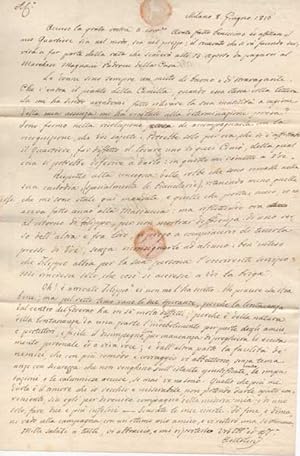
Lettera autografa firmata inviata a Giacomo Emiliani, Bologna
Erscheinungsdatum: 1816
Anbieter: Libreria Antiquaria Pontremoli SRL, Milano, MI, Italien
Verkäuferbewertung 5 von 5 Sternen
Milano 1816, giugno 8 Lettera di carattere economico e familiare: "[.] Le donne sono sempre un misto di buono e di stravagante. Che c'entra il pianto della Camilla, quando essa stessa colla lettera [.] mi ha eccitato alla determinazione presa? [.] Rispetto alla consegna delle robbe che sono rimaste nella sua custodia (specialmente le biancherie) [.] vi prego di compiacervi vi prego di tenerla presso di Voi, senza consegnarla ad alcuno [.]". Antolini fu architetto, ingegnere e urbanista. Insegnò a Milano all'Accademia di Brera e fu membro dell'Académie des beaux-arts di Parigi. Diresse i lavori per realizzare il Foro Bonaparte a Milano. 290x196 mm 1 carta scritta al recto. Al verso il nome del destinatario. Manoscritto a inchiostro nero. Carta con filigrana. Tracce di sigillo.


![Bild des Verkäufers für Idee elementari di architettura civile per le scuole del disegno di Giovanni Antolini Architetto di S.M. Imperiale e Reale [.] zum Verkauf von Govi Rare Books LLC](https://pictures.abebooks.com/inventory/md/md31895470484.jpg)


