Gesamtpreis (1 Artikel Artikel):
Versandziel:

gebwiler jerome (1 Ergebnisse)
Direkt zu den wichtigsten Suchergebnissen
Suchfilter
Produktart
- Alle Product Types
- Bücher (1)
- Magazine & Zeitschriften (Keine weiteren Ergebnisse entsprechen dieser Verfeinerung)
- Comics (Keine weiteren Ergebnisse entsprechen dieser Verfeinerung)
- Noten (Keine weiteren Ergebnisse entsprechen dieser Verfeinerung)
- Kunst, Grafik & Poster (Keine weiteren Ergebnisse entsprechen dieser Verfeinerung)
- Fotografien (Keine weiteren Ergebnisse entsprechen dieser Verfeinerung)
- Karten (Keine weiteren Ergebnisse entsprechen dieser Verfeinerung)
- Manuskripte & Papierantiquitäten (Keine weiteren Ergebnisse entsprechen dieser Verfeinerung)
Zustand Mehr dazu
- Neu (Keine weiteren Ergebnisse entsprechen dieser Verfeinerung)
- Wie Neu, Sehr Gut oder Gut Bis Sehr Gut (Keine weiteren Ergebnisse entsprechen dieser Verfeinerung)
- Gut oder Befriedigend (Keine weiteren Ergebnisse entsprechen dieser Verfeinerung)
- Ausreichend oder Schlecht (Keine weiteren Ergebnisse entsprechen dieser Verfeinerung)
- Wie beschrieben (1)
Einband
- alle Einbände
- Hardcover (1)
- Softcover (Keine weiteren Ergebnisse entsprechen dieser Verfeinerung)
Weitere Eigenschaften
- Erstausgabe (Keine weiteren Ergebnisse entsprechen dieser Verfeinerung)
- Signiert (Keine weiteren Ergebnisse entsprechen dieser Verfeinerung)
- Schutzumschlag (Keine weiteren Ergebnisse entsprechen dieser Verfeinerung)
- Angebotsfoto (1)
Sprache (1)
Preis
- Beliebiger Preis
- Weniger als EUR 20 (Keine weiteren Ergebnisse entsprechen dieser Verfeinerung)
- EUR 20 bis EUR 45 (Keine weiteren Ergebnisse entsprechen dieser Verfeinerung)
- Mehr als EUR 45
Gratisversand
- Kostenloser Versand nach USA (Keine weiteren Ergebnisse entsprechen dieser Verfeinerung)
Land des Verkäufers
Verkäuferbewertung
-
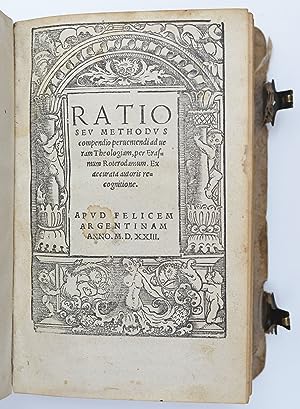
Ratio seu methodus; Enchiridion; Modus orandi Deum; Gravissimae sacrilegii
Verlag: Knobloch; Seltz, Strasbourg, Hagenau, 1528
Anbieter: Földvári Books, Budapest, Ungarn
Verkäuferbewertung 5 von 5 Sternen

Four works in one volume. Four works in one volume. In contemporary wooden panels with the traces of leather and a codex leaf on spine. Spine with three raised bands. The original copper clasps are presented. The title pages of the first three works (by Erasmus) with identical architectural borders. Erasmus, Desiderius Ratio seu methodus compendio perveniendi ad veram theologiam. [Ratio verae theologiae.] Argentorati [Strasbourg]: Ioannes Knoblochus [Knobloch], October 1523. 80 leaves. [Bound with:] Erasmus, Desiderius Enchiridion militis Christiani, saluberrimis praeceptis refertum []. Argentorati [Strasbourg]: Ioannes Knoblochus [Knobloch], November 1524. 100 leaves. [Bound with:] Erasmus, Desiderius Modus orandi Deum. Argentorati [Strasbourg]: Ioannes Knoblochus [J. Knobloch], December 1524. [46] leaves. [Bound with:] Gebwiler, Hieronymus Gravissimae sacrilegii, ac contemptae theosebiae ultionis, ethnicorum Hebraeorum et Christianorum verißimis comprobatae exemplis syngramma, []. Haguenau, [Wilhelm Seltz], 1528. [32] leaves (last blank). Three sixteenth-century, early Erasmus editions, printed by Knobloch, bound with Gebwiler's first edition containing the earliest printed quotation from Hortus deliciarum. The third work in the volume, Modus orandi Deum, is generally regarded as the central text of Desiderius Erasmus's teaching on prayer. The present edition, dated December 1524, is the second, following the first edition issued by Froben in October of the same year. The work circulated widely soon after publication: by the end of 1525, ten further impressions had appeared from presses across Europe. USTC records only eight surviving institutional copies of this December 1524 edition (B. Er. I; Mynors 587; Bezzel 1285; Schmidt VII, 284; VD16 E 3169; USTC 676366; EON 2424). The first work, Ratio seu methodus (October 1523), is likewise an early edition. Its editio princeps was published in Leuven by Thierry Martens in November 1518. This Knobloch edition is scarce: USTC records only four copies (Augsburg, Cambridge, Edinburgh, Neuchâtel) and it is not listed in VD16 (USTC 709423; Müller, Knobloch 395; Benzing 544). The second work, Enchiridion militis Christiani (Handbook of the Christian Knight), is among Erasmus' earliest writings, first printed in 1503. The preliminaries include all four Latin poems by Thomas More, which first appeared together in the Mainz edition of 1520. This edition is also rare: USTC records only five institutional copies (VD16 E 2774; USTC 650176). The final work in the sammelband is Gravissimae sacrilegii by Jérôme Gebwiler. Gebwiler is recognized as the earliest scholar to describe Hortus deliciarum (Bischoff 1973, p. 13), the illuminated encyclopedic manuscript compiled by Herrad of Landsberg, twelfth-century abbess of Hohenburg Abbey (Mont Sainte-Odile), destroyed in 1870 during the siege of Strasbourg. In this work, Gebwiler quotes the dedicatory poem of Hortus deliciarum, attributed either to Herrad herself or to Relinda of Hohenburg, her predecessor as abbess (Griffiths 2013, p. 231). This quotation represents the earliest appearance of the text in print (VD16 G 597; USTC 660780). References: Bischoff, C.: L'histoire. In: Green, R. et al.: Herrad von Hohenburg, Hortus deliciarum. London, Leiden: The Warburg Institute, University of Leiden, E. J. Brill, 1979. pp. 916.; Griffiths, F.: Herrad of Hohenbourg and the Poetry of the Hortus deliciarum: Cantat tibi cantica. In: Churchill, L. J. et al.: Women Writing Latin. [] Volume 2. Medieval Modern Women Writing Latin. New York, London: Routledge, 2013. pp. 231 264. . Signs on top edge in ink. Old collection stamp on verso of inner front pastedown. Sporadic manuscript marginal notes removed. Occasional underlines in the text throughout. Few stains throughout, some leaves tanned. The title page of the fourth work (Gebwiler) with a tiny loss to the right edge, with no effect on the text. Overall in fine condition. In contemporary wooden panels with the traces of leather and a codex leaf on spine. Spine with three raised bands. The original copper clasps are presented. The title pages of the first three works (by Erasmus) with identical architectural borders.