Gesamtpreis (1 Artikel Artikel):
Versandziel:

garcesi (1 Ergebnisse)
Direkt zu den wichtigsten Suchergebnissen
Suchfilter
Produktart
- Alle Product Types
- Bücher (1)
- Magazine & Zeitschriften (Keine weiteren Ergebnisse entsprechen dieser Verfeinerung)
- Comics (Keine weiteren Ergebnisse entsprechen dieser Verfeinerung)
- Noten (Keine weiteren Ergebnisse entsprechen dieser Verfeinerung)
- Kunst, Grafik & Poster (Keine weiteren Ergebnisse entsprechen dieser Verfeinerung)
- Fotografien (Keine weiteren Ergebnisse entsprechen dieser Verfeinerung)
- Karten (Keine weiteren Ergebnisse entsprechen dieser Verfeinerung)
- Manuskripte & Papierantiquitäten (Keine weiteren Ergebnisse entsprechen dieser Verfeinerung)
Zustand Mehr dazu
- Neu (Keine weiteren Ergebnisse entsprechen dieser Verfeinerung)
- Wie Neu, Sehr Gut oder Gut Bis Sehr Gut (Keine weiteren Ergebnisse entsprechen dieser Verfeinerung)
- Gut oder Befriedigend (1)
- Ausreichend oder Schlecht (Keine weiteren Ergebnisse entsprechen dieser Verfeinerung)
- Wie beschrieben (Keine weiteren Ergebnisse entsprechen dieser Verfeinerung)
Einband
- alle Einbände
- Hardcover (1)
- Softcover (Keine weiteren Ergebnisse entsprechen dieser Verfeinerung)
Weitere Eigenschaften
- Erstausgabe (Keine weiteren Ergebnisse entsprechen dieser Verfeinerung)
- Signiert (Keine weiteren Ergebnisse entsprechen dieser Verfeinerung)
- Schutzumschlag (Keine weiteren Ergebnisse entsprechen dieser Verfeinerung)
- Angebotsfoto (1)
Sprache (1)
Preis
- Beliebiger Preis
- Weniger als EUR 20 (Keine weiteren Ergebnisse entsprechen dieser Verfeinerung)
- EUR 20 bis EUR 45 (Keine weiteren Ergebnisse entsprechen dieser Verfeinerung)
- Mehr als EUR 45
Gratisversand
- Kostenloser Versand nach USA (Keine weiteren Ergebnisse entsprechen dieser Verfeinerung)
Land des Verkäufers
Verkäuferbewertung
-
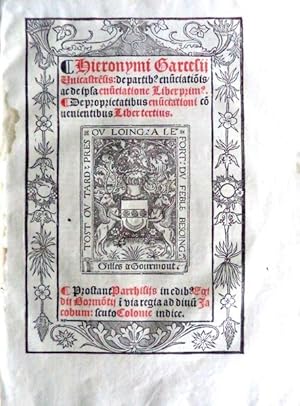
DE PARTIBUS ENUNCIATIONES AC DE IPSA ENUNCIATIONE.
Anbieter: Livraria Castro e Silva, Lisboa, Portugal
Verkäuferbewertung 5 von 5 Sternen

Hard Cover. Zustand: Good. HIERONYMI GARCESII Unicastrensis: de partib[us] enunciationes ac de ipsa enunciatione Liber primum. De proprietatibus enunciationi convenientibus Liber tertius. [Vinheta tipográfica do impressor Gilles de Gourmont]. Prostant Parrhisiis in edib. Egidii Go[u]rmo[n]tii i[n] via regia ad divi Jacobum: scuto Colonie indice. 1523. In 4º de 27x20 cm. Com [ii], xxxiiii fólios. Encadernação recente em pergaminho rígido ao gosto da época. Magnifica impressão post-incunbular a duas colunas com caracteres góticos, belamente ilustrada com marca do impressor na folha de rosto que foi impressa a duas, cores negro e vermelho. Capitulares xilografadas decoradas no início dos capítulos do texto. Ilustrada no texto com um diagrama. Único exemplar conhecido enriquecido com notas marginais manuscritas coevas do século XVI e sublinhados: Com ligeiros vestígios de manchas de humidade. Folio 19 e folio 20 repetidos uma vez por erro tipográfico. Pertenceu em tempos à preciosa Biblioteca do Mosteiro de Santa Cruz, ver Teixeira de Carvalho, p. 356. De excepcional raridade, talvez exemplar único, pois não consta dos mais importantes e exaustivos reportórios bibliográficos, como Brunet, nem na minuciosa e pormenorizada bibliografia sobre livreiros e impressores parisienses da autoria de Renouard e Moreau. Não existem exemplares nas mais importantes bibliotecas do mundo, nem nas bibliotecas portuguesas e o reportório em linha USTC, não regista a obra. Obra publicada pela Universidade de Paris sobre lógica, linguística, filosofia e dialética. Ilustrada com um diagrama lógico sobre as oposições ou contrários do pensamento. Gilles de Gourmont (em latim Egidius Gormontius) foi um impressor e livreiro activo em Paris, entre 1499 e 1533, conhecido como sendo um pioneiro da impressão em línguas orientais e o primeiro a imprimir em Paris obras inteiramente em grego, em 1507 e 1508. Editor da primeira gramática de hebraico, publicada em Paris tal como indica no início desta obra ?primus Graecarum e hebraerarum litterarum Parrhisiis Impressor' [primeiro impressor de literatura grega e hebraica em Paris]. O Mosteiro de Santa Cruz foi uma das mais importantes casas religiosas de Portugal, tendo desempenhado um papel fundamental na formação do Reino de Portugal recebeu numerosos privilégios e direitos de D. Afonso Henriques (que está sepultado na capela-mor juntamente com D. Sancho I) e de muitos outros reis de Portugal. Ficou célebre pelo elevado nível da sua escola claustral, do seu scriptorium, da biblioteca que se caracterizava pelo valor e raridade dos seus livros e da sua escola de música. Era um centro de irradiação económica, espiritual e intelectual, que desempenhou uma função fundamental no desenvolvimento de Portugal, durante 700 anos, tendo-se destacado logo no início, por ter sido o local de formação de Santo António. Com o decreto de extinção de todos as casas religiosas de Portugal, em 1834, o seu rico património foi destruído ou dispersou-se, com grave perda para o nosso país. Foi fundado por D. Telo, arcediago da Sé de Coimbra, a 28 de Junho de 1131, com a intenção de renovar a vida canónica, projecto a que aderiram cónegos da sé, como D. João Peculiar, mais tarde, bispo do Porto e arcebispo de Braga e D. Teotónio, que se tornou o primeiro prior do Mosteiro, e foi canonizado em 1163, pelo Papa Alexandre III. A vida comunitária começou em Fevereiro de 1132, o primeiro edifício monástico foi construído até cerca de 1150, em 1154 recebeu o privilégio de isenção episcopal. A igreja foi sagrada a 7 de Janeiro de 1229. A construção do edifício primitivo foi dirigida por Mestre Roberto, arquitecto franco, sendo utilizadas técnicas e soluções recentemente introduzidas em Portugal. In quarto of 27x20 cm. [ii], xxxii folios. Recent binding in stiff parchment in contemporary style. Magnificent two-column post-incunbula printing with gothic characters, beautifully illustrated with the printer"s device on the title page, printed in two colours, black and red. Decorated woodcut capitals at the beginning of the chapters. Illustrated in text with a diagram. The only known copy, enriched with handwritten marginal notes from the 16th century and underlining: With slight traces of damp stains. Folio 19 and folio 20 repeated once due to typographical error. It once belonged to the precious Library of the Monastery of Santa Cruz (Teixeira de Carvalho, p. 356). Of exceptional rarity, perhaps a unique copy, as it is not included in the most important and exhaustive bibliographical repositories, such as Brunet"s, nor in the meticulous and detailed bibliography on Parisian booksellers and printers by Renouard and Moreau. There are no copies in the most important libraries in the world, nor in Portuguese libraries, and the USTC online repertoire does not record the work. Work published by the University of Paris on logic, linguistics, philosophy and dialectics. Illustrated with a logical diagram on the oppositions or opposites of thought. Gilles de Gourmont (in Latin Egidius Gormontius) is a printer and bookseller active in Paris between 1499 and 1533 known for his role as a pioneer of printing in Eastern languages. He was the first to print volumes entirely in Greek in Paris, in 1507 and 1508. He was also the publisher of the first Parisian Hebrew grammar, as he himself states in this book ?primus Graecarum and hebraerarum litterarum Parrhisiis Impressor? (first printer of Greek and Hebrew literature in Paris). The Monastery of Santa Cruz was one of the most important religious houses in Portugal, and having played a fundamental role in the formation of the Kingdom of Portugal, it received numerous privileges and rights from King Afonso Henriques (who is buried in the chancel together with King Sancho I) and many other kings of Portugal. It was famous for the high standard of its cloistered school, its scriptorium, its library, which was characterised by the value and rarity of its books, and its music school. It was a centre of economic.