

Gesamtpreis (1 Artikel Artikel):
Versandziel:

fritz strassmann hahn (16 Ergebnisse)
Direkt zu den wichtigsten Suchergebnissen
Suchfilter
Produktart
- Alle Product Types
- Bücher (15)
- Magazine & Zeitschriften (Keine weiteren Ergebnisse entsprechen dieser Verfeinerung)
- Comics (Keine weiteren Ergebnisse entsprechen dieser Verfeinerung)
- Noten (Keine weiteren Ergebnisse entsprechen dieser Verfeinerung)
- Kunst, Grafik & Poster (Keine weiteren Ergebnisse entsprechen dieser Verfeinerung)
- Fotografien (Keine weiteren Ergebnisse entsprechen dieser Verfeinerung)
- Karten (Keine weiteren Ergebnisse entsprechen dieser Verfeinerung)
- Manuskripte & Papierantiquitäten (1)
Zustand Mehr dazu
- Neu (Keine weiteren Ergebnisse entsprechen dieser Verfeinerung)
- Wie Neu, Sehr Gut oder Gut Bis Sehr Gut (2)
- Gut oder Befriedigend (1)
- Ausreichend oder Schlecht (Keine weiteren Ergebnisse entsprechen dieser Verfeinerung)
- Wie beschrieben (13)
Einband
Weitere Eigenschaften
- Erstausgabe (12)
- Signiert (Keine weiteren Ergebnisse entsprechen dieser Verfeinerung)
- Schutzumschlag (1)
- Angebotsfoto (12)
Sprache (3)
Preis
- Beliebiger Preis
- Weniger als EUR 20 (Keine weiteren Ergebnisse entsprechen dieser Verfeinerung)
- EUR 20 bis EUR 45 (Keine weiteren Ergebnisse entsprechen dieser Verfeinerung)
- Mehr als EUR 45
Gratisversand
Land des Verkäufers
Verkäuferbewertung
-

Künstliche Umwandlungsprozesse bei Bestrahlung des Thoriums mit Neutronen; Auftreten isomerer Reihen durch Abspaltung von alpha-Strahlen. SS. 538-552. Mit 4 Abbildungen. In: Zeitschrift für Physik. Band 109.
Sprache: Englisch
Verlag: Berlin Springer, 1938
Anbieter: Antiquariat Gerhard Gruber, Heilbronn, Deutschland
Verkäuferbewertung 4 von 5 Sternen

Erstausgabe
(22 x 15,5 cm). VIII, 776 S. Mit 332 Abbildungen. Halbleinwandband der Zeit. Erste Ausgabe. - "Es werden die bei der Bestrahlung von Thorium mit langsamen und schnellen Neutronen auftretenden Prozesse untersucht. Es zeigte sich, daß vier Umwandlungsreihen auftreten. Die eine Reihe wird durch einen Anlagerungsprozeß ausgelöst, die drei anderen entstehen durch alpha-Strahlenabspaltung und stellen drei isomere Reihen dar" (Zusammenfassung). - "The compound nucleus would have interested Meitner in any case: its quantized vibrations were expected to account for gamma emission spectra, a field of interest to Meitner since the early 1920s. In a 1938 publication (the offered item) on the products of the neutron irradiation of thorium. Meitner concluded that no satisfactory theory existed for multiple inherited isomerism" (Sime, Lise Meitner S. 455). - Stempel auf Titel. Einband gering bestoßen und unteres Kapital leicht beschädigt, sonst gut erhalten.
-
Thirteen papers documenting the discovery of nuclear fission, contained in 13 issues of Die Naturwissenschaften, including the discovery paper itself, 'Über den Nachweis und das Verhalten der bei der Bestrahlung des Urans mittels Neutronen entstehenden Erdalkalimetalle,' published on 6 January 1939
Verlag: Springer, Berlin, 1939
Anbieter: SOPHIA RARE BOOKS, Koebenhavn V, Dänemark
Verkäuferbewertung 5 von 5 Sternen

Erstausgabe
First edition. The Discovery of Nuclear Fission. First edition, journal issues in original printed wrappers, including the true first appearance of Hahn and Strassmann's discovery of nuclear fission, as well as the work of Hahn and Meitner which led up to the discovery, and the subsequent work of Hahn and Strassmann on the identification of the fission products. "Few modern discoveries have influenced mankind so rapidly and so profoundly as has nuclear fission" (Segré, p. 42). "Early in December 1938 [Hahn and Strassmann] thought they had established some decay chains in which the genetic relations appeared to be solidly known. Supposedly four isotopes of radium were decaying to Ac[tinium] and then to Th[orium] . To make doubly sure, Hahn and Strassmann decided to identify the radium isotopes beyond any doubt. They submitted them to several stringent chemical tests using barium as a carrier and radium as a tracer.These superb experiments forced Hahn and Strassmann to conclude reluctantly that the hypothetical radium isotopes were in fact barium! In their historic 22 December paper [published 6 January 1939] for Naturwissenschaften they wrote: 'As chemists, in consequence of the experiments just described, we should change the schema given above and introduce the symbols of Ba, La, Ce in place of Ra, Ac, Th. As 'nuclear chemists,' working very close to the field of physics, we cannot yet bring ourselves to take such a drastic step, which goes against all previous experiences of nuclear physics.' A few lines earlier, however, the authors had noted 'that the sum of the mass numbers of Ba + Ma [technetium], for instance 138 + 101, gives 239'-a clear sign that they were thinking of fission. This is the moment of the discovery of nuclear fission" (Segré, p. 42). Hahn and Strassmann's paper "started scientists down the path to the atomic bomb. Originally collaborating with Lise Meitner who was forced to flee Nazi Germany in 1938, they had been working with uranium and bombarding samples with slow neutrons. They realized that this caused the uranium atoms to split into lighter nuclei releasing large amounts of energy, and the implications were not lost to a world at war" (Dibner). "Experiments conducted in 1938 at Berlin by Hahn and Strassman [sic] were reported to Lise Meitner, an Austrian scientist who had fled to Copenhagen to escape religious persecution. She and her nephew, O. R. Frisch, working in Niels Bohr's laboratory, found the true explanation of these phenomena. The interpolation of a neutron into the nucleus of a uranium atom caused it to divide into two parts and to release energy amounting to about 200,000,000 electron volts. This process bore such a close similarity to the division of a living cell that Frisch suggested the use of the term 'fission' to describe it" (PMM). Hahn received the 1944 Nobel Prize in Chemistry "for his discovery of the fission of heavy nuclei." We have been unable to trace any other comparable set of these original issues, or even just the January 6 issue, in original printed wrappers, on the market. Hahn and Strassmann's work is most often encountered in bound volumes of Die Naturwissenschaften (or extracts therefrom), or in the summary paper 'Uber das Zerplatzen des Urankernes Durch Langsame Neutronen' published in the Transactions of the Prussian Academy of Sciences 1939 (it appeared as issue No. 12 of this journal, published in the summer of 1939). Hahn and Meitner worked together at the Kaiser-Wilhelm Institute (KWI) of Chemistry in Berlin from 1912, discovering the new element protactinium in 1918; Strassmann joined them there in 1929 and Götte in 1935. When, after the First World War, limitations for women in the academic world were lifted, Meitner became professor at the KWI; Hahn became its director in 1928. "In 1934 [Enrico] Fermi roused the world of radioactivity with his method of neutron bombardment and that same year reported on the possible production of transuranic elements by irradiating uranium with neutrons. The irradiation had led to radioactive substances with different half-lives such as 10s, 40s, 13min, and 90min. Fermi's group had separated the 13-min and 90-min 'bodies' chemically from uranium and had shown that they were not isotopes of elements, which are located only a few places below uranium in the Periodic Table . they assumed that the uranium nucleus with the extra neutron transformed, via beta decay, into a nucleus of an element with the number 93 in the Periodic Table. That could still be unstable and transit, by another beta decay, into a nucleus of element 94. "The idea of more than 92 elements was, of course, contested. Ida Noddack, a renowned chemist and co-discoverer of the element rhenium, pointed out that all known elements had to be excluded before new ones were proposed. This very sound advice was not taken. Nuclear physicists saw no possibility for a nucleus to fragment into large pieces. Nothing more drastic than alpha decay had ever been observed. Another way out was also proposed: in spite of Fermi's interpretation, his 13-min body might be an isotope of protactinium, element number 91. Here Hahn and [Lisa] Meitner came in. After all, they were discoverers of protactinium and knew the properties of this element" (Brandt, pp. 264-265). "'On the Artificial Conversion of Uranium with Neutrons' [1 - see numbering of papers below], Hahn and Meitner called their first work on the uranium problem, which was published on 11 January 1935 in Naturwissenschaften. In the text it says, 'Amongst the many radioactive substances produced with neutrons uranium claims a special interest. For Fermi, Rasetti, and d'Agostino came to the conclusion from their common investigation that a radioactive element of higher atomic number than 92 was formed by the irradiation of uranium with neutrons . We now have set about a detailed investigation of this uranium process .' "It was not protoactinium. Hahn and Meitner succeeded in ascertaining that with.
-
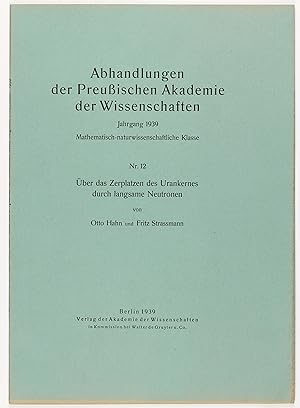
Über das Zerplatzen des Urankernes durch langsame Neutronen. Aus den Abhandlungen der Preußischen Akademie der Wissenschaften Jahrgang 1939. Math.-naturw. Klasse. Nr. 12.
Verlag: Berlin: Verlag der Akademie der Wissenschaften, 1939
Anbieter: Gloria Mortzeck, Karlsdorf, Deutschland
Verkäuferbewertung 3 von 5 Sternen

20 S. 4°, Brosch. in Hardcover-Decke, innen mit Buntpapierbezug. Einband hinten leicht berieben, unten gr. Fehlstelle. Papier gebräunt und lichtrandig. Insgesamt noch guter Zustand. Bibliotheksexemplar Stempel und Signatur im Titel. 1000 gr.
-
![Bild des Verkäufers für Uber das Zerplatzen des Urankernes durch langsame Neutronen (1939) [together with] Die chemische Abscheidung der bei der Spaltung des Urans entstehenden Elemente und Atomarten (1944) zum Verkauf von Between the Covers-Rare Books, Inc. ABAA](https://pictures.abebooks.com/inventory/md/md31386292420.jpg)
Uber das Zerplatzen des Urankernes durch langsame Neutronen (1939) [together with] Die chemische Abscheidung der bei der Spaltung des Urans entstehenden Elemente und Atomarten (1944)
Verlag: Akademie der Wissenschaften, Berlin, 1944
Anbieter: Between the Covers-Rare Books, Inc. ABAA, Gloucester City, NJ, USA
Verbandsmitglied: ABAA ESA ILAB IOBA
Verkäuferbewertung 5 von 5 Sternen
Softcover. Zustand: Near Fine. Two offprints. Quartos. The first and third of Hahn and Strassmann's three important papers on nuclear fission (the bursting of the uranium nucleus by slow neutrons), from the series: Abhandlungen der Preußischen Akademie der Wissenschaften, (1939, No. 12; and 1944, No. 12). Both copies are in the original printed wrappers, in near fine condition with light toning at the edges. Both papers give a comprehensive account of their discovery of "the fission of uranium and thorium in medium heavy atomic nuclei". Hahn received the Nobel Prize for Chemistry in 1944. An attractive pair of scarce offprints in the original, bright wrappers.
-
'Uber das Zerplatzen des Urankernes Durch Langsame Neutronen.' [TOGETHER WITH:] HAHN, STRASSMANN and Hans GÖTTE. 'Einiges Uber die Experimentelle Entwirrung der bei der Spaltung des Urans Auftretenden Elemente und Atomarten.' [TOGETHER WITH:] HAHN and STRASSMANN. 'Die Chemische Abscheidung der bei der Spaltung des Urans Entstehenden Elemente und Atomarten (Allgemeiner Teil).' Together three offprints from Abhandlungen der preussischen Akademie der Wissenschaften
Verlag: Walter de Gruyter und Co, Berlin, 1944
Anbieter: SOPHIA RARE BOOKS, Koebenhavn V, Dänemark
Verkäuferbewertung 5 von 5 Sternen
Erstausgabe
First edition. DIBNER 168: NUCLEAR FISSION - THE TRUE OFFPRINT ISSUES. First edition, the true offprint issues, i.e., in orange wrappers, of the three fundamental papers on nuclear fission which eventually lead to the creation of the atom bomb. ".experiments conducted in 1938 at Berlin by Hahn and Strassman [sic] were reported to Lise Meitner, an Austrian scientist who had fled to Copenhagen to escape religious persecution. She and her nephew, O. R. Frisch, working in Niels Bohr's laboratory, found the true explanation of these phenomena. The interpolation of a neutron into the nucleus of a uranium atom caused it to divide into two parts and to release energy amounting to about 200,000,000 electron volts. This process bore such a close similarity to the division of a living cell that Frisch suggested the use of the term 'fission' to describe it" (PMM). "Hahn and Strassmann published this article [i.e. the 1939 paper] that started scientists down the path to the atomic bomb. Originally working with Lise Meitner who was forced to flee Nazi Germany in 1938, they had been working with uranium and bombarding samples with slow neutrons. They realized that this caused the uranium atoms to split into lighter nuclei and releasing large amounts of energy, and the implications were not lost to a world at war" (Dibner). Hahn received the 1944 Nobel Prize in Chemistry "for his discovery of the fission of heavy nuclei." Hahn and Meitner worked together at the Kaiser-Wilhelm Institute (KWI) of Chemistry in Berlin from 1912, discovering the new element protactinium in 1918; Strassmann joined them there in 1929 and Götte in 1935. When, after the First World War, limitations for women in the academic world were lifted, Meitner became professor at the KWI; Hahn became its director in 1928. "In 1934 [Enrico] Fermi roused the world of radioactivity with his method of neutron bombardment and that same year reported on the possible production of transuranic elements by irradiating uranium with neutrons. The irradiation had led to radioactive substances with different half-lives such as 10s, 40s, 13min, and 90min. Fermi's group had separated the 13-min and 90-min 'bodies' chemically from uranium and had shown that they were not isotopes of elements, which are located only a few places below uranium in the Periodic Table . they assumed that the uranium nucleus with the extra neutron transformed, via beta decay, into a nucleus of an element with the number 93 in the Periodic Table. That could still be unstable and transit, by another beta decay, into a nucleus of element 94. "The idea of more than 92 elements was, of course, contested. Ida Noddack, a renowned chemist and co-discoverer of the element rhenium, pointed out that all known elements had to be excluded before new ones were proposed. This very sound advice was not taken. Nuclear physicists saw no possibility for a nucleus to fragment into large pieces. Nothing more drastic than alpha decay had ever been observed. Another way out was also proposed: in spite of Fermi's interpretation, his 13-min body might be an isotope of protactinium, element number 91. Here Hahn and [Lisa] Meitner came in. After all, they were discoverers of protactinium and knew the properties of this element. They were able to show that the activity in question was not due to protactinium and became convinced that transuranic elements had been produced. They began intensive work in this new field, from 1935 onwards together with Strassmann . Quite a number of substances with different half-lives and different chemical properties were found in uranium irradiated with neutrons. A detailed scheme for their production was proposed, which implied the creation and subsequent decay of four, possibly five, transuranic elements. It was not seriously challenged by other groups working in the field. "When Austria was annexed in 1938, Lise Meitner became a German citizen and, because of her Jewish descent, was in acute danger. Helped by Hahn and other colleagues, she fled via Holland and Denmark to Sweden, where she could work in the Physical Institute of the Academy of Sciences in Stockholm. "Hahn and Strassmann continued alone. The decay products of the apparent transuranic elements seemed to contain three substances, which underwent beta decays of different half-lives and were chemically very similar to barium. They were taken to be isomeric nuclei of the isotope Ra231 of radium. Radium is an alkaline-earth metal as is barium and is located below barium in the second column of the Periodic Table, hence the similarity. Hahn and Strassmann tried to isolate the radium. Since only minute quantities could have been produced, a precipitation with barium as carrier from a solution was performed; the barium was to carry along the chemically similar radium. The precipitate then only contained barium and radium, which were to be separated in the next step. As mentioned above, Hahn was well versed in the method of separation, fractional crystallization, originally introduced by Marie Curie. But although they tried hard and checked and rechecked their method, Hahn and Strassmann were unable to separate any radium by chemical means. In their first paper they still conclude rather cautiously: 'We come to the conclusion: Our 'radium isotopes' have the properties of barium; as chemists we should rather say the new bodies are not radium but barium. [. . . ] As 'nuclear chemists', in a certain sense close to nuclear physics, we cannot yet decide ourselves to perform this step contradicting all previous experience of nuclear physics. A series of strange coincidences might still have faked our results.' "Hahn had kept Meitner informed by letter about the work and he mailed her a copy of the manuscript of the paper on 21 December 1938, the same day it was submitted to Die Naturwissenschaften. The manuscript reached her in a small town near Gothenburg, where she had gone to visit Swedish friends over Christmas and where she had a.
-

Über das Zerplatzen des Uran- und des Thor-Kerns in leichtere Atome. SS. (673)-680. In: Physikalische Zeitschrift. Jg. 40.
Sprache: Deutsch
Verlag: Leipzig Hirzel, 1939
Anbieter: Antiquariat Gerhard Gruber, Heilbronn, Deutschland
Verkäuferbewertung 4 von 5 Sternen
Erstausgabe
(27,5 x 19,5 cm). XV, 728 S. Mit zahlreichen Abbildungen, 13 Tafeln und 1 Porträt. Halblederband der Zeit. Erste Ausgabe der im Jahr der Entdeckung der Kernspaltung entstandenen Arbeit. - Stempel auf Vorsatz und Titel. Einband leicht bestoßen, sonst gut erhalten.
-
Über das Zerplatzen des Urankernes durch langsame Neutronen.
Sprache: Deutsch
Verlag: Berlin Verlag der Akademie, 1939
Anbieter: Antiquariat Gerhard Gruber, Heilbronn, Deutschland
Verkäuferbewertung 4 von 5 Sternen
Erstausgabe
EUR 1.320,00
EUR 40,00 Versand
Versand von Deutschland nach USAAnzahl: 1 verfügbar
In den Warenkorb(29,5 x 21 cm). 20 S. Mit 4 Abbildungen. Original-Broschur. (Sonderdruck aus: Abh. der Preuß. Akad. der Wiss.). Erste Ausgabe. - "The first of Hahn and Strassmann's three fundamental papers on nuclear fission, containing the first comprehensive account of the phenomenon. (The remaining two papers. were published in 1942 and 1944 respectively). In 1938 Hahn and Strassmann had demonstrated the presence of radioactive barium, lanthanum and cesium among the products of neutron bombardment of uranium, an observation that seemed to contradict all previous experiences of nuclear physics. The two men announced their puzzling findings in a paper, "Ueber den Nachweis und das Verhalten der bei der Bestrahlung des Urans mittels Neutronen entstehenden Erdalkalimetalle" published in 'Naturwissenschaften' on 6 January 1939" (Norman). - Umschlag stellenweise etwas berieben und leicht ausgebleicht, sonst sauber und gut erhalten. - DSB 6, 14; Norman 963; Gerlach 194.
-
Über das Zerplatzen des Urankernes durch langsame Neutronen. Offprint from: Abhandlungen der Preussischen Akademie der Wissenschaften, No. 12.
Sprache: Deutsch
Verlag: Verlag der Akademie der Wissenschaften, Berlin, 1939
Anbieter: Milestones of Science Books, Ritterhude, Deutschland
Verkäuferbewertung 5 von 5 Sternen
Erstausgabe
EUR 1.400,00
EUR 45,00 Versand
Versand von Deutschland nach USAAnzahl: 1 verfügbar
In den WarenkorbSoft cover. Zustand: Fine. 1st Edition. 4to (296 x 210 mm). [1-3] 4-20 pp., text diagrams. Original publisher's printed wrappers (very light fading along spine and edges). Text very little age-tonend, mostly to outer margins. An almost pristine copy. ---- Dibner 168; Norman 963; DSB VI, pp. 16-17. FIRST EDITION, OFFPRINT ISSUE, of one of Hahn and Strassmann's fundamental papers on nuclear fission. In their radiochemical investigations they observed that neutron bombardment of uranium produced highly radioactive material, including the chemical elements barium, lanthanum and cerium. It was their collaborator Lise Meitner (at that time in Swedish exile from Nazi Germany), who interpreted their observations as nuclear fission. It remained to Bohr and Fermi to apply fission to the making of the atomic bomb, a project with which neither Hahn nor Strassmann had any involvement. Hahn was awarded the 1944 Nobel Prize in chemistry. (see R. Sohlmann et al. Nobel, the man and his prizes, p. 387). - Visit our website to see more images!
-
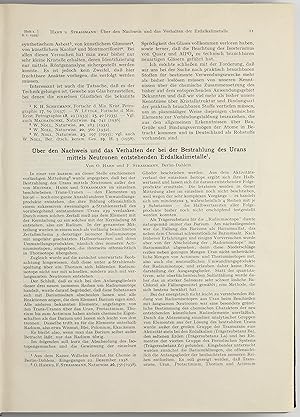
Über den Nachweis und das Verhalten der bei der Bestrahlung des Urans mittels Neutronen entstehenden Erdalkalimetalle (and 5 further articles)
Sprache: Deutsch
Verlag: Julius Springer, Berlin, 1939
Anbieter: Milestones of Science Books, Ritterhude, Deutschland
Verkäuferbewertung 5 von 5 Sternen
Erstausgabe
Hardcover. Zustand: Very Good. 1st Edition. In: Die Naturwissenschaften. Vol. 27. Berlin, J. Springer, 1939. 4to (27:20,5 cm). With numerous illustrations in text; xviii, 862 pp. Title-leaf with library- and deaccession-stamp. Later cloth-backed boards. ---- PMM 422 (b); Poggendorff VIIa/2, 356 & 4, 568; Norman 963 Anm. - First printing of Hahn and Straßmann's famous paper on the discovery of nuclear fission. "In 1938 Hahn and Strassmann had demonstrated the presence of radioactive barium, lanthanum and cerium among the products of neutron bombardment of uranium, an observation that seemed to contradict all previous experiences of nuclear physics. The two men announced their puzzling findings in a paper, 'Ueber den Nachweis und das Verhalten.', published in 'Naturwissenschaften' on 6 January 1939" (Norman). - Entire volume, comprising 5 other papers by Hahn and Straßmann. --- Erstdruck des berühmten Artikels vom 6. Januar 1939, in dem Otto Hahn und Fritz Straßmann von ihrer Entdeckung der Kernspaltung berichten. Aus dem entscheidende Experiment vom 17. Dezember 1938 (der "Radium-Barium-Mesothorium-Fraktionierung") schloß Hahn auf ein "Zerplatzen" des Urankerns; weitere radiochemische Untersuchungen lieferten den unwiderlegbaren Beweis, daß das Uran in aus leichteren Elementen bestehende Bruchstücke gespalten worden war. - Im vollständigen Jahrgang, darin noch 5 weitere Artikel von Hahn u. Straßmann zur Kernspaltung: 1. Nachweis der Entstehung aktiver Bariumisotope aus Uran und Thorium durch Neutronenbestrahlung; Nachweis weiterer aktiver Bruchstücke bei der Uranspaltung (S. 89-95). - 2. Über die Bruchstücke beim Zerplatzen des Urans (S. 163-164). - 3. Zur Frage nach der Existenz der 'Trans-Urane' (S. 451-453). - 4. Weitere Spaltprodukte aus der Bestrahlung des Urans mit Neutronen (S. 529-534). - 5. Über einige Bruchstücke beim Zerplatzen des Thoriums (S. 544-547, mit S. Flügge).
-
Ms. Brief mit eigenh. Unterschrift.
Verlag: Mainz, 3. V. 1976., 1976
Anbieter: Kotte Autographs GmbH, Roßhaupten, Deutschland
Verbandsmitglied: ILAB PADA VDA
Verkäuferbewertung 5 von 5 Sternen
Manuskript / Papierantiquität
EUR 1.800,00
EUR 20,00 Versand
Versand von Deutschland nach USAAnzahl: 1 verfügbar
In den Warenkorb4to. 1 1/4 pp. An einen jungen Amerikaner, der sich für Naturwissenschaften interessierte.Da werden Sie sicher wissen, dass Otto Hahn und ich Chemiker waren - nicht physiker, wie oft angenommen wird. Lise Meitner war die Physikerin, die über 30 Jahre mit Otto Hahn zusammengearbeitet hatte und Deutschland im Sommer 1938 verlassen musste, weil Sie Jüdin war []Nachdem wir die Kernspaltung in Berlin entdeckt hatten, wurde Lise Meitner in Kenntnis gesetzt. Gemeinsam mit ihrem Neffen, dem Physiker Otto Robert Frisch [] hat sie unser Ergebnis mit phyiskalischen Methoden bestätigt []" - Beiliegt: Portraitphotographie ohne U., ein Druck seines Vortrags Friedliche Chemie der Atomkerne" (1948).
-
Über die Umwandlungsreihen des Urans, die durch Neutronenbestrahlung erzeugt werden. Offprint from: Zeitschrift für Physik. 106. Band. 3. und 4. Heft.
Verlag: Berlin: Julius Springer, 1937, 1937
Anbieter: Peter Harrington. ABA/ ILAB., London, Vereinigtes Königreich
Verbandsmitglied: ABA ILAB PBFA
Verkäuferbewertung 5 von 5 Sternen
Erstausgabe
EUR 2.405,48
EUR 25,69 Versand
Versand von Vereinigtes Königreich nach USAAnzahl: 1 verfügbar
In den WarenkorbFirst edition, offprint issue, in which Meitner as the principal author and her colleagues examine the products of neutron bombardment of uranium and their decay patterns. It is part of a long series of experimental work undertaken by the Berlin team between 1934 and 1938, which culminated in the discovery of nuclear fission. "In 1934, intrigued by Enrico Fermi's experiments indicating that transuranic elements were produced by the neutron irradiation of uranium, Meitner [1878-1968] recruited Hahn, and later Strassmann, for the investigation that resulted in the discovery of nuclear fission. Meitner was the team's leader, interpreting the data from chemistry, radiochemistry, and her own physical measurements into the context of nuclear physics" (Dictionary of Women in Science). After the Second World War broke out, Meitner (of Jewish origin) fled Germany for Stockholm. Her forced emigration "shattered her career and clouded her scientific reputation. Five months after she left Berlin, the remaining members of her team announced the splitting of the uranium nucleus, a discovery in which she should have fully shared. Although Meitner and her nephew, the physicist Otto Frisch, gave the first theoretical interpretation for the process (and named it fission), the 1944 Nobel Prize in chemistry was awarded to Hahn alone" (Dictionary of Women in Science). Meitner concluded this paper somewhat speculatively, saying that "the processes must be neutron capture by uranium-238, which leads to three isomeric nuclei of uranium-239. This result is very difficult to reconcile with current concepts of the nucleus". It was submitted for publication in May 1937, concurrent with a near-identical second paper by the team, led by Hahn as the first author and published in the Chemische Berichte. Counter to Meitner's ambiguity, Hahn interpreted the data much more decisively, stating that the "chemical distinction [of transuranes] from all previously known elements needs no further discussion". Their contrasting reports speak to the disciplinary divide - between physics and chemistry - with which the team continued to grapple. Octavo, pp. 249-70. With numerous tables and diagrams within text. Original printed wrappers, wire-stitched as issued. "Kern" ("nucleus") pencilled on front cover. Spine splitting a little at ends: a near-fine copy.
-
Einiges über die experimentelle Entwirrung der bei der Spaltung des Urans auftretenden Elemen und Atomarten. Nach Versuchen von Otto Hahn, Fritz Strassmann und Hans Götte.
Erscheinungsdatum: 1942
Anbieter: Antiq. F.-D. Söhn - Medicusbooks.Com, Marburg, Deutschland
Verkäuferbewertung 5 von 5 Sternen
Erstausgabe
Abh. Preuss. Akad. Wiss., 1942/ 3. - Berlin, Verlag Akademie der Wissenschaften, 1942, 4°, 30 pp., 19 Fig., orig. Broschur. First Edition! The second of Hahn and Strassman's three fundamental papers on nuclear fission. For the first paper in the series, 'Uber das Zerplatzen des Urankernes durch langsame Neutronen' (1939 ) see Dibner, Heralds of Science 168 ; and Norman Library 96 3. Otto Hahn (1879- 1968) was a German chemist, and a pioneer in the fields of radioactivity and radiochemistry. Hahn is referred to as the father of nuclear chemistry. Hahn and Lise Meitner discovered radioactive isotopes of radium, thorium, protactinium and uranium. He also discovered the phenomena of radioactive recoil and nuclear isomerism, and pioneered rubidium-strontium dating. In 1938, Hahn, Lise Meitner and Fritz Strassmann discovered nuclear fission, for which Hahn received the 1944 Nobel Prize for Chemistry. Nuclear fission was the basis for nuclear reactors and nuclear weapons. Together with his assistants, Hans-Joachim Born, Siegfried Flügge, Hans Götte, Walter Seelmann-Eggebert and Strassmann, he catalogued about one hundred fission product isotopes. They also investigated means of isotope separation; the chemistry of element 93; and methods for purifying uranium oxides and salts.
-
'Uber das Zerplatzen des Urankernes Durch Langsame Neutronen.' [TOGETHER WITH:] HAHN, STRASSMANN and Hans GÖTTE. 'Einiges Uber die Experimentelle Entwirrung der bei der Spaltung des Urans Auftretenden Elemente und Atomarten.' [TOGETHER WITH:] HAHN and STRASSMANN. 'Die Chemische Abscheidung der bei der Spaltung des Urans Entstehenden Elemente und Atomarten (Allgemeiner Teil).' Together three issues of Abhandlungen der preussischen Akademie der Wissenschaften
Verlag: Walter de Gruyter und Co, Berlin, 1944
Anbieter: SOPHIA RARE BOOKS, Koebenhavn V, Dänemark
Verkäuferbewertung 5 von 5 Sternen
Erstausgabe
First edition. NUCLEAR FISSION. First edition, offprint issues, of the three fundamental papers on nuclear fission which eventually lead to the creation of the atom bomb. ".experiments conducted in 1938 at Berlin by Hahn and Strassman [sic] were reported to Lise Meitner, an Austrian scientist who had fled to Copenhagen to escape religious persecution. She and her nephew, O. R. Frisch, working in Niels Bohr's laboratory, found the true explanation of these phenomena. The interpolation of a neutron into the nucleus of a uranium atom caused it to divide into two parts and to release energy amounting to about 200,000,000 electron volts. This process bore such a close similarity to the division of a living cell that Frisch suggested the use of the term 'fission' to describe it" (PMM). "Hahn and Strassmann published this article [i.e. the 1939 paper] that started scientists down the path to the atomic bomb. Originally working with Lise Meitner who was forced to flee Nazi Germany in 1938, they had been working with uranium and bombarding samples with slow neutrons. They realized that this caused the uranium atoms to split into lighter nuclei and releasing large amounts of energy, and the implications were not lost to a world at war" (Dibner). Hahn received the 1944 Nobel Prize in Chemistry "for his discovery of the fission of heavy nuclei." Hahn and Meitner worked together at the Kaiser-Wilhelm Institute (KWI) of Chemistry in Berlin from 1912, discovering the new element protactinium in 1918; Strassmann joined them there in 1929 and Götte in 1935. When, after the First World War, limitations for women in the academic world were lifted, Meitner became professor at the KWI; Hahn became its director in 1928. "In 1934 [Enrico] Fermi roused the world of radioactivity with his method of neutron bombardment and that same year reported on the possible production of transuranic elements by irradiating uranium with neutrons. The irradiation had led to radioactive substances with different half-lives such as 10s, 40s, 13min, and 90min. Fermi's group had separated the 13-min and 90-min 'bodies' chemically from uranium and had shown that they were not isotopes of elements, which are located only a few places below uranium in the Periodic Table . they assumed that the uranium nucleus with the extra neutron transformed, via beta decay, into a nucleus of an element with the number 93 in the Periodic Table. That could still be unstable and transit, by another beta decay, into a nucleus of element 94. "The idea of more than 92 elements was, of course, contested. Ida Noddack, a renowned chemist and co-discoverer of the element rhenium, pointed out that all known elements had to be excluded before new ones were proposed. This very sound advice was not taken. Nuclear physicists saw no possibility for a nucleus to fragment into large pieces. Nothing more drastic than alpha decay had ever been observed. Another way out was also proposed: in spite of Fermi's interpretation, his 13-min body might be an isotope of protactinium, element number 91. Here Hahn and [Lisa] Meitner came in. After all, they were discoverers of protactinium and knew the properties of this element. They were able to show that the activity in question was not due to protactinium and became convinced that transuranic elements had been produced. They began intensive work in this new field, from 1935 onwards together with Strassmann . Quite a number of substances with different half-lives and different chemical properties were found in uranium irradiated with neutrons. A detailed scheme for their production was proposed, which implied the creation and subsequent decay of four, possibly five, transuranic elements. It was not seriously challenged by other groups working in the field. "When Austria was annexed in 1938, Lise Meitner became a German citizen and, because of her Jewish descent, was in acute danger. Helped by Hahn and other colleagues, she fled via Holland and Denmark to Sweden, where she could work in the Physical Institute of the Academy of Sciences in Stockholm. "Hahn and Strassmann continued alone. The decay products of the apparent transuranic elements seemed to contain three substances, which underwent beta decays of different half-lives and were chemically very similar to barium. They were taken to be isomeric nuclei of the isotope Ra231 of radium. Radium is an alkaline-earth metal as is barium and is located below barium in the second column of the Periodic Table, hence the similarity. Hahn and Strassmann tried to isolate the radium. Since only minute quantities could have been produced, a precipitation with barium as carrier from a solution was performed; the barium was to carry along the chemically similar radium. The precipitate then only contained barium and radium, which were to be separated in the next step. As mentioned above, Hahn was well versed in the method of separation, fractional crystallization, originally introduced by Marie Curie. But although they tried hard and checked and rechecked their method, Hahn and Strassmann were unable to separate any radium by chemical means. In their first paper they still conclude rather cautiously: 'We come to the conclusion: Our 'radium isotopes' have the properties of barium; as chemists we should rather say the new bodies are not radium but barium. [. . . ] As 'nuclear chemists', in a certain sense close to nuclear physics, we cannot yet decide ourselves to perform this step contradicting all previous experience of nuclear physics. A series of strange coincidences might still have faked our results.' "Hahn had kept Meitner informed by letter about the work and he mailed her a copy of the manuscript of the paper on 21 December 1938, the same day it was submitted to Die Naturwissenschaften. The manuscript reached her in a small town near Gothenburg, where she had gone to visit Swedish friends over Christmas and where she had also invited her nephew Otto Frisch. We have already met him as collaborato.
-

Über die bei der Uranspaltung auftretenden Molybdän-Isotope. SS. 789-800. Mit 3 Abbildungen. In: Zeitschrift für Physik. Band 117.
Sprache: Deutsch
Verlag: Berlin Springer, 1941
Anbieter: Antiquariat Gerhard Gruber, Heilbronn, Deutschland
Verkäuferbewertung 4 von 5 Sternen
Erstausgabe
(22,5 x 15 cm). VIII, 803 S. Mit 314 Abbildungen. Halbleinwandband der Zeit. Erste Ausgabe. - "Auf Grund einer neuen japanischen Arbeit. wurden unsere bisherigen Befunde. noch einmal überprüft. Bei völliger Bestätigung unserer früheren experimentellen Ergebnisse ist die Deutung der Versuche nunmehr ganz anders geworden. Bei der Uranspaltung entsteht 1. ein 12-Minuten-Molybdän, das sich offenbar in ein sehr kurzlebiges Isotop des Elements 43 (Ma) umwandelt. 2. Es entsteht ein 14-Minuten-Molybdän, das sich in ein Isotop des Elements 43 von 14 Minuten Halbwertszeit umwandelt. Das früher für ein einheitliches 18-Minuten-Molybdän-Isotop gehaltene Produkt ist also in Wirklichkeit eine Mischung von drei Körpern sehr ähnlicher Halbwertszeit, die durch ihr Zusammenspiel, gleichgültig zu welcher Zeit gemessen wird, den früher gefundenen 18-Minuten-Abfall ergeben. 3. Das schon früher beschriebene 67-Stunden-Molybdän wurde bestätigt" (Zusammenfassung). - Stempel auf Vorsatz und Titel, sonst sauber und gut erhalten.
-
Die chemische Abscheidung der bei der Spaltung des Urans entstehenden Elemente und Atomarten (Allgemeiner Teil) (12: pp.1-14, 1 Fig.).
Erscheinungsdatum: 1944
Anbieter: Antiq. F.-D. Söhn - Medicusbooks.Com, Marburg, Deutschland
Verkäuferbewertung 5 von 5 Sternen
Erstausgabe
Abh. Preuss. Akad. Wiss., 1944/1-12. - Berlin, Verlag Akademie der Wissenschaften, 1944-1945, 4°, 57; 24; 80; 30; 12; 24; 18; 77; 14 pp., zahlr. Abbildungen, Halbleinenband d.Zt.; St.a.Tit. First Edition! The third of Hahn and Strassman's three fundamental papers on nuclear fission. For the first paper in the series, 'Uber das Zerplatzen des Urankernes durch langsame Neutronen' (1939 ) see Dibner, Heralds of Science 168 ; and Norman Library 96 3. Otto Hahn (1879- 1968) was a German chemist, and a pioneer in the fields of radioactivity and radiochemistry. Hahn is referred to as the father of nuclear chemistry. Hahn and Lise Meitner discovered radioactive isotopes of radium, thorium, protactinium and uranium. He also discovered the phenomena of radioactive recoil and nuclear isomerism, and pioneered rubidium-strontium dating. In 1938, Hahn, Lise Meitner and Fritz Strassmann discovered nuclear fission, for which Hahn received the 1944 Nobel Prize for Chemistry. Nuclear fission was the basis for nuclear reactors and nuclear weapons. Together with his assistants, Hans-Joachim Born, Siegfried Flügge, Hans Götte, Walter Seelmann-Eggebert and Strassmann, he catalogued about one hundred fission product isotopes. They also investigated means of isotope separation; the chemistry of element 93; and methods for purifying uranium oxides and salts.
-
Die chemische Abscheidung der bei der Spaltung des Urans entstehende Element und Atomarten (allgemeiner Teil). Offprint
Erscheinungsdatum: 1944
Anbieter: Jeremy Norman's historyofscience, Novato, CA, USA
Verkäuferbewertung 2 von 5 Sternen


![Bild des Verkäufers für 'Uber das Zerplatzen des Urankernes Durch Langsame Neutronen.' [TOGETHER WITH:] HAHN, STRASSMANN and Hans GÖTTE. 'Einiges Uber die Experimentelle Entwirrung der bei der Spaltung des Urans Auftretenden Elemente und Atomarten.' [TOGETHER WITH:] HAHN and STRASSMANN. 'Die Chemische Abscheidung der bei der Spaltung des Urans Entstehenden Elemente und Atomarten (Allgemeiner Teil).' Together three offprints from Abhandlungen der preussischen Akademie der Wissenschaften zum Verkauf von SOPHIA RARE BOOKS](https://pictures.abebooks.com/inventory/md/md30726213747.jpg)


![Bild des Verkäufers für 'Uber das Zerplatzen des Urankernes Durch Langsame Neutronen.' [TOGETHER WITH:] HAHN, STRASSMANN and Hans GÖTTE. 'Einiges Uber die Experimentelle Entwirrung der bei der Spaltung des Urans Auftretenden Elemente und Atomarten.' [TOGETHER WITH:] HAHN and STRASSMANN. 'Die Chemische Abscheidung der bei der Spaltung des Urans Entstehenden Elemente und Atomarten (Allgemeiner Teil).' Together three issues of Abhandlungen der preussischen Akademie der Wissenschaften zum Verkauf von SOPHIA RARE BOOKS](https://pictures.abebooks.com/inventory/md/md22861563763.jpg)

