
Fourier ch (11 Ergebnisse)

- Hardcover
Anbieter: PBShop.store US, Wood Dale, IL, USAPBShop.store US
Verkäufer/-in kontaktierenVerkäufer/-in mit 5 SternenZustand: Neu
EUR 44,41
Versand nach gratisVersand innerhalb von USAAnzahl: 15 verfügbar
HRD. Zustand: New. New Book. Shipped from UK. Established seller since 2000.

- Softcover
Anbieter: PBShop.store US, Wood Dale, IL, USAPBShop.store US
Verkäufer/-in kontaktierenVerkäufer/-in mit 5 SternenZustand: Neu
EUR 34,77
Versand nach gratisVersand innerhalb von USAAnzahl: 15 verfügbar
PAP. Zustand: New. New Book. Shipped from UK. Established seller since 2000.
- Hardcover
Anbieter: PBShop.store UK, Fairford, GLOS, Vereinigtes KönigreichPBShop.store UK
Verkäufer/-in kontaktierenVerkäufer/-in mit 5 SternenZustand: Neu
EUR 38,75
EUR 6,76 VersandVersand von Vereinigtes Königreich nach USAAnzahl: 15 verfügbar
HRD. Zustand: New. New Book. Shipped from UK. Established seller since 2000.
- Softcover
Anbieter: PBShop.store UK, Fairford, GLOS, Vereinigtes KönigreichPBShop.store UK
Verkäufer/-in kontaktierenVerkäufer/-in mit 5 SternenZustand: Neu
EUR 30,43
EUR 5,78 VersandVersand von Vereinigtes Königreich nach USAAnzahl: 15 verfügbar
PAP. Zustand: New. New Book. Shipped from UK. Established seller since 2000.
 Weitere Bilder
Verlag: Paris, 1840. 1840
Anbieter: Último Capítulo S.L., Barcelona, B, SpanienÚltimo Capítulo S.L.
Verkäufer/-in kontaktierenVerkäufer/-in mit 4 SternenZustand: Gebraucht
EUR 35,00
EUR 14,50 VersandVersand von Spanien nach USAAnzahl: 1 verfügbar
Tome II seul. 451 pages. 3 feuillets. Tables et avertissement XV. (21,5x13,5cm). Demi-cuir. Dos avec titre, auteur et tomaison en lettres dorées. Couverture et dos légèrement frottés. Coins et coiffes émoussés. Publié à Paris en 1840, ce second tome du traité de Charles Fourier aborde les concepts fondamentaux de l'association d…omestique-agricole et de l'attraction industrielle. À une époque marquée par la Révolution industrielle et ses répercussions sociales, l'auteur propose une alternative aux systèmes économiques et sociaux existants, en mettant l'accent sur la coopération et l'harmonie entre les individus au sein des communautés. Les idées de Fourier, bien que peu mises en pratique de son vivant, ont influencé les mouvements utopistes et socialistes ultérieurs, résonnant encore aujourd'hui dans les débats sur le travail, l'écologie et le vivre ensemble. Papier légèrement brunie avec petites taches et reousseurs sans gravité. Traces de déchirures. Sinon exemplaire bien conservé. Tome II seul.

- Hardcover
Anbieter: Librairie Philosophique J. Vrin, Paris, , FrankreichLibrairie Philosophique J. Vrin
Verkäufer/-in kontaktierenVerkäufer/-in mit 4 SternenZustand: Gebraucht - Gut bis sehr gut
EUR 40,00
EUR 21,96 VersandVersand von Frankreich nach USAAnzahl: 1 verfügbar
Couverture rigide. Zustand: Bon. FOURIER (Ch.).Théorie des quatre mouvements et des destinées générales.Nouv. éd. corrig. et augm. du Nouveau monde amoureux (extraits). Publié pour la première fois, d'articles et de documents également inédits, d'une importante introduction par Mme S. Debout, et d'une notice biographique sur l'a…uteur.P., 1967, in-4°, cart. pl. toile éditeur, texte sur 2 col. 800 gr.

Verlag: Paris Crochard 1820
Anbieter: Zentralantiquariat Leipzig GmbH, Leipzig, DeutschlandZentralantiquariat Leipzig GmbH
Verkäufer/-in kontaktierenVerkäufer/-in mit 5 SternenZustand: Gebraucht
EUR 370,00
EUR 48,00 VersandVersand von Deutschland nach USAAnzahl: 1 verfügbar
In: Annales de chimie et de physique (Gay-Lussac et Arago) Bd. 22, S. 375-389 (inkl. 1 gef. Kpfr.-Taf.). Hldr. d. Zt. m. Rsch. Einbd. berieben u. bestoßen. Rücken beschäd. (abgeplatzt u. m. Fehlst.). Vorsätze leimschattig. Exlibris a. Innendeckel. St. a. u. verso Tit. Gebräunt u. etwas braunfl. Poggendorff I, 784 u. II, 312. Ers…te Ausgabe des Berichtes über die Experimente zur Thermoelektrizität, die Oersted und Fourier gemeinsam unternahmen. - Der Band (insgesamt mit 3 Kpfr.-Taf. u. 448 S.) enthält noch weitere wichtige Abhandlungen u.a. von: Becquerel, Berthier, Savary, Amici, Poisson. Sprache: Französisch.
 Weitere Bilder
- Softcover
- Erstausgabe
Anbieter: L'Ancienne Librairie, paris, , FrankreichL'Ancienne Librairie
Verkäufer/-in kontaktierenVerkäufer/-in mit 5 SternenZustand: Gebraucht
EUR 1.140,00
EUR 26,00 VersandVersand von Frankreich nach USAAnzahl: 1 verfügbar
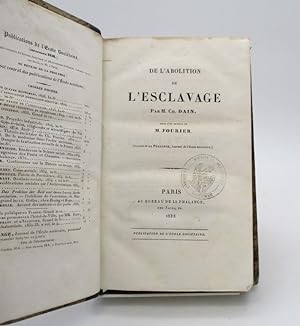
X brochures en 1 vol. in-8, demi-basane brune, dos lisse romantique orné de frises et filets dorés, tranches marbrées (reliure défraîchie, petites rousseurs, quelques mouillures angulaires, petits manques marginaux à l'une des brochures). DAIN (Ch.); FOURIER (Ch.). De l'abolition de l'esclavage [.]suivi d'un article de M. Fourie…r. Paris, au bureau de La Phalange, 1836. 54 pp. Édition originale de ce tiré à part de la revue La Phalange, publication de l'École Sociétaire. CONSIDERANT (Victor). Déraisons et Dangers de l'engouement pour les chemins de fer. Avis à l'Opinion et aux Capitaux. Paris, au bureau de La Phalange et chez Ducor, 1838. 93 pp., couverture conservée. Édition originale de cette publication de l'École Sociétaire, complet de son catalogue in fine. [CONSIDERANT (Victor)] La Conversion c'est l'impôt. Paris, H. Delloye, 1838. 57 pp., couverture conservée. Édition originale de cette publication anonyme de Considerant. CONSIDERANT (Victor). La Paix ou la Guerre. Paris, au bureau de La Phalange, février 1839. 45 pp., couverture conservée. Deuxième édition de ce manifeste au préalable paru dans la revue La Phalange. CONSIDERANT (Victor). De la politique générale et du rôle de la France en Europe suivi d'Une appréciation de la marche du gouvernement depuis juillet 1830. Paris, au bureau de La Phalange et chez Perrotin, 1840. 8-[2]-160 pp., couverture conservée. Édition originale. Il a été relié, entre la table des matières et l'avertissement, un autre article de Considerant : "Projet sur la loi sur les sucres", tiré à part de la revue La Phalange, où il a été publié pour la première fois le 1er février 1840. CONSIDERANT (Victor). Contre M. Arago - Réclamation du droit de propriété. Paris, au bureau de La Phalange , juin 1840. 80 pp., couverture conservée. Édition originale de la brochure en réponse au discours d'Arago du 16 mai 1840 sur la réforme électorale. Elle comprend la représentation d'un phalanstère dans le texte, ainsi qu'un plan sur le second plat de couverture et La Théorie du droit de propriété. [CONSIDERANT (Victor)] Théorie générale de Fourier. Lyon, chez Nourtier, 1841. 16 pp., couverture conservée. Édition originale de ce discours prononcé par Considerant à la 5e section du Congrès le 5 septembre 1841. [Anonyme] Immoralité de la doctrine de Fourier. Paris, chez les marchands de nouveautés, s.d. [1841] 46 pp. Édition originale de cette plaquette. Ex-dono manuscrit "offert par l'École Sociétaire" et tampon "Considerant et Cie" au premier feuillet de faux-titre. Voir photographie(s) / See picture(s) * Membre du SLAM et de la LILA / ILAB Member. La librairie est ouverte du lundi au vendredi de 14h à 19h. Merci de nous prévenir avant de passer,certains de nos livres étant entreposés dans une réserve.
- Hardcover
Anbieter: A. Gerits & Son b.v., Diemen, , NiederlandeA. Gerits & Son b.v.
Verkäufer/-in kontaktierenVerkäufer/-in mit 5 SternenZustand: Gebraucht
EUR 1.500,00
EUR 17,50 VersandVersand von Niederlande nach USAAnzahl: 1 verfügbar
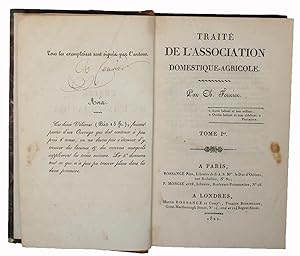
Paris, Librairie Sociétaire, 1841-1845. 6 volumes. 8vo. Contemporary half calf, marbled boards, spines richly gilt with gilt lettering, a very nice copy. Del Bo, Fourier, p. 8; Del Bo-Gerits, Supplement, p. 16. Second edition, scarce. 1. Théorie des quatre mouvements et des destinées générales. Deuxième édition. With 1 folding t…able. (4), xxxvi, 484 pp. 2-5. Théorie de l'unité universelle (Traité de l'association domestique-agricole). Deuxième édition. With 1 folding table. (4), lxviii, (2), xlii, 243, (1), 107 pp.; xv, 451 pp.; viii, 593, (1) pp.; xii, 603 pp. 6. Le nouveau monde industriel et sociétaire. Deuxième édition. With two plates. (2), xvi, 489 pp. Del Bo does not mention the plates in vol. 6.
 Weitere Bilder
- Hardcover
- Erstausgabe
- Signiert
Anbieter: Herman H. J. Lynge & Søn ILAB-ABF, Copenhagen, , DänemarkHerman H. J. Lynge & Søn ILAB-ABF
Verkäufer/-in kontaktierenVerkäufer/-in mit 4 SternenZustand: Gebraucht
EUR 11.712,84
Versand nach gratisVersand von Dänemark nach USAAnzahl: 1 verfügbar
Paris, Bossange père" Londres, Martin Bossange et Comp., 1822 & 1823. 8vo. [Traité:] Two lovely contemporary, uniform half calf bindings with gilding and blindstamped ornamentations to spines. "E. C." in gilt lettering to top of spine on both volumes + [Sommaire:] a bit later red half cloth with marbled paper over boards. Gilt t…itle to spine. [Traité]: signed by the author on verso of half-title in vol. 1: "Ch Fourier". Title-page of vol. 1 with a small light brown stain (probably candle-starin), far from affecting lettering. Both volumes in lovely condition, with only very light occassional brownspoting. LXXX, 592 pp." VIII, 648 pp. [Sommaire:] Title-page slightly browned, evenly. Otherwise very nice, clean, and fresh. 16 pp, pp. (1329) -1448 + 4 ff. (= (A8 (unnumbered) - on two leaves, first recto and second verso blank) + B8, C8, D8, E8).A lovely set. Scarce first edition of Fourier's milestone work of political theory, which is considered a founding work of Utopian Socialism and a main inspiration for Marx. The work, which contains "the essence of Fourier's doctrine" (David Owen Evans, Social Romanticism in France 1830-1848, p. 129.), is here presented together with the exceedingly rare complete supplement, which was published the following year.It is in the "Traité." that Fourier presents the revolutionary ideas that Marx were to adopt and use in his "Kapital", namely the theory of poverty and exploitation and its relation to the means of production. These same ideas are those that made Marx speak of Fourier's "Gargantuan view of man".It is due to the "Traité de l'association" that Fourier is considered one of the founding fathers of Utopian Socialism (being by far the most utopian of them)" in his quest for a more equal society, he became one of the very first to defend things such as same-sex sexuality and the rights of women - in fact, it is Fourier that later coins the word "Feministe", while stating that the position of women in society was equal to that of slaves. Many of his publications preceded those of de Saint-Simon, Owens, and Marx, but his ideas seemed to find greater influence when interpreted by others. Due to the lack of success of the "Traité", Fourier decided, the following year, to publish the "Sommaire", in an attempt to draw attention to his revolutionary ideas in the "Traité". The "Sommaire" constitutes a short, more easily understood, summary, though also containing some additional new work. The "Sommaire" is often referred to as "The Appendix" to the "Traité" and is considered as belonging to that work. One of the central themes of the work is the thought of "harmony": "The word harmonisme - here fully explained and described for the first time - was first applied to the highest of the passions or motives of humankind" then (as a synonym for Harmonie) to the ultimate stage of social evolution. The fortunate inhabitants of the perfected world he called harmoniens, a word coined in the present work. These words were duly translated by the Fourierites of other lands. Harmony, the Harmonic state, Harmonization, or integral contrasted association, were the terms used in the earliest English translations in 1841 to describe Fourier's proposed social system and Harmonism was employed in the 1850's. The inhabitants were spoken of as Harmonians" and Fourier's philosophy as a whole was sometimes described as the Harmonian Doctrine. Even the word harmonious was called into service as a technical term, one English disciple writing of a Harmonious Phalanx." (Bestor, The Evolution of the Socialist Vocabulary, p. 264).Charles Fourier claimed to find inspiration in the exorbitant price of an apple in a Parisian restaurant and he convinced himself that he could design a more efficient way to produce and deliver goods. Unlike other socialists of his day, Fourier believed that the pursuit of self interest served as an effective incentive to productive work. He simply did not believe that the market economy of his day successfully mobilized the pursuit of self interest for the common good and he was offended by the low productivity of labor. He argued that most people were employed in deadening jobs that failed to fully utilize their energies, and that nearly two thirds of all workers were performing virtually useless tasks. A more efficient economic organization promised enormous benefits to all if only a benefactor capitalist would advance the money necessary to set up the first community or ''phalanstery''.Phalanxes, structures called Phalanstères or "grand hotels", were four level apartment complexes where the richest had the uppermost apartments and the poorest occupied the ground floor residence. Wealth was determined by one's job, jobs were assigned based on the interests and desires of the individual. There were incentives: jobs people might not enjoy doing would receive higher pay. Fourier considered trade, which he associated with Jews, to be the "source of all evil" and advocated that Jews be forced to perform farm work in the phalansteries. Furthermore he believed that there were twelve common passions which resulted in 810 types of character (it is not clear why exactly this number), so the ideal phalanx would have exactly 1620 people. One day there would be six million of these, loosely ruled by a world "omniarch", or a World Congress of Phalanxes.Fourier and his contemporaries such as Owen and Saint-Simon were named utopian socialist because of their visions of imaginary ideal societies. Many saw them as not being grounded in the material conditions of society and as reactionary. Despite Fourier's lacking sense of practicality his ideas profoundly influenced all later socialist political and economic though" Not only was he immortalized by Marx, "John Stuart Mill shared the same enthusiasm for Fourier as did the German Marx and Engels and the American George Ripley. Fourier's was "the most skillfully combined, and with the greatest foresight of objections, of all.
- Signiert
Anbieter: A. Gerits & Son b.v., Diemen, , NiederlandeA. Gerits & Son b.v.
Verkäufer/-in kontaktierenVerkäufer/-in mit 5 SternenZustand: Gebraucht
EUR 200,00
EUR 17,50 VersandVersand von Niederlande nach USAAnzahl: 1 verfügbar
Paris, Dentu, 1874. 2 parts in 1 volume, 105 pp., continuously paginated. 8vo. Sewn, original printed covers, some small loss of paper to spine, nice uncut copy. Del Bo, Fourier, pp. 9 & 76. The first work is an unedited letter, dated December 26, 1803 and published for the first time by Charles Pellarin with a commentary. The l…etter of Fourier is signed 'Fourrier'.


