Gesamtpreis (1 Artikel Artikel):
Versandziel:

fortification (24 Ergebnisse)
Direkt zu den wichtigsten Suchergebnissen
Suchfilter
Produktart
- Alle Product Types
- Bücher (23)
- Magazine & Zeitschriften (Keine weiteren Ergebnisse entsprechen dieser Verfeinerung)
- Comics (Keine weiteren Ergebnisse entsprechen dieser Verfeinerung)
- Noten (Keine weiteren Ergebnisse entsprechen dieser Verfeinerung)
- Kunst, Grafik & Poster (Keine weiteren Ergebnisse entsprechen dieser Verfeinerung)
- Fotografien (Keine weiteren Ergebnisse entsprechen dieser Verfeinerung)
- Karten (Keine weiteren Ergebnisse entsprechen dieser Verfeinerung)
- Manuskripte & Papierantiquitäten (1)
Zustand Mehr dazu
- Neu (6)
- Wie Neu, Sehr Gut oder Gut Bis Sehr Gut (2)
- Gut oder Befriedigend (5)
- Ausreichend oder Schlecht (Keine weiteren Ergebnisse entsprechen dieser Verfeinerung)
- Wie beschrieben (11)
Einband
Weitere Eigenschaften
- Erstausgabe (2)
- Signiert (Keine weiteren Ergebnisse entsprechen dieser Verfeinerung)
- Schutzumschlag (Keine weiteren Ergebnisse entsprechen dieser Verfeinerung)
- Angebotsfoto (14)
Sprache (3)
Gratisversand
Land des Verkäufers
Verkäuferbewertung
-

Report of the Board of Ordnance and Fortification
Anbieter: PBShop.store US, Wood Dale, IL, USA
Verkäuferbewertung 5 von 5 Sternen

PAP. Zustand: New. New Book. Shipped from UK. Established seller since 2000.
-

Report of the Board of Ordnance and Fortification January 5, 1892 Referred to the Committee on Appropriations and Ordered to Be Printed Classic Reprint
Anbieter: PBShop.store US, Wood Dale, IL, USA
Verkäuferbewertung 5 von 5 Sternen
HRD. Zustand: New. New Book. Shipped from UK. Established seller since 2000.
-
Report of the Board of Ordnance and Fortification
Anbieter: PBShop.store UK, Fairford, GLOS, Vereinigtes Königreich
Verkäuferbewertung 5 von 5 Sternen
EUR 23,83
EUR 4,76 shipping
Ships from Vereinigtes Königreich to USAAnzahl: 15 verfügbar
In den WarenkorbPAP. Zustand: New. New Book. Shipped from UK. Established seller since 2000.
-
Report of the Board of Ordnance and Fortification January 5, 1892 Referred to the Committee on Appropriations and Ordered to Be Printed Classic Reprint
Anbieter: PBShop.store UK, Fairford, GLOS, Vereinigtes Königreich
Verkäuferbewertung 5 von 5 Sternen
EUR 29,61
EUR 5,74 shipping
Ships from Vereinigtes Königreich to USAAnzahl: 15 verfügbar
In den WarenkorbHRD. Zustand: New. New Book. Shipped from UK. Established seller since 2000.
-

Annuaire de la Societe d'Histoire et d'Archeologie du Ried-Nord.
Verlag: Eigenverlag, Drusenheim, 1999
Sprache: Französisch
Anbieter: Antiquariat Uwe Berg, Toppenstedt, Deutschland
Verkäuferbewertung 5 von 5 Sternen
399 S., reich bebildert, OPbd., Gr.-8*. Sauberer Pappband. 69 Sprache: Französisch Gewicht in Gramm: 1000.
-

GENERAL APPEARANCE OF ANCIENT FORT & BASTIONED FORTRESS - Detailed and Attractive - an Original Hand-Coloured Antique Engraved View
Erscheinungsdatum: 1880
Sprache: Englisch
Anbieter: K Books Ltd ABA ILAB, York, YORKS, Vereinigtes Königreich
Verbandsmitglied: ABA ILAB PBFA
Verkäuferbewertung 5 von 5 Sternen
EUR 23,57
EUR 22,31 shipping
Ships from Vereinigtes Königreich to USAAnzahl: 1 verfügbar
In den WarenkorbNo Binding. Zustand: Very Good. Mounted and ready to frame. Very good condition. ca 1880. *Impressive & uncommon original hand-coloured antique scene. Attractive and decorative .
-

Report Of The Board On Fortifications Or Other Defenses Appointed By The President Of The United States Under The Provisions Of The Act Of Congress Ap
Verlag: Creative Media Partners, LLC Okt 2022, 2022
ISBN 10: 1016885768 ISBN 13: 9781016885768
Sprache: Englisch
Anbieter: AHA-BUCH GmbH, Einbeck, Deutschland
Verkäuferbewertung 5 von 5 Sternen
Taschenbuch. Zustand: Neu. Neuware.
-
[Général Fleury [General Baron Hubert Rohault de Fleury], French soldier in the Napoleonic Wars.] Autograph Note Signed, accepting an invitation from 'Madame la Bne: de Seebach'.
Verlag: 'Paris. 2 Mai', 1856
Anbieter: Richard M. Ford Ltd, London, Vereinigtes Königreich
Verkäuferbewertung 5 von 5 Sternen
Manuskript / Papierantiquität
EUR 41,24
EUR 5,15 shipping
Ships from Vereinigtes Königreich to USAAnzahl: 1 verfügbar
In den WarenkorbSee his entry in Encyclopaedia Britannica. Not to be confused with Fleury (1815-1884), whose handwriting is markedly different. 1p, 12mo. On grey paper. In good condition, lightly aged. Neatly folded twice. Reads: 'Le Général Fleury se rendra avec le plus grand plaisir a l'invitation que Madame la Bne: de Seebach lui a fait l'honneur de lui adresser. / Paris. 2 Mai 1856.' The recipient is presumably the mother of the Alsatian artist Baron Lothar von Seebach (1853-1930).
-

Report Of The Board On Fortifications Or Other Defenses Appointed By The President Of The United States Under The Provisions Of The Act Of Congress Ap
Verlag: Creative Media Partners, LLC Okt 2022, 2022
ISBN 10: 1016880774 ISBN 13: 9781016880770
Sprache: Englisch
Anbieter: AHA-BUCH GmbH, Einbeck, Deutschland
Verkäuferbewertung 5 von 5 Sternen
Buch. Zustand: Neu. Neuware.
-
Sonderangebot
EUR 14,86
EUR 105,00 shipping
Ships from Deutschland to USAAnzahl: 1 verfügbar
In den WarenkorbZustand: Sehr gut. Zustand: Sehr gut | Seiten: 278 | Sprache: Englisch | Produktart: Bücher | Keine Beschreibung verfügbar.
-
17th century quantity surveying - 40 accurate plans of existing fortified cities.
Verlag: Amsterdam, Louis Elzevier, 1648
Anbieter: Hünersdorff Rare Books ABA ILAB, London, Vereinigtes Königreich
Verkäuferbewertung 2 von 5 Sternen

EUR 4.124,28
EUR 25,74 shipping
Ships from Vereinigtes Königreich to USAAnzahl: 1 verfügbar
In den WarenkorbHardcover. Zustand: Very Good. No Jacket. Special Edition. Dögen, Matthias. L' architecture militaire moderne, ou Fortification: confirme par diverses histoires tant anciennes que nouvelles, & enrichie des figures de principales forteresses qui sont en l Europe . mise en françois par Helie Poirier, Parisien. Amsterdam, Louis Elzevir, 1648. Folio. Engraved title + [3]f + 543 (misnumbered 547)p. With 70 engraved plates and 10 double-sided leaves of tables. Contemporary vellum; neatly rebacked. The handsome first edition in French produced on excellent paper; the translation by Helie Poirier made from the original Latin of 1647 published at the same press. This work on Dutch military architecture is unique in its period for the 40 accurate plans of existing fortified towns and for its careful attention to quantity surveying. The fine engraved title shows surveyors at work with a fortress in the background. Dögen (c.1605-72), a Prussian mathematician, presents his arguments based on practical experience gained in military service under Maurice and later, Frederick Henry of Orange. He considered the building of fortresses during peace time one of the best guarantees for the prevention of war. A few occasional light spots, but a very good, crisp copy, rare in this state. From the collection of the Earl of Ancaster with his engraved armorial bookplate pasted inside front cover (signed Harry Soane 1896). Jähns 1128-31; Jordan 0910; Rahir 1072; Spaulding & Karpinski 151; Willems 1063.
-
Del modo di fortificar le citta.
Verlag: Venice [Nicolini da Sabio], 1556
Anbieter: Hünersdorff Rare Books ABA ILAB, London, Vereinigtes Königreich
Verkäuferbewertung 2 von 5 Sternen
EUR 5.302,65
EUR 25,74 shipping
Ships from Vereinigtes Königreich to USAAnzahl: 1 verfügbar
In den WarenkorbHardcover. Zustand: Very Good. No Jacket. 2nd Edition. Zanchi, Giovan Battista de'. Del Modo Di Fortificar Le Città. Venice [Nicolini da Sabio] 1556. Small 4to. 63 + [1]p. Italic & roman letter. Fine oval woodcut portrait of the author on title within scroll-work border, 8 woodcuts (5 full-page, 2 folding); decorative head-pieces and historiated woodcut initials. Vellum paper binding 'a la rustica'. The earliest printed Italian monograph on fortification. First published in 1554, the book is also the earliest to appear in Europe on the subject after Dürer's specialist treatise of 1527 (Etliche underricht zur befestigung der Stett). Other contemporary writers such as Cataneo, Tartaglia, and Valle only contributed in the form of chapters. Zanchi (1515-c.1586), a military engineer in the Venetian service, explains that the introduction of artillery called for a reform of the existing fortification systems which were not strong enough to withstand the impact of the new arm. He advocates a system of defence based on octagonal and square boundaries with bastions at the angles. The woodcuts are among the earliest showing the new pentagonal form of bastion. The dedication is to Maximilian of Austria. The book was influential through reprints and piracies. A French translation by François de la Treille was published as his own work at Lyons (1556), and an English version translated from the French was included in Peter Whithorne's Certaine waies (London 1562). A good copy with firm impressions of the illustrations. Berlin Katalog 3508; Breman 345; Cockle 767 (note); Jordan 4188; Riccardi II, 649.
-

Corona imperiale dell'architettura militare . Divisa in due trattati.
Verlag: Venice, Barezzo Barezzi for the author,, 1618
Anbieter: Hünersdorff Rare Books ABA ILAB, London, Vereinigtes Königreich
Verkäuferbewertung 2 von 5 Sternen
Erstausgabe
EUR 4.124,28
EUR 25,74 shipping
Ships from Vereinigtes Königreich to USAAnzahl: 1 verfügbar
In den WarenkorbHardcover. Zustand: Very Good. No Jacket. 1st Edition. 2 parts in 1 volume, folio. I: [24] + 287 (misnumbered 299) + [1 blank]p + [4]p index; II: 83 + [1 blank]p. Roman & italic letter. Engraved allegorical title to first part incorporating author's bust portrait aged 58, signed Gaspar Rispoldi in tailend margin; 48 large engravings (1 full-page) of which 5 are bound in as 3 extra leaves outside collation (including repeats). 2 engraved and 6 woodcut head-pieces. Ornaments and initials. Large woodcut printer's device on p299. 18th century vellum with gilt-stamped morocco title label on spine. First edition of this comprehensive treatise on the theory and practice of fortification, the first work published by the prolific Roman military writer. Sardi is credited for advocating the construction of extended two-tiered flanks to be protected by orillons, semicircular projections at the shoulder of a bastion intended to cover the guns and defenders on the flank. The author's dedication to four Genoese patrons (Bartolomeo Lomellino, Giovan Domenico Pallavicini, Giacomo Catanio & Giorgio Doria) is dated 24 November 1618. A reprint appeared at Bologna in 1687. Tips of tailend blank corners lightly stained, some occasional light toning, otherwise a very good copy. Breman 260; Cockle 810; Jähns 1098-99; Jordan 3301; Riccardi II, 423.
-

Neu-herfürgegebene Kriegs-Architectur welchergestalt die Vestungsgebäue auff unterschiedliche wohlpracticirliche Arten zue noch mehrer verstärck .
Verlag: Munich, Johann Jäcklin, 1673, 1673
Anbieter: Hünersdorff Rare Books ABA ILAB, London, Vereinigtes Königreich
Verkäuferbewertung 2 von 5 Sternen
EUR 2.945,92
EUR 25,74 shipping
Ships from Vereinigtes Königreich to USAAnzahl: 1 verfügbar
In den WarenkorbHardcover. Zustand: Very Good. No Jacket. 2nd Edition. Small folio. Engraved allegorical title signed 'C. G. Amling' + [6] + 39 pages text + 14 folding engraved plates with 68 illustrations. Typographical ornaments. Contemporary half vellum. Enlarged edition, corrected by the author (first published 1664), of this influential German treatise on late baroque military architecture by the Bavarian engineer Heidemann, a follower of Daniel Speckle (1536-89) of Strassburg, one of the first exponents of modern fortification. Heidemann still considered the use of orillons for the protection of the flanks of bastions as essential, a method largely abandoned by that time under the influence of the Dutch systems of fortification. A re-interpretation of his theories was offered by Sturm in his Architectura Militaris hypoth.-eclectico (1702). The beautiful allegorical title by the Bavarian court engraver Carl Gustav von Amling (1651-1702) incorporates a view of Munich in the background. A very fresh copy of this handsome book printed on good quality paper. Jähns 1343; Jordan 1636.
-
Fein gemalte, aquarellierte Zeichnung einer Festung aus der Vogelschau, wohl Saint Venant in Nordost-Frankreich.
Verlag: Frankreich?, um 1720., 1720
Anbieter: Antiquariat Thomas Rezek, München, Deutschland
Verkäuferbewertung 5 von 5 Sternen
circa 20 x 23 cm. 1 Blatt verso weiss "Aquarell über Tusche auf festem Papier in Schwarz, Rosa und verschiedenen Grüntönen. Unten rechts alt als "St. Venant" bezeichnet. Im Spanischen Erbfolgekrieg fand 1710 eine Belagerung von Saint-Venant statt. " - Sauber, dekorativ.
-
La Fortification reduicte en art et demonstree. Edition seconde, augmentee de plusieurs desseins?.
Verlag: Frankfurt, Paul Jacobi for Johann Theodor de Bry in Oppenheim, 1617., 1617
Anbieter: Antiquariat Thomas Rezek, München, Deutschland
Verkäuferbewertung 5 von 5 Sternen
Fol., circa 30,5 x 20 cm. Title with engraved border, 3 ff., 98 pp., 39 (instead of 47) engraved plates, most double-page Contemporary vellum VD17 23:297466C. Second, presumably pirated edition of the first independent French treatise on military architecture, first published in 1600 and a pioneering work in introducing the Italian style of fortification north of the Alps. The author Errard from Bar le Duc worked for the Duke of Lorraine and was an engineer who later on designed several citadels for Henri IV. - This copy unfortunately not complete. It would appear that the missing plates had already not been present a long time ago as old blank leaves were bound in where they should be. We have plates 2-8, 10-31 and 38-47 (missing: 1, 9 and 32-37) - price strongly reduced due to this! - Some browning, little staining, to the end little light waterstains, binding rubbed and dusty with stains, laces gone, but else still very good - price considerably reduced because of missing plates.
-
The field engineer. Translated from the French, with observations and remarks on each chapter. Together with the addition of several new figures. to explain the author's constructions. By John Muller, Master of the Royal-Academy at Woolwich.
Verlag: London, John Millan, 1760., 1760
Anbieter: Antiquariat Thomas Rezek, München, Deutschland
Verkäuferbewertung 5 von 5 Sternen
Erstausgabe
8°. 3 ff., X pp., 2 ff., 278 pp., 1 f., 36+1 large folding plates Contemporary calf binding "English STC, T72790. First English edition, translated from the French (L'Ingénieur de campagne, ou traité de la fortification passagère, 1750). Many plates show fortified bridges or towns, many in Germany or France. - The plates: after number 8 there is one called "A", plates 28 and 29 are together on one leaf, number 30 is obviosuly misnumbered as 34 which then comes again. There are 1-36 and A, so together 37, the second edition from 1773 seems to have only 36 plates. " - Small old 18th cent owner s inscriptions, minor browning, few plates frayed to the outer edges but no loss of image, binding rubbed, hinges with cracking but not loose.
-
Maniere de fortifier de Mr. De Vauban? Avec un traité de geometrie? 2 parts in 1 volume.
Verlag: Amsterdam, Mortier, 1689., 1689
Anbieter: Antiquariat Thomas Rezek, München, Deutschland
Verkäuferbewertung 5 von 5 Sternen
8°. Engraved frontispiece, 2 ff., 65 pp., 2 ff.; 1 f., 99 pp., 2 ff., 8 + 22 = 30 folding engraved plates "Contemporary mottled calf with title "Vauban" to spine" Jordan 575 (variants exist). Second edition, first published in 1681 (in Paris). The first part gives an introduction into geometry especially for the use of the officer and archtict. The second deals with fortifications in general, following the theories and examples given by Vauban (1633-1707), the most influential military architect and engineer of his age. This part has 22 plates with shapes and elements of fortresses. - Minor browning and just a few spots, a little rubbed, last endpaper renewed, but quite nice.
-
Traité de fortification.
Verlag: [Northern Germany?,, 1685
Anbieter: ASHER Rare Books, T Goy Houten, Niederlande
Verkäuferbewertung 5 von 5 Sternen
An extensive manuscript manual on fortification in French, discussing the design, construction and defence of a wide variety of regular and irregular fortifications, gates, bridges, etc., and with chapters on attacking fortifications, mines and other subjects. It is extensively illustrated, including many full-page or folding fortification plans, with one folding fortification plan and one folding cross-section of fortifications in colour.The text notes in several places that it is based on the work of Sébastien Le Prestre de Vauban (1633-1707), so it was almost certainly written after he began to publish his work on fortification in 1673, and probably no earlier than the 1680s, when he fully developed his methods and published more detailed works on fortification. Although written in French it seems likely to come from northern Germany.Much of the paper is slightly browned, and the ink has left a shadow on the back of the pages or the facing pages. The corner of one leaf was restored before the manuscript was written. One leaf (a cancel, blank except for a page number) is detached, and some of the slips extending the margins have come partly loose. A long tear along the fold of 1 folding leaf professionally restored. Some worm holes in the gutter margin of about 30 leaves, not affecting the text or drawings. Most leaves are in good condition. Binding professionally restored with only some minor worn to the boards. An interesting illustrated manuscript fortifications manual, in French but probably from northern Germany. Contemporary or near-contemporary calf, sewn on 5 cords, gold-tooled spine , with the title ("Traite de fortif.") in the 2nd of 6 compartments and each of the others with a lozenge-shaped flower ornament and 4 corner-pieces. Manuscript in French, written in black ink on paper in an easily readable cursive hand, with the title in a pen and ink cartouche with 2 soldiers, a mortar, 2 cannons and other military attributes, the whole in a pen-drawn single-line border; about 45 pen and ink drawings (14 full-page and 8 larger folding, 2 of the folding ones in red and black ink with coloured washes, one of the colour folding leaves 36 x 27 cm), mostly showing fortification plans but also diagrams, sections, and a view of an estate with, in the foreground, a man at a table with a fortification model. Pages: [1], [3 blank], 164 pp., ll. 165-171, [172], pp. 173-197, 197 [bis], 198-289, [24 blank, partly numbered].
-
Fortificacam moderna, ou recopilacam De differentes Methodos de fortificar, De que usao, os Espanhoes, Francezes, Italianos & Hollandezes? traduzido por ordem de S. Magestade que Deos guarde.
Verlag: Lisboa (Lissabon), Officina Real Deslandesiana, 1713., 1713
Anbieter: Antiquariat Thomas Rezek, München, Deutschland
Verkäuferbewertung 5 von 5 Sternen
circa 20,5 x 14,5 cm. 8 ff., 336 pp., 46 folding engraved plates Contemporary repaired full calf Jordan 2871. Uncommon Portuguese translation from the French of this classic manual of military architecture. - Some worming without loss of text, only the first leaves with light stains, some pages with small marginal spots, but mostly clean. Binding completely restored using the old material with some additions to the spine in the same colour. - Despite the small flaws still a very good copy, complete with all 46 plates.
-
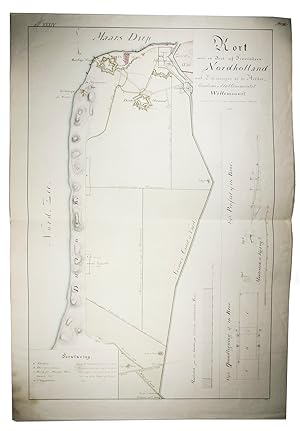
Kort over en deel af provindsen Nordholland med befestningen af de Helder, maritime & etablissementet Willemsoort samt en deel af den nye Nordhollandske Canal.
Verlag: [The Netherlands?],, 1825
Anbieter: ASHER Rare Books, T Goy Houten, Niederlande
Verkäuferbewertung 5 von 5 Sternen
Manuscript fortification plan, showing the Den Helder fortifications and the Willemsoord shipyard, built in the 19th century as commissioned by Napoleon Bonaparte, drawn by the Danish-Norwegian military engineer and quartermaster Rasmus Krag (1763-1838). The map shows the so-called Den Helder fortifications, also known as the "Stelling Den Helder", an impressive line of forts, defensive works and connecting dikes. This line had already been used during the Eighty Years' War against sea attacks. In 1811 Napoleon gave the order to expand it, wanting to make Den Helder the war harbour of The Netherlands because of its strategic location.The plan is numbered in the upper left corner "Pl. XXXIV" in red ink and "Nr. 16" in the right upper corner in black ink, the latter struck through, and signed by "Krag" in the lower right corner below the plan. Some marginal soiling, stain in the lower left corner and some small spots on the plan, small tear in the upper left corner, but overall in good condition. A highly interesting and finely executed manuscript plan, important for Dutch maritime and military history. Folded. With a pen and ink-drawn fortification plan (ca. 85 x 55 cm) of the Den Helder fortifications and the marine shipyard Willemsoord, coloured by a contemporary hand, with a manuscript title, scales and a key in Danish, written in a fine and legible 19th-century hand surrounding the plan. On Whatman wove paper. Pages: [1] sheet.
-
[FORTIFICATION] Tratado de fortificación regular, iregular y de campaña with nuevos ideas de fortificar las trincheras. 18th century.
Erscheinungsdatum: 1750
Anbieter: Konstantinopel ANTIQUARIAN BOOKSELLERS., ENSCHEDE, Niederlande
Verkäuferbewertung 3 von 5 Sternen

Hardcover. Zustand: Fine. Contemporary vellum. In 8vo (194 x 150 mm). [216] papers (written 212) and 13 + [3] tables. Spanish manuscript about military architecture, written in beautiful legible script and illustrated by 13 tables with large fortifications (some colored) and 3 unnumbered tables with smaller drawings. The work is divided into four parts: "De la Fortificacion", "De la Fortificacion irregular", "De la fortificaz. efectiva sobre el terreno" and finally" De la Fortificacion de Campaña.The text quotes Padua, Pesaro, Turin, Verona, Urbino, Venice, Bergamo, Bologna, Florence, Mantua, Milan, Parma, Genoa, Naples and Palermo.
-
Grondbeginselen der vestingbouw, volgens de verschillende manieren van versterken van Pagan, Vauban en Coehoorn. Geconstrueerd getekend en beschreven door C C van Hooff.
Verlag: [The Hague],, 1796
Anbieter: Antiquariaat FORUM BV, Houten, Niederlande
Verkäuferbewertung 5 von 5 Sternen
Unpublished manuscript for a complete introductory course in the design and construction of fortifications, with 19 large folding leaves with meticulously drawn fortification plans and sections in colour. It was compiled, drawn and written by Cornelis Christiaan van Hooff (1778-1812), then an 18-year-old Lieutenant in the Dutch Napoleonic corps of military engineers. The title notes that it follows the methods of Blaise François, Comte de Pagan (1604-1665), Sébastien Le Prestre de Vauban (1633-1707) and Menno van Coehoorn (1634-1704), the greatest 17th-century French and Dutch masters of the art of fortification. Van Hooff began to study law but switched to engineering. The French Revolutionary army invaded the Netherlands in 1794/95 and the Batavian Republic was proclaimed on 19 January 1795. Van Hooff became a Lieutenant in the corps of engineers on 28 October 1795. He produced the present manuscript in the following year. He was to rise to the rank of Lieuitenant-Colonel in 1809, but requested and received an honorary discharge in 1810, apparently due to poor health, and died in 1812 at age 33. With library stamp. In very good condition. The binding is rubbed, but still good.l For Van Hooff: Van der Aa VIII, pp. 1084-1085 (mentioning what may be the present manuscript). Contemporary half, sprinkled, tanned sheepskin, sewn on 3 tapes, gold-tooled spine with a gold-tooled ochre vellum label in the 2nd of 7 spine divisions and a leopard(?) courant in each of the others, paste-paper sides. With a calligraphic title-page and 19 folding drawings (mostly about 32.5 x 51 cm, 6 longer: 78 to 138 cm, the longest assembled from 2 pieces before drawing) with 45 numbered figures (1-32, numbers 28, 30 and 32 calling themselves plates and containing 10, 4 and 2 numbered figures respectively), showing fortification plans and sections in black and red ink with coloured washes (grey, green, light brown and two shades of pink), some lettering in brown ink. Most drawings include a scale. The drawings are tipped to the fore-edge margin of 19 integral blank leaves (not included in the pagination) so that they fold out and can be viewed while consulting the text. Stubs have been bound in in several places to leave room for the folding drawings. With an 1857(?) photograph (albumen print) of a (ca. 1795?) miniature oval portrait of the author and 4 documents concerning the manuscript and the author's family (1933-1965), all loosely inserted. Pages: [1], [1 blank], 81, [1 blank], [1], [3 blank] pp. plus 19 integral blank ll. with drawings tipped onto them.
-
Proekt ukrepleniya g. Varna (i.e.: "A project of the fortification of town of Varna"). Dopol. Otd. Sht. Kapitan (Stabskapitän, staff captain) Sedel'nikov.
Anbieter: Herman H. J. Lynge & Søn ILAB-ABF, Copenhagen, Dänemark
Verkäuferbewertung 4 von 5 Sternen

Varna 1888-89. 131 x 126 cm. joined by 4 sheets. Large manuscript surveying map of the fortress of Varna and its vicinity of with contour lines and defensive fortresses, including the fortified lines along the Black Sea coast. Depicting in all 19 defensive installations in all directions from Varna. Surveyed by the Russian captain, Kapitan Scrodel'uikov. Pen and ink with watercolour. With scale. On good thick paper. With 4 small punched holes (stars).