

Gesamtpreis (1 Artikel Artikel):
Versandziel:

ferrerio (20 Ergebnisse)
Direkt zu den wichtigsten Suchergebnissen
Suchfilter
Produktart
- Alle Product Types
- Bücher (18)
- Magazine & Zeitschriften (Keine weiteren Ergebnisse entsprechen dieser Verfeinerung)
- Comics (Keine weiteren Ergebnisse entsprechen dieser Verfeinerung)
- Noten (Keine weiteren Ergebnisse entsprechen dieser Verfeinerung)
- Kunst, Grafik & Poster (2)
- Fotografien (Keine weiteren Ergebnisse entsprechen dieser Verfeinerung)
- Karten (Keine weiteren Ergebnisse entsprechen dieser Verfeinerung)
- Manuskripte & Papierantiquitäten (Keine weiteren Ergebnisse entsprechen dieser Verfeinerung)
Zustand Mehr dazu
Einband
Weitere Eigenschaften
- Erstausgabe (Keine weiteren Ergebnisse entsprechen dieser Verfeinerung)
- Signiert (Keine weiteren Ergebnisse entsprechen dieser Verfeinerung)
- Schutzumschlag (Keine weiteren Ergebnisse entsprechen dieser Verfeinerung)
- Angebotsfoto (14)
Sprache (4)
Gratisversand
Land des Verkäufers
Verkäuferbewertung
-

Ferrerii Historia Abbatum De Kynlos: Una Cum Vita Thomae Chrystalli Abbatis (Classic Reprint)
Anbieter: PBShop.store US, Wood Dale, IL, USA
Verkäuferbewertung 5 von 5 Sternen

PAP. Zustand: New. New Book. Shipped from UK. Established seller since 2000.
-
Ferrerii Historia Abbatum De Kynlos: Una Cum Vita Thomae Chrystalli Abbatis (Classic Reprint)
Anbieter: PBShop.store UK, Fairford, GLOS, Vereinigtes Königreich
Verkäuferbewertung 5 von 5 Sternen
EUR 25,46
EUR 3,81 Versand
Versand von Vereinigtes Königreich nach USAAnzahl: 15 verfügbar
In den WarenkorbPAP. Zustand: New. New Book. Shipped from UK. Established seller since 2000.
-

Ferrerii Historia Abbatum De Kynlos Una Cum Vita Thomae Chrystalli Abbatis Classic Reprint
Anbieter: PBShop.store US, Wood Dale, IL, USA
Verkäuferbewertung 5 von 5 Sternen
HRD. Zustand: New. New Book. Shipped from UK. Established seller since 2000.
-

Se una barca potesse
Verlag: Edizioni Nuove Scritture, 2002
Anbieter: Librodifaccia, Alessandria, AL, Italien
Verkäuferbewertung 5 von 5 Sternen
Zustand: Buone. italiano Condizioni dell'esterno: leggermente logorata Condizioni dell'interno: Buone.
-

Se una barca potesse
Verlag: Edizioni Nuove Scritture, 2002
Anbieter: Librodifaccia, Alessandria, AL, Italien
Verkäuferbewertung 5 von 5 Sternen
Zustand: Buone. italiano Condizioni dell'esterno: Buone Condizioni dell'interno: dedica autore.
-
Ferrerii Historia Abbatum De Kynlos Una Cum Vita Thomae Chrystalli Abbatis Classic Reprint
Anbieter: PBShop.store UK, Fairford, GLOS, Vereinigtes Königreich
Verkäuferbewertung 5 von 5 Sternen
EUR 33,78
EUR 4,81 Versand
Versand von Vereinigtes Königreich nach USAAnzahl: 15 verfügbar
In den WarenkorbHRD. Zustand: New. New Book. Shipped from UK. Established seller since 2000.
-

Il telefono
Verlag: Hoepli, 1920
Anbieter: Librodifaccia, Alessandria, AL, Italien
Verkäuferbewertung 5 von 5 Sternen
Zustand: Buone. italiano Condizioni dell'esterno: Rovinata Condizioni dell'interno: Discrete con Difetti, macchie bruniture.
-

IL TELEFONO.
Verlag: manuali Hoepli, Milano, 1920
Anbieter: studio bibliografico pera s.a.s., LUCCA, LU, Italien
Verkäuferbewertung 4 von 5 Sternen

Copertina rigida. Zustand: discrete. 2ª edizione rifatta e ampliata. Cm.15x10. Pg.XX, 588. Legatura in tela editoriale con titoli in oro. Con 290 illustrazioni e 16 grandi tavole a colori. 450 gr.
-

Il Telefono.
Verlag: Milano, Ulrico Hoepli, Editore-Libraio della Real Casa, Manuali Hoepli,, 1920
Anbieter: Librería Berceo (Libros Antiguos), Madrid, M, Spanien
Verkäuferbewertung 5 von 5 Sternen
-10 x 15,5 cm.- , XVII + 588 págs. Con 290 ilustraciones y 16 grandes desplegables. Enc. tela editorial. (BUEN EJEMPLAR.) (Manual que puede servir para reparar los antiguos teléfonos.).
-

Palazzi di Roma de piu Celebri Architetti?Libro Primo
Verlag: Giovanni Giacomo de Rossi. circa 1655-1670., (Rome), 1655
Anbieter: Alexandre Antique Prints, Maps & Books, Toronto, ON, Kanada
Verkäuferbewertung 4 von 5 Sternen
Full marbled paper boards backed in brown morocco. Spine with 5 raised bands, gilt-lettered calf label in second compartment, remaining with floral gilt motifs. Marbled pasted and free endpapers. All edges speckled red. , Very good example of this volume illustrating Roman architecture. Pietro Ferrerio (1600-1654) was an Italian architect. He produced these drawings of existing Roman buildings for Rossi?s publication. Oblong Folio (370 x 460 mm). , Size : Oblong Folio , Illustrated with 96 engravings, including title.
-
Palazzi di Roma de piu celebri architetti. Libro primo (Palaces of Rome by the Most Celebrated Architects. First Book)
Verlag: si vendeno per Gio. Iacomo Rossi [Domenico de Rossi ?], [Rome], 1691
Anbieter: ERIC CHAIM KLINE, BOOKSELLER (ABAA ILAB), Santa Monica, CA, USA
Verkäuferbewertung 3 von 5 Sternen

Oblong folio (36.3 by 48 cm). Part 1 (of 2) only. Engraved title and dedication (plate no. 1); 43 numbered plates (nos. 2-44) with elevations and plans of palaces (plate no. 33 plan printed and inserted in portrait format). Recent vellum-backed boards to style, gilt title at spine, yapp edges, exposed thongs. Finger smudges and light soiling (mostly marginal) throughout; 2 cm marginal tear at plate no. 24. A very good, exceptionally wide-margined copy. Later (expanded) issue of the first part of these Roman palace illustrations by the architect and engraver Pietro Ferrerio (1600-1654). Palazzi di Roma resulted from an unprecedentedly ambitious publication policy of the print dealer Giovanni Giacomo de' Rossi. In additional to amassing an enormous collection of engraved plates, De' Rossi published several collections illustrating the architecture of Rome, including churches, gardens, and fountains. Ferrerio's death in 1654 delayed the publication of the second part, which would appear sometime between 1670 and 1678, with engravings by Giovanni Battista Falda (1643-1678). Ferrario's opus was the first "to provide systematic, measured, and uniformly scaled illustrations of Roman palaces built in the fifteenth, sixteenth, and seventeenth centuries. The illustrations in this collection demonstrate that Ferrerio was closely focused upon his work. He uses an unadorned style of representation, showing the chosen palaces in line drawings in plan, section, and elevation. and the regularity and consistency of the representational style is as remarkable as the uniformity with which it presents the palace facades, which are especially striking in the austerity of their disciplined composition." (Millard). The most important Roman buildings are illustrated, starting from the works of Bramante, Raphael, Peruzzi and Michelangelo, then moving on to Vignola, Ammannati, Ligorio, Della Porta, and allowing modest space for architects of the 16th-century, such as Bernini, Borromini, and Domenico Fontana. A member of the Accademia di San Luca since 1634, Ferrerio's principal claim to recognition is in fact the present work. He may have provided a consultation in the controversial demolition of the bell tower at Saint Peter's built by Gian Lorenzo Bernini in 1641. Notes on the issue points and the date of publication: Like the Fowler copy, all plates are numbered in the plate at the lower right-hand corner. Plate no. 1, the engraved title page, notes "Libro Primo" below the title on a pedestal beneath drapery which contains De Rossi's dedication to Cardinal Antonio Barberini, surrounded by an architectural background. According to Thieme-Becker (vol. xi, p. 226) the first part of Palazzi di Roma was published in 1655. The British Library likely has a copy of this first issue, with 41 plates and without "Libro Primo" on the title page. Our copy, however (apart from a small discrepancy in the count of signed vs. unsigned plates), is identical with the Fowler copy, comprising 44 numbered plates, with the addition of "Libro Primo" on the title. Plate no. 27 is signed "Gio. Batt. Falda incis." Plate no. 44 notes "nella Stamp.a di Dom.co de Rossi erede di Gio. Giac.o de Rossi in Roma all Pace con Privil. del Som. Pont." Careful inspection counts 31 plates signed by Ferrerio and 11 unsigned (vs. 29 signed / 13 unsigned, per Fowler). Fowler notes that their copy. and those in the Library of Congress, the Avery Library and the New York Public Library, which are dated [1655] in their catalogs, are a later issue by Domenico de Rossi of the plates originally published by Giovanni Giacomo de Rossi. Domenico took over the press sometime after 1691, the date usually given for the death of Giovanni. Four plates appear in this issue which are not found in the earlier issue at the British Library: No. 20: Pianta del'Palazzo del' Duca di Cere alla Fontana di Trevi No. 25: Palazzo dell'ill.mo. Et rev.mo. Monsig: Gio: Francesco Negrone No. 27: Veduta di dentro del palazz.
-
Palazzi di Roma de più celebri architetti disegnati da Pietro Ferrerio pittore et architetto. Libro primo [-secondo]
Verlag: [Roma], Si vendeno per Gio. Giacomo Rossi all'insegna di Parigi alla Pace [1655-1691], [Roma], 1655
Anbieter: Libreria Alberto Govi di F. Govi Sas, Modena, MO, Italien
Verkäuferbewertung 5 von 5 Sternen
Zustand: Good. Due parti in un volume in folio oblungo (mm. 370×475). Il volume contiene in totale 106 tavole calcografiche accompagnate da didascalie in italiano. 101 tavole (di cui una pieghevole composta da due tavole separate), compresi i due frontespizi incisi, provengono dalla serie I Palazzi di Roma. 5 tavole, convenzionalmente considerate parte della serie (la mappa del Collegio Romano, la mappa di Villa Borghese, il palazzo del Principe Chigi, palazzo Bolognetti e uno dei due palazzi Corsini) non sono presenti e sono state sostituite da 5 tavole pieghevoli non pertinenti ma sempre provenienti dai torchi di Giovanni Giacomo de Rossi (Colonna Traiana, Colonna Antonina, Obelisco Vaticano, Obelisco Lateranense e Obelisco di Santa Maria Maggiore). La prima parte è dedicata al cardinale Antonio Barberini, la seconda al cardinale Camillo Massimo. Il titolo della seconda parte recita: Nuovi disegni dell'architettura e piante dei palazzi di Roma dei più celebri architetti, disegnate e intagliate da Gio. Battista Falda. Rilegatura moderna in marocchino nocciola con dorature ai piatti e al dorso, tagli antichi a spruzzo, conservato in cofanetto di cartone marmorizzato. Alcune macchioline e fioriture occasionali, bordo destro dell'ultima carta smarginato per circa 10 mm, ma bella copia, molto fresca, con le tavole ottimamente impresse.Nonostante la rilegatura recente, le tavole pieghevoli sostitutive fanno parte di questo volume sin dall'inizio, come dimostrano i tagli antichi e la vecchia numerazione manoscritta delle tavole. Le tavole dei Palazzi di Roma sono in prima tiratura prima della numerazione. La prima tiratura è riconoscibile anche dalle didascalie sulle tavole che attribuiscono ancora la proprietà del palazzo situato in Piazza S. Marco nel Rione della Pigna alla famiglia d'Aste, palazzo che sarebbe stato successivamente acquistato dal marchese Rinuccini; o sulla tavola di Palazzo Caffarelli, successivamente acquistato da G.A. Coltrolini; o ancora sulla tavola di Palazzo Mattei, acquistato nel 1682 da G.F. Negroni. Due delle tavole non incluse nel volume, la mappa del Collegio Romano e la mappa di Villa Borghese (incise da Antonio Barbey su disegno di Carlo Quadri), furono aggiunte alla serie da Domenico de Rossi, erede di Giovanni Giacomo de Rossi, solo dopo il 1691.?This is the first publication to provide systematic, measured, and uniformly scaled illustrations of Roman palaces built in the fifteenth, sixteenth, and seventeenth centuries. By focusing exclusively on the palace, this book becomes a compendium of exempla, not only illustrating the great houses of a very special city, but also establishing the typology of the residential palace. Thus the book is of great documentary value, even though the illustrations do not aspire to high aesthetic achievement [. . .] This trendsetting book on Roman palaces is divided into two parts. Ferrerio was the author of most of the illustrations in the first part, except for one sheet engraved by Giovanni Battista Falda, who was also responsible for forty of the sixty sheets of the second part. While Falda's work and successful career as an engraver associated with the Roman publisher Giovanni Giacomo de Rossi have been amply documented, much less is known about Ferrerio, who seems to have practiced as an architect and engraver, and whose principal claim to recognition is this album of palace illustrations. He was a member of the Accademia di San Luca, where he was a registered member in 1634 [. . .] The illustrations in this collection demonstrate that Ferrerio was closely focused upon his work. He uses an unadorned style of representation, showing the chosen palaces in line drawings in plan, section, and elevation. Cross-hatching in the elevations is reserved for window and door openings, while in the sections cross-hatching is used to represent depth of space. An engraved line tightly frames the engraved illustrations, and the regularity and consistency of the representational style is as. Book.
-
PALATIORUM ROMANORUM à Celeberrimis fui ævi ARCHITECTIS erectorum PARS PRIMA; PALATORIUM ROMANORUM à præstantißimis sui ævi Architectis ædivicatorum PARS SECUNDA. Cui acceßerunt Immortalis gloriæ Architecti ANDREAE PALLADII PRAEDIA AEDESQUE HORTENSES Iussu Ipsus hincindè IN STATU VENETO â fundamentis erectæe e extructæ, adjunctis ICHONOGRAPHIS, Palmorumq Scalis
Verlag: Iohannes Iacobus de Sandrart, Nürnberg, 1694
Anbieter: buch&kunst, Menziken, AG, Schweiz
Verkäuferbewertung 5 von 5 Sternen
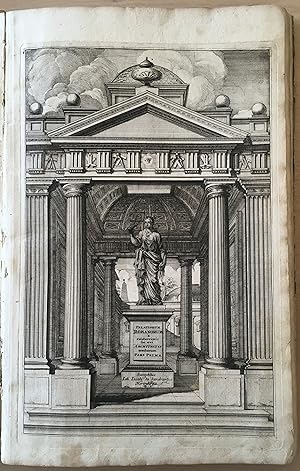
Hardcover. Zustand: Gut bis sehr gut. Folio (37 x 23 cm), Halbpergament mit Buntpapier-Bezug, Titelblatt Teil 1, 40 Blatt mit 20 doppelseitigen Kupfern auf starkem Bütten,Titelblatt Teil 2, 32 Blatt mit 10 doppelseitigen und 13 ganzseitigen Kupfern auf starkem Bütten, darstellend Römische Renaissancepaläste, 1 leeres Blatt. Wenige doppelseitige Kupfer zeigen die Grundrisse von Palästen, die ganzseitigen Platten stets mit Auf- und Grundriss. Die meisten Kupfer wurden gezeichnet von Pietro Ferrerio (1600 - 1654/55). Johann Jakob Sandrart (1630 - 1708), Kupferstecher, Kunsthändler und Verleger, Neffe von Joachim Sandrart (1606 - 1688), dem Verfasser der »Teutschen Academie«, an welcher er massgeblich beteiligt war. Von Jakob Sandrart besteht ein ausführliches Nachlassinventar, aus welchem ein umfangreicher Bestand an Büchern, Kunstblättern und Kupferplatten hervorgeht - darunter auch von seinem Onkel Joachim Sandrart übernommene Platten - der nach dem Tod der Witwe vermutlich über den Kunsthandel veräussert wurde. Der Architekt und Maler Pietro Ferrerio wird in der Zeit zwischen 1634 und 1653 als Künstler der Accademia San Luca in Rom nachgewiesen. Seine Darstellungen von Römischen Villen bestechen durch Präzision und Detailgenauigkeit und waren als Studienvorlagen für Architekten gedacht. Ferrerio war auch in Architektur-Diskursen aktiv, indem er im Zusammenhang mit der Fertigstellung des Petersdoms für Bernini eintrat. --- Zustand: Einband stärker betrieben, mit kleinen Fehlstellen im Papier, Blätter insgesamt nur gering fleckig, über 3/4 des Bandes kleines Wurmloch am Rande, ohne Darstellungsverluste; 3 Blätter mit kleinem Randeinriss, dieser jeweils fachmännisch mit säurefreiem Archivband restauriert. Insgesamt sehr schönes Exemplar der äusserst raren Veröffentlichung! --- Folio (37 x 23 cm), half vellum with colored paper cover, title page part 1, 40 sheets with 20 double-sided copperplates on strong laid paper, title page part 2, 32 sheets with 10 double-sided and 13 full-page copperplates on strong laid paper, depicting Roman Renaissance palaces, 1 blank sheet. Few double-page coppers show the ground plans of palaces, the full-page plates always with elevation and ground plan. Most of the copperplates are drawn by Pietro Ferrerio (1600 - 1654/55). Johann Jakob Sandrart (1630 - 1708) was an engraver, art dealer and publisher and the nephew of Joachim Sandrart (1606 - 1688), the author of the "Teutsche Academie", in which Jakob Sandrart was significantly involved. There is a detailed inventory of Jakob Sandrart's estate, which shows an extensive stock of books, art sheets and copper plates - including plates taken over from his uncle Joachim Sandrart - which was presumably sold via the art trade after the death of his widow. The architect and painter Pietro Ferrerio is recorded as an artist of the Accademia San Luca in Rome between 1634 and 1653. His depictions of Roman villas captivate with precision and detail and were intended as study models for architects. Ferrerio was also active in architectural discourses, in which he took sides with Bernini in connection with the completion of St. Peter's Basilica. --- Condition: binding more operated, with small lacks in the paper, leaves overall only slightly stained, over 3/4 of the volume small wormhole at the edge, without loss of images; 3 leaves with small marginal tear, this in each case professionally restored with acid-free archival tape. Overall very nice copy of the extremely rare publication!
-
IL TEMPIO MISTICO DEL LO SPIRITO SANTO
Verlag: Imp Angelo Bontognale
Anbieter: Libreria Anticuaria Marc & Antiques, Sabadell, B, Spanien
Verkäuferbewertung 5 von 5 Sternen
Encuadernación de tapa dura. Zustand: Excelente. Vicenza. 468 pág. 14x7,5. 1683. Missal Italiano que contiene 26 preciosos grabados de época. pequeña falta en pag 311(falta trocito). Magnífica Obra. Ref 8.3 Biblioteca A. Language: eng.
-
Palazzi di Roma : Volumes I [and] II.
Sprache: Italienisch
Verlag: Westmead ; Gregg, 1967
Anbieter: Antiquariat Thomas Haker GmbH & Co. KG, Berlin, Deutschland
Verbandsmitglied: GIAQ
Verkäuferbewertung 5 von 5 Sternen
SonderangebotEUR 280,00
EUR 40,00 Versand
Versand von Deutschland nach USAAnzahl: 1 verfügbar
In den WarenkorbCloth. Zustand: Gut. 44, 61 p. ; ill. ; 34 x 48 cm. Guter Zustand. 34 x 48 cm. Neudruck der beiden Originalbände in einem Einband. Bibliotheksexemplar mit Stempeln und Signatur auf Einband. Einband an Kanten leicht berieben, am Rücken minimal eingerissen. Sonst Seiten sauber. / Good. 34 x 48 cm. Reprint of the 2 original volumes in one volume. Ex-library with usual markings. Cover slightly worn at edges, with minimal tears at spine. Clean pages. Sprache: Italienisch Gewicht in Gramm: 2300 Reprint of 1st edition in 2 volumes, Rome, Rossi, 1655.
-
Palazzi di Roma. Volumes I & II. Republished by Gregg Press Ltd.
Sprache: Italienisch
Verlag: Farnborough Gregg Press Ltd, 1967
Anbieter: Galerie Valentien GmbH, Stuttgart, Deutschland
Verbandsmitglied: BVDG ILAB VDA
Verkäuferbewertung 5 von 5 Sternen
Hardcover. Zustand: Gut. Gebunden in grüne OLwd., 2 Bde in einem, goldfarbener Titeldruck, 34 x 48,5 cm, Kante des Einbandes leicht verschmutzt, sonst guter Zustand, cover a bit dirty, apart from that age-appropriate good condition, Versand wie Kunde wünscht; empfohlen: Paketversand + Transportversicherung für einen Wert bis 2500 Euro/Auslandsporto auf Anfrage/Shipping charges foreign countries on request 1810 gr.
-

Disegno del Palazzo del Cardinale Alesandrino Nella Piazza de SS. Apostoli Architettura del P. Dominco Pacanelli da Faenza Matematico. Fabricato l'Anno MDLXXXV.
Verlag: Rom: Giovanni Giacomo de Rossi, 1635
Anbieter: Antiquariat Tautenhahn, Lübeck, Deutschland
Verbandsmitglied: GIAQ ILAB VDA
Verkäuferbewertung 5 von 5 Sternen
Kunst / Grafik / Poster
Kupferstich 25 x 28,5 cm, Blattgröße 25,5 x 39,5 cm. Die Fassade zeigt den Palazzo Massimo alle Colonne, erbaut 1532 von dem Architekten Baldassare Peruzzi. Titel, Zeichner und Maßangabe in Scala di Palmi unter dem Bild. Wasserzeichen: Oval mit aufgesetzter Krone. - Bei mehreren Besitzerwechseln wurde das Gebäude immer wieder umbenannt. Heute heißt es Palazzo Valentini, davor Palazzo Bonelli. Aus: Palazzi di Roma, Hrsg. Giovanni Giacomo de Rossi. Das Blatt ohne Nummerierung, vermutlich aus der ersten Auflage. - Pietro Ferrerio 1600 - 1654, Architekt. - Am rechten Bildrand ein blauer Stempel. Das Papier leicht gebräunt und fleckig, oben rechts ein Wasserfleck, den guten Gesamteindruck nicht störend. Kraftvoller, sauberer Druck.
-
Palazzo delli Re D'Inghilterra su 'la Via di Borgo nuovo Hoggi del l'Emi et Re Sig. Cardinale Girolamo Coloia Architettura di Bramante Fabricato Lanno M.D IIII. - Pianta del Palazzo dell Em. Sig. Card. Colonna in Borgo. - [Zwei Blätter zusammen]. -
Verlag: Rom: Giovanni Giacomo de Rossi, 1635
Anbieter: Antiquariat Tautenhahn, Lübeck, Deutschland
Verbandsmitglied: GIAQ ILAB VDA
Verkäuferbewertung 5 von 5 Sternen
Kunst / Grafik / Poster
Kupferstiche, Blattgröße 25,5 x 40 cm. Ansicht 21,5 x 33,5 cm, Grundriss 34 x 23 Die Fassade zeigt den Palazzo Castellesi oder auch Palazzo Corneto, erbaut von dem Architekten Bramante 1504. Unter dem Bild der Titel und der Verweis auf Pietro Ferrerio. Beiliegend: Grundriss des Palazzos. Durch mehrere Besitzerwechsel (Kardinal Adriano Castelleri da Corneto und u.a. auch die Botschaft von England) wurde das Gebäude immer wieder umbenannt. Nach der Bezeichnung Palazzo Giraud heißt es heute Palazzo Torlonia. Wasserzeichen auf dem Blatt Grundriss: Oval mit aufgesetzter Krone. - Aus: Palazzi di Roma, Hrsg. Giovanni Giacomo de Rossi. Blätter ohne Nummerierung, vermutlich aus der ersten Auflage. - Pietro Ferrerio 1600 - 1654, Architekt. - Bei beiden Blättern ein verwaschener blauer Stempel. Das Papier leicht gebräunt und minimal fleckig. Das Blatt der Fassade unten rechts deutlich fingerfleckig, der Druck kraftvoll und klar.
-
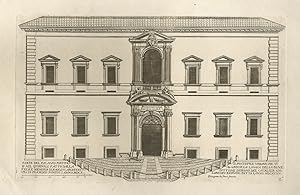
Parte del Palazzo Pontificio nel Quirinale fatto dalla felice memoria di Paolo V. Architettura di Flaminio Pontio l'anno MDCX. Il Pontefice Urbano VIII vi agggiunse la Loggia della Benedizione disegno del cavalier Gio. Lorenzo Bernino, fatta l'anno MDCXXXV.
Anbieter: Libreria Oreste Gozzini snc, Firenze, FI, Italien
Verkäuferbewertung 5 von 5 Sternen
[Roma, Giovanni Giacomo de Rossi, seconda metà del XVI sec.], incisione in rame all'acquaforte, mm. 220x356 (l'impronta della lastra) 347x500 (il foglio). Tavola proveniente dall'album: "Palazzi di Roma de piu celebri architetti disegnati da Pietro Ferrerio pittore et architetto". Perfette condizioni.
-
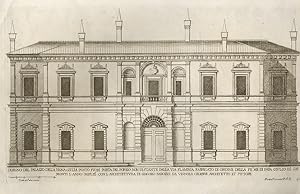
Disegno del Palazzo della Vigna Giulia posto fuori porta del Popolo non distante dalla via Flaminia. Fabricato di ordine della. Fe.e Me.a di Papa Giulio III de Monti l'anno MDLIII con l'architettura di Giacomo Barozzi da Vignola celebre architetto et pittore.
Anbieter: Libreria Oreste Gozzini snc, Firenze, FI, Italien
Verkäuferbewertung 5 von 5 Sternen
[Roma, Giovanni Giacomo de Rossi, seconda metà del XVI sec.], incisione in rame all'acquaforte, mm. 257x426 (l'impronta della lastra) 340x500 (il foglio). Tavola proveniente dall'album: "Palazzi di Roma de piu celebri architetti disegnati da Pietro Ferrerio pittore et architetto". Perfette condizioni.


![Bild des Verkäufers für Palazzi di Roma de più celebri architetti disegnati da Pietro Ferrerio pittore et architetto. Libro primo [-secondo] zum Verkauf von Libreria Alberto Govi di F. Govi Sas](https://pictures.abebooks.com/inventory/md/md32353576173.jpg)

![Bild des Verkäufers für Palazzi di Roma : Volumes I [and] II. zum Verkauf von Antiquariat Thomas Haker GmbH & Co. KG](https://pictures.abebooks.com/inventory/md/md32328376026.jpg)
![Bild des Verkäufers für Palazzo delli Re D'Inghilterra su 'la Via di Borgo nuovo Hoggi del l'Emi et Re Sig. Cardinale Girolamo Coloia Architettura di Bramante Fabricato Lanno M.D IIII. - Pianta del Palazzo dell Em. Sig. Card. Colonna in Borgo. - [Zwei Blätter zusammen]. - zum Verkauf von Antiquariat Tautenhahn](https://pictures.abebooks.com/inventory/md/md31840670978.jpg)