Gesamtpreis (1 Artikel Artikel):
Versandziel:

ely timothy (15 Ergebnisse)
Direkt zu den wichtigsten Suchergebnissen
Suchfilter
Produktart
- Alle Product Types
- Bücher (15)
- Magazine & Zeitschriften (Keine weiteren Ergebnisse entsprechen dieser Verfeinerung)
- Comics (Keine weiteren Ergebnisse entsprechen dieser Verfeinerung)
- Noten (Keine weiteren Ergebnisse entsprechen dieser Verfeinerung)
- Kunst, Grafik & Poster (Keine weiteren Ergebnisse entsprechen dieser Verfeinerung)
- Fotografien (Keine weiteren Ergebnisse entsprechen dieser Verfeinerung)
- Karten (Keine weiteren Ergebnisse entsprechen dieser Verfeinerung)
- Manuskripte & Papierantiquitäten (Keine weiteren Ergebnisse entsprechen dieser Verfeinerung)
Zustand Mehr dazu
- Neu (3)
- Wie Neu, Sehr Gut oder Gut Bis Sehr Gut (3)
- Gut oder Befriedigend (2)
- Ausreichend oder Schlecht (Keine weiteren Ergebnisse entsprechen dieser Verfeinerung)
- Wie beschrieben (7)
Einband
Weitere Eigenschaften
Sprache (2)
Gratisversand
Land des Verkäufers
Verkäuferbewertung
-
Flight into Egypt
Anbieter: World of Books (was SecondSale), Montgomery, IL, USA
Verkäuferbewertung 5 von 5 Sternen

Zustand: Good. Item in good condition. Textbooks may not include supplemental items i.e. CDs, access codes etc.
-
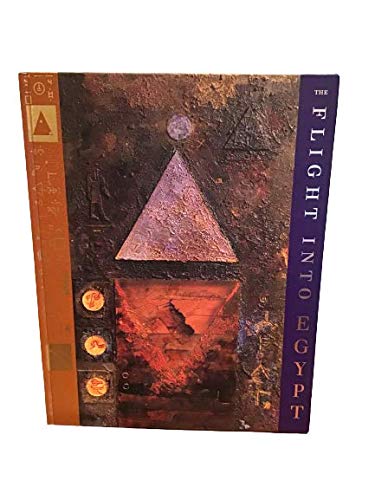
Flight into Egypt: Binding the Book
Anbieter: Southampton Books, Sag Harbor, NY, USA
Verkäuferbewertung 5 von 5 Sternen
Erstausgabe
Hardcover. Zustand: Like New. First Edition. First Edition, First Printing. Published by Chronicle Books Llc, 1995. Quarto. Hardcover. Book is like new. 100% positive feedback. 30 day money back guarantee. NEXT DAY SHIPPING! Excellent customer service. Please email with any questions. All books packed carefully and ship with free delivery confirmation/tracking. All books come with free bookmarks. Ships from Sag Harbor, New York.
-

The Tables of Jupiter
Sprache: Englisch
Verlag: Donald H. Sheehan Gallery, 2004
ISBN 10: 1880269171 ISBN 13: 9781880269176
Anbieter: Visible Voice Books, Cleveland, OH, USA
Verkäuferbewertung 5 von 5 Sternen
paperback. Zustand: Very Good. Donald H. Sheehan Gallery January 2004 large 8vo. 47 pages. clean, tight copy.
-

Advances in Visual Informatics: 9th International Visual Informatics Conference, IVIC 2025, Guangzhou, China, November 1213, 2025, Proceedings (Lecture Notes in Computer Science, 16215)
Anbieter: Revaluation Books, Exeter, Vereinigtes Königreich
Verkäuferbewertung 5 von 5 Sternen
EUR 141,92
EUR 14,43 Versand
Versand von Vereinigtes Königreich nach USAAnzahl: 2 verfügbar
In den WarenkorbPaperback. Zustand: Brand New. 476 pages. 9.25x6.10x9.21 inches. In Stock.
-

Taschenbuch. Zustand: Neu. Advances in Visual Informatics | 9th International Visual Informatics Conference, IVIC 2025, Guangzhou, China, November 12-13, 2025, Proceedings | Halimah Badioze Zaman (u. a.) | Taschenbuch | Lecture Notes in Computer Science | xix | Englisch | 2025 | Springer | EAN 9789819538072 | Verantwortliche Person für die EU: Springer Verlag GmbH, Tiergartenstr. 17, 69121 Heidelberg, juergen[dot]hartmann[at]springer[dot]com | Anbieter: preigu.
-

Advances in Visual Informatics : 9th International Visual Informatics Conference, IVIC 2025, Guangzhou, China, November 12-13, 2025, Proceedings
Anbieter: AHA-BUCH GmbH, Einbeck, Deutschland
Verkäuferbewertung 5 von 5 Sternen
Taschenbuch. Zustand: Neu. Druck auf Anfrage Neuware - Printed after ordering - This book constitutes the refereed proceedings of the 9th International Conference on Advances in Visual Informatics, IVIC 2025, held in Guangzhou, China in November 12-13, 2025.The 36full papers presented were carefully reviewed and selected from 69 submissions.They are grouped into the following topics: Keynote; Modeling and Simulation; Mixed Reality and Human-Computer Interaction; Intelligent Data Analytics; Applied AI; Visual Informatics Applications.
-

Bones of the Book: An Oblong Identity
Verlag: Timothy Ely, Colfax, WA, 2015
Anbieter: Lux Mentis, Booksellers, ABAA/ILAB, Portland, ME, USA
Verbandsmitglied: ABAA ILAB MABA MBS
Verkäuferbewertung 4 von 5 Sternen

Signiert
Hardcover. Zustand: Fine in Fine Archival Box. Unique. Unique. Hardcover. Bones of the Book is the second in a three-book series that differs significantly from most of Ely?s other work. These books are both biographical and autobiographical. Each honors the important influence of family members in Ely?s life, and combines it with an aspect of bookbinding?the format Ely has chosen to house his artwork throughout his career. In each case, there is also a third narrative that plays a significant role in Ely?s identity as an individual and as an artist. The series began with Binding the Book:The Flight Into Egypt in 1985. Egypt is about Ely?s grandfather, the journal he left behind about his mysterious trip to Egypt between the wars, bookbinding, and the geography of Egypt. For much more information about Binding the Book: The Flight Into Egypt, see The Flight into Egypt: Binding the Book (Chronicle Books, 1995). In Bones of the Book, the visual narrative combines Ely?s origins (Snohomish, WA, his parents, and their hardware store), and the close relationship between book structure and human anatomy. The third book has yet to be made. Ely plans for it to be about his Uncle Jack and his work as a combat photographer in the Pacific during WWII. In addition to the three-fold, co-mingled story line in Bones, as in all of Ely?s art, there are layers of references drawn from alchemy, mathematics, mythology, geography, and geology. "In the early part of the last decade of the 20th century, I wished to contemplate my origins, especially the early and all-consuming attraction to the form of the book and how that might have evolved for me. Beyond deep reading, I have found that the best way to become informed about an event or gather a bit of enlightenment is to make an expressive book. Bones of the Book began as a thought structure aimed at the skeletal system of the body and of the book, as they seem to me to contain functions that echo each other. I also wanted to fuse the influences of my parents and their choice of livelihood into the book by referencing the location of their hardware store and its impact on what I have chosen to do as an artist. My parents, Everett [b. 1914] and Frances [b. 1918], met at a paper mill where they both worked, then married at the outset of America?s involvement in World War II. In about 1948, they opened a hardware store in Snohomish, Washington (a map in the book drawn from memory is an attempt to locate the store in space), which set the tone for my entire life until they retired in 1978. The hardware store. I long to travel back through time and view it again, for until I began this contemplation, I was not really aware of how much that family business, the community it served, and the tools and materials it contained affected me. I was introduced to the hardware business around the age of 11, not knowing how connected to the arts of the book this would be. It was to be my first real training in the process of building things, and, coupled with the local library where I practically lived when I wasn?t at the store, really became the focus of my interests. When I first began to work this out, I came to believe that there was an inextricable link between what influenced me, and how I came to know the craft of making a book. There seemed to be in place an existing gnosis which acted as both a guide and a set of techniques?a skeletal anatomy was at hand. I began drawing bones in graduate school after a trip to a forbidden beach at the mouth of the Hoh River yielded up a hoard of bird, fish, and crab remains. Though the Hoh Reservation was off limits, some cigarettes gave us entry. That same summer a second pile of bones from draft horses in central Washington gave me a new scale. Then, my Uncle Jack, living in Alaska, would provide the third leg of the bone ?tripod' of visual clues by sending me boxes of bones from a lonely beach near Hoonah, Alaska.These bones would provide both visual inspiration and material for inks. (Bone black ink is especially bluish and potent!) Bones of the Book reflects both my identity as a maker of things, and bones as structural supports, and how that metaphor maps itself onto the cultural object/artifact of the book. As parts of the book traditionally have names of body parts to identify the book terrain, this seems apt. Books have a dorsal structure?a spine?and just as in a humanoid, if this is damaged the book is compromised. A book has a head and tail, and sometimes this head is crowned in gold, gilded, or otherwise given an ornamental treatment. As the names of a book?s parts and their function lend connection to bones and anatomy, so also does the chosen structure of this book. The search for both an appropriately robust and workable binding, and one that properly expresses my artistic intentions, provided a series of opportunities to examine a sampling of medieval books that satisfy these requirements. The structural skeleton of Bones of the Book is supported by a continuous membrane of aged gampi, a Japanese paper possessed of astonishing properties. This paper forms a long, double fold along each folio and is known as a ?half loose? guard. Being somewhat impenetrable to adhesive, this paper reduces the friction of the folio so that it facilitates, without drag, the mobility of the book structure. Put simply, it opens well without adding stress to the binding. In tandem with the sewing supports, cotton textile, and tissue as metaphoric muscle mass, the book begins to resemble an intelligent and projective body. The Doctor said ??It?s alive!?? Bones of the Book was finished as of June 11, 2015. It puts to rest and completes a long examined set of ideas, and its own initial structural challenges provoked a method of working that I can see to have a multiplicity of future uses." [Artist statement, T. Ely/ July 2015/ Colfax, WA] Timothy C. Ely is a renowned and enigmatic figure in the book world. His one-of-a-kind manuscript books combine elaborate and often mysterious painted and draw.
-
Photographic Series
Verlag: Paperworks, Portland, OR, 1981
Anbieter: Lux Mentis, Booksellers, ABAA/ILAB, Portland, ME, USA
Verbandsmitglied: ABAA ILAB MABA MBS
Verkäuferbewertung 4 von 5 Sternen
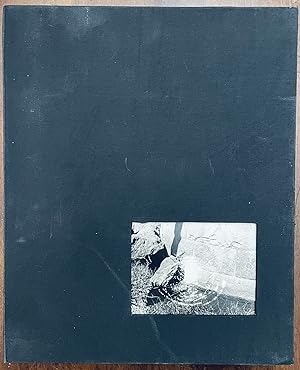
Loose mounts. Zustand: Fine in Very Good Archival Box. Unique. Unique. Loose mounts. Paperworks was the name of Ely's d/b/a before he moved to NYC. This set of photos, from rather early in Ely's career, has been in his ex-wife's private collection until now. Timothy C. Ely is a renowned and enigmatic figure in the book world. His one-of-a-kind manuscript books combine elaborate and often mysterious painted and drawn folios contained within finely crafted bindings, most of which are original designs or variations on traditional binding techniques. Each book carries layers of both materials and meaning. Each drawing and element elicit revelations, personal to each viewer. ?For the last forty years, his books and other works have sprung from a central core of concepts, owing to a fascination with obscure or seemingly incomprehensible forms inspired by science and other projections from the history of the human imagination. This spectrum of inspiration includes such things as fractured and whole grids, cypher systems, landforms and landscapes as viewed from a satellite, and the archeological overlay of some of these sites, especially those containing libraries. Originally, the atlas format provided a platform for the rendering of his complex maps, which gradually gave way to an expanded psychological viewpoint of a larger universal scheme. Much of Ely?s work is richly annotated with his own glyphs he calls ?cribriform.? While they are made up of a finite set of marks, they take on many different ?meanings? depending on the tool with which they are drawn. He has written and spoken often about the roots and evolution of these drawings. Gestural in their formation, these trailings evoke a sense of language and meaningful discourse. Though suggestive, they never yield up a firm translation.? [A. Schoolman]. Minor shelf/edge wear, cloth on box shows some bubbling, else bright and clean. Black cloth archival box with cutout/inlayed b/w photograph; seven handmade paper covered mount boards, each with inlaid b/w photograph. 11x13.5? Illus. (b/w plates).
-
The Black Chamber
Verlag: Timothy Ely, Portland, OR, 1984
Anbieter: Lux Mentis, Booksellers, ABAA/ILAB, Portland, ME, USA
Verbandsmitglied: ABAA ILAB MABA MBS
Verkäuferbewertung 4 von 5 Sternen
Signiert
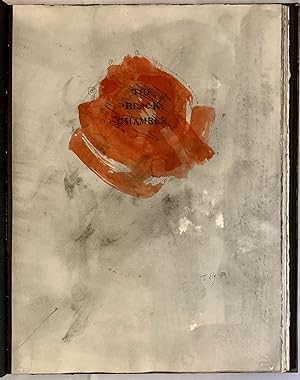
Hardcover. Zustand: Near Fine. Unique. Unique. Hardcover. This work, from early in Ely's career, has been in his ex-wife's private collection until now. Printed and mss elements, nearly all in tones of black (the only color is a clot of red over the title on the title page). Overall, a more organic feel than much of his later work. Timothy C. Ely is a renowned and enigmatic figure in the book world. His one-of-a-kind manuscript books combine elaborate and often mysterious painted and drawn folios contained within finely crafted bindings, most of which are original designs or variations on traditional binding techniques. Each book carries layers of both materials and meaning. Each drawing and element elicit revelations, personal to each viewer. ?For the last forty years, his books and other works have sprung from a central core of concepts, owing to a fascination with obscure or seemingly incomprehensible forms inspired by science and other projections from the history of the human imagination. This spectrum of inspiration includes such things as fractured and whole grids, cypher systems, landforms and landscapes as viewed from a satellite, and the archeological overlay of some of these sites, especially those containing libraries. Originally, the atlas format provided a platform for the rendering of his complex maps, which gradually gave way to an expanded psychological viewpoint of a larger universal scheme. Much of Ely?s work is richly annotated with his own glyphs he calls ?cribriform.? While they are made up of a finite set of marks, they take on many different ?meanings? depending on the tool with which they are drawn. He has written and spoken often about the roots and evolution of these drawings. Gestural in their formation, these trailings evoke a sense of language and meaningful discourse. Though suggestive, they never yield up a firm translation.? [A. Schoolman]. Minimal shelf/edge wear, else tight, bright, and unmarred. Quarterbound, black leather spine, exposed black cords, black pigment and resin covered board (highly textured); painted pastedowns, heavy black paper free endpages. to. np. Illus. (b/w plates, colored plate). Signed and dated by the artist.
-
Approach to the Site [Unique Binding]
Verlag: Waterstreet Press, Brooklyn, NY, 1986
Anbieter: Lux Mentis, Booksellers, ABAA/ILAB, Portland, ME, USA
Verbandsmitglied: ABAA ILAB MABA MBS
Verkäuferbewertung 4 von 5 Sternen
Hardcover. Zustand: Fine in Fine Archival Box. Limited Edition. Limited Edition. Hardcover. Ten folios, offset printed on Arches cover buff. This copy bound in 1998 in a unique binding by the author/illustrator Timothy C. Ely. "'Approach to the Site' is one of the very few editioned books I have made. In itself it is a departure from my other editioned books because the printing was done using commercial offset lithography. I made this choice having seen some impressive examples of work produced by Waterstreet Press in Brooklyn, a fine book and art printer. My paper choice suggests oxidation and entropy. We all go yellow in the end. I received a grant from the Pollock-Krasner Foundation which funded the printing and supplies for the binding. 'Approach to the Site' is a reflection on my ideas of libraries and how those ideas both inspired and directed some of my work at that time. In the early 80?s, when this book was produced, a core idea for me rippled out from the image of Library as Island. I had visited national libraries in England, Italy and France and, of course, the Library of Congress and the New York Public library. I always look in on any library I pass for they seem to me to be like ponds of influence and all you have to do is throw in a stone. I am one of those stones. In addition to the visits, absorbing architecture and the direct influence and inspiration of physical books, I read a book on the history of the early Christian Church called 'THE LIVES OF THE DESERT FATHERS'. I became intrigued with the idea of an archetypal library as a radiant island or colony of thinkers and seekers. North Africa seems to be a string of beads, a constellation of sorts, each bead or star a monastery, many with a library. For some forgotten reason I set the archetype in central Turkey. The library was not Atlantis-like or special beyond just being an amazing repository of world knowledge, perhaps concealed or requiring clearance like the Vatican Library and its veiled basement. I began a small series of now lost sketches mostly done in the American Museum of Natural History in New York. These would guide my ideas as I drew each mylar color separation by hand. A few images used 4 colors, some two, and many were monochromatic reflecting a set of subjects I would have liked to have found in this secret library. The edition took decades to complete as I am a reluctant edition binder. With my work on unique manuscript books and other projects there has always been something more compelling to do. I tended to bind a few copies of 'Approach to the Site' at a time or when a client showed some interest." [Timothy C. Ely, February 2017] As often happens with editioned books, copies of 'Approach to the Site' were not completed and numbered sequentially. Ely retains copy #1, unbound. Over time, many of the case bound copies were repurposed. Far fewer than the stated edition of 49 copies were issued or actually exist. Timothy C. Ely is a renowned and enigmatic figure in the book world. His one-of-a-kind manuscript books combine elaborate and often mysterious painted and drawn folios contained within finely crafted bindings, most of which are original designs or variations on traditional binding techniques. Each book carries layers of both materials and meaning. Each drawing and element elicit revelations, personal to each viewer. ?For the last forty years, his books and other works have sprung from a central core of concepts, owing to a fascination with obscure or seemingly incomprehensible forms inspired by science and other projections from the history of the human imagination. This spectrum of inspiration includes such things as fractured and whole grids, cypher systems, landforms and landscapes as viewed from a satellite, and the archeological overlay of some of these sites, especially those containing libraries. Originally, the atlas format provided a platform for the rendering of his complex maps, which gradually gave way to an expanded psychological viewpoint of a larger universal scheme. Much of Ely?s work is richly annotated with his own glyphs he calls ?cribriform.? While they are made up of a finite set of marks, they take on many different ?meanings? depending on the tool with which they are drawn. He has written and spoken often about the roots and evolution of these drawings. Gestural in their formation, these trailings evoke a sense of language and meaningful discourse. Though suggestive, they never yield up a firm translation.? [A. Schoolman]. Tight, bright, and unmarred. Boards covered in remaindered leaves and fragments from the printing (partially revealed) and then given a crusticular treatment using various sands and aggregate compounds from many high desert landscapes, conventional sewing. Housed in a custom clamshell box by the artist. fo 27.5cm x 37cm. Numbered limited edition, this being 42 of 49.
-
![Bild des Verkäufers für Synesthesia [1992 announcement bi-fold card] zum Verkauf von Marcus Campbell Art Books](https://pictures.abebooks.com/inventory/md/md32329729324.jpg)
Synesthesia [1992 announcement bi-fold card]
Verlag: New York: Granary Books, 1991
Anbieter: Marcus Campbell Art Books, London, Vereinigtes Königreich
Verbandsmitglied: ABA ILAB PBFA
Verkäuferbewertung 4 von 5 Sternen
EUR 106,99
EUR 21,93 Versand
Versand von Vereinigtes Königreich nach USAAnzahl: 1 verfügbar
In den Warenkorb25.5 x 18cm. Bi-fold colour announcement card on rough-cut thick paper stock. Rear panel bears painted red cross. Loosely inserted is a small slip of paper announcing the pre-publication price for the limited edition Synesthesia artist's book. Terence McKenna was a West Coast American philosopher, ethnobotanist, and "psychedelic theoretician" who collaborated with printer and book artist Timothy Ely to produce the lavish hand-made book published in December 1992 in a limited edition.
-
scighte.
Verlag: O.O. The Poote Press 1987., 1987
Anbieter: Buch + Kunst + hommagerie Sabine Koitka, Basel, Schweiz
Verkäuferbewertung 3 von 5 Sternen

Kl.-4°. 12 nn. Bll. Mit Textill. Orig.-Fadenheftung (2 Lederriemchen). Eines von 85 Ex. (Nr. 85), gedruckt auf handgeschöpftem Papier. - Timothy C. Ely (*1949) ist ein zeitgenössischer amerikanischer Maler, Grafiker und Buchbinder, der dafür bekannt ist, handgefertigte Einzelbücher als Kunstobjekte zu erstellen. Viele von Elys Arbeiten sind mit seinen eigenen Glyphen beschriftet, die er "cribriform" nennt. Er unterrichtete am Center for Book Art in New York. Seine Arbeiten befinden sich in vielen privaten und öffentlichen Sammlungen, darunter die Library of Congress, das Brooklyn Museum, das Boston Athenaeum, das Getty Research Institute, das Victoria and Albert Museum und die Lilly Library. - Phantasievolle Zusammenarbeit mit Joe Napora (*1944), dem leidenschaftlichen und produktiven amerikanischen Dichter, Essayist, Herausgeber, Verleger und Aktivist. Lang en.
-
LOST & FOUND
Verlag: Caliban Press, [Montclair, New Jersey], 1989
Anbieter: Phillip J. Pirages Rare Books (ABAA), McMinnville, OR, USA
Verkäuferbewertung 4 von 5 Sternen
Erstausgabe
235 x 160 mm. (9 1/4 x 6 1/4"). [10] leaves. UNIQUE BLACK MOROCCO BY TIMOTHY ELY, covers with inlaid red morocco frame enclosing a leather panel with a color illustration onlaid onto a metallic black material, the covers accented with geometric figures in colored metallics and blind tooling, smooth spine, black metallic handmade endpapers, top edges a metallic gray. In the original complementary black leather clamshell box. With three full-page and two smaller hand-painted geometrical illustrations by Ely. With a printed program for "Memo 7 & Other Works," an exhibition of 20 Ely books, including this one, and with a press release from Caliban Press regarding the publication of this title, laid in. As new. This is a striking one-of-a-kind fine press production of a noted activist's short story, illustrated and bound by one of the most creative members of the American book community now at work. Here in its first appearance in print, "Lost & Found" is the story of a lost traveller who slowly learns what he is searching for. In the words of the Caliban Press press release that accompanies the present copy, as "a personal meditation on Berrigan's own life and a questioning look at contemporary values, 'Lost & Found' eventually poses questions we all must answer." Our author, Berrigan (1921-2016), was a Jesuit priest best remembered for his writing and peace activism--his anti-Vietnam War efforts led to his becoming the first priest on the FBI's most wanted list. The text is accompanied by original artworks and a unique binding by multidisciplinary artist Timothy Ely. In vibrant color, his illustrations take the form of abstract maps labeled with unreadable text. This motif is reflected in the mixed-media cover, created specially for our unique copy by Ely himself (the rest of the edition was bound in paste paper by the publisher). Born in 1949, Ely is known for making books with singular bindings using a variety of materials such as wax, resin, textiles, a range of pigments, and leather. As in the present case, his memorable creations are described as telling visual narratives, often using maps, geometric images, and cryptic scripts. Ely has long been a regular correspondent and admirer of Philip Smith, and there has obviously been a cross-fertilization in terms of technique and style between the two binders--but there is no book maker quite like Ely, past or present. Ely has taught bookbinding, drawing, and creativity workshops in many places in the world from Scandinavia to Central America. His books and other works can be found in various museums and libraries, most extensively in the United States and Europe. Our publisher Mark McMurray studied letterpress printing at the Red Ozier Press and bookbinding with Ely before founding the Caliban Press in 1985. McMurray spent nearly 30 years working as a special collections librarian while running the Caliban Press on the side, then, in 2018, retired from academia to focus on making books full time. FIRST EDITION. ONE OF 125 COPIES SIGNED by Ely and Berrigan.
-
Onomystrya
Erscheinungsdatum: 2000
Anbieter: Ursus Rare Books, New York, NY, USA
Verkäuferbewertung 2 von 5 Sternen

ELY, Timothy. Onomystrya. One-of-a-kind manuscript book. 20 pp., consisting of title with 18 painted and drawn folios, drawn and painted throughout by Timothy Ely with each page containing drawings in ink, dry pigments, watercolour, gouache, dilute acrylics and gilded metals. 8vo, 375 x 225 mm., bound in black metallic on boards, relief lettering with decorative highlights, preserved in new cloth box. Portland, Oregon: Timothy Ely, 1994. Unique painted manuscript. Timothy Ely's Onomystrya is a visual laboratory, a metaphysical realm, consisting of symbolic images of architecture, floorplans, geometry, perspective, celestial spheres, phantasmagoric spaces, ideograms, horizons and symbolic mathematical writing. The mystical text, labeled "cribiform" by the artist, is a hybrid of scripts by ancient scribes, engravers and calligraphers, Chinese characters, ciphers, Egyptian hieroglyphics, cryptographs, codes and various secret writings. The cribiform is meant to function "as an intermediary to other types of meaning." Certainly, the connection to Carl Jung's theories on single marks and symbols as messages from the collective unconscious comes immediately to mind. This painted manuscript echoes the style and interpretative world of illustrated works of Pacioli, Vitruvius, Serlio, Boullée, Tyco Brahe, Mercator, Celarius, Leonardo and Galileo, as well as evoking the modern sensibility of Max Ernst and Iliazd, as seen in their masterpiece Maximiliana of 1964. Timothy Ely began making books in the 1950s with one surviving example from that time: a small cookbook covered in stars. Ely has taught bookbinding, drawing and creativity workshops in many places in the world from Scandinavia to Central America. His books and other works can be found in museums and libraries, most extensively in the United States and Europe.
-
Synesthesia
Verlag: Granary Books, New York, 1992
Anbieter: Burnside Rare Books, ABAA, Portland, OR, USA
Verbandsmitglied: ABAA CBA ILAB
Verkäuferbewertung 5 von 5 Sternen
Erstausgabe Signiert
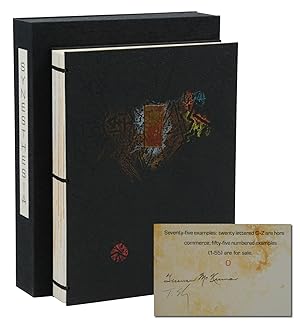
Zustand: Fine. Signed Limited First Edition. First edition. An artist's book containing drawn and painted images by Timothy C. Ely, set against text written by Terence McKenna, with typography by Philip Gallo. From a limited edition of only 75 copies, signed by McKenna and Ely. Of those 75, there were 55 numbered copies and 20 hors commerce copies lettered G-Z, and this is copy letter O. Pages printed letterpress on Rives BFK in pairs on single leaves, wrapped around and pasted onto thick card stock and adorned with original watercolor paintings by Ely; sewn binding with brass rods securing textblock to black embossed paper-covered boards with decorative brass piece affixed to upper board, housed in original black cloth chemise case with printed paper title label to spine. Fine. In 1991, McKenna visited an exhibition at Granary Books featuring Ely's work, and this collaboration would result. A fantastic push and pull of Gallo's refined typography set against Ely's abstract watercolor, offering a visual landscape for the eye to wander, perfectly paired with McKenna's text on broad themes such as art, language, history and nature.


![Bild des Verkäufers für Approach to the Site [Unique Binding] zum Verkauf von Lux Mentis, Booksellers, ABAA/ILAB](https://pictures.abebooks.com/inventory/md/md30659581307.jpg)