Gesamtpreis (1 Artikel Artikel):
Versandziel:

einstein albert german physicist nobel (55 Ergebnisse)
Direkt zu den wichtigsten Suchergebnissen
Suchfilter
Produktart
- Alle Product Types
- Bücher (Keine weiteren Ergebnisse entsprechen dieser Verfeinerung)
- Magazine & Zeitschriften (Keine weiteren Ergebnisse entsprechen dieser Verfeinerung)
- Comics (Keine weiteren Ergebnisse entsprechen dieser Verfeinerung)
- Noten (Keine weiteren Ergebnisse entsprechen dieser Verfeinerung)
- Kunst, Grafik & Poster (Keine weiteren Ergebnisse entsprechen dieser Verfeinerung)
- Fotografien (Keine weiteren Ergebnisse entsprechen dieser Verfeinerung)
- Karten (Keine weiteren Ergebnisse entsprechen dieser Verfeinerung)
- Manuskripte & Papierantiquitäten (55)
Zustand Mehr dazu
- Neu (Keine weiteren Ergebnisse entsprechen dieser Verfeinerung)
- Wie Neu, Sehr Gut oder Gut Bis Sehr Gut (Keine weiteren Ergebnisse entsprechen dieser Verfeinerung)
- Gut oder Befriedigend (Keine weiteren Ergebnisse entsprechen dieser Verfeinerung)
- Ausreichend oder Schlecht (Keine weiteren Ergebnisse entsprechen dieser Verfeinerung)
- Wie beschrieben (55)
Einband
Weitere Eigenschaften
- Erstausgabe (Keine weiteren Ergebnisse entsprechen dieser Verfeinerung)
- Signiert (4)
- Schutzumschlag (2)
- Angebotsfoto (55)
Sprache (1)
Gratisversand
- Kostenloser Versand nach USA (Keine weiteren Ergebnisse entsprechen dieser Verfeinerung)
Land des Verkäufers
Verkäuferbewertung
-

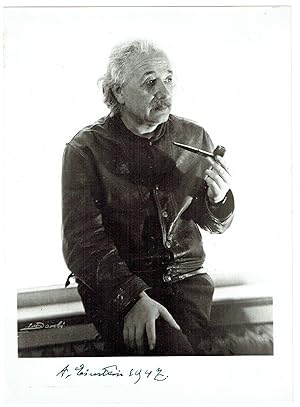
Photograph signed ("A. Einstein 1947").
Verlag: No place, 1947., 1947
Anbieter: Antiquariat INLIBRIS Gilhofer Nfg. GmbH, Vienna, A, Österreich
Verbandsmitglied: ILAB VDA VDAO
Verkäuferbewertung 5 von 5 Sternen

Manuskript / Papierantiquität
EUR 35.000,00
EUR 30,00 Versand
Versand von Österreich nach USAAnzahl: 1 verfügbar
In den Warenkorb176 x 128 mm, annotated in pencil on verso: "Albert Einstein pl credit Lotte Jacobi 2299-2". A contemplative pose of Einstein in his famous leather jacket, holding his pipe, taken by Lotte Jacobi during the 1938 photo session she undertook with the theoretical physicist for Life magazine. - From the collection of Kalman Talansky (1924-2021).
-
Photograph signed ("A Einstein 1947").
Verlag: n. p., 1947, 1947
Anbieter: Kotte Autographs GmbH, Roßhaupten, Deutschland
Verkäuferbewertung 5 von 5 Sternen
Manuskript / Papierantiquität
EUR 35.000,00
EUR 20,00 Versand
Versand von Deutschland nach USAAnzahl: 1 verfügbar
In den Warenkorb176 : 128 mm. Albert Einstein and his famous bomber jacket. A contemplative pose of Einstein holding his pipe taken by Lotte Jacobi during the 1938 photo session she undertook with the theoretical physicist for Life magazine. - Photograph by Lotte JACOBI (1896-1990), Princeton, 1938.Annotated in pencil on verso: "Albert Einstein pl. credit Lotte Jacobi 2299-2".
-
Typed letter signed A. Einstein".
Verlag: Princeton, 30. I. 1940., 1940
Anbieter: Kotte Autographs GmbH, Roßhaupten, Deutschland
Verkäuferbewertung 5 von 5 Sternen
Manuskript / Papierantiquität
EUR 14.500,00
EUR 20,00 Versand
Versand von Deutschland nach USAAnzahl: 1 verfügbar
In den Warenkorb4to. 1 p. Blind embossed letterhead. To the young aspiring Romanian physicist Melanie Serbu (1909-1979), in German living now in Zurich, Switzerland."I believe that the concerns of colleague Wenzel are entirely justified. What I wrote to you was just an insight, casually expressed without knowledge of the relevant specialized literature. Of course, I also don't have the time to engage with this literature and can, therefore, take no responsibility for the matter. However, it would probably be best to choose the topic of the dissertation in line with a colleague there. This way, you can be sure that the work will be accepted if it is completed to his satisfaction, whereas otherwise, you might risk expending a lot of effort in vain."Ich glaube, dass die Bedenken des Kollegen Wenzel durchaus berechtigt sind. Was ich Ihnen schrieb, war nur ein apercu, leichthin ohne Kenntnisse der einschlägigen Spezal-Literatur geäussert. Ich habe natürlich auch nicht Zeit, mich mit dieser Literatur zu befassen und kann deshalb in der Sache keinerlei Verantwortung übernehmen. Es dürfte aber wohl das Beste sein, das Thema der Dissertation in Einklang mit einem dortigen Kollegen zu wählen. Dann sind Sie sicher, dass die Arbeit angenommen wird, wenn sie zu dessen Befriedigung vollendet wird, während Sie sonst riskieren würden, eine Fülle von Arbeit nutzlos aufzuwenden.
-

Typed letter signed with 8 autograph words inserted.
Verlag: Princeton, NJ, 5 Aug. 1949., 1949
Anbieter: Antiquariat INLIBRIS Gilhofer Nfg. GmbH, Vienna, A, Österreich
Verbandsmitglied: ILAB VDA VDAO
Verkäuferbewertung 5 von 5 Sternen
Manuskript / Papierantiquität
EUR 22.000,00
EUR 30,00 Versand
Versand von Österreich nach USAAnzahl: 1 verfügbar
In den Warenkorb4to. 1 page. To the German-American mathematician Ernst Gabor Straus. Einstein refers to a work he has just written in which he resolves the equations of the gravitational field issues from Bianchi's identities; he also congratulates Straus on a beautiful mathematical discovery and invokes by comparison the proof of transcendence of numbers that the latter had simplified. - An assistant to Einstein from 1944 to 1948, Ernst Gabor Straus detected a computational error in one of Einstein's works and, in order to correct it, wrote a paper with him in 1946 entitled "A Generalization of the Relativistic Theory of Gravitation". In 1949, having left his position with Einstein at Princeton University, he published "Some Results in Einstein's Unified Field Theory". The two scientists remained in a working relationship afterwards. - On headed paper; perfectly preserved.
-
Typed letter signed ("A. Einstein").
Verlag: Princeton, NJ, 2. II. 1940., 1940
Anbieter: Antiquariat INLIBRIS Gilhofer Nfg. GmbH, Vienna, A, Österreich
Verbandsmitglied: ILAB VDA VDAO
Verkäuferbewertung 5 von 5 Sternen
Manuskript / Papierantiquität
4to. 1 p. Signature and one handwritten correction in green ink. In German. Framed, matted and glazed (46 x 62 cm) with a photographic portrait. To the Russian-French hydrodynamic engineer Wsevolode Grünberg in New York City, concerning a contested inheritance matter in which Einstein had reluctantly agreed to assist. From 1939, Einstein acted as a go-between for Grünberg and his friend János Plesch, an important Hungarian physician who had emigrated to England. "Concerning the inheritance matter", Einstein writes, "I regret having to report that we were not successful in getting my friend to England, as the War prevented it. Nor can I imagine that any hindrance remains to proceeding with the final settlement. I intend once more to encourage Mr. Plesch to put everything in order. As regards your inventions, I suggest that you send them for evaluation to my friend Professor Karman at the California Institute of Technology, who is a first-class expert and has influential connections to the realm of construction and practical implementation in the field. I enclose a letter to him [.]" (transl.). - Wsevolode Grünberg was the nephew of the Russian orthodontist and collector Josef Grünberg, a close friend of both Albert Einstein, who gave him the nickname "Bolshie", and János Plesch during their time in Berlin. It appears that Einstein and his second wife Elsa had become acquainted with Wsevolode Grünberg shortly before their friend's death in 1932. Travelling to America in 1939, Grünberg approached Einstein for an introduction to fellow engineers in the U.S. and help with his inheritance issue back in Europe. The two men met in June 1939 at the home of Irving Lehman in Port Chester, New York, and Einstein subsequently did what he could for Grünberg. In the early 1940s, Grünberg's important hydrofoil designs were used by the National Advisory Committee for Aeronautics (NACA) to build a seaplane model that was successfully tested at Langley, VA. Ironically, the classification of the project prevented the French citizen Grünberg from seeing the results of the tests until years after the war. Grünberg later became a U.S. citizen, changing his name to Waldemar A. Craig. - Traces of folds. On Einstein's embossed Princeton stationery.
-

Typed letter signed ('A. Einstein') to Hugo Bergmann
Verlag: Princeton, 2 January 1950, 1950
Anbieter: Kotte Autographs GmbH, Roßhaupten, Deutschland
Verkäuferbewertung 5 von 5 Sternen
Manuskript / Papierantiquität
EUR 9.500,00
EUR 20,00 Versand
Versand von Deutschland nach USAAnzahl: 1 verfügbar
In den Warenkorb4to. One page, 279 x 216mm. Blind embossed letterhead. In German. 'The controversy about the foundations of the physics of probability'. Einstein is sending in a separate packet the volume printed for his 70th birthday (Albert Einstein: Philosopher-Scientist). 'I am sending it to you as I think that the controversy about the foundations of the physics of probability will perhaps interest you'. Once Bergmann has finished with the book, Einstein asks him to pass it to Rosa Dukas, sister of Einstein's assistant, Helen. Einstein has been discussing the problems of the Hebrew University with the recently-elected president, Selig Brodetzky, who has visited. Selig Brodetzky (1888-1954) was second president of the Hebrew University during a turbulent period, marked by the forced abandonment of the campus on Mount Scopus and disputes with the University Senate.
-
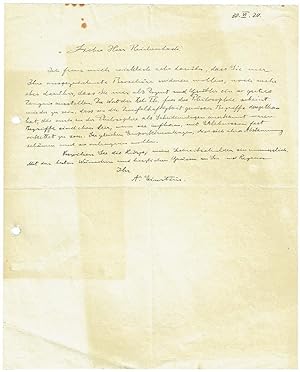
Autograph Letter Signed ("A. Einstein"), in German.
Verlag: [Berlin], June 30, 1920, 1920
Anbieter: Kotte Autographs GmbH, Roßhaupten, Deutschland
Verkäuferbewertung 5 von 5 Sternen
Manuskript / Papierantiquität
EUR 30.000,00
EUR 20,00 Versand
Versand von Deutschland nach USAAnzahl: 1 verfügbar
In den Warenkorb4to. 1 page. Einstein on the value of relativity for philosophy. Einstein writes to Hans Reichenbach, the philosopher of science and an influential expositor of Relativity. In part (translation): "I am really very pleased that you want to dedicate your excellent brochure to me, but even more so that you give me such high marks as a lecturer and thinker. The value of the th.[eory] of rel.[ativity] for philosophy seems to me to be that it exposed the dubiousness of certain concepts that even in philosophy were recognized as small change. Concepts are simply empty when they stop being firmly linked to experiences. They resemble upstarts who are ashamed of their origins and want to disown them." The letter was published in the Collected Papers of Albert Einstein, vol 10, doc 66, pp 323-324 (CPAE Translation, vol 10, doc 66, p 201). Slightly uneven toning, a few spots in upper margin, two-hole punch at left margin, folding creases.
-
Autograph manuscript of scientific calculations.
Verlag: No place, [March 1950 - early April 1951]., 1951
Anbieter: Antiquariat INLIBRIS Gilhofer Nfg. GmbH, Vienna, A, Österreich
Verbandsmitglied: ILAB VDA VDAO
Verkäuferbewertung 5 von 5 Sternen
Manuskript / Papierantiquität
EUR 38.000,00
EUR 30,00 Versand
Versand von Österreich nach USAAnzahl: 1 verfügbar
In den Warenkorb4to (280 x 216 mm). 1½ pages. Dated (likely in the hand of Helen Dukas) in pencil at upper and lower right. The manuscript comprises approximately 31 lines of mathematical workings. Einstein devoted the last thirty years of his life to the quest to combine general relativity and Maxwell's theory of electromagnetism into a single physical and mathematical framework which would account for all of the then-known fundamental forces of nature - a "unified field theory". Although his early attempts in the 1920s focused on "distant parallelism", he later concentrated on an approach treating both the metric tensor and the affine connection as fundamental fields, often introducing an element of asymmetry (in variance to the theory of general relativity). Einstein often complained of the heavy mathematical burden imposed by this approach, as demonstrated in the present manuscript. - In mint condition. - Sotheby's, 30 May 1979, lot 49 (part).
-

Typed letter signed ("A. Einstein").
Verlag: Princeton, New Jersey, 21. IV. 1942., 1942
Anbieter: Antiquariat INLIBRIS Gilhofer Nfg. GmbH, Vienna, A, Österreich
Verbandsmitglied: ILAB VDA VDAO
Verkäuferbewertung 5 von 5 Sternen
Manuskript / Papierantiquität
EUR 12.000,00
EUR 30,00 Versand
Versand von Österreich nach USAAnzahl: 1 verfügbar
In den Warenkorb4to. 1 page. In German. On blindstamped headed stationery. To the Hungarian-born physicist Cornelius Lanczos (1893-1974) at Purdue University, Lafyette, Indiana, about Lanczos's wave tensor, pointing out that it is indeed invariant in special-relativistic terms, but not the way in which it is constituted from individual waves of different frequencies; adding that his own research on complex space is not yet finished: "Nun noch eine Bemerkung über Ihren Wellen-Tensor: Es ist zwar richtig, dass dieser als Ganzes genommen spezial-relativistisch invariant ist, nicht aber die Art und Weise wie er aus Einzelwellen verschiedener Frequenz konstituiert ist [.] Meine Untersuchungen über den komplexen Raum sind noch nicht fertig". - Einstein further discusses his suffering from "bilious attacks", along with the challenges theoretical physicists face in finding defence work, and advises Lanczos to remain at Purdue University, as getting a job at the Institute for Advanced Study or elsewhere might prove difficult due to the lack of money there, compounded by xenophobia: "Ich glaube aber, dass Leute, die vorwiegend theoretisch gearbeitet haben, nicht so viel begehrt sind, besonders wenn noch die Xenophobie in Frage kommt". - Einstein's remarks about defence work are poignant: although the Einstein-Szilard letter to F. D. Roosevelt on 2 August 1939 effectively launched the Manhattan Project to construct an atomic bomb, he was himself denied clearance to work on it in July 1940, in part because of his pacifist views. In June 1943 he was, however, reported to be advising the Ordnance Bureau of the U.S. Navy on the theory of explosives. - Small tear to left margin.
-

Autograph letter signed ("A. Einstein").
Verlag: Princeton, New Jersey, 4. XII. 1949., 1949
Anbieter: Antiquariat INLIBRIS Gilhofer Nfg. GmbH, Vienna, A, Österreich
Verbandsmitglied: ILAB VDA VDAO
Verkäuferbewertung 5 von 5 Sternen
Manuskript / Papierantiquität
EUR 28.000,00
EUR 30,00 Versand
Versand von Österreich nach USAAnzahl: 1 verfügbar
In den Warenkorb4to. 1 page. In German. To the Hungarian-born physicist Cornelius Lanczos (1893-1974) with thanks for sending him a copy of his book "The Variational Principles of Mechanics" (1949) and for his having dedicated it to him, pointing out that it has freed him for the time being from the burden of being a passionate non-reader. Einstein ironically adds that despite everything he has learned so far about the American people he hopes the work will gradually find general distribution in U.S. universities: "Sie wissen, dass ich ein leidenschaftlicher Nichtleser bin. Aber Ihr Buch wird mich für eine Zeit von diesem Laster befreien [.] Ich zweifle nicht, dass dies Buch allmählich eine allgemeine Verbreitung in den hiesigen Universitäten finden wird, trotz allem was ich von unseren neuen Landsleuten allmählich in Erfahrung gebracht habe". - Returning to their shared obsession with gravitational theory, Einstein provides three equations which he now feels certain constitute the "overdetermined system" which is "the only natural generalisation of the gravitational equations". The reasoning that has brought him to this conclusion appears as an appendix in "the new edition of my old relativity book", which he will send Lanczos as soon as he has a copy. - Very well preserved.
-
Typed letter signed ("A. Einstein").
Verlag: Princeton, New Jersey, 14. II. 1955., 1955
Anbieter: Antiquariat INLIBRIS Gilhofer Nfg. GmbH, Vienna, A, Österreich
Verbandsmitglied: ILAB VDA VDAO
Verkäuferbewertung 5 von 5 Sternen
Manuskript / Papierantiquität
EUR 22.000,00
EUR 30,00 Versand
Versand von Österreich nach USAAnzahl: 1 verfügbar
In den Warenkorb4to. 1½ pp. In German. On blindstamped headed stationery. To the Hungarian-born physicist Cornelius Lanczos (1893-1974) on the intolerant and megalomaniac character of Erwin Schrödinger. Einstein considers him "intuitively extraordinarily gifted man" who suffers from so stormy a temperament that it makes him argue entirely contradictory opinions in short succession, so that one could quite frequently refute Schrödinger with Schrödinger: "Er ist ein intuitiv ausserordentlich begabter Mensch mit einem stürmischen Temperament und nicht frei von cäsarischen Anwandlungen. Das Temperament bringt ihn dazu, sich zu einer Zeit mit einer Auffassung A zu identifizieren und nach einiger Zeit mit der damit unverträglichen Auffassung B, sodass man meistens Schrödinger mit Schrödinger am schlagendsten widerlegen könnte". - Further, Einstein disapproves of Lanczos's intention to leave his position in Dublin, not least because finding a position in America where one can "immerse oneself in problems" is not at all easy; he urges his friend not to be too suspicious of others' attitudes towards him, even if strong nationalism is a well-known phenomenon among the Irish. - Lanczos had taken over Schrödinger's post at the School of Theoretical Physics at the Dublin Institute for Advanced Studies in 1952, and in spite of some early difficulties was to remain there for the rest of his life. Einstein himself would pass away only two months after the present letter. - Two small tears near lower left corner and left margin.
-

Autograph letter signed ("A. E.").
Verlag: Princeton, New Jersey, 19. VI. 1943., 1943
Anbieter: Antiquariat INLIBRIS Gilhofer Nfg. GmbH, Vienna, A, Österreich
Verbandsmitglied: ILAB VDA VDAO
Verkäuferbewertung 5 von 5 Sternen
Manuskript / Papierantiquität
EUR 15.000,00
EUR 30,00 Versand
Versand von Österreich nach USAAnzahl: 1 verfügbar
In den Warenkorb4to. 1 page. In German. To the Hungarian-born physicist Cornelius Lanczos (1893-1974), approving of his philosophical lecture, with a snappy remark about the Austrian philosopher Otto Weininger (1880-1903). Einstein comments that positivists and pragmatists appear as "bearers of a world-feeling" in the same way that the Epicureans must have seemed to pious Jews and Christians, or the way "the female" appeared to the misogynic Weininger, pointing out that "unmusical engineering souls" obsessed with sense-data have lost their understanding for questions of philosophy: "Die Positivisten und Pragmatisten erscheinen da so ähnlich als Träger eines Weltgefühls wie die Epicuräer den frommen Juden und Christen erschienen, oder das Weibliche dem Weininger. Es ist aber etwas Wahres daran, nämlich, dass diese philosophischen Richtungen mit auf die Sens-data starrendem Blick, das Verständnis für das Wunder der Begreiflichkeit des nur so indirekt Gegebenen verloren haben, unmusikalische Ingenieur-Seelen". - Einstein concludes that Lanczos's reasoning seems quite "un-American" and wonders how the learned people in the United States reacted to such thoughts, considering it a kind of "psychological test": "Es würde mich interessieren zu erfahren, wie so was Unamerikanisches auf das hiesige gelehrte Volk wirkt. Haben Sie diesbezügliche Erfahrungen gesammelt? Es würde eine Art psychologischer 'test'". - Einstein's use of the word "un-American" in relation to Lanczos's philosophical exploration is prophetic, as Lanczos would indeed be suspected of "Un-American" leanings during the McCarthy-era. - Lower left corner slightly worn, otherwise very well preserved.
-

Typed letter signed ("A. Einstein").
Verlag: Los Angeles, California, 9. VII. 1952., 1952
Anbieter: Antiquariat INLIBRIS Gilhofer Nfg. GmbH, Vienna, A, Österreich
Verbandsmitglied: ILAB VDA VDAO
Verkäuferbewertung 5 von 5 Sternen
Manuskript / Papierantiquität
EUR 14.500,00
EUR 30,00 Versand
Versand von Österreich nach USAAnzahl: 1 verfügbar
In den Warenkorb4to. 1 page. In German. Greek letter psi added by hand. On blindstamped headed stationery. To the Hungarian-born physicist Cornelius Lanczos (1893-1974) on the difficulties of finding one's way in life, discussing his ongoing dispute with Erwin Schrödinger and Max Born over the "Copenhagen Interpretation" of quantum mechanics. - Einstein is happy to hear that Lanczos is content in his new position in Dublin and no longer considers fleeing to Brazil, an idea Einstein found rather amusing. He compares the struggle of existence with living in the midst of a herd of buffalos, always under threat of being trampled: "Dies ist schon das Beste, was unsereinem erreichbar ist: man ist in eine Büffelherde geboren und muss froh sein, wenn man nicht vorzeitig zertrampelt wird. Die Idee einer Flucht nach Brasilien fand ich etwas drollig". - Turning to scientific matters, Einstein comments on Schrödinger's "desperate attempt" to dismiss the Born rule in favour of the wave function as a stand-alone description of the facts: "Schrödinger hat neuestens den verzw[e]ifelten Versuch unternommen, die Born'sche Interpretation zu verwerfen und die [psi] Funktion unmittelbar als die volls[t]ändige Beschreibung der realen Tatbestände zu proklamieren". - Lanczos had come under suspicion for possible communist affinities in McCarthyite America, and this appears to have caused his move to Ireland in 1952, where he took over Erwin Schrödinger's position at the School of Theoretical Physics at the Dublin Institute for Advanced Studies. Einstein's long-standing objection to the predominance of statistics in the Copenhagen Interpretation was famously summed up in his dictum 'God does not play dice'. The psi function represents the amplitude of the wave in Schrödinger's time wave equation.
-

Eigenh. Brief mit Unterschrift Albert".
Verlag: O. O. , Sonntag, XII.54"
Anbieter: Kotte Autographs GmbH, Roßhaupten, Deutschland
Verkäuferbewertung 5 von 5 Sternen
Manuskript / Papierantiquität
EUR 18.500,00
EUR 20,00 Versand
Versand von Deutschland nach USAAnzahl: 1 verfügbar
In den Warenkorb4to. 1 p. Gelocht. An seinen Enkel Bernhard, nach dessen Hochzeit mit Aude Ascher. Lieber Hardi! | Der Bettelbrief hat mir sehr gefallen. Er zeigt, dass Dir der Sprung ins Joch recht gut gethan hat. Hoffentlich hast Du das Geld schon erhalten; wenns nicht reicht, will ich gerne noch weiter nachhelfen. Für die Kälte-Empfindlichkeit der Füsse Deiner Frau gibt es eine Art einfacher elektrischer Lampe [], die rotes und ultrarotes Licht in einem Bündel abgibt. Besonders für die Übergangsjahreszeit ist es nützlich []" - Hierzu die Zeichnung. Ich kann mir denken, dass Dir die soliden Schweizer Lehrmethoden besser gefallen als die oberflächlichen amerikanischen. Überhaupt ist in der Schweiz alles gesünder und ehrlicher - allerdings auch etwas kleinlich und phantasielos. Es imponiert mir, mit was für einer Energie Deine Frau sich auf ihren Beruf vorbereitet. Ihr ruhige und sichere Art wird auch auf Dich wirken. Ich bin ziemlich geschwächt von einer Anemia, so dass ich nicht einmal eine Treppe steigen kann. Aber der Kopf ist immer noch brauchbar und lebendig, sodass ich mich des Daseins freuen kann []"Lieber Hardi" to his grandson Bernhard Caesar Einstein]. Endearing personal letter to his grandson, with a pen drawing. Bernhard Caesar Einstein (1930-2008), son of Hans Albert, had married in 1954 Doris Aude Ascher (born in 1938): they had 5 children.Einstein picks up somewhat sarcastically on his ,beggar's letter' ('Bettelbrief') and the new ,marital yoke' ('der Sprung ins Joch'). He hopes he has received the money and if that is not enough he will help more if needed. With regards to his wife's cold feet ('die Kälte-Empfindlichkeit der Füsse Deiner Frau'), there is a sort of simple electrical lamp that projects a red light and ultra red light, useful during transitional seasons. He draws the lamp and concludes that it does not require very much electricityEinstein comments that Swiss teaching methods are likely better that American ones. In general, evreything is better and more honest in Switzerland but also a bit petty and lacking imagination ('Überhaupt ist in der Schweiz alles gesünder und ehrlicher allerdings auch etwas kleinlich und phantasielos.') He himself is weakened by anemia and cannot walk up stairs. But the head is still operable and alive in order to be grateful for existence ('Aber der Kopf ist immer noch brauchbar und lebendig, sodass ich mich des Daseins freuen kann.')For about two weeks, from January 2 to 13, Eisenhower spent his furlough in Washington, D.C., visiting his wife and attending a series of conferences. He then returned to London to plan for Overlordthe invasion of France at Normandy [Stephen E. Ambrose, Eisenhower: Soldier and President].
-

Typed letter signed A. Einstein".
Verlag: Knollwood, Saranac Lake, 10. VIII. 1940., 1940
Anbieter: Kotte Autographs GmbH, Roßhaupten, Deutschland
Verkäuferbewertung 5 von 5 Sternen
Manuskript / Papierantiquität
EUR 8.500,00
EUR 20,00 Versand
Versand von Deutschland nach USAAnzahl: 1 verfügbar
In den Warenkorb4to. 1/2 p. Folded. Airmail paper. To the German-American musicologist Hans Rosenwald in Chicago. Einstein declined the request for an article, stating that due to his fame, [] jeder Auesserung von mir mehr Gewicht beigelegt wird als objektiv berechtigt und wünschbar ist []" - Rosenwald (1907-1988) was the editor of "Who is Who in Music," and the request was addressed to the physicist, who was also known as an excellent violinist. Rosenwald emigrated in 1936 and had been a lecturer in Chicago since 1938.
-
Typed letter signed. A. Einstein".
Verlag: Princeton, 11. V. 1951., 1951
Anbieter: Kotte Autographs GmbH, Roßhaupten, Deutschland
Verkäuferbewertung 5 von 5 Sternen
Manuskript / Papierantiquität
EUR 9.500,00
EUR 20,00 Versand
Versand von Deutschland nach USAAnzahl: 1 verfügbar
In den Warenkorb4to. 1 p. Blind embossed stationery A. Einstein, [] Princeton". Important letter illustrating Einstein's care for his younger sister, Maya. To Dorothea Koenig in Nashville regarding the poor health condition of Einstein's sister, Maya: Ich weiss natürlich von Maja's alter Bekanntschaft mit Frau Glinz-Frey. Die Tatsache, dass diese keine Briefe mehr von meiner Schwester empfangen hat beruht auf deren schwerer Erkrankung (fortgeschrittene Arteriosklerose des Gehirns), welche ihr das Leben und Schreiben seit einiger Zeit unmöglich macht. Es ist sehr freundlich von Ihnen, Ihren Besuch anzubieten. Ein solcher würde sich jedoch nicht empfehlen, da meine Schwester im Sprechen ausserordentlich behindert ist und bei Gelegenheit eines Besuches sich ihres Zustandes schmerzlicher bewusst wird als sonst. Ich wage es deshalb gar nicht, von Ihrem Briefe etwas zu erwähnen. []" - In February 1939, Maja Einstein emigrated to the USA and moved in with her brother Albert in Princeton. Her husband was denied entry to the USA for health reasons, so he stayed with relatives in Geneva. Maja Einstein intended to return home after the end of World War II. In 1946, she suffered a stroke; she also developed arteriosclerosis and became bedridden, preventing her from returning to Europe. The couple maintained a correspondence by letter until Maja Einstein's death. She passed away on June 25, 1951, due to pneumonia following a fractured upper arm in Princeton.Albert Einstein reported after his sister's death: "In the last few years, I read to her every evening from the finest books of old and new literature.".
-

Typed letter signed ("A. Einstein").
Verlag: Princeton, 6. X. 1938., 1938
Anbieter: Antiquariat INLIBRIS Gilhofer Nfg. GmbH, Vienna, A, Österreich
Verbandsmitglied: ILAB VDA VDAO
Verkäuferbewertung 5 von 5 Sternen
Manuskript / Papierantiquität
EUR 15.000,00
EUR 30,00 Versand
Versand von Österreich nach USAAnzahl: 1 verfügbar
In den Warenkorb4to (212 x 278 mm). ½ page. In German. To Edward Cushing, writing in support of the Austrian educator Eugenie Schwarzwald (1872-1940), founder of the "Schwarzwaldschule" for young women, after her assets were seized by the Nazis. In response to a prior letter from Mr. Cushing, Einstein writes: "I personally feel great respect and warm sympathy for Mrs. Schwarzwald. However, since I lead a rather isolated life, I have few personal acquaintances and no knowledge of people who could be approached [.] If you should learn about such people from your American friends, I should be very glad to write to them. Also, I should be able to make a modest contribution myself [.]" (transl.). - This letter relates to Mrs. Eugenie Schwarzwald, a progressive Austrian philanthropist who founded the innovative Schwarzwald school to educate Austrian girls. She was forced to leave Austria due to her Jewish ancestry; her assets were seized by the National Socialists, and the Schwarzwald schools were forcibly closed. Edward Cushing began the "Schwarzwald fund" to support her financially after the seizure of her assets, and in conjunction with the American journalist Dorothy Thompson, rallied for their intended emigration to America - likely referenced here. - Llight mailing folds impacting signature, two small spots of loss at the centrefolds. - From the collection of Kalman Talansky (1924-2021). - Cf. John M. Spalek et al., Deutschsprachige Exilliteratur seit 1933, p. 379.
-
Autograph letter signed.
Verlag: Berlin, 22. III. 1929., 1929
Anbieter: Kotte Autographs GmbH, Roßhaupten, Deutschland
Verkäuferbewertung 5 von 5 Sternen
Manuskript / Papierantiquität
EUR 19.500,00
EUR 20,00 Versand
Versand von Deutschland nach USAAnzahl: 1 verfügbar
In den Warenkorb8vo. 1 1/2 pp. Double sheet. Printed letterhead Haberlandstr. 5 | Berlin W.". To Marie Barthelts in Winterhur : Ich erinnere mich noch ganz gut an unser Musizieren vor 29 Jahren. Seitdem hab ich viel heruntergefiedelt und auch sonst ein so merkwürdig arbeits- und ereignisreiches Leben geführt, dass das versprochene Kikeriki mir im Halse stecken geblieben ist. Es hätte Ende 1905 sein müssen. Ihr Briefchen war für mich vom schönsten, was bei diesem 50. Geburstag kam. Es wurde mir wieder alles von damals lebendig, die frohe, wenn auch harte Jugend, die guten Menschen, die fast alle aus dem Leben oder meinem Gesichtskreis weggegangen sind. Ich selbst bin ein grauhaariger, leidender Mensch geworden, aber der frohe Sinn und die Freude am Musizieren sind geblieben. Meine Eltern sind längst tot. Ich freue mich für Sie, dass Sie Ihre Mutter haben behalten dürfen. Seien Sie mit ihr bestens gegrüsst von Ihrem alten A. Einstein"Translation: I remember quite well our music-making from 29 years ago. Since then, I've fiddled away a lot and led such a strangely eventful life that the promised cock-a-doodle-doo has stuck in my throat. It must have been the end of 1905. Your little letter was the loveliest thing that came for me on this 50th birthday. It brought everything back to me from those days, the joyful, albeit tough youth, the good people, most of whom have passed away or left my circle. I myself have become a gray-haired, suffering person, but the joyful spirit and the pleasure in making music have remained. My parents have long been dead. I am happy for you that you have been able to keep your mother. Please give her my best regards. Yours sincerely, your old A. Einstein".
-
Autograph letter signed.
Verlag: [Berlin], 27. II. 1924., 1924
Anbieter: Kotte Autographs GmbH, Roßhaupten, Deutschland
Verkäuferbewertung 5 von 5 Sternen
Manuskript / Papierantiquität
EUR 28.000,00
EUR 20,00 Versand
Versand von Deutschland nach USAAnzahl: 1 verfügbar
In den WarenkorbFolio. 1 p. Folded. To Hermann Anschütz-Kaempfe: Der freundliche Brief von Ihrer Frau [Reta Stöve] und auch von Ihnen hat sehr wohlgethan und meiner Frau [Elsa Eisntein] das Vorurteil verscheucht, dass Sie ihr in irgend einer Weise übelwollen oder mich von ihr abzuziehen suchen. Man muss Frauen nehmen wie sie sind und ihnen das Leben so leicht als möglich machen wenn nicht aus purer Gutmütigkeit, halbaus Gutmütigkeit, so doch halb aus Klugheit. Dazu haben Sie mir in freundlicherWeise verholfen. Ich komme dann sehr gern wieder nach Kiel, nur muss ich anfangs Mai zum Philoesophenkongress nach Neapel. Das hat sich nichtvermeiden lassen, weil dort ein besonderer Tag der Rel[ativitäts]-Theorie gewidment ist. Mitte Mai kann ich aber gut nach Kiel kommen und freue mich schon darauf. Dass bei bewegter Kugelschale durch das Magnetfeld Drehmomente auf die Kugel übertragen werden, ist nicht ganz zu vermeiden, aber der dadurch erzeugte systematische Fehler kann nicht bedeutend sein, wohl nicht grösser als der durch Wasserreibung bedingte.Dagegen wird eben nichts zu machen sein. Wichtig ist, dass der Blasring schöngleichmässig ist, dass bei blosser Drehung um die Vertikale nichts derartigesauftritt. Ich arbeite fest, wurde aber von der physikalischen Muse an der Naseherumgeführt. Hoffentlich kommts besser []"Translated: "The kind letter from your wife [Reta Stöve] and also from you has been very comforting, dispelling any prejudice my wife [Elsa Einstein] may have had that you bear ill will towards her or seek to alienate me from her in any way. One must take women as they are and make life as easy for them as possible - if not out of pure good nature, then partly out of good nature and partly out of prudence. You have helped me in a friendly manner towards this end. I will be very happy to return to Kiel, but I must go to the Philosophy Congress in Naples at the beginning of May. This could not be avoided, as a special day dedicated to the Theory of Relativity will be observed there. However, I can come to Kiel in mid-May and look forward to it. The fact that torques are transferred to the ball due to the moving ball shell through the magnetic field cannot be completely avoided, but the systematic error thus generated cannot be significant, probably not greater than that caused by water friction. However, there will be nothing to be done about it. It is important that the bubble ring is evenly formed, so that nothing of the sort occurs with mere rotation around the vertical axis. I am working hard, but have been led astray by the muse of physics. Hopefully, it will improve [.]".
-

Typed letter signed.
Verlag: Le-Coq-sur-Mer, 14 July 1933., 1933
Anbieter: Antiquariat INLIBRIS Gilhofer Nfg. GmbH, Vienna, A, Österreich
Verbandsmitglied: ILAB VDA VDAO
Verkäuferbewertung 5 von 5 Sternen
Manuskript / Papierantiquität
EUR 14.000,00
EUR 30,00 Versand
Versand von Österreich nach USAAnzahl: 1 verfügbar
In den Warenkorb4to. 1 page. In German. Writing to the Home Office in support of Lisa Einstein's initiative to remain in England: "Miss Einstein is the daughter of a distinguished man, one of the finest doctors in Stuttgart. She has studied medicine for two years and is forced by the measures against German Jews to give up her studies. She therefore wishes to begin training as a nurse. This career path, too, is closed to her in Germany by the new regulations. Guy's Hospital of London has declared itself willing to give her further training when she will have received permission to stay in England for the necessary period [.]" (translated). - Traces of folds; slight damage to edges and in the centrefold. Accompanied by a contemporary English translation.
-

Typed letter signed.
Verlag: Pasadena, 21 Jan. 1931., 1931
Anbieter: Antiquariat INLIBRIS Gilhofer Nfg. GmbH, Vienna, A, Österreich
Verbandsmitglied: ILAB VDA VDAO
Verkäuferbewertung 5 von 5 Sternen
Manuskript / Papierantiquität
EUR 16.000,00
EUR 30,00 Versand
Versand von Österreich nach USAAnzahl: 1 verfügbar
In den Warenkorb4to. 1 page. Addressed to Mark Carter, Chairman of the ORT Organization, Los Angeles. The present letter was written in the course of Albert Einstein's second visit to the United States, while he was spending time at the California Institute of Technology (Caltech), Pasadena, where he met with physicists and astronomers to discuss topics related to his theory of relativity. At that time, Einstein was invited by Mark Carter, Chairman of ORT, Los Angeles, to attend a benefit event featuring a performance by actors belonging to the Habima Theatre. Einstein was a great admirer of Habima. Einstein wrote: "The efforts of ORT for the rehabilitation of Eastern European Jewry are of the highest importance for the Jewish people as a whole. A disease is definitely being healed here, which has brought distress to our people for centuries. I personally attended an unforgettable performance of 'The Dybbuk' at the Habima Theatre and I am convinced that the high level of this play will be enthusiastically received locally as well" (transl. from the German original). - The organization known as ORT ("Organization for Rehabilitation through Training") was established in Tsarist Russia in 1880 by Jewish philanthropists with the goal of providing professional training for members of struggling Jewish communities in Eastern Europe. The organization established a network of schools in the Pale of Settlement and in Russia, which, following the First World War, expanded to the West and opened branches throughout the world. In late October, 1930, the British branch of ORT held a luncheon attended by academics, philanthropists, and rabbis. In attendance were George Bernard Shaw, H.G. Wells, Lord Lionel Walter Rothschild, and Chief Rabbi of the United Kingdom Joseph Herman (Zvi) Hertz. These figures were joined by Albert Einstein, who took the opportunity to express his great regard for the ORT organization in a speech he delivered at the event. - Typed on the official stationery of the California Institute of Technology. Stains. Fold lines. Minor creases. Remnants of glued paper on verso.
-
Typed letter signed ("A. Einstein").
Verlag: Princeton, 6 October 1938, 1938
Anbieter: Kotte Autographs GmbH, Roßhaupten, Deutschland
Verkäuferbewertung 5 von 5 Sternen
Manuskript / Papierantiquität
EUR 15.000,00
EUR 20,00 Versand
Versand von Deutschland nach USAAnzahl: 1 verfügbar
In den Warenkorb4to. 1 p. 212 : 278mm (light mailing folds impacting signature, two small spots of loss at the centerfolds). In German. Einstein supports Austrian educator Eugenie Schwarzwald, founder of the "Schwarzwald'sche school" for young women, after her assets were seized by the Nazis. In response to a prior letter from Mr. Cushing, Einstein writes: [] I personally feel great respect and warm sympathy for Mrs. Schwarzwald. However, since I lead a rather isolated life, I have few personal acquaintances and no knowledge of people who could be approached. If you should learn about such people from your American friends, I should be very glad to write to them. Also, I should be able to make a modest contribution myself []"This letter relates to Mrs. Eugenie Schwarzwald -- a progressive Austrian philanthropist who founded the innovative Schwarzwald school to educate Austrian girls. She was forced to leave Austria due to her Jewish ancestry, where her assets were seized by the Nazis and the Schwarzwald schools were forcibly closed. Edward Cushing began the "Schwarzwald fund" to financially support her after the seizure of her assets, and in conjunction with American journalist Dorothy Thompson, rallied for their intended emigration to America - likely referenced here. (see Deutschsprachige Exiliterature seit 1933, John M. Spalek et al., p. 379).
-
Typed postcard signed A. Einstein".
Verlag: Berlin W., Haberlandstr. 5, 19. II. 1929., 1929
Anbieter: Kotte Autographs GmbH, Roßhaupten, Deutschland
Verkäuferbewertung 5 von 5 Sternen
Manuskript / Papierantiquität
EUR 7.500,00
EUR 20,00 Versand
Versand von Deutschland nach USAAnzahl: 1 verfügbar
In den WarenkorbOblong-8vo. 1 p. To aspiring Romanian physicist Melanie Serbu (1909-1979), in German."I recommend starting with geometry (planimetry) for the time being. A textbook for algebra will follow. [.]"Ich rate Ihnen, einstweilen mit Geometrie (Planimetrie) anzufangen. Ein Lehrbuch für Algebra folgt. []".
-
Typed letter signed A. Einstein".
Verlag: Berlin W., Haberlandstr. 5, z.zt. Caputh b. Potsdam, 19. VI. 1929., 1929
Anbieter: Kotte Autographs GmbH, Roßhaupten, Deutschland
Verkäuferbewertung 5 von 5 Sternen
Manuskript / Papierantiquität
EUR 6.500,00
EUR 20,00 Versand
Versand von Deutschland nach USAAnzahl: 1 verfügbar
In den Warenkorb4to. 1/2 p. Printed letterhead. Smaller tears to folds. To aspiring Romanian physicist Melanie Serbu (1909-1979), in German. Einstein probably included a letter of recommendation. "Enclosed is the requested letter, in which, of course, only as much is stated as I can justify."Anbei das gewünschte Schreiben, indem natürlich nur soviel steht, als ich verantworten kann.".
-
Typed letter signed A. Einstein".
Verlag: Princeton, 8. IX. 1937., 1937
Anbieter: Kotte Autographs GmbH, Roßhaupten, Deutschland
Verkäuferbewertung 5 von 5 Sternen
Manuskript / Papierantiquität
EUR 14.000,00
EUR 20,00 Versand
Versand von Deutschland nach USAAnzahl: 1 verfügbar
In den Warenkorb4to. 3/4 p. Age toning and paper clip impression to the upper border. To the young aspiring Romanian physicist Melanie Serbu (1909-1979), in German."I thank you for your kind letters, from which I happily discern your cheerful disposition. By the way, it is not entirely clear from your communications whether you received and understood my letter on the unified treatment of the mechanics of the solid and liquid states. If this is not the case, I am happy to write to you about it again. It is undoubtedly an interesting area of work for a dissertation, even in the event that the relevant ideas are not fundamentally new."Ich danke Ihnen für Ihre freundlichen Briefchen, aus denen ich gerne Ihre frohe Gemütsverfassung erkenne. Es geht übrigens aus Ihren Mitteilungen nicht klar hervor, ob Sie meinen Brief über die einheitliche Behandlung der Mechanik des festen und flüssigen Zustandes erhalten und verstanden haben. Sollte es nicht der Fall sein, so will ich Ihnen gerne noch einmal darüber schreiben. Es ist zweifellos ein interessantes Arbeitsgebiet für eine Dissertation, selbst in dem Falle, dass die betreffenden Gedanken im Prinzip nicht neu wären. []".
-
Typed letter signed A. Einstein".
Verlag: Princeton, 7. V. 1937., 1937
Anbieter: Kotte Autographs GmbH, Roßhaupten, Deutschland
Verkäuferbewertung 5 von 5 Sternen
Manuskript / Papierantiquität
EUR 17.500,00
EUR 20,00 Versand
Versand von Deutschland nach USAAnzahl: 1 verfügbar
In den Warenkorb4to. 1 3/4 pp. Blind embossed letterhead. Expected folds. Some age toning. To the young aspiring Romanian physicist Melanie Serbu (1909-1979), in German."[] I was very happy about . . . your successful exams. With regard to the marriage proposal from the . . . private lecturer you named, I cannot allow myself to judge. In and of itself, I believe that it is better for a woman to be married. If the man is not a Jew, marriage seems risky, especially under today's conditions as differences can easily emerge afterward, originally concealed by the desire for connection. Your idea of coming here doesn't seem to me to be advisable, especially since the mentality of the Prague area is probably much closer to you than the local people. It also has fewer difficulties from a financial point of view, and the prospect of finding a job here is not particularly good, even for real Americans. Even if you were here, you would get very little from me, because I don't teach and my time and energy is taken up to the last. I have indeed been somewhat ill in the last few months, but I am now completely recovered and able to work. Nonetheless, one is essentially finished as one approaches sixty. You can then depart with the joyful feeling that you have done your part and found fruitful paths. I am very happy that you are developing so well in Prague and that your tireless efforts have enabled you to overcome the really big obstacles presented by the unfamiliar environment and a disorderly and inadequate education. However, it would bring me particular joy if you were to truly find a like-minded companion. [.] P.S. If you have a scientific question that no one there can answer, I will be happy to provide you with an answer." Schon lange hätte ich Ihnen geschrieben, wenn ich nicht durch eine unvorstellbare Korrespondenz beständig gehetzt wäre. - Ich habe mich sehr über Ihre erfreuliche Nachricht betreffs Ihrer Geschwister und Ihres geglückten Examens gefreut. Bezüglich des Heiratsantrages von Seiten des von Ihnen genannten Privat-Dozenten kann ich mir kein Urteil erlauben. An und für sich glaube ich, dass es für eine Frau besser ist, wenn sie verheiratet ist. Wenn der Mann kein Jude ist, erscheint eine Verheiratung - besonders unter den heutigen Verhältnissen - riskant, da sich nachträglich leicht Gegensätze herausstellen, die ursprünglich durch den Wunsch nach Verbindung verdeckt werden.Ihre Idee, hierherzukommen, erscheint mir nicht empfehlenswert, zumal Ihnen die Mentalität der Prager Umgebung erheblich näher stehen dürfte als die hiesigen Menschen. Es hat auch vom finanziellen Standpunkt aus weniger Schwierigkeiten und die Aussicht, hier eine Stelle zu finden, ist selbst für waschechte Amerikaner nicht besonders günstig. Selbst wenn Sie hier wären, würden Sie von mir sehr wenig haben, weil ich ja nicht lehre und meine Zeit und Kraft bis aufs letzte in Anspruch genommen ist. - Ich war in den letzten Monaten tatsächlich einigermassen krank, bin aber wieder völlig hergestellt und arbeitsfähig. Immerhin ist man in der Hauptsache fertig, wenn man den Sechzig näherrückt. Man kann dann in dem frohen Gefühl abfahren, dass man das Seine getan und fruchtbare Wege gefunden hat.Ich freue mich sehr darüber, dass sie sich in Prag so schön entwickeln und durch Ihr unermüdliches Streben die wirklich grossen Hindernisse haben überwinden können, welche die fremde Umgebung und eine ungeordnete und mangelhafte Vorbildung Ihnen bereitet haben. Eine besondere Freude aber wäre es mir, wenn Sie wirklich einen gleichstrebenden Gefährten finden würden. [] P.S. Wenn Sie eine wissenschaftliche Frage haben, die Ihnen dort niemand beantworten kann, so werde ich mich freuen, Sie Ihnen zu beantworten.".
-
Typed letter signed A. Einstein".
Verlag: Berlin W., Haberlandstr. 5, 9. X. 1928., 1928
Anbieter: Kotte Autographs GmbH, Roßhaupten, Deutschland
Verkäuferbewertung 5 von 5 Sternen
Manuskript / Papierantiquität
EUR 28.000,00
EUR 20,00 Versand
Versand von Deutschland nach USAAnzahl: 1 verfügbar
In den Warenkorb4to. 1 p. Printed letterhead. Folded. Some age toning. To aspiring Romanian physicist Melanie Serbu (1909-1979), in German. Perhaps impressed by her boldness, Einstein replied by recommending a book introducing his theory: Die Idee der Relativitätstheorie (1921) by Hans Thirring:You have evidently got hold of one of those popularizations of the theory of relativity which only superficially touches on the subject. . . . However, this cannot be understood without prior knowledge of physics. If you have such prior knowledge, I recommend reading a book on this subject that Prof. Thirring has published at the University of Vienna."Sie haben augenscheinlich eine von jenen Popularisierungen der Relativitäts-Theorie in die Hand bekommen, die nur ganz äusserlich den Gegenstand streift. Dies entnehme ich daraus, dass Sie glauben, die angeführte Stelle des Romans könnte mit der Theorie etwas zu schaffen haben. Diese aber lässt sich ohne physikalische Vorkenntnisse nicht verstehen. Für den Fall, dass Sie über solche Vorkenntnisse verfügen, empfehle ich Ihnen die Lektüre eines Buches, das Herr Prof. Thirring an der Universität Wien über diesen Gegenstand hat erscheinen lassen. []".
-
Typed letter signed A. Einstein".
Verlag: Princeton, 23. I. 1935., 1935
Anbieter: Kotte Autographs GmbH, Roßhaupten, Deutschland
Verkäuferbewertung 5 von 5 Sternen
Manuskript / Papierantiquität
EUR 12.500,00
EUR 20,00 Versand
Versand von Deutschland nach USAAnzahl: 1 verfügbar
In den Warenkorb4to. 1 p. Expected folds. To aspiring Romanian physicist Melanie Serbu (1909-1979), in German."I consider it conceivable that you could study at the German University in Prague. The theoretical physicist there, Professor Philipp Frank, is a friend of mine and a quite wealthy man. He will surely make an effort to facilitate your admission if I write to him. I will do the latter as soon as you express a corresponding desire. I am convinced that this would be the right choice for you, both from a scientific and practical standpoint."Frank wrote a paper on causality that impressed Albert Einstein, leading to an active exchange between the two. Frank completed his habilitation in 1910 at the University of Vienna and became a lecturer there. On Einstein's recommendation, Frank became his successor at the German University in Prague in 1912, where he stayed until 1938.Ich halte es für denkbar, dass Sie an der deutschen Universität in Prag studieren könnten. Der dortige theoretische Physiker, Professor Philipp Frank ist ein Freund von mir und ein recht wohlhabender Mann. Er wird sich sicher bemühen, Ihnen die Aufnahme zu ermöglichen, wenn ich ihm schreibe. Letzteres will ich tun, sobald Sie einen diesbezüglichen Wunsch aussprechen. Ich bin überzeugt, dass dies für Sie das Richtige wäre, sowohl vom wissenschaftlichen wie vom praktischen Standpunkt aus.".
-
Autograph Letter Signed, "A. Einstein".
Verlag: No place , 21 December 1937, 1937
Anbieter: Kotte Autographs GmbH, Roßhaupten, Deutschland
Verkäuferbewertung 5 von 5 Sternen
Manuskript / Papierantiquität
EUR 25.000,00
EUR 20,00 Versand
Versand von Deutschland nach USAAnzahl: 1 verfügbar
In den Warenkorb4to. 1 p. Faint scattered soiling, minor loss to lower left corner, folds. Nice letter to Ruth Norden, in German, praising her translation, approving of her community with some exceptions [participants in 1939 World's Fair?], suggesting other acceptable candidates, inquiring about possible candidates from other countries, comparing a potential candidate to Freud, observing that people would be less vulnerable if their quality were as high as they are numerous, and expressing gratitude for a long telegram. Norden who was responsible for translating a number of Einstein's writings into English. One of these was his 1938 article "Why do they hate the Jews?", which was his only public discussion of Hitler's campaign against the Jews."You have done a great translating job and it is factually better than the original. The community that you take interest in seems very likable to me, except for Lindberg [Charles Lindbergh], who hasn't shown much concern for the suffering of human beings. As far as Maderiaga [Salvador de Madariaga] is concerned, I am not quite sure whether he is an honest human being--so I'll have to add a question mark to him as well. . . . I would also accept Andre Gide and Albert Schweitzer as well. Maybe [Ignazio] Silone as well . . . . Is there any Russian out there that seems acceptable and has not been decapitated yet? I know of none, and neither do I know any Scandinavian, Dutch, South American, Spaniard and none from the English Colonies. Just like with Freud; probably only to be used as a one-horse carriage. "Looking at today's humankind, one can only notice with regret that the numbers do not make up for quality: if quantity would substitute for quality we'd be in great shape compared to tiny old Greece. "Finally, I have to express my condolences for your poor wallet since you have sent such a lengthy telegram. I was very touched and will show it to your potential husband to keep him from making the wrong decision; so please keep me informed." In September of 1938, the Westinghouse Electric and Manufacturing Company deposited a time capsule at the site of the 1938 New York World's Fair to be opened 5,000 years hence. The capsule contained letters addressed to the future inhabitants of Earth by luminaries of the day, including Thomas Mann, Robert A. Millikan, and Albert Einstein. According to a September 16, 1938 New York Times article, "Einstein Hopeful for Better World," the uncredited but "authorized English translation" of Einstein's letter contained the observation that "people living in different countries kill each other at irregular time intervals, so that . . . any one who thinks about the future must live in fear and terror. This is due to the fact that the intelligence and character of the masses are incomparably lower than the intelligence and character of the few who produce something valuable for the community. I trust that posterity will read these statements with a feeling of proud and justified superiority." It is likely that the translator of Einstein's time capsule letter was Ruth Norden, who was responsible for many of Einstein's English translations at the time, including "Why Do They Hate the Jews," published in Collier's Magazine on November 26, 1938. The work praised in the present lot is probably the very same time capsule letter translation.Sie haben die Sache prachtvoll übersetzt; es ist faktisch besser als das Original. Die von Ihnen ins Auge gefasste Gemeinschaft gefällt mir recht gut bis auf Lindberg [d.i. Charles Lindbergh], der doch nicht gezeigt hat, dass er für die Leiden der Menschenwelt viel übrig hat. Bei Maderiaga [d.i. Salvador de Madariaga] bin ich nicht sicher, ob er ein ehrlicher Mensch ist; zu ihm muss ich auch ein Fragezeichen setzen. Über mich selbst will ich schweigen oder zu meinen Gunsten anführen, dass mich die andern ja nicht so genau kennen. Ich würde den André Gide doch aufnehmen, ausserdem Albert Schweizer. Vielleicht auch den [Ignazio] Silone, jenen wund.
-
Autograph letter signed A. Einstein".
Verlag: no place , 25. V. 1937., 1937
Anbieter: Kotte Autographs GmbH, Roßhaupten, Deutschland
Verkäuferbewertung 5 von 5 Sternen
Manuskript / Papierantiquität
EUR 25.000,00
EUR 20,00 Versand
Versand von Deutschland nach USAAnzahl: 1 verfügbar
In den Warenkorb4to. 1 p. Minor paper loss to upper border. Some age toning and expected folds. To the young aspiring Romanian physicist Melanie Serbu (1909-1979), in German."I believe the fundamental idea is partially correct. However, in my view, it stems from an incorrect conception of the solid body. When you deform such a body, the elastic stress forces disappear more or less rapidly with the given deformation. With constant deformation forces, a more or less pronounced flow occurs accordingly - independent of the current deformation process. The body bends very slowly. Think of solid pitch or wax, but also lead.In comparison to sufficiently rapid processes, the material behaves similarly to an ideal, i.e., non-flowing but only elastic solid body. However, with very slowly changing loads, the flowing aspect takes precedence. I believe that the natural transition to liquids is to be sought here.The idea of liquids as easily flowing solid bodies would then suggest the existence of high-frequency transverse waves in liquids but not that they do not deform with sufficiently small deformation limits. So, I see the transition in a very different way than you do: Liquids would be solid bodies where the property of flowing far outweighs that of elastic angular deformation. I don't know if attempts have been made to generate high-frequency transverse waves in liquids, which would make the elasticity properties observable despite the predominant flowing characteristics."Ich glaube der Grundgedanke ist teilweise richtig. Aber er geht nach meiner Ansicht von einer unrichtigen Auffassung des festen Körpers aus. Wenn Sie nämlich einen solchen deformieren, dann verschwinden die elastischen Spannungs-Kräfte bei gegebener Deformation mehr oder weniger rasch. Bei konstant gegebenen Deformationskräften tritt demgemäss ein mehr oder weniger ausgeprägtes Fliessen auf - unabhängig von dem momentanen Deformationsvorgang. Der Körper verbiegt sich ganz langsam. Denken Sie an festes Pech oder Wachs, aber auch an Blei.Genügend raschen Vorgängen gegenüber verhält sich das Ding ähnlich einem idealen, d.h. nichtfliessenden sondern nur elastischen festen Körper. Bei ganz langsam veränderlichen Belastungen aber tritt das Fliessen in den Vordergrund. Ich glaube nun, dass hier der natürliche Übergang zu den Flüssigkeiten zu suchen ist.Die Auffassung von Flüssigkeiten als leicht fliessende feste Körper würde dann erwarten lassen, dass es in Flüssigkeiten Transversalwellen von sehr hoher Frequenz gebe, aber nicht, dass sie sich bei genügend kleinen Deformationsgrenzen nicht deformieren. Ich sehe also den Übergang in ganz anderer Weise wie Sie: Flüssigkeiten wären feste Körper bei denen die Eigenschaft des Fliessens die der elastischen Angular-Deforation weit überwiegt. Ich weiss nicht ob man schon versucht hat, in Flüssigkeiten Transversalwellen von hoher Frequenz zu erzeugen, die dann die Elastizitätseigenschaften beobachtbar erscheinen liessen trotz der vorwiegenden Fliesseigenschaften. []".