
Editor vogt (231 Ergebnisse)

- Hardcover
Anbieter: ThriftBooks-Dallas, Dallas, TX, USAThriftBooks-Dallas
Verkäufer/-in kontaktierenVerkäufer/-in mit 5 SternenZustand: Gebraucht - Wie neu
EUR 8,99
Versand nach gratisVersand innerhalb von USAAnzahl: 1 verfügbar
Hardcover. Zustand: As New. No Jacket. Pages are clean and are not marred by notes or folds of any kind. ~ ThriftBooks: Read More, Spend Less.
- Hardcover
Anbieter: ThriftBooks-Atlanta, AUSTELL, GA, USAThriftBooks-Atlanta
Verkäufer/-in kontaktierenVerkäufer/-in mit 5 SternenZustand: Gebraucht - Wie neu
EUR 8,99
Versand nach gratisVersand innerhalb von USAAnzahl: 1 verfügbar
Hardcover. Zustand: As New. No Jacket. Pages are clean and are not marred by notes or folds of any kind. ~ ThriftBooks: Read More, Spend Less.
- Hardcover
Anbieter: Better World Books, Mishawaka, IN, USABetter World Books
Verkäufer/-in kontaktierenVerkäufer/-in mit 5 SternenZustand: Gebraucht - Befriedigend
EUR 10,41
Versand nach gratisVersand innerhalb von USAAnzahl: 1 verfügbar
Zustand: Good. Pages intact with minimal writing/highlighting. The binding may be loose and creased. Dust jackets/supplements are not included. Stock photo provided. Product includes identifying sticker. Better World Books: Buy Books. Do Good.

Fifty Years of the Best Science Fiction From Analog
Schmidt, Stanley (editor); Stuart, Don A.; Weinbaum, Stanley G.; Campbell, John W., Jr.; De Camp, L. Sprague; Smith, George O.; Heinlein, Robert A.; Van Vogt, A. E.; Brown, Fredric; Sturgeon, Theodore
Verlag: Davis Publications, Inc.
- Softcover
Anbieter: ThriftBooks-Atlanta, AUSTELL, GA, USAThriftBooks-Atlanta
Verkäufer/-in kontaktierenVerkäufer/-in mit 5 SternenZustand: Gebraucht - Ausreichend
EUR 7,03
Versand nach gratisVersand innerhalb von USAAnzahl: 1 verfügbar
Paperback. Zustand: Fair. No Jacket. Readable copy. Pages may have considerable notes/highlighting. ~ ThriftBooks: Read More, Spend Less.
Fifty Years of the Best Science Fiction From Analog
Schmidt, Stanley (editor); Stuart, Don A.; Weinbaum, Stanley G.; Campbell, John W., Jr.; De Camp, L. Sprague; Smith, George O.; Heinlein, Robert A.; Van Vogt, A. E.; Brown, Fredric; Sturgeon, Theodore
Verlag: Davis Publications, Inc.
- Softcover
Anbieter: ThriftBooks-Atlanta, AUSTELL, GA, USAThriftBooks-Atlanta
Verkäufer/-in kontaktierenVerkäufer/-in mit 5 SternenZustand: Gebraucht - Ausreichend
EUR 8,99
Versand nach gratisVersand innerhalb von USAAnzahl: 1 verfügbar
Paperback. Zustand: Fair. No Jacket. Readable copy. Pages may have considerable notes/highlighting. ~ ThriftBooks: Read More, Spend Less.
- Hardcover
- Erstausgabe
Anbieter: Bookfever, IOBA (Volk & Iiams), Ione, CA, USABookfever, IOBA (Volk & Iiams)
Verkäufer/-in kontaktierenVerkäufer/-in mit 5 SternenZustand: Gebraucht - Befriedigend
EUR 13,51
EUR 4,33 VersandVersand innerhalb von USAAnzahl: 1 verfügbar
Zustand: GOOD. First printing. An anthology of nine provocative stories about urban life in the future - includes Enchanted Village by A.E. Van Vogt, The Deeps by Keith Roberts, The Menace from Earth by Robert Heinlein, Metropolitan Nightmare by Stephen Vincent Benet, The Luckiest Man in Denv by C.M. Kornbluth, The City That Lov…es You by Raymond Banks, The Place Where Chicago Was by James Harmon, Natural State by Damon Knight, and Plenitude by Will Worthington. 245 pp. Ex-library with the usual markings, but overall tight and clean in a very good dj. sunning to the spine of the dj as is common with this title.).

Verlag: Coo Press Ltd, London, 1976
- Softcover
- Erstausgabe
Anbieter: Jeff Hirsch Books, ABAA, Wadsworth, IL, USAJeff Hirsch Books, ABAA
Verkäufer/-in kontaktierenVerkäufer/-in mit 5 SternenZustand: Gebraucht
EUR 18,01
EUR 6,12 VersandVersand innerhalb von USAAnzahl: 1 verfügbar
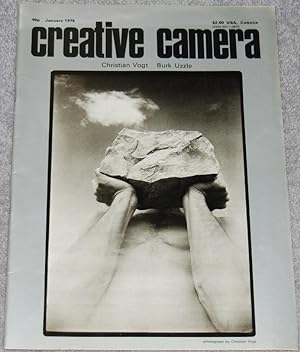
First Edition. First edition. Softcover. January 1976. Features portfolios of images by photographers Christian Vogt and Burk Uzzle. A close to near fine copy in stapled wrappers with some minor wear and a few small spots. Please notice that the info page has 1975 printed even though this issue is actually from 1976.
- Hardcover
Anbieter: Revaluation Books, Exeter, Vereinigtes KönigreichRevaluation Books
Verkäufer/-in kontaktierenVerkäufer/-in mit 5 SternenZustand: Neu
EUR 22,28
EUR 14,59 VersandVersand von Vereinigtes Königreich nach USAAnzahl: 1 verfügbar
Hardcover. Zustand: Brand New. 11.50x9.50x0.50 inches. In Stock.

Handbook of Middle American Indians, Volume 7 Ethnology, part 1
Vogt, Evon Z., Volume Editor, Robert Wauchope General Editor
- Hardcover
Anbieter: N. Fagin Books, Chicago, IL, USAN. Fagin Books
Verkäufer/-in kontaktierenVerkäufer/-in mit 5 SternenZustand: Gebraucht - Gut
EUR 31,51
EUR 5,24 VersandVersand innerhalb von USAAnzahl: 1 verfügbar
Hardcover. Zustand: Very Good. Dust Jacket Included. 1969. Mesoamerica, Native Americans. University of Texas Press. 576p., very good cloth, no dust jacket 4/24.
Microgravity; A Teacher's Guide With Activities for Physical Science [EG-103]
Vogt, Gregory L., and Wargo, Michael J., and Rosenberg, Carla B. (Editor)
Verlag: Washington DC, 1995
- Softcover
Anbieter: Ground Zero Books, Ltd., Silver Spring, MD, USAGround Zero Books, Ltd.
Verkäufer/-in kontaktierenVerkäufer/-in mit 5 SternenZustand: Gebraucht - Befriedigend
EUR 20,26
EUR 4,37 VersandVersand innerhalb von USAAnzahl: 1 verfügbar
Wraps. Zustand: Good. v, 74 pages. Illustrations. Glossary. NASA Educational Materials. NASA Educational Resources. Scuff on title page. Tear at page 73/74. Cover has some wear, soiling, and corner crease. This was prepared under the auspices of the National Aeronautics and Astronautics Administration, Office of Live and Microgr…avity Sciences and Applications, Microgravity Science and Applications Division and Office of Human Resources and Education, Education Division, The term micro-g environment (also µg, often referred to by the term microgravity) is more or less a synonym of weightlessness and zero-g, but indicates that g-forces are not quite zero, just very small. The symbol for microgravity, µg, was used on the insignias of Space Shuttle flights STS-87 and STS-107, because these flights were devoted to microgravity research in low Earth orbit. A "stationary" micro-g environment[2] would require traveling far enough into deep space so as to reduce the effect of gravity by attenuation to almost zero. This is the simplest in conception, but requires traveling an enormous distance, rendering it most impractical. For example, to reduce the gravity of the Earth by a factor of one million, one needs to be at a distance of 6 million kilometers from the Earth, but to reduce the gravity of the Sun to this amount one has to be at a distance of 3.7 billion kilometers. (The gravity due to the rest of the Milky Way is already smaller than one millionth of the gravity on Earth, so we do not need to move away further from its center[citation needed]). Thus it is not impossible, but it has only been achieved so far by four interstellar probes (Voyager 1 and 2, part of the Voyager program, Pioneer 10 and 11 part of the Pioneer program) and they did not return to Earth. To reduce the gravity to one thousandth of that on Earth's surface, one needs to be at a distance of 200,000 km. At a distance relatively close to Earth (less than 3000 km), gravity is only slightly reduced. As an object orbits a body such as the Earth, gravity is still attracting objects towards the Earth and the object is accelerated downward at almost 1g. Because the objects are typically moving laterally with respect to the surface at such immense speeds, the object will not lose altitude because of the curvature of the Earth. When viewed from an orbiting observer, other close objects in space appear to be floating because everything is being pulled towards Earth at the same speed, but also moving forward as the Earth's surface "falls" away below. All these objects are in free fall, not zero gravity.

Controversies in the Classroom A Radical Teacher Reader
Entin, Joseph B. (Editor)/ Rosen, Robert C. (Editor)/ Vogt, Leonard (Editor)
Sprache: Englisch
Verlag: Teachers College Pr, 2008
Serie: Teaching for Social Justice, Buch 9 von 36. Buch 9 von 36 - Teaching for Social Justice
- Softcover
Anbieter: Revaluation Books, Exeter, Vereinigtes KönigreichRevaluation Books
Verkäufer/-in kontaktierenVerkäufer/-in mit 5 SternenZustand: Neu
EUR 27,04
EUR 11,67 VersandVersand von Vereinigtes Königreich nach USAAnzahl: 2 verfügbar
Paperback. Zustand: Brand New. 190 pages. 8.75x6.00x0.50 inches. In Stock.

Sprache: Englisch
Verlag: Star Press, Inc., Burbank, California, 1963
- Softcover
- Erstausgabe
- Zeitschrift
Anbieter: Arroyo Seco Books, Pasadena, Member IOBA, Pasadena, CA, USAArroyo Seco Books, Pasadena, Member IOBA
Verkäufer/-in kontaktierenVerkäufer/-in mit 4 SternenVerbandsmitglied: IOBA
Zustand: Gebraucht - Gut
EUR 31,51
EUR 6,99 VersandVersand innerhalb von USAAnzahl: 1 verfügbar
Wrappers. Zustand: Very Good +. First Edition. 128 Pp. Reprints Tennessee Williams 1928 "The Vengeance Of Nitocris". A Fine Unworn, Unopened Copy, Absolutely Bright And Clean, But Has 3/4 Tear At Bottom Of Front Spine Edge, And A Single 1/8" X 1/4" Chip At Upper Right Corner Of Front Panel. Morris Scott Dollens Color Covers (ill…ustrator).

- Softcover
Anbieter: Revaluation Books, Exeter, Vereinigtes KönigreichRevaluation Books
Verkäufer/-in kontaktierenVerkäufer/-in mit 5 SternenZustand: Neu
EUR 27,37
EUR 11,67 VersandVersand von Vereinigtes Königreich nach USAAnzahl: 2 verfügbar
Paperback. Zustand: Brand New. 197 pages. 8.90x6.00x0.60 inches. In Stock.

Concern for Anabaptist Renewal: A Radical Reformation Reader, 1971 (CONCERN: A Pamphlet Series for Questions of Christian Renewal)
Vogt, Virgil (Editor) / Roberts, Laura Schmidt (Editor) / Roth, John D. (Contributor)
- Softcover
Anbieter: Revaluation Books, Exeter, Vereinigtes KönigreichRevaluation Books
Verkäufer/-in kontaktierenVerkäufer/-in mit 5 SternenZustand: Neu
EUR 27,43
EUR 11,67 VersandVersand von Vereinigtes Königreich nach USAAnzahl: 2 verfügbar
Paperback. Zustand: Brand New. 186 pages. 9.00x6.00x0.42 inches. In Stock.
Verlag: Lawrence Livermore National Laboratory, Livermore, CA, 2017
- Softcover
- Erstausgabe
Anbieter: Ground Zero Books, Ltd., Silver Spring, MD, USAGround Zero Books, Ltd.
Verkäufer/-in kontaktierenVerkäufer/-in mit 5 SternenZustand: Gebraucht - Gut
EUR 22,51
EUR 4,37 VersandVersand innerhalb von USAAnzahl: 2 verfügbar
Wraps. Zustand: Very good. 28 cm, 24 pages plus covers. Wraps. Illustrations (some in color). Covers have slight wear and soiling. Science & Technology Review is currently published eight times a year to communicate, to a broad audience, the Laboratory's scientific and technological accomplishments in support of national securit…y and other enduring national needs. The publication's goal is to help readers understand these accomplishments and appreciate their value to the individual citizen, the nation, and the world. Lawrence Livermore National Laboratory (LLNL) is an American federal research facility in Livermore, California, United States, founded by the University of California in 1952. A Federally Funded Research and Development Center (FFRDC), it is primarily funded by the U.S. Department of Energy (DOE) and managed and operated by Lawrence Livermore National Security, LLC (LLNS), a partnership of the University of California, Bechtel, BWX Technologies, AECOM, and Battelle Memorial Institute in affiliation with the Texas A&M University System. In 2012, the laboratory had the synthetic chemical element livermorium named after it. LLNL was established in 1952 as the University of California Radiation Laboratory at Livermore, an offshoot of the existing UC Radiation Laboratory at Berkeley. It was intended to spur innovation and provide competition to the nuclear weapon design laboratory at Los Alamos in New Mexico, home of the Manhattan Project that developed the first atomic weapons. Edward Teller and Ernest Lawrence,[2] director of the Radiation Laboratory at Berkeley, are regarded as the co-founders of the Livermore facility. The new laboratory was sited at a former naval air station of World War II. It was already home to several UC Radiation Laboratory projects that were too large for its location in the Berkeley Hills above the UC campus, including one of the first experiments in the magnetic approach to confined thermonuclear reactions (i.e. fusion). About half an hour southeast of Berkeley, the Livermore site provided much greater security for classified projects than an urban university campus. Lawrence tapped 32-year-old Herbert York, a former graduate student of his, to run Livermore. Under York, the Lab had four main programs: Project Sherwood (the Magnetic Fusion Program), Project Whitney (the weapons design program), diagnostic weapon experiments (both for the Los Alamos and Livermore laboratories), and a basic physics program. York and the new lab embraced the Lawrence "big science" approach, tackling challenging projects with physicists, chemists, engineers, and computational scientists working together in multidisciplinary teams. Lawrence died in August 1958 and shortly after, the university's board of regents named both laboratories for him, as the Lawrence Radiation Laboratory. Historically, the Berkeley and Livermore laboratories have had very close relationships on research projects, business operations and staff. The Livermore Lab was established initially as a branch of the Berkeley Laboratory. The Livermore Lab was not officially severed administratively from the Berkeley Lab until 1971. To this day, in official planning documents and records, Lawrence Berkeley National Laboratory is designated as Site 100, Lawrence Livermore National Lab as Site 200, and LLNL's remote test location as Site 300. The laboratory was renamed Lawrence Livermore Laboratory (LLL) in 1971. Presumed First Edition, First printing thus.
Verlag: Lawrence Livermore National Laboratory, Livermore, CA, 2016
- Softcover
- Erstausgabe
Anbieter: Ground Zero Books, Ltd., Silver Spring, MD, USAGround Zero Books, Ltd.
Verkäufer/-in kontaktierenVerkäufer/-in mit 5 SternenZustand: Gebraucht - Gut
EUR 22,51
EUR 4,37 VersandVersand innerhalb von USAAnzahl: 1 verfügbar
Wraps. Zustand: Very good. 28 cm, 20 pages plus covers. Wraps. Illustrations (some in color). Covers have slight wear and soiling. Science & Technology Review is currently published eight times a year to communicate, to a broad audience, the Laboratory's scientific and technological accomplishments in support of national securit…y and other enduring national needs. The publication's goal is to help readers understand these accomplishments and appreciate their value to the individual citizen, the nation, and the world. Lawrence Livermore National Laboratory (LLNL) is an American federal research facility in Livermore, California, United States, founded by the University of California in 1952. A Federally Funded Research and Development Center (FFRDC), it is primarily funded by the U.S. Department of Energy (DOE) and managed and operated by Lawrence Livermore National Security, LLC (LLNS), a partnership of the University of California, Bechtel, BWX Technologies, AECOM, and Battelle Memorial Institute in affiliation with the Texas A&M University System. In 2012, the laboratory had the synthetic chemical element livermorium named after it. LLNL was established in 1952 as the University of California Radiation Laboratory at Livermore, an offshoot of the existing UC Radiation Laboratory at Berkeley. It was intended to spur innovation and provide competition to the nuclear weapon design laboratory at Los Alamos in New Mexico, home of the Manhattan Project that developed the first atomic weapons. Edward Teller and Ernest Lawrence,[2] director of the Radiation Laboratory at Berkeley, are regarded as the co-founders of the Livermore facility. The new laboratory was sited at a former naval air station of World War II. It was already home to several UC Radiation Laboratory projects that were too large for its location in the Berkeley Hills above the UC campus, including one of the first experiments in the magnetic approach to confined thermonuclear reactions (i.e. fusion). About half an hour southeast of Berkeley, the Livermore site provided much greater security for classified projects than an urban university campus. Lawrence tapped 32-year-old Herbert York, a former graduate student of his, to run Livermore. Under York, the Lab had four main programs: Project Sherwood (the Magnetic Fusion Program), Project Whitney (the weapons design program), diagnostic weapon experiments (both for the Los Alamos and Livermore laboratories), and a basic physics program. York and the new lab embraced the Lawrence "big science" approach, tackling challenging projects with physicists, chemists, engineers, and computational scientists working together in multidisciplinary teams. Lawrence died in August 1958 and shortly after, the university's board of regents named both laboratories for him, as the Lawrence Radiation Laboratory. Historically, the Berkeley and Livermore laboratories have had very close relationships on research projects, business operations and staff. The Livermore Lab was established initially as a branch of the Berkeley Laboratory. The Livermore Lab was not officially severed administratively from the Berkeley Lab until 1971. To this day, in official planning documents and records, Lawrence Berkeley National Laboratory is designated as Site 100, Lawrence Livermore National Lab as Site 200, and LLNL's remote test location as Site 300. The laboratory was renamed Lawrence Livermore Laboratory (LLL) in 1971. Presumed First Edition, First printing thus.

- Softcover
Anbieter: Revaluation Books, Exeter, Vereinigtes KönigreichRevaluation Books
Verkäufer/-in kontaktierenVerkäufer/-in mit 5 SternenZustand: Neu
EUR 12,16
EUR 11,67 VersandVersand von Vereinigtes Königreich nach USAAnzahl: 2 verfügbar
Paperback. Zustand: Brand New. 110 pages. German language. 5.71x0.35x8.19 inches. In Stock.

- Hardcover
Anbieter: Revaluation Books, Exeter, Vereinigtes KönigreichRevaluation Books
Verkäufer/-in kontaktierenVerkäufer/-in mit 5 SternenZustand: Neu
EUR 30,79
EUR 11,67 VersandVersand von Vereinigtes Königreich nach USAAnzahl: 2 verfügbar
Hardcover. Zustand: Brand New. 100 pages. 8.00x5.25x0.75 inches. In Stock.
Verlag: Universitetsforlaget
Anbieter: Kennys Bookstore, Olney, MD, USAKennys Bookstore
Verkäufer/-in kontaktierenVerkäufer/-in mit 5 SternenZustand: Gebraucht - Gut
EUR 12,93
EUR 9,18 VersandVersand innerhalb von USAAnzahl: 1 verfügbar
Zustand: Very Good.

3 Days
Bernhard, Thomas/ Radax, Ferry (Photographer)/ Lindgren, Laura (Editor)/ Vogt, Georg (Afterword)
- Hardcover
Anbieter: Revaluation Books, Exeter, Vereinigtes KönigreichRevaluation Books
Verkäufer/-in kontaktierenVerkäufer/-in mit 5 SternenZustand: Neu
EUR 33,07
EUR 11,67 VersandVersand von Vereinigtes Königreich nach USAAnzahl: 1 verfügbar
Hardcover. Zustand: Brand New. 160 pages. 9.00x5.50x0.75 inches. In Stock.

- Softcover
Anbieter: Revaluation Books, Exeter, Vereinigtes KönigreichRevaluation Books
Verkäufer/-in kontaktierenVerkäufer/-in mit 5 SternenZustand: Neu
EUR 33,42
EUR 11,67 VersandVersand von Vereinigtes Königreich nach USAAnzahl: 1 verfügbar
Paperback. Zustand: Brand New. 200 pages. 8.00x5.25x0.90 inches. In Stock.
Verlag: Universitetsforlaget, 1971
Anbieter: Kennys Bookshop and Art Galleries Ltd., Galway, GY, IrlandKennys Bookshop and Art Galleries Ltd.
Verkäufer/-in kontaktierenVerkäufer/-in mit 5 SternenZustand: Gebraucht - Gut
EUR 12,00
EUR 10,50 VersandVersand von Irland nach USAAnzahl: 1 verfügbar
Zustand: Very Good.

Verlag: Dreyers Forlag, Oslo, 1961
- Hardcover
Anbieter: Godley Books, Hyde, Vereinigtes KönigreichGodley Books
Verkäufer/-in kontaktierenVerkäufer/-in mit 5 SternenZustand: Gebraucht - Gut
EUR 12,02
EUR 18,62 VersandVersand von Vereinigtes Königreich nach USAAnzahl: 1 verfügbar
Hard Cover. Zustand: Very Good (+). No Jacket. No marks or inscriptions. No creasing to covers or to spine. A very clean very tight copy with slightly sunned boards and tiny bump to lower rear corner. 144pp. Eighth revised edition. A well illustrated book covering most aspects of Norway and Norwegian life. We do not use stock ph…otos, the picture displayed is of the actual book for sale. Every one of our books is in stock in the UK ready for immediate delivery. Size: 11.75 x 8.5 inches.

Queer*Welten 10-2023
Vogt, Judith C. (Editor) / Richter, Lena (Editor) / Knopp-Sullivan, Heike (Editor)
Sprache: Deutsch
Verlag: Ach je Verlag, 2023
Serie: Queer*Welten, Buch 10 von 13. Buch 10 von 13 - Queer*Welten
- Softcover
Anbieter: Revaluation Books, Exeter, Vereinigtes KönigreichRevaluation Books
Verkäufer/-in kontaktierenVerkäufer/-in mit 5 SternenZustand: Neu
EUR 12,25
EUR 14,59 VersandVersand von Vereinigtes Königreich nach USAAnzahl: 1 verfügbar
Paperback. Zustand: Brand New. German language. 8.31x5.87x0.47 inches. In Stock.

Law and Disputing in the Middle Ages: Proceedings of the Ninth Carlsberg Academy Conference on Medieval Legal History 2012
Andersen, Per, Kirsi Salonen, Helle Moller Sigh and Helle Vogt, eds. (Editor)
Verlag: DJOF Publishing, 2012
- Softcover
- Erstausgabe
Anbieter: Structure, Verses, Agency Books, Spray, OR, USAStructure, Verses, Agency Books
Verkäufer/-in kontaktierenVerkäufer/-in mit 5 SternenZustand: Gebraucht - Wie neu
EUR 25,21
EUR 6,34 VersandVersand innerhalb von USAAnzahl: 1 verfügbar
Softcover. Zustand: As New. First Edition. Sterling condition softcover copy, with unfurled tips, tight binding, and clean internals, showing only very slight shelf- and edge-wear to the glossy, illustrated wrappers. From the publisher's blurb, "This book contains the proceedings of the conference "Law and Disputing in the Middl…e Ages," held in May 2012 at the Carlsberg Academy in Copenhagen. It includes articles from an international group of scholars on various aspects of disputing, not only from a legal perspective, but also sociological and historical perspectives in the Middle Ages. The geographical focus is on Europe, covering a multitude of aspects regarding law and disputing, such as the concept of disputing itself, the formal and practical sides of dispute settlements, as well as various disputing strategies. The book will be of interests to students and scholars working within European legal culture studies and the cultural, social, and economic history of the Middle Ages." Contributions by all four editors and by Stephen White, Bruce B. Brasington, Bruno Lemesle, Matthew W. McHattie, Jon Vidar Sigurdsson, Jonathan Rose, Paul Hyams, Pia Letto-Vanamo, Kate Hammond, Gianluca Raccagni, Nella Lonza, Frederik Kegnaert, Joshua C. Tate, Albrech Cordes, John Witte, Jr. and Per Andersen.Member, I.O.B.A., C.B.A., and adherent to the highest ethical standards. Additional postage may be required for oversize or especially heavy volumes, and for sets.

- Softcover
Anbieter: Revaluation Books, Exeter, Vereinigtes KönigreichRevaluation Books
Verkäufer/-in kontaktierenVerkäufer/-in mit 5 SternenZustand: Neu
EUR 35,65
EUR 11,67 VersandVersand von Vereinigtes Königreich nach USAAnzahl: 2 verfügbar
Paperback. Zustand: Brand New. 182 pages. 8.90x5.90x0.40 inches. In Stock.

- Softcover
Anbieter: Revaluation Books, Exeter, Vereinigtes KönigreichRevaluation Books
Verkäufer/-in kontaktierenVerkäufer/-in mit 5 SternenZustand: Neu
EUR 36,48
EUR 11,67 VersandVersand von Vereinigtes Königreich nach USAAnzahl: 2 verfügbar
Paperback. Zustand: Brand New. reprint edition. 290 pages. 8.75x6.25x0.75 inches. In Stock.

- Softcover
Anbieter: Revaluation Books, Exeter, Vereinigtes KönigreichRevaluation Books
Verkäufer/-in kontaktierenVerkäufer/-in mit 5 SternenZustand: Neu
EUR 35,49
EUR 14,59 VersandVersand von Vereinigtes Königreich nach USAAnzahl: 2 verfügbar
Paperback. Zustand: Brand New. 226 pages. 9.06x6.10x0.59 inches. In Stock.

- Softcover
Anbieter: Revaluation Books, Exeter, Vereinigtes KönigreichRevaluation Books
Verkäufer/-in kontaktierenVerkäufer/-in mit 5 SternenZustand: Neu
EUR 38,21
EUR 11,67 VersandVersand von Vereinigtes Königreich nach USAAnzahl: 2 verfügbar
Paperback. Zustand: Brand New. 192 pages. 8.75x6.00x0.50 inches. In Stock.
 Weitere Bilder
Verlag: Coo Press Ltd., London, 1976
- Softcover
- Erstausgabe
Anbieter: Springhead Books, Rochester, Vereinigtes KönigreichSpringhead Books
Verkäufer/-in kontaktierenVerkäufer/-in mit 5 SternenZustand: Gebraucht - Gut
EUR 13,17
EUR 19,85 VersandVersand von Vereinigtes Königreich nach USAAnzahl: 1 verfügbar
Soft cover. Zustand: Very Good. 1st Edition. Includes works by Christian Vogt ; Burk Uzzle. Paginated pages 1-36, illustrations. Slight shelf wear to edges, staples starting to rust, no inscriptions. Photographs available on request. All books dispatched same or next working day in robust packaging.


