

Gesamtpreis (1 Artikel Artikel):
Versandziel:

dill harald (18 Ergebnisse)
Direkt zu den wichtigsten Suchergebnissen
Suchfilter
Produktart
- Alle Product Types
- Bücher (18)
- Magazine & Zeitschriften (Keine weiteren Ergebnisse entsprechen dieser Verfeinerung)
- Comics (Keine weiteren Ergebnisse entsprechen dieser Verfeinerung)
- Noten (Keine weiteren Ergebnisse entsprechen dieser Verfeinerung)
- Kunst, Grafik & Poster (Keine weiteren Ergebnisse entsprechen dieser Verfeinerung)
- Fotografien (Keine weiteren Ergebnisse entsprechen dieser Verfeinerung)
- Karten (Keine weiteren Ergebnisse entsprechen dieser Verfeinerung)
- Manuskripte & Papierantiquitäten (Keine weiteren Ergebnisse entsprechen dieser Verfeinerung)
Zustand Mehr dazu
- Neu (7)
- Wie Neu, Sehr Gut oder Gut Bis Sehr Gut (4)
- Gut oder Befriedigend (5)
- Ausreichend oder Schlecht (Keine weiteren Ergebnisse entsprechen dieser Verfeinerung)
- Wie beschrieben (2)
Einband
Weitere Eigenschaften
- Erstausgabe (1)
- Signiert (Keine weiteren Ergebnisse entsprechen dieser Verfeinerung)
- Schutzumschlag (Keine weiteren Ergebnisse entsprechen dieser Verfeinerung)
- Angebotsfoto (10)
Sprache (3)
Gratisversand
- Kostenloser Versand nach USA (Keine weiteren Ergebnisse entsprechen dieser Verfeinerung)
Land des Verkäufers
Verkäuferbewertung
-

Aluminium Phospahte and Sulfate Minerals - Prospecting Targets or Prospecting Tools?.
Verlag: Schweizerbart sche Verlagsbuchhandlung, 1997
Anbieter: Abrahamschacht-Antiquariat Schmidt, Freiberg, Deutschland
Verkäuferbewertung 4 von 5 Sternen

8°, Originalbroschur, Seiten 27- 38, geringe Gebrauchsspuren an Einband und Block, Block sauber und fest, Rücken ordentlich mit Klebestreifen verstärkt Zeitschrift für Angewandte Geologie, Band 43 Deutsch 300g.
-

Oberpfälzer Heimat 2013: 57. Band, Beiträge zur Heimatkunde der Oberpfalz
Anbieter: Ostmark-Antiquariat Franz Maier, Waffenbrunn, Deutschland
Verkäuferbewertung 4 von 5 Sternen
Softcover. Zustand: Wie neu. Broschur mit vielen, z. T. farbigen Fotos, Kartenskizzen und -ausschnitten, 21x15 cm, 236 Seiten, Zustand: wie Neu!(intern: Oberpfalz).
-
Sedimentpetrographie des Stockheimer Rotliegendbeckens, Nordostbayern. Mit 12 abbildungen und 13 Tafeln. 2. Titel: Disthen im Schwermineralspektrum des Erbendrofer Permokarbons. Mit 2 Abbildungen.
Sprache: Deutsch
Verlag: Hannover 1988. In Kommission: Schweizerbart, Stuttgart., 1988
Anbieter: Antiquariat Stefan Wulf, Berlin, Deutschland
Verkäuferbewertung 5 von 5 Sternen

Gr. Oktav, Org.-Softcover mit illustr. Org.-SU, 72 S., 2 Bll., mit einer großen farbigen Faltkarte im Anhang, wohlerhaltenes Exemplar. [Geologisches Jahrbuch Reihe D]. [Geologisches Jahrbuch Reihe D]. 1000 g.
-

The Hagendorf-Pleystein Province: the Center of Pegmatites in an Ensialic Orogen (Modern Approaches in Solid Earth Sciences, 15)
Buch 10 von 23: Modern Approaches in Solid Earth SciencesAnbieter: Ria Christie Collections, Uxbridge, Vereinigtes Königreich
Verkäuferbewertung 5 von 5 Sternen
EUR 115,43
EUR 13,86 Versand
Versand von Vereinigtes Königreich nach USAAnzahl: Mehr als 20 verfügbar
In den WarenkorbZustand: New. In.
-

The Hagendorf-Pleystein Province: the Center of Pegmatites in an Ensialic Orogen
Buch 10 von 23: Modern Approaches in Solid Earth SciencesSprache: Englisch
Verlag: Springer International Publishing, 2015
ISBN 10: 3319188054 ISBN 13: 9783319188058
EUR 92,27
EUR 48,99 Versand
Versand von Deutschland nach USAAnzahl: Mehr als 20 verfügbar
In den WarenkorbGebunden. Zustand: New.
-

The Hagendorf-Pleystein Province: the Center of Pegmatites in an Ensialic Orogen
Buch 10 von 23: Modern Approaches in Solid Earth SciencesSprache: Englisch
Verlag: Springer International Publishing, 2016
ISBN 10: 3319350420 ISBN 13: 9783319350424
EUR 92,27
EUR 48,99 Versand
Versand von Deutschland nach USAAnzahl: Mehr als 20 verfügbar
In den WarenkorbZustand: New.
-
Taschenbuch. Zustand: Neu. The Hagendorf-Pleystein Province: the Center of Pegmatites in an Ensialic Orogen | Harald G. Dill | Taschenbuch | xiv | Englisch | 2016 | Springer | EAN 9783319350424 | Verantwortliche Person für die EU: Springer Verlag GmbH, Tiergartenstr. 17, 69121 Heidelberg, juergen[dot]hartmann[at]springer[dot]com | Anbieter: preigu.
-

The Hagendorf-Pleystein Province: the Center of Pegmatites in an Ensialic Orogen
Buch 10 von 23: Modern Approaches in Solid Earth SciencesSprache: Englisch
Verlag: Springer International Publishing, Springer International Publishing, 2016
ISBN 10: 3319350420 ISBN 13: 9783319350424
Anbieter: AHA-BUCH GmbH, Einbeck, Deutschland
Verkäuferbewertung 5 von 5 Sternen
Taschenbuch. Zustand: Neu. Druck auf Anfrage Neuware - Printed after ordering - This book will broaden readers' understanding of pegmatites in a special geodynamic setting, dealing with the emplacement of the Hagendorf-Pleystein Pegmatite Province (HPPP) in the Central European Variscides. This treatise illustrates the complex processes leading to the formation and partial destruction of the pegmatites, documenting the geochronological, chemical, mineralogical, geological and geomorphological / sedimentological data set. The book starts with a detailed account of the economic geology of the various pegmatites, explaining why these deposits are a major resource of ceramic raw materials. In its concluding section, a model of the pegmatite evolution in an ensialic orogen provides meaningful insights into the genetic aspects of pegmatite generation.The Late Paleozoic rare-element pegmatites of the HPPP, Oberpfalz-SE, Germany, rank among the largest concentrations in Europe. The biggest pegmatite of this mining district totals 4.4 million tons of ore (Hagendorf-South). The mining history of the HPPP is restricted to the 20th century, when local entrepreneurs started mining operations in search of ceramic raw materials, feldspar and quartz. Today the 'Silbergrube Aplite' is still worked for feldspar. The traditional mining of pegmatitic and aplitic rocks in Central Europe, such as the Bohemian Massif, which is shared by Germany, the Czech Republic, Poland and Austria, has been focused on these industrial minerals. In addition to these major commodities, lithium was mined for a period of time. But even today many of these pegmatites of calc-alkaline affiliation have not lost their appeal to mineralogists and mineral enthusiasts for their wealth of minerals that contain P, Nb, Ta, Li, Be, B, U, Th, Sc, Ti and Sn. The most favorable crustal section to bring about pegmatitic rocks of this type, encompassing pegmatoids, metapegmatites, reactivated pseudopegmatites and pegmatites sensu stricto is the ensialic orogen,exemplified by the Variscan (Hercynian) Orogen, which geodynamically connects the Paleozoic pegmatite provinces in North America and Europe. The geological history of the HPPP, however, goes much further than the Carboniferous-Permian magmatic activity, when the last structural disturbances of the Variscan orogeny affected the NE-Bavarian Basement between 450 and 330 Ma. During this time mafic magmatic rocks together with calcareous and arenaceous sediments were converted into paragneisses, calcsilicate rocks, and amphibolites. It is the period of time when tectonic shortening led to over thrusting and when the emplacement of nappes and the architectural elements of the ensialic orogen began taking shape. During the Late Permian, the Mesozoic and the Cenozoic, the HPPP did not lie idle in geological terms; hypogene and supergene alteration continued and found its most recent expression in alluvial-fluvial 'nigrine' placer deposits, which resulted from the unroofing of the pegmatites and aplites in the HPPP and can be used even outside HPPP as an ore guide to pegmatites.
-

The Hagendorf-Pleystein Province: the Center of Pegmatites in an Ensialic Orogen
Buch 10 von 23: Modern Approaches in Solid Earth SciencesAnbieter: AHA-BUCH GmbH, Einbeck, Deutschland
Verkäuferbewertung 5 von 5 Sternen
Buch. Zustand: Neu. Druck auf Anfrage Neuware - Printed after ordering - This book will broaden readers' understanding of pegmatites in a special geodynamic setting, dealing with the emplacement of the Hagendorf-Pleystein Pegmatite Province (HPPP) in the Central European Variscides. This treatise illustrates the complex processes leading to the formation and partial destruction of the pegmatites, documenting the geochronological, chemical, mineralogical, geological and geomorphological / sedimentological data set. The book starts with a detailed account of the economic geology of the various pegmatites, explaining why these deposits are a major resource of ceramic raw materials. In its concluding section, a model of the pegmatite evolution in an ensialic orogen provides meaningful insights into the genetic aspects of pegmatite generation.The Late Paleozoic rare-element pegmatites of the HPPP, Oberpfalz-SE, Germany, rank among the largest concentrations in Europe. The biggest pegmatite of this mining district totals 4.4 million tons of ore (Hagendorf-South). The mining history of the HPPP is restricted to the 20th century, when local entrepreneurs started mining operations in search of ceramic raw materials, feldspar and quartz. Today the 'Silbergrube Aplite' is still worked for feldspar. The traditional mining of pegmatitic and aplitic rocks in Central Europe, such as the Bohemian Massif, which is shared by Germany, the Czech Republic, Poland and Austria, has been focused on these industrial minerals. In addition to these major commodities, lithium was mined for a period of time. But even today many of these pegmatites of calc-alkaline affiliation have not lost their appeal to mineralogists and mineral enthusiasts for their wealth of minerals that contain P, Nb, Ta, Li, Be, B, U, Th, Sc, Ti and Sn. The most favorable crustal section to bring about pegmatitic rocks of this type, encompassing pegmatoids, metapegmatites, reactivated pseudopegmatites and pegmatites sensu stricto is the ensialic orogen,exemplified by the Variscan (Hercynian) Orogen, which geodynamically connects the Paleozoic pegmatite provinces in North America and Europe. The geological history of the HPPP, however, goes much further than the Carboniferous-Permian magmatic activity, when the last structural disturbances of the Variscan orogeny affected the NE-Bavarian Basement between 450 and 330 Ma. During this time mafic magmatic rocks together with calcareous and arenaceous sediments were converted into paragneisses, calcsilicate rocks, and amphibolites. It is the period of time when tectonic shortening led to over thrusting and when the emplacement of nappes and the architectural elements of the ensialic orogen began taking shape. During the Late Permian, the Mesozoic and the Cenozoic, the HPPP did not lie idle in geological terms; hypogene and supergene alteration continued and found its most recent expression in alluvial-fluvial 'nigrine' placer deposits, which resulted from the unroofing of the pegmatites and aplites in the HPPP and can be used even outside HPPP as an ore guide to pegmatites.
-
The Hagendorf-Pleystein Province: the Center of Pegmatites in an Ensialic Orogen (Modern Approaches in Solid Earth Sciences)
Buch 10 von 23: Modern Approaches in Solid Earth SciencesAnbieter: Revaluation Books, Exeter, Vereinigtes Königreich
Verkäuferbewertung 5 von 5 Sternen
EUR 155,35
EUR 40,49 Versand
Versand von Vereinigtes Königreich nach USAAnzahl: 2 verfügbar
In den WarenkorbPaperback. Zustand: Brand New. reprint edition. 475 pages. 9.25x6.10x1.11 inches. In Stock.
-

Zustand: Gut. Zustand: Gut | Seiten: 566 | Sprache: Deutsch | Produktart: Bücher | Keine Beschreibung verfügbar.
-
Zustand: Sehr gut. Zustand: Sehr gut | Seiten: 566 | Sprache: Deutsch | Produktart: Bücher | Keine Beschreibung verfügbar.
-

Der Luftkrieg in Nordostbayern - Ein vergessenes Kapitel unserer Heimatgeschichte
Sprache: Deutsch
Verlag: Heinz Späthling, Weißenstadt, 2011
ISBN 10: 3926621958 ISBN 13: 9783926621955
Anbieter: 3 Mile Island, Grafenwöhr, Deutschland
Verkäuferbewertung 4 von 5 Sternen
Erstausgabe
Hardcover. Zustand: Sehr gut. 1. Auflage. Pappband - sehr gut.
-
Der Luftkrieg in Nordostbayern Ein vergessenes Kapitel unserer Heimatgeschichte [Gebundene Ausgabe] ADIZ Bombenangriffe Drittes Reich Drittes Reich; Militär-/Kriegs-Geschichte Einflugbetrieb Fermeldeeinrichtungen Flak Fliegerschulen Funkmessgeräte Jagdbomber Jagdflugzeuge Jagdflugzeugfertigung Kalter Krieg Kampfflugzeuge Luftkrieg 1939-1945 Luftnachrichtentruppe Luftwaffe Luftwaffenverbände Messerschmitt Nachtschlachtflugzeuge Nahaufklärer Nordostbayern Nordostbayern, Geschichte; Militär-/Kriegs-Geschichte RAF Sachsen Schlachtflugzeuge Schulmaschinen Thüringen Tschechische Republik USAAF Harald G. Dill (Autor), Karlheinz Hetz (Autor)
Anbieter: BUCHSERVICE / ANTIQUARIAT Lars Lutzer, Wahlstedt, Deutschland
Verkäuferbewertung 4 von 5 Sternen
Hardcover. Zustand: gut. 2011. Vom Reichsluftschutzkeller zur Endkampfarena - Der Luftkrieg in Nordostbayern. In den Anfangsjahren lag die Bayerische Ostmark weit ab vom Schuß . Die Ausbildung der Piloten auf Segelflugzeug und Jagdeinsitzer, die Unterweisung der schwarzen Männer (Bodenpersonal), die Lehrlingsausbildung zum RLM-Luftfahrzeugtechniker und die Produktion von Jagdflugzeugen in den Messerschmittwerken verliefen in Nordostbayern weitgehend ohne Beeinträchtigung durch die alliierten Luftstreitkräfte. 1943 verdeutlichten die ersten Abstürze deutscher und alliierter Flugzeuge nach Luftkämpfen und Flak-Beschuß, dass diese relativ ruhigen Zeiten sich ihrem Ende näherten. Die nordostbayerischen Städte wurden in der Prioritätenskala des Bomberkommandos vom Ausweich- zum Hauptziel empor gestuft. 1945 brach die Luftwaffeninfrastruktur immer mehr zusammen und die Reste der Luftwaffe, in Nordostbayern eingekesselt zwischen den Westalliierten und der Roten Armee, lagen am Boden. Die Flugzeugwerke in der Oberpfalz produzierten die neuesten Baureihen der Me 109 und die den alliierten Jagdflugzeugen überlegene Me 262 , während die Luftwaffenangehörigen quasi vor den Werkstoren der Produktionsstätten als Fliegerinfanteristen an der heutigen Ostgrenze Bayerns eine Westfront aufzubauen suchten. Ende April und Anfang Mai gab es für zahlreiche Luftwaffenangehörigen nur noch einen Ausweg aus dieser Endkampfarena. Solange der Treibstoff reichte und noch flugfähige Maschinen vorhanden waren, strebten die Menschen nach Westen, in die von der US Armee besetzten Gebiete. Oberfranken, das nördliche Mittelfranken und die nördliche Oberpfalz lagen gewissermaßen im Zentrum des damaligen Großdeutschen Reiches . Diese geostrategisch günstige Lage ermöglichte in den Anfangsjahren des 2. Weltkrieges die Ausbildung von Luftwaffenpersonal unter quasi friedensmäßigen Bedingungen. Im Zuge dieser Ausbildung kam es immer wieder zu Flugunfällen. Dies gilt auch für Werkstatt- und Überführungsflüge, die zwar in den Anfangsjahren des Krieges noch unbehelligt von den gegnerischen Luftstreitkräften durchgeführt werden konnten, aber auch nicht ohne material- und ausbildungsbedingte Abstürze abliefen. Die abgelegene Position der Region und die Nähe zum KZ Flossenbürg waren mit ein Grund für die Dislozierung der Jagdflugzeugproduktion in die nördliche Oberpfalz (Messerschmittwerke). Die ersten Luftangriffe fanden 1940 ausgeführt durch RAF-Bomber statt. Die Luftkriegslage verschlimmerte sich aber zusehends als die 8. USAAF 1943 begann Rüstungszentren in Schweinfurt, Nürnberg und Regensburg zu bombardieren. Mitte 1944 erschienen US-Bomber über Nordbayern mit Begleitjägern, die nicht nur die Bomber gegen die deutschen Jagdflugzeuge schützen, sondern auch bereits zu Tiefangriffen auf militärische Einrichtungen übergingen. Ende 1944 und 1945 nahmen diese Tiefangriffe der US-amerikanischen Kampfflugzeuge stark zu. Jagdbomber, zweimotorige Kampfflugzeuge, Nahaufklärer wurden von der Luftwaffe gegen die vorrückenden alliierten Bodentruppen aufgeboten, unterstützt von leichten Fla-Batterien. Die meisten schweren Fla-Batterien waren bereits an bedeutendere Schutzobjekte wie Raffinerien und Hydrierwerke verlegt worden. Im Zuge des Rückzuges im Frühjahr 1945 brach auch die Infrastruktur der Luftraumüberwachung bestehend aus Flugwachstützpunkten und Funkmessstationen zusammen. Einige Luftwaffensoldaten, im Erdeinsatz nicht ausgebildet, wurden noch gegen die US Army eingesetzt. Unmittelbar vor und nach der Kapitulation versuchten Luftwaffenangehörige sich der Gefangenschaft durch die Rote Armee zu entziehen. Einigen gelang es mit den letzten Maschinen aus dem ehemaligen Protektorat Böhmen und Mähren (Tschechische Republik) und von Österreich nach Nordostbayern, in die von der US Army besetztes Gebiete zu fliehen. Sprache deutsch Maße 165 x 230 mm Einbandart: gebunden Geisteswissenschaften Geschichte Regionalgeschichte Ländergeschichte ADIZ Bombenangriffe Drittes Reich Drittes Reich; Militär-/Kriegs-Geschichte Einflugbetrieb Fermeldeeinrichtungen Flak Fliegerschulen Funkmessgeräte Jagdbomber Jagdflugzeuge Jagdflugzeugfertigung Kalter Krieg Kampfflugzeuge Luftkrieg 1939-1945 Luftnachrichtentruppe Luftwaffe Luftwaffenverbände Messerschmitt Nachtschlachtflugzeuge Nahaufklärer Nordostbayern Nordostbayern, Geschichte; Militär-/Kriegs-Geschichte RAF Sachsen Schlachtflugzeuge Schulmaschinen Thüringen Tschechische Republik USAAF ISBN-10 3-926621-95-8 / 3926621958 ISBN-13 978-3-926621-95-5 / 9783926621955 Der Luftkrieg in Nordostbayern Ein vergessenes Kapitel unserer Heimatgeschichte [Gebundene Ausgabe] Harald G. Dill (Autor), Karlheinz Hetz (Autor) In deutscher Sprache. 208 pages. 23,4 x 17 x 1,8 cm.
-

Die Oberpfälzer Flussspat-Anthologie: "Bunte Steine" prägen die Region und ihre Menschen um den Wölsenberg "bunte Steine" prägen die Region und ihre Menschen um den Wölsenberg
Anbieter: Book Broker, Berlin, Deutschland
Verkäuferbewertung 5 von 5 Sternen
Gebundene Ausgabe. Zustand: Sehr gut. 312 S. Alle Bücher & Medienartikel von Book Broker sind stets in gutem & sehr gutem gebrauchsfähigen Zustand. Die Ausgabe des gelieferten Exemplars kann um bis zu 10 Jahre vom angegebenen Veröffentlichungsjahr abweichen und es kann sich um eine abweichende Auflage handeln. Unser Produktfoto entspricht dem hier angebotenen Artikel, dieser weist folgende Merkmale auf: Helle/saubere Seiten in fester Bindung. Leichte Gebrauchsspuren. Sprache: Deutsch Gewicht in Gramm: 854.
-

Sedimentpetrographie des Stockheimer Rotliegendbeckens, Nordostbayern Disthen im Schwermineralspektrum des Erbendorfer Permokarbons / Harald Dill. Hrsg. von d. Bundesanstalt für Geowiss. u. Rohstoffe u.d. Geolog. Landesämtern in d. Bundesrepublik Deutschland / Geologisches Jahrbuch / Reihe D / Mineralogie, Petrographie, Geochemie, Lagerstättenkunde ; Heft 88
Sprache: Deutsch
Verlag: Stuttgart : Schweizerbart, 1988
Anbieter: Bücher bei den 7 Bergen, Sibbesse, Deutschland
Verkäuferbewertung 5 von 5 Sternen
brosch., engl. Zustand: Gut. 72 S. : Ill. (z.T. farb.), graph. Darst., Kt. ; 25 cm Literaturangaben. Guter Zustand. EZ1303 Sprache: Deutsch Gewicht in Gramm: 440.
-
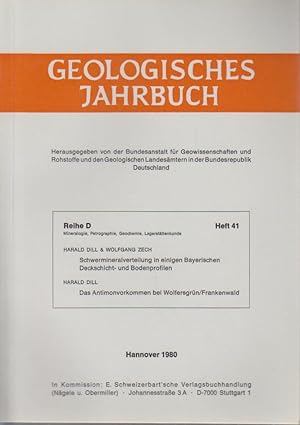
Schwermineralverteilung in einigen bayerischen Deckschicht- und Bodenprofilen / Harald Dill und Wolfgang Zech Das Antimonvorkommen bei Wolfersgrün, Frankenwald / Harald Dill / Geologisches Jahrbuch / Reihe D / Mineralogie, Petrographie, Geochemie, Lagerstättenkunde ; Heft 41.
Sprache: Deutsch
Verlag: Stuttgart : Schweizerbart, 1980
Anbieter: Bücher bei den 7 Bergen, Sibbesse, Deutschland
Verkäuferbewertung 5 von 5 Sternen
brosch. Zustand: Gut. 38 S. : Ill. (farb.), Kt. ; 24 cm Literaturangaben. Guter Zustand. EH3111 Sprache: Deutsch Gewicht in Gramm: 200.
-

Neue Ergebnisse zur Mineralogie der primären Uranträger auf den Gruben Höhensteinweg, Poppenreuth und Wäldel, Mähring in Nordostbayern mit besonderer Berücksichtigung der Uran-Titan- und Phosphor-Kohlenstoff-Verbindungen / Harald Dill / Geologisches Jahrbuch / Reihe D / Mineralogie, Petrographie, Geochemie, Lagerstättenkunde ; Heft 42.
Sprache: Deutsch
Verlag: Hannover : Bundesanstalt für Geowiss. u. Rohstoffe - Stuttgart : Schweizerbart, 1980
Anbieter: Bücher bei den 7 Bergen, Sibbesse, Deutschland
Verkäuferbewertung 5 von 5 Sternen
brosch. Zustand: Gut. 42 S. : Ill., graph. Darst., Kt. ; 24 cm Literaturverz. S. 25 - 28. Guter Zustand. EH3110 Sprache: Deutsch Gewicht in Gramm: 200.


