

Gesamtpreis (1 Artikel Artikel):
Versandziel:

dempsey bob (20 Ergebnisse)
Direkt zu den wichtigsten Suchergebnissen
Suchfilter
Produktart
- Alle Product Types
- Bücher (20)
- Magazine & Zeitschriften (Keine weiteren Ergebnisse entsprechen dieser Verfeinerung)
- Comics (Keine weiteren Ergebnisse entsprechen dieser Verfeinerung)
- Noten (Keine weiteren Ergebnisse entsprechen dieser Verfeinerung)
- Kunst, Grafik & Poster (Keine weiteren Ergebnisse entsprechen dieser Verfeinerung)
- Fotografien (Keine weiteren Ergebnisse entsprechen dieser Verfeinerung)
- Karten (Keine weiteren Ergebnisse entsprechen dieser Verfeinerung)
- Manuskripte & Papierantiquitäten (Keine weiteren Ergebnisse entsprechen dieser Verfeinerung)
Zustand Mehr dazu
- Neu (5)
- Wie Neu, Sehr Gut oder Gut Bis Sehr Gut (Keine weiteren Ergebnisse entsprechen dieser Verfeinerung)
- Gut oder Befriedigend (12)
- Ausreichend oder Schlecht (Keine weiteren Ergebnisse entsprechen dieser Verfeinerung)
- Wie beschrieben (3)
Einband
Weitere Eigenschaften
Sprache (2)
Gratisversand
Land des Verkäufers
Verkäuferbewertung
-

Dempsey Bob : In His Own Voice
Anbieter: Better World Books: West, Reno, NV, USA
Verkäuferbewertung 5 von 5 Sternen

Zustand: Good. Former library copy. Pages intact with minimal writing/highlighting. The binding may be loose and creased. Dust jackets/supplements are not included. Includes library markings. Stock photo provided. Product includes identifying sticker. Better World Books: Buy Books. Do Good.
-

Dempsey
Verlag: Avon
Anbieter: ThriftBooks-Atlanta, AUSTELL, GA, USA
Verkäuferbewertung 5 von 5 Sternen
Unknown. Zustand: Good. No Jacket. Pages can have notes/highlighting. Spine may show signs of wear. ~ ThriftBooks: Read More, Spend Less.
-
Who's Who in Boxing
Sprache: Englisch
Verlag: First edition, published by Arlington House, New Rochelle, New York, 1974., 1974
ISBN 10: 0870002325 ISBN 13: 9780870002328
Erstausgabe
Very good with very good dust jacket. Dust jacket is lightly bumped along top and bottom edges. Small smudge in margin of page 122. 208 pages.
-
The best of Bob Edwards
Anbieter: Chapter 1, Johannesburg, GAU, Südafrika
Verkäuferbewertung 5 von 5 Sternen
Hardcover. Zustand: Good. Zustand des Schutzumschlags: Good. Publication of 271 pages. The spine of the book has faded slightly. The dust jacket has slight chipped marks, small tear and is slightly edge worn. Underneath the boards remain in good condition. But it still presents handsomely in cellophane. The binding is excellent. There is slight tanning around the block of the book. The pages are bright and attractive, and the text remains clear. GK. Our orders are shipped using tracked courier delivery services.
-

Restoring Praise and Worship to the Church
Anbieter: Ria Christie Collections, Uxbridge, Vereinigtes Königreich
Verkäuferbewertung 5 von 5 Sternen
EUR 21,55
EUR 13,80 Versand
Versand von Vereinigtes Königreich nach USAAnzahl: Mehr als 20 verfügbar
In den WarenkorbZustand: New. In English.
-

Massacre in the Sun
Verlag: William Heinemann, 1961
Anbieter: World of Rare Books, Goring-by-Sea, SXW, Vereinigtes Königreich
Verkäuferbewertung 5 von 5 Sternen
EUR 20,87
EUR 5,55 Versand
Versand von Vereinigtes Königreich nach USAAnzahl: 1 verfügbar
In den WarenkorbZustand: Good. 1961. Reprint. 248 pages. Orange pictorial dust jacket over red cloth. Black and white photographic plates. Pages are lightly tanned at the edges, with light foxing. Occasional thumb marks to pages edges. Binding has remained firm. Boards have slight shelf wear with bumping to corners. Spine ends are a little crushed. Light tanning to spine and edges. Boards are slightly bowed. Slight forward lean to text block. Light wear to unclipped dust jacket with tears, nicks and creases to spine, edge and corners. Light tanning to spine and edges. Moderate loss to spine ends.
-
Dempsey Bob: In His Own Voice
Anbieter: Ria Christie Collections, Uxbridge, Vereinigtes Königreich
Verkäuferbewertung 5 von 5 Sternen
EUR 30,27
EUR 13,80 Versand
Versand von Vereinigtes Königreich nach USAAnzahl: 10 verfügbar
In den WarenkorbZustand: New. In.
-
Dempsey Bob: In His Own Voice
Anbieter: Revaluation Books, Exeter, Vereinigtes Königreich
Verkäuferbewertung 5 von 5 Sternen
EUR 49,90
EUR 17,28 Versand
Versand von Vereinigtes Königreich nach USAAnzahl: 2 verfügbar
In den WarenkorbHardcover. Zustand: Brand New. 208 pages. 10.00x9.00x1.02 inches. In Stock.
-
Dempsey; By the Man Himself
Verlag: Simon and Schuster, New York, 1960
Anbieter: Ground Zero Books, Ltd., Silver Spring, MD, USA
Verkäuferbewertung 5 von 5 Sternen
Erstausgabe
Hardcover. Zustand: good, fair. Zustand des Schutzumschlags: Fair. First Printing. 22 cm. [6], 249, [1] pages. Illustrations. Index. DJ in plastic sleeve, DJ worn, soiled, torn, and chipped, ink notes on p. 242 and on rear endpaper. The inside story of the sport of boxing, an era, and a man who rode them to the top. William Harrison "Jack" Dempsey (June 24, 1895 - May 31, 1983), nicknamed Kid Blackie, and The Manassa Mauler, was an American professional boxer who competed from 1914 to 1927, and reigned as the world heavyweight champion from 1919 to 1926. A cultural icon of the 1920s, Dempsey's aggressive fighting style and exceptional punching power made him one of the most popular boxers in history. Many of his fights set financial and attendance records, including the first million-dollar gate. He pioneered the live broadcast of sporting events in general, and boxing matches in particular. Dempsey is ranked tenth on The Ring magazine's list of all-time heavyweights and seventh among its Top 100 Greatest Punchers, while in 1950 the Associated Press voted him as the greatest fighter of the past 50 years. In September 1926, Dempsey fought former U.S. Marine Gene Tunney in Philadelphia, a fighter who had only lost once in his career. Tunney was considered the underdog against Dempsey. The match ended in an upset, with Dempsey losing his title on points in 10 rounds. When Dempsey returned to his dressing room, he explained his loss to his wife by saying, "Honey, I forgot to duck." Fifty-five years later president Ronald Reagan borrowed this quote when his wife Nancy visited him in the emergency room after the attempt on his life. Dempsey finally achieved widespread popularity when he lost his championship title. On September 23, 1926, he was defeated by challenger Gene Tunney before a record crowd of 120,000 fans in Philadelphia. When the bruised and battered Dempsey returned to his hotel that night, his wife, shocked at his gruesome appearance, asked him what happened. "Honey," Dempsey famously answered. "I forgot to duck." The hilarious and self-effacing anecdote made Dempsey something of a folk legend for the rest of his life. A year later, in 1927, Dempsey challenged Tunney to a rematch in a fight that would become one of the most controversial in boxing history. Dempsey knocked Tunney down in the seventh round but forgot a new rule requiring him to return to a neutral corner while the referee counted, extending the pause in the fight. Dempsey's slipup afforded Tunney at least five precious extra seconds to recover and return to his feet, and Tunney eventually won the fight. Although Dempsey fans argue that he would have won if not for the "long count," Tunney maintained that he was in control throughout the fight. After his second loss to Tunney, Dempsey retired from boxing but remained a prominent cultural figure. He opened Jack Dempsey's Restaurant in New York City, where he was famous for his hospitality and willingness to chat with any customer who walked through his doors. He also tried his hand at acting. He and his wife, actress Estelle Taylor, co-starred in a Broadway play called The Big Fight, and Dempsey appeared in a handful of films, including The Prizefighter and the Lady (1933) and Sweet Surrender (1935). During World War II, Dempsey put all questions surrounding his war record to rest by serving as a lieutenant commander in the Coast Guard.
-
Massacre in the Sun
Verlag: London, Melbourne & Toronto: Heinemann, 1961
Anbieter: BookLovers of Bath, Peasedown St. John, BATH, Vereinigtes Königreich
Verkäuferbewertung 5 von 5 Sternen
EUR 33,22
EUR 17,28 Versand
Versand von Vereinigtes Königreich nach USAAnzahl: 1 verfügbar
In den WarenkorbHardback in Dust Wrapper. Zustand: Very Good. Zustand des Schutzumschlags: Very Good. Condition Notes: Price Clipped; Hardback. Dust wrapper over red boards with silver titles to the spine; Measures 8½" x 5½" (0.8 kg); pp 248; Index; Cover art by Fratini; Includes: Black & white photographs; || The book is on the shelf, ready to be appropriately packed, and posted from the pastoral paradise of Peasedown St. John, Bath, by a real bookseller in a real book shop - with my personal guarantee and beady eye on the Consumer Contracts Regulations. REMEMBER! Buying my copy means the book shop Jack Russells get their supper! My Book #188609 ||.
-

Gebunden. Zustand: New. Über den AutorDempsey Bob is a celebrated artist and a dedicated teacher, who began carving in 1969. His work is in the numerous public and private, national and international collections. He is an Officer of the Order of Can.
-
Dempsey; By the Man Himself
Verlag: Simon and Schuster, New York, 1960
Anbieter: Ground Zero Books, Ltd., Silver Spring, MD, USA
Verkäuferbewertung 5 von 5 Sternen
Erstausgabe
Hardcover. Zustand: Good. Zustand des Schutzumschlags: Fair. First Printing [Stated]. 22 cm. [6], 249, [1] pages. Illustrations. Index. Some soiling and small stains on fore-edge, small tears/chips to DJ edges. The inside story of the sport of boxing, an era, and a man who rode them to the top. William Harrison "Jack" Dempsey (June 24, 1895 - May 31, 1983), nicknamed Kid Blackie, and The Manassa Mauler, was an American professional boxer who competed from 1914 to 1927, and reigned as the world heavyweight champion from 1919 to 1926. A cultural icon of the 1920s, Dempsey's aggressive fighting style and exceptional punching power made him one of the most popular boxers in history. Many of his fights set financial and attendance records, including the first million-dollar gate. He pioneered the live broadcast of sporting events in general, and boxing matches in particular. Dempsey is ranked tenth on The Ring magazine's list of all-time heavyweights and seventh among its Top 100 Greatest Punchers, while in 1950 the Associated Press voted him as the greatest fighter of the past 50 years. In September 1926, Dempsey fought former U.S. Marine Gene Tunney in Philadelphia, a fighter who had only lost once in his career. Tunney was considered the underdog against Dempsey. The match ended in an upset, with Dempsey losing his title on points in 10 rounds. When Dempsey returned to his dressing room, he explained his loss to his wife by saying, "Honey, I forgot to duck." Fifty-five years later president Ronald Reagan borrowed this quote when his wife Nancy visited him in the emergency room after the attempt on his life. Dempsey finally achieved widespread popularity when he lost his championship title. On September 23, 1926, he was defeated by challenger Gene Tunney before a record crowd of 120,000 fans in Philadelphia. When the bruised and battered Dempsey returned to his hotel that night, his wife, shocked at his gruesome appearance, asked him what happened. "Honey," Dempsey famously answered. "I forgot to duck." The hilarious and self-effacing anecdote made Dempsey something of a folk legend for the rest of his life. A year later, in 1927, Dempsey challenged Tunney to a rematch in a fight that would become one of the most controversial in boxing history. Dempsey knocked Tunney down in the seventh round but forgot a new rule requiring him to return to a neutral corner while the referee counted, extending the pause in the fight. Dempsey's slipup afforded Tunney at least five precious extra seconds to recover and return to his feet, and Tunney eventually won the fight. Although Dempsey fans argue that he would have won if not for the "long count," Tunney maintained that he was in control throughout the fight. After his second loss to Tunney, Dempsey retired from boxing but remained a prominent cultural figure. He opened Jack Dempsey's Restaurant in New York City, where he was famous for his hospitality and willingness to chat with any customer who walked through his doors. He also tried his hand at acting. He and his wife, actress Estelle Taylor, co-starred in a Broadway play called The Big Fight, and Dempsey appeared in a handful of films, including The Prizefighter and the Lady (1933) and Sweet Surrender (1935). During World War II, Dempsey put all questions surrounding his war record to rest by serving as a lieutenant commander in the Coast Guard.
-

Dempsey Bob : In His Own Voice
Sprache: Englisch
Verlag: Figure 1 Publishing Sep 2022, 2022
ISBN 10: 177327161X ISBN 13: 9781773271613
Anbieter: AHA-BUCH GmbH, Einbeck, Deutschland
Verkäuferbewertung 5 von 5 Sternen
Buch. Zustand: Neu. Neuware - Dempsey Bob: In His Own Voice is based on the first full-scale solo museum exhibition of this extraordinary Tahltan-Tlingit artist, one of the finest living carvers of the Northwest Coast. Drawing from extensive interviews with the artist by the exhibition's co-curator, Sarah Milroy, the book presents the story of his life told his own way, including extensive and intimate reflections on the creation of particular works. Gorgeous photographs of the artworks, which are drawn from key private collections in Canada and public collections in Canada, the US and beyond, are supplemented with material from his sketchbooks to create a vivid portrait of the creative process.
-
Dempsey, by the Man Himself as told to Bob Considine and Bill Slocum (inscribed by Jack Dempsey to his friend)
Sprache: Englisch
Verlag: Simon and Schuster, New York, 1960
Anbieter: Yesterday's Book Shop, CORVALLIS, OR, USA
Verkäuferbewertung 5 von 5 Sternen
Erstausgabe Signiert
Hardcover. Zustand: Very Good. 1st Edition. See photos for condition details. Hardcover with dust jacket. Original price of $3.95 is still present on the front flap. DJ shows quite a bit of edge wear and chipping, chipping to the spine edges being the worst. The underside of the dust jacket was neatly reinforced with masking tape along the top and bottom edges, over the decades the glue from the tape has darkened the exterior side of the jacket. The tape is dry and brittle and appears to be very easy to remove if desired. Gray cloth boards underneath are clean with the only issue being some very light edge fade and corner bumps. Internal binding is good and text pages are tight. No hinge issues present. The biggest flaw with the interior of the book is the bottom edge of a few pages in the front has an indentation from a paperclip, the title page and opposite page also has a rust mark from this. Inscribed and signed by Jack Dempsey on the second end page which reads: "To my friend Edward Leaney (possibly Leavey) my Best Always Pal - Jack Dempsey 9/6/60". No other handwriting found in book, no bookplates, no library markings, no remainder marks. Stated first printing on the copyright page. Signed by Author(s).
-
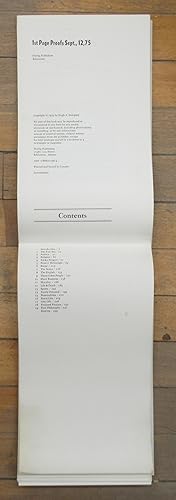
The Best of Bob Edwards
Verlag: Hurtig, Edmonton, 1975
ISBN 10: 0888300964 ISBN 13: 9780888300966
Anbieter: Attic Books (ABAC, ILAB), London, ON, Kanada
Verkäuferbewertung 5 von 5 Sternen
Zustand: Very good. Galley proof. Approx. 112 leaves. 18 x 63 cm, unbound, folded once. Notation in ink: Extra Edwards galleys. Accompanied by typed publisher's information sheet. Outer leaf a bit darkened.
-
Dempsey; By the Man Himself
Verlag: Simon and Schuster, New York, 1960
Anbieter: Ground Zero Books, Ltd., Silver Spring, MD, USA
Verkäuferbewertung 5 von 5 Sternen
Erstausgabe Signiert
Hardcover. Zustand: Good. First Printing [stated]. 22 cm. [6], 249, [1] pages. Usual library markings, slight text darkening, some wear to board/spine edges. Signed by the author (Dempsey). Illustrations. Index. The inside story of the sport of boxing, an era, and a man who rode them to the top. William Harrison "Jack" Dempsey (June 24, 1895 - May 31, 1983), nicknamed Kid Blackie, and The Manassa Mauler, was an American professional boxer who competed from 1914 to 1927, and reigned as the world heavyweight champion from 1919 to 1926. A cultural icon of the 1920s, Dempsey's aggressive fighting style and exceptional punching power made him one of the most popular boxers in history. Many of his fights set financial and attendance records, including the first million-dollar gate. He pioneered the live broadcast of sporting events in general, and boxing matches in particular. Dempsey is ranked tenth on The Ring magazine's list of all-time heavyweights and seventh among its Top 100 Greatest Punchers, while in 1950 the Associated Press voted him as the greatest fighter of the past 50 years. In September 1926, Dempsey fought former U.S. Marine Gene Tunney in Philadelphia, a fighter who had only lost once in his career. Tunney was considered the underdog against Dempsey. The match ended in an upset, with Dempsey losing his title on points in 10 rounds. When Dempsey returned to his dressing room, he explained his loss to his wife by saying, "Honey, I forgot to duck." Fifty-five years later president Ronald Reagan borrowed this quote when his wife Nancy visited him in the emergency room after the attempt on his life. Dempsey finally achieved widespread popularity when he lost his championship title. On September 23, 1926, he was defeated by challenger Gene Tunney before a record crowd of 120,000 fans in Philadelphia. When the bruised and battered Dempsey returned to his hotel that night, his wife, shocked at his gruesome appearance, asked him what happened. "Honey," Dempsey famously answered. "I forgot to duck." The hilarious and self-effacing anecdote made Dempsey something of a folk legend for the rest of his life. A year later, in 1927, Dempsey challenged Tunney to a rematch in a fight that would become one of the most controversial in boxing history. Dempsey knocked Tunney down in the seventh round but forgot a new rule requiring him to return to a neutral corner while the referee counted, extending the pause in the fight. Dempsey's slipup afforded Tunney at least five precious extra seconds to recover and return to his feet, and Tunney eventually won the fight. Although Dempsey fans argue that he would have won if not for the "long count," Tunney maintained that he was in control throughout the fight. After his second loss to Tunney, Dempsey retired from boxing but remained a prominent cultural figure. He opened Jack Dempsey's Restaurant in New York City, where he was famous for his hospitality and willingness to chat with any customer who walked through his doors. He also tried his hand at acting. He and his wife, actress Estelle Taylor, co-starred in a Broadway play called The Big Fight, and Dempsey appeared in a handful of films, including The Prizefighter and the Lady (1933) and Sweet Surrender (1935). During World War II, Dempsey put all questions surrounding his war record to rest by serving as a lieutenant commander in the Coast Guard.
-
Dempsey (First Edition, signed in the year of publication)
Verlag: Simon and Schuster, 1960
Anbieter: Visible Voice Books, Cleveland, OH, USA
Verkäuferbewertung 5 von 5 Sternen
Signiert
Hardcover. Zustand: Very Good. Simon and Schuster January 1960 Binding: Hardcover signed by the author , inscribed by Dempsey , dust jacket has many chips and tears $NRP.
-
DEMPSEY By the Man Himself
Verlag: Simon and Schuster: NY, 1960
Anbieter: John K King Used & Rare Books, Detroit, MI, USA
Verkäuferbewertung 5 von 5 Sternen
Erstausgabe Signiert
Hardcover. Zustand: Very Good. Photos, 8.5 x 5.5", cloth, 249pp with index, extremities a little bumped else a nice, clean copy in a rubbed and lightly edge-worn dustjacket. FIRST EDITION, FIRST PRINTING, INSCRIBED "To Carl S___ lots of luck pal." AND SIGNED BY THE AUTHOR, JACK DEMPSEY.
-
Dempsey, by the Man Himself
Verlag: Simon and Schuster, New York, 1960
Anbieter: PsychoBabel & Skoob Books, Didcot, Vereinigtes Königreich
Verkäuferbewertung 5 von 5 Sternen
Erstausgabe Signiert
EUR 550,67
EUR 14,40 Versand
Versand von Vereinigtes Königreich nach USAAnzahl: 1 verfügbar
In den WarenkorbHardcover. Zustand: Very Good. First Edition. Hardcover. First printing, signed and dedicated by Dempsey: "To my good friend Bobby Mellin, you being a pal of Sammy makes you my pal. Good luck, Jack Dempsey, 7/21/60. P.S. Hurry up and get well we miss you, Jack + Sammy", with a doodle of a musical score (Robert Mellin known for prolific songwriting and music publishing in the mid-20th century, some of which were covered by the Rat Pack - could "Sammy" be Sammy Davis Jr.?). Stated first printing, in unclipped jacket, faintly marked and worn, with nicked extremities. Boards and interior are clean and sound. Very good in good jacket. A collectible signed copy with particular interest around the association. TS. Signed by Author. Used.
-
Dempsey By The Man Himself.
Erscheinungsdatum: 1960
Anbieter: Antikvariat Röde Orm, Göteborg, Schweden
Verkäuferbewertung 5 von 5 Sternen
Simon and Schuster.New York.1960.First printing.Publishers decorated cloth. 249 (1) pages. Illustrated. Small note on the lower part of the first blank. Nice copy in fine condition. Some news-clips about Dempsey tucked in the book. Signed by the Champ himself! Jack Dempsey's signature on the first blank page.


