Gesamtpreis (1 Artikel Artikel):
Versandziel:

council ten (2 Ergebnisse)
Direkt zu den wichtigsten Suchergebnissen
Suchfilter
Produktart
- Alle Product Types
- Bücher (2)
- Magazine & Zeitschriften (Keine weiteren Ergebnisse entsprechen dieser Verfeinerung)
- Comics (Keine weiteren Ergebnisse entsprechen dieser Verfeinerung)
- Noten (Keine weiteren Ergebnisse entsprechen dieser Verfeinerung)
- Kunst, Grafik & Poster (Keine weiteren Ergebnisse entsprechen dieser Verfeinerung)
- Fotografien (Keine weiteren Ergebnisse entsprechen dieser Verfeinerung)
- Karten (Keine weiteren Ergebnisse entsprechen dieser Verfeinerung)
- Manuskripte & Papierantiquitäten (Keine weiteren Ergebnisse entsprechen dieser Verfeinerung)
Zustand Mehr dazu
- Neu (Keine weiteren Ergebnisse entsprechen dieser Verfeinerung)
- Wie Neu, Sehr Gut oder Gut Bis Sehr Gut (Keine weiteren Ergebnisse entsprechen dieser Verfeinerung)
- Gut oder Befriedigend (Keine weiteren Ergebnisse entsprechen dieser Verfeinerung)
- Ausreichend oder Schlecht (Keine weiteren Ergebnisse entsprechen dieser Verfeinerung)
- Wie beschrieben (2)
Einband
- alle Einbände
- Hardcover (Keine weiteren Ergebnisse entsprechen dieser Verfeinerung)
- Softcover (Keine weiteren Ergebnisse entsprechen dieser Verfeinerung)
Weitere Eigenschaften
- Erstausgabe (Keine weiteren Ergebnisse entsprechen dieser Verfeinerung)
- Signiert (Keine weiteren Ergebnisse entsprechen dieser Verfeinerung)
- Schutzumschlag (Keine weiteren Ergebnisse entsprechen dieser Verfeinerung)
- Angebotsfoto (2)
Sprache (1)
Preis
- Beliebiger Preis
- Weniger als EUR 20 (Keine weiteren Ergebnisse entsprechen dieser Verfeinerung)
- EUR 20 bis EUR 45 (Keine weiteren Ergebnisse entsprechen dieser Verfeinerung)
- Mehr als EUR 45
Gratisversand
- Kostenloser Versand nach USA (Keine weiteren Ergebnisse entsprechen dieser Verfeinerung)
Land des Verkäufers
Verkäuferbewertung
-
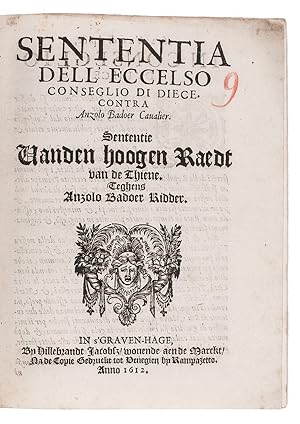
Sententia dell' Eccelso Conseglio di Diece. Contra Anzolo Badoer cavalier.Sententie vanden Hoogen Raedt van de Thiene. Teghens Anzolo Badoer ridder.
Verlag: Hillebrant Jacobsz. van Wouw,, The Hague,, 1612
Anbieter: ASHER Rare Books, T Goy Houten, Niederlande
Verkäuferbewertung 5 von 5 Sternen

First bilingual (Italian and Dutch) edition of a sentence pronounced by the government of the Venetian Republic (the Consiglio dei Dieci or Council of Ten) on 21 April 1612, declaring Anzolo Badoer (in absentia) a traitor, stripping him of his knighthood, confiscating his property, banishing him from the city and the Republic's territories and sentencing him to be hanged, in the original Italian with a parallel Dutch translation. It also offers a reward for his capture dead or alive (4000 ducats if captured in the Republic and 6000 ducats if captured abroad). Anzolo or Angelo Badoer (1565- 1630) was the eldest son of Alberto Badoer (1540-1592), who had served as Venetian ambassador to Spain, the Holy Roman Empire and Rome until his premature death. Anzolo succeeded to his father's knighthood and followed him into diplomatic service as Venetian ambassador to France from 1602 until he came into conflict with the Council of Ten in 1607.With a large "9" on the title-page in red pencil. In very good condition. An important document of dramatic intrigues, here published with a Dutch translation.l Knuttel 1938a; STCN (5 copies); cf. ICCU: PUVE\019213 (1612 Venice ed., in Italian only); for Badoer: Diz. Biogr. Italiani 5 (1963) (on www.treccani.it). Sewn without supports, in later plain paper wrapper (formerly side stitched through 3 holes). With a woodcut vignette (face with 2 cornucopias) on title-page, 2 woodcut decorated initials (2 series, both arabesque). With the Italian text in italic, the Dutch text in textura and with incidental roman. Pages: [15], [1 blank] pp.
-

Sommario delle Parti prese nell'illustriss. Conseglio di Diese 1561. & 1563. Circa le Armi.
Erscheinungsdatum: 1589
Anbieter: Maggs Bros. Ltd ABA, ILAB, PBFA, London, Vereinigtes Königreich
Verbandsmitglied: ABA ILAB PBFA
Verkäuferbewertung 5 von 5 Sternen
EUR 2.083,49
EUR 31,21 Versand
Versand von Vereinigtes Königreich nach USAAnzahl: 1 verfügbar
In den WarenkorbWith woodcut arms of the Republic of Venice, featuring the lion of St Mark, woodcut initial. Single sheet (425x275mm) printed on paper, one side only, tipped in to window mount (small hole not affecting legibility, minor spotting, otherwise very good condition). Calle delle Rasse, Venice, 14 November, The only copy found of this broadside, restating stringent regulations regarding the carrying of personal weapons in the city of Venice, first issued in 1561 and again in 1563. Issued by the Council of Ten - Consiglio di Dieci - the 'severest and most feared of Venetian constitutional bodies' (G. Cozzi, 'Authority and the Law in Renaissance Venice', in J. R. Hale, Renaissance Venice (London, 1973), p.294) responsible for security and intelligence in the Republic, this proclamation describes the laws regarding carrying arms, and the punishments to be meted out to those in violation. The rules differ according to time of day. Carrying any form of weapon at night, it begins, is completely prohibited, even for those in possession of an arms licence, from two hours after sunset in winter, and one hour after sunset in summer. The punishments are severe. In all cases, weapons will be immediately confiscated, and in addition, those found carrying will be subject to a fine of 200 lire per person, and a further 200 per weapon confiscated. Those who fail to pay will be imprisoned; those who refuse to pay or do not pay fast enough will be publicly subjected to the standard three sessions of 'tratti di corda', a form of corporal punishment in which the individual was restrained with hands tied behind their back, and raised by a rope attached to their wrists. During the day, the rules vary. Those found with weapons without an official licence to own or carry are subject to a penalty, which varied according to the nature of the weapon. Shorter knifes - cortelo, pugnale, daghetta - are subject to a fine of 10 lire; longer knives - pistolese (known as a lengua de vaca, a cow's tongue, similar to a machete in shape), stiletto, fusetto and crosetta incur four months in prison and 200 lire; a spada, side sword, or cortella, thirty lire; a weapon of iron/lead - presumably a gun or pistol - in addition to a dagger, 50 lire; a polearm, 200 lire, and those with arms anywhere else on their person, in addition to the above stated, 100 lire. An interesting distinction is drawn between defensive and offensive weapons, with the possession of offensive weapons incurring an escalation in punishment; in all cases the weapon(s) shall be immediately confiscated, and if the fine is not immediately paid, the individual shall, again, be subject to torture by tratti di corda, in a public place. Those who resist or refuse the instructions of the guard or official shall receive double the fine, double the length of torture, and thrown in prison; they will be unable to leave prison without their crime first being discussed by the Council of Ten, who will decide whether they merit being put to death. Interestingly, a portion of the text of this proclamation outlines the punishment meted out to law enforcers who either do not report the discovery, return the confiscated weapon to the lawbreaker, or supply it to someone else. Whether this proclamation related to a precise instance or period of social unrest in Venice is uncertain, though violence was 'a common feature of early modern Italian life' (V. Bartels, 'Defence, Honour and Dress', Refashioning the Renaissance (accessed online)) and we have found numerous proclamations issued throughout the sixteenth and early seventeenth century by the Council of Ten (all in 4to format) prohibiting arms - arquebuses in particular, in several instances - banditry, assassination, and duels. Civil unrest 'surged from two connected wellsprings, interest and honor, both rooted in the anthropological bedrock of Mediterranean sociability [.] The more frequent violence was, the more it was tolerated and the more the pretexts for it.