

Gesamtpreis (1 Artikel Artikel):
Versandziel:

contributions james cain (2 Ergebnisse)
Direkt zu den wichtigsten Suchergebnissen
Suchfilter
Produktart
- Alle Product Types
- Bücher (Keine weiteren Ergebnisse entsprechen dieser Verfeinerung)
- Magazine & Zeitschriften (2)
- Comics (Keine weiteren Ergebnisse entsprechen dieser Verfeinerung)
- Noten (Keine weiteren Ergebnisse entsprechen dieser Verfeinerung)
- Kunst, Grafik & Poster (Keine weiteren Ergebnisse entsprechen dieser Verfeinerung)
- Fotografien (Keine weiteren Ergebnisse entsprechen dieser Verfeinerung)
- Karten (Keine weiteren Ergebnisse entsprechen dieser Verfeinerung)
- Manuskripte & Papierantiquitäten (Keine weiteren Ergebnisse entsprechen dieser Verfeinerung)
Zustand Mehr dazu
- Neu (Keine weiteren Ergebnisse entsprechen dieser Verfeinerung)
- Wie Neu, Sehr Gut oder Gut Bis Sehr Gut (Keine weiteren Ergebnisse entsprechen dieser Verfeinerung)
- Gut oder Befriedigend (2)
- Ausreichend oder Schlecht (Keine weiteren Ergebnisse entsprechen dieser Verfeinerung)
- Wie beschrieben (Keine weiteren Ergebnisse entsprechen dieser Verfeinerung)
Einband
- alle Einbände
- Hardcover (Keine weiteren Ergebnisse entsprechen dieser Verfeinerung)
- Softcover (1)
Weitere Eigenschaften
- Erstausgabe (Keine weiteren Ergebnisse entsprechen dieser Verfeinerung)
- Signiert (Keine weiteren Ergebnisse entsprechen dieser Verfeinerung)
- Schutzumschlag (Keine weiteren Ergebnisse entsprechen dieser Verfeinerung)
- Angebotsfoto (2)
Sprache (1)
Preis
- Beliebiger Preis
- Weniger als EUR 20
- EUR 20 bis EUR 45
- Mehr als EUR 45 (Keine weiteren Ergebnisse entsprechen dieser Verfeinerung)
Gratisversand
Land des Verkäufers
Verkäuferbewertung
-
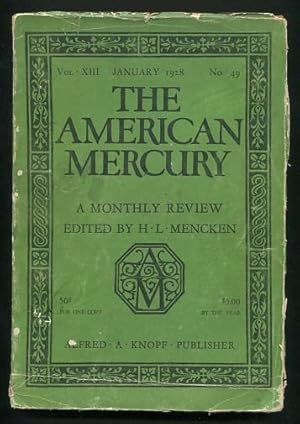
The American Mercury (January 1928)
Verlag: The American Mercury, Inc., New York, 1928
Anbieter: ReadInk, ABAA/IOBA, Los Angeles, CA, USA
Verbandsmitglied: ABAA ILAB IOBA
Verkäuferbewertung 5 von 5 Sternen

Magazin / Zeitschrift
Periodical. Zustand: Good. (Vol. XIII; No. 49). [Good only, with heavy external wear, rubbing/scuffing/soiling to covers; internally clean]. If any issue of The American Mercury can be described as "literarily star-studded," this would probably be it, with contributions from Sinclair Lewis ("The Man Who Knew Coolidge"), Jim Tully ("A California Holiday"), and a relative newcomer to the scene, James M. Cain. Cain's contribution, "Trial by Jury," was only the fifth time his work had appeared in the Mercury, and like the previous pieces (usually referred to as "dialogues") it took the form of a brief dramatic playlet -- in this case on a serious topic, the trial of a man accused of murdering a Ku Klux Klansman. Jim Tully was already a well-established literary celebrity at the time and his ironically-titled article here is one of his most famous, recounting his visit to San Quentin prison, where he witnessed an execution by hanging. The Lewis story, "The Man Who Knew Coolidge," was actually the first section of his novel (of the same name) that would be published in April of that year. Also in this issue: Mencken's editorial, on the subject of lawyers. ("The sad thing about lawyers is not that so many of them are stupid, but that so many of them are intelligent. The craft is a great devourer of good men; it sucks in and wastes almost as many as the monastic life consumed in the Middle Ages.") There's also a longish article about the work of James Branch Cabell, by the novelist Joseph Hergesheimer, as well as theatre criticism by George Jean Nathan (discussing the theatre of Max Reinhardt, John Galsworthy's "Escape," and "'Coquette' and the Sex Plays"); and an article, "The Railroads at Bay," by Charles Angoff.
-

The Screen Writer (October 1946)
Verlag: The Screen Writers' Guild, Inc., Hollywood, 1946
Anbieter: ReadInk, ABAA/IOBA, Los Angeles, CA, USA
Verbandsmitglied: ABAA ILAB IOBA
Verkäuferbewertung 5 von 5 Sternen
Magazin / Zeitschrift
Magazine. Zustand: Very Good. (Vol. II, No. 5). [a decent, clean copy, with some browning at the edges]. The lead article in this issue is "Just What is A.A.A.?" by James M. Cain. Well, it was the American Authors' Authority, a concept that was being pushed hard by Cain and others at the time; it proposed setting up a central copyright repository that would cover all professional writers -- novelists, playwrights, poets and screenwriters -- to improve their bargaining position with publishers and producers, track rights and royalties (like ASCAP does for music), represent writers in legal disputes, and lobby for more favorable copyright and tax legislation. Not surprisingly, it ignited a firestorm of opposition from both inside and outside the literary world (with some politicians, in a presaging of the HUAC hearings, claiming that it was a commie plot), and had been shot down by the end of 1946. Also in this issue: "SWG -- Trade Union or Writers' Protective Association?" by Philip Dunne; "Want to Buy the Brooklyn Bridge?" by Howard Dimsdale & Guy Endore, a discussion of the concept of public domain; "Problems of the Outdoor Action Writer," by Jack Natteford & Luci Ward; "Re: ' Coming of Age '," by Lester Cole, a response to an earlier article by screenwriter Mary McCall Jr., hashing over some of the controversies about screenwriters' wage scales during the formation and early years of the SWG; "Opinion and the Motion Picture," by Richard G. Hubler. The "Editorial" section discusses the AAA situation, ending with the Executive Board's promise "to keep you informed on the more sprightly and imaginative of the current rumors in forthcoming issues of this magazine." Under the heading "S.W.G. Bulletin" is the text of a couple of resolutions passed by the Guild related to the then-current Hollywood labor dispute, and the ttext of a press release about the Authors' League and the AAA. There is also an extensive section of excerpts from the press regarding the AAA controversy.
