

Gesamtpreis (1 Artikel Artikel):
Versandziel:

conrad felsing (4 Ergebnisse)
Direkt zu den wichtigsten Suchergebnissen
Suchfilter
Produktart
- Alle Product Types
- Bücher (2)
- Magazine & Zeitschriften (Keine weiteren Ergebnisse entsprechen dieser Verfeinerung)
- Comics (Keine weiteren Ergebnisse entsprechen dieser Verfeinerung)
- Noten (Keine weiteren Ergebnisse entsprechen dieser Verfeinerung)
- Kunst, Grafik & Poster (1)
- Fotografien (Keine weiteren Ergebnisse entsprechen dieser Verfeinerung)
- Karten (Keine weiteren Ergebnisse entsprechen dieser Verfeinerung)
- Manuskripte & Papierantiquitäten (1)
Zustand Mehr dazu
- Neu (Keine weiteren Ergebnisse entsprechen dieser Verfeinerung)
- Wie Neu, Sehr Gut oder Gut Bis Sehr Gut (Keine weiteren Ergebnisse entsprechen dieser Verfeinerung)
- Gut oder Befriedigend (2)
- Ausreichend oder Schlecht (Keine weiteren Ergebnisse entsprechen dieser Verfeinerung)
- Wie beschrieben (2)
Einband
- alle Einbände
- Hardcover (Keine weiteren Ergebnisse entsprechen dieser Verfeinerung)
- Softcover (Keine weiteren Ergebnisse entsprechen dieser Verfeinerung)
Weitere Eigenschaften
- Erstausgabe (Keine weiteren Ergebnisse entsprechen dieser Verfeinerung)
- Signiert (Keine weiteren Ergebnisse entsprechen dieser Verfeinerung)
- Schutzumschlag (Keine weiteren Ergebnisse entsprechen dieser Verfeinerung)
- Angebotsfoto (2)
Sprache (1)
Preis
- Beliebiger Preis
- Weniger als EUR 20 (Keine weiteren Ergebnisse entsprechen dieser Verfeinerung)
- EUR 20 bis EUR 40
- Mehr als EUR 40
Gratisversand
Land des Verkäufers
Verkäuferbewertung
-

Johann Conrad Felsing - Bildnis Johann Calvin - um 1820 - punktierter Kupferstich
Verlag: Johann Conrad Felsing
Anbieter: Irrgang Fine Arts, Berlin, Deutschland
Verkäuferbewertung 3 von 5 Sternen

Kunst / Grafik / Poster
Zustand: Good. KÜNSTLER: Johann Conrad Felsing; TITEL: Bildnis Johann Calvin; JAHR: um 1820; DARSTELLUNG: Brustbildd des Reformators in Talar in Seitenansicht von rechts.; BESCHRIFTUNG: Unterhalb der Darstellung typografisch bezeichnet ".Zwickau bei Gebr. Schumann". Oben links Bleistiftvermerk.; MAßE: Das Blatt misst ca. 26,5 x 21,5 cm, die Darstellung ca. 9,5 x 7,0 cm.; ZUSTAND: Satter, kontrastreicher Druck mit kräftigem Plattenrand auf Büttenpapier. Der Bogen gebräunt, an den Kanten stärker gedunkelt, etwas angeschmutzt und punktuell fleckig. Ecken und Ränder wenig bestoßen.; PROVENIENZ: Aus Berliner Privatbesitz.;
-

D. Elisabethae Borboniae Principi. 1656.
Verlag: Darmstadt, Germany: Johann Velten, [ca. 1820]., 1820
Anbieter: Wittenborn Art Books, San Francisco, CA, USA
Verkäuferbewertung 5 von 5 Sternen

Manuskript / Papierantiquität
Zustand: Good. Engraving mounted on backing paper. 4to. Very Good with minor creasing. Text in French.
-
Karte von Hessen-Darmstadt.
Verlag: Frankfurt: Heinrich Ludwig Broenner, 1790, 1790
Anbieter: Arader Galleries - AraderNYC, New York, NY, USA
Verkäuferbewertung 5 von 5 Sternen
HAAS, Johann Heinrich - FELSING, Johann Conrad (1766-1819). Karte von Hessen-Darmstadt. Frankfurt: Heinrich Ludwig Broenner, 1790 EXCEPTIONALLY FINE folding engraved map in 15 sheets (each sheet 20 4/8 x 25 inches), each laid down on linen in 12 sections, centred on Darmstadt and showing in great detail the landgraviate of Hesse-Darmstadt, and the route of the Rhine and its tributaries from Frankfurt in the north to Frankenthal in the south, but extending to cover Hanau, Reinheim and Manheim to the east. Preserved in contemporary tree calf solander boxes, with red and black morocco lettering-pieces on the spine. Provenance: with the supra libros on the case of Ernest Augustus (17711851), king of Hanover, fifth son of George III and Queen Charlotte, as Duke of Cumberland, his sale Sotheby's 16th December 2010, lot 50 The map which includes Darmstadt has the title "I. Bogen der angekündigten Situations-Charte, aufgenommen und gezeichnet durch Maaß, Artillerie-Lieutenant zu Darmstadt" along the top margin. Hesse-Darmstadt was originally only the small territory of Upper Katzenelnbogen with Darmstadt, being situated in what is now the extreme southern portion of the present-day Land (state) of Hessen. "But the landgraviate received significant accretions of territory during the 17th and 18th centuries, partly owing to its steadfast loyalty to the Habsburg Holy Roman emperors. Hesse-Darmstadt entered Napoleon's Confederation of the Rhine in 1806 and was consequently raised to the status of a grand duchy in that year. Hesse-Darmstadt joined the allies in 1813 and entered the German Confederation in 1815. The Congress of Vienna ceded some of Hesse-Darmstadt's lands to Prussia and Bavaria but in compensation gave the duchy, among other territories, a district on the west bank of the Rhine containing the important cities of Mainz and Worms. The grand duke Louis I (reigned 17681830) granted Hesse-Darmstadt a constitution in 1820, carried through other reforms, and made the grand duchy the first of the southern German states to join the Prussian Zollverein (Customs Union). Hesse-Darmstadt thereafter oscillated between liberalism and conservatism. The duchy sided with the Austrians in the Seven Weeks' War (1866) and consequently lost its territory north of the Main River to the Prussian-sponsored North German Confederation. But when the German empire was founded in 1871, Hesse-Darmstadt became one of its constituent states" (Encyclopedia Britannica online). Created duke of Cumberland and Teviotdale, and earl of Armagh, in April 1799, Prince Ernest"slim, tall, and handsome in his youthwished to follow a military career and in June 1790 sought permission to train with the Prussian army. But George III insisted he should serve with the 9th Hanoverian hussars (which he entered as lieutenant in 1790 and of which he became lieutenant-colonel in 1793), later transferring him to the less dashing heavy dragoons, a move the prince bitterly resented. He was promoted major-general in the Hanoverian army in February 1794. He fought with courage in Flanders and the Netherlands against the French. When commanding the Hanoverian light battalion of grenadiers at Villers-en-Cauchi on 6 August 1793 he 'behaved remarkably well, with the greatest coolness and spirit' (The Later Correspondence of George III, ed. A. Aspinall, 5 vols., 196270, 2.72) and apparently carried off bodily a French dragoon officer as prisoner; a similar event has been ascribed to Ernest outside Nijmegen in November 1794" (DNB). Never very popular in England, and often surrounded by the whiff of scandal, including accusations of murder and incest, from 1818 to 1828 the Cumberlands lived in voluntary exile, mostly in Berlin. As Victoria's eldest surviving uncle the duke was certain of accession in Hanover, becoming King in June of 1837.
-
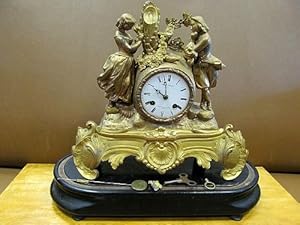
Bronzierte Kaminuhr. Ein junges Liebespaar umrahmt die Uhr und das Mädchen ritzt die Anfangsinitialen in einen Baumstumpf einer Eiche.
Anbieter: Antiquariat Friederichsen e. K., Hamburg, Deutschland
Verbandsmitglied: BOEV
Verkäuferbewertung 5 von 5 Sternen
EUR 2.500,00
EUR 60,00 Versand
Versand von Deutschland nach USAAnzahl: 1 verfügbar
In den WarenkorbDie Kaminuhr ist 31 cm maximal breit, 30 cm maximale Höhe bei einer Tiefe von 10 cm. Das emaillierte Uhrenzifferblatt ist gemarkt mit *Conrad Felsing, Brüderstrasse No. 20, Berlin*, das Uhrwerk innen ebenfalls gemarkt mit *Conrad Felsing, Berlin* sowie der Typenbezeichnung *5453* der untere Sockel der Uhr verso gemarkt mit *10 Ph. Mouray*. Die Uhr wohl aus bronziertem Eisen (?) mit einer bronzenen Schmuckblende und bronzenen Applikationen am Sockel und Aufbau der Uhr. Das Pendel und der Schlüssel liegen lose bei, ebenso ein loses kleines Teil ( ein kleiner abgebrochener Ast oben an der Uhr ). Die Uhr ist nicht richtig funktionstüchtig, das Ziffernblatt ist etwas fleckig, die Uhr teils berieben bzw. teils etwas oxydiert. Wohl um 1840-1850 herum gefertigt. ( Gewicht 3000 Gramm ). Die Uhr steht auf einem schwarzlackiertem Holzsockel, dieser verso handschriftlich beschriftet ( unleserlich ), der Holzsockel stärker berieben sowie mit kleiner Beschädigung. Der Glassturz hierzu fehlt. >>>Johann Conrad Felsing: wurde im Schwarzwald geboren, wo die Familie Völtzing seit dem Jahre 1733 Uhren herstellte, sein Geburtsdatum ist nicht bekannt. Um 1820 herum siedelte Johann Conrad Völtzing nach Berlin um und änderte seinen Name in Felsing. Er gründete die Firma Conrad Felsing, zuerst am Schloßfreiheit No. 1, Berlin, später Unter der Linden 20 in Berlin. 1847 wurde Conrad Mitglied der Innung und 1850 Altmeister. Die Firma wurde zum Hof-Uhrmacher benannt. Johann Felsing wurde um 1878 in Berlin als Sohn von Hofuhrmacher Albert Karl Julius Felsing geboren. Er übernahm nach dem Tod seines Vaters 1901 die Firma Conrad Felsing in Berlin. Ein Teil des Geschäftshauses wurde von Willibald Felsing an den Optiker und Instrumentenmacher Oskar Messter vermietet, der hier das erste Berliner Filmstudio einrichtete. Hierdurch erlangte Felsing Kontakte mit der Theater und Filmwelt, was später auch seiner Nichte Marlene Dietrich nutzte, die ihn Onkel Willi nannte. Das Schaufenster der Firma neben dem Hotel Adlon, ganz in der Nähe vom Brandenburger Tor, war weitbekannt und in jedem Baedeker als ein Wahrzeichen von Berlin aufgeführt. Hier pendelte eine Weltuhr.mit der zentralen Anzeige der Zeit in Berlin - hierum acht kleinere Zifferblätter mit Angabe der Zeit in London, New York, San Francisco, Tokio, Bangkok, Karatchi, Teheran und Moskau. 1924 gründete Willi König und Willibald Albert Conrad Felsing aus dem "Zentralverband der Deutschen Uhrmacher" die Firma "Markenuhr GmbH". Als Marke wurde ZentRa verwendet bzw. übernommen. 1927 wurde daraus die "ZentRa Garantiegemeinschaft e.V." gegründet. Ab 1940 war die Firma an den Fertigstellungsarbeiten der A. Lange & Söhne Beobachtungsuhr Kaliber 48 beteiligt. Die Firma Conrad Felsing blieb bis zm Ende des Zweiten Weltkriegs in ihrem Geschäft in der Straße Unter den Linden in Berlin bis zur Zerstörung tätig. >>Johann Conrad Felsing: was born in the Black Forest, where the Völtzing family had been making clocks since 1733. His date of birth is unknown. Around 1820, Johann Conrad Völtzing moved to Berlin and changed his name to Felsing. He founded the Conrad Felsing company, first at Schloßfreiheit No. 1, Berlin, and later at Unter der Linden 20 in Berlin. In 1847, Conrad became a member of the guild and a past master in 1850. The company was named Court Clockmaker. Johann Felsing was born around 1878 in Berlin, the son of court clockmaker Albert Karl Julius Felsing. He took over the Conrad Felsing company in Berlin after the death of his father in 1901. Willibald Felsing rented part of the commercial building to the optician and instrument maker Oskar Messter, who set up Berlin's first film studio there. This gave Felsing contacts in the theater and film world, which later benefited his niece Marlene Dietrich, who called him Uncle Willi. The company's shop window next to the Hotel Adlon, very close to the Brandenburg Gate, was widely known and listed in every Baedeker's as a Berlin landmark. Here, a world clock swung, with the central display showing the time in Berlin, and around it, eight smaller dials indicating the time in London, New York, San Francisco, Tokyo, Bangkok, Karachi, Tehran, and Moscow. In 1924, Willi König and Willibald Albert Conrad Felsing, part of the "Central Association of German Watchmakers," founded the company "Markenuhr GmbH." ZentRa was used or adopted as the brand. In 1927, this brand became the "ZentRa Garantiegemeinschaft e.V." (ZentRa Guarantee Association). From 1940 onwards, the company was involved in the completion of the A. Lange & Söhne observation watch, calibre 48. The Conrad Felsing company remained in business until the end of the Second World War in its shop on Unter den Linden in Berlin, until it was destroyed. <<< (Picture available // web image available) (I would like to thank Mr. Fabianke for his kind comments on the creation of the watch) (Storage location: windows backside )( Please note: Unfortunately, shipping is not possible here - please only pick up or self-organized transport by arrangement ) / Item 12908.


