

Gesamtpreis (1 Artikel Artikel):
Versandziel:

chief luce (30 Ergebnisse)
Direkt zu den wichtigsten Suchergebnissen
Suchfilter
Produktart
- Alle Product Types
- Bücher (28)
- Magazine & Zeitschriften (2)
- Comics (Keine weiteren Ergebnisse entsprechen dieser Verfeinerung)
- Noten (Keine weiteren Ergebnisse entsprechen dieser Verfeinerung)
- Kunst, Grafik & Poster (Keine weiteren Ergebnisse entsprechen dieser Verfeinerung)
- Fotografien (Keine weiteren Ergebnisse entsprechen dieser Verfeinerung)
- Karten (Keine weiteren Ergebnisse entsprechen dieser Verfeinerung)
- Manuskripte & Papierantiquitäten (Keine weiteren Ergebnisse entsprechen dieser Verfeinerung)
Zustand Mehr dazu
- Neu (Keine weiteren Ergebnisse entsprechen dieser Verfeinerung)
- Wie Neu, Sehr Gut oder Gut Bis Sehr Gut (2)
- Gut oder Befriedigend (17)
- Ausreichend oder Schlecht (7)
- Wie beschrieben (4)
Einband
Weitere Eigenschaften
- Erstausgabe (13)
- Signiert (Keine weiteren Ergebnisse entsprechen dieser Verfeinerung)
- Schutzumschlag (6)
- Angebotsfoto (5)
Sprache (3)
Gratisversand
Land des Verkäufers
Verkäuferbewertung
-

Life's Picture History of Western Man
Verlag: New York: TIME Inc. 1951, 1951
Anbieter: ThriftBooks-Dallas, Dallas, TX, USA
Verkäuferbewertung 5 von 5 Sternen

Hardcover. Zustand: Fair. No Jacket. Readable copy. Pages may have considerable notes/highlighting. ~ ThriftBooks: Read More, Spend Less.
-

Ancient Writers: 1
Anbieter: ThriftBooks-Atlanta, AUSTELL, GA, USA
Verkäuferbewertung 5 von 5 Sternen
Hardcover. Zustand: Fair. No Jacket. Former library book; Readable copy. Pages may have considerable notes/highlighting. ~ ThriftBooks: Read More, Spend Less.
-
Ancient Writers: 1
Anbieter: ThriftBooks-Atlanta, AUSTELL, GA, USA
Verkäuferbewertung 5 von 5 Sternen
Hardcover. Zustand: Good. No Jacket. Former library book; Pages can have notes/highlighting. Spine may show signs of wear. ~ ThriftBooks: Read More, Spend Less.
-
Picture Cook Book
Verlag: Time Inc, 1958
Anbieter: Redux Books, Grand Rapids, MI, USA
Verkäuferbewertung 5 von 5 Sternen
Paperback. Zustand: Good. Hardcover with DJ. Pages are clean and unmarked. Covers show minor shelf wear. Binding is tight, hinges strong. Dust jacket shows edge wear. Book has a slight musty smell from basement storage.; 100% Satisfaction Guaranteed! Ships same or next business day!
-
Time Capsule 1959.
Verlag: Time Life Books
Anbieter: ThriftBooks-Dallas, Dallas, TX, USA
Verkäuferbewertung 5 von 5 Sternen
Hardcover. Zustand: Fair. No Jacket. Readable copy. Pages may have considerable notes/highlighting. ~ ThriftBooks: Read More, Spend Less.
-

life magazine may 4 1953 africa a continent in ferment
Verlag: Time Inc, 1953
Anbieter: H&G Antiquarian Books, Sheboygan, WI, USA
Verkäuferbewertung 4 von 5 Sternen

Soft cover. Zustand: Very Good. Magzine cover and text all in very good condition, binding tight and square a coupe center pages loose, text clean and unmarked PO sticker residue on front cover.
-
Sports Illustrated; September 23, 1963
Verlag: Time Inc., 1963
Anbieter: Zubal-Books, Since 1961, Cleveland, OH, USA
Verkäuferbewertung 5 von 5 Sternen
Zustand: Very Good. softcover, small mailing label to front cover, light wear to spine and covers else text clean and binding tight. - If you are reading this, this item is actually (physically) in our stock and ready for shipment once ordered. We are not bookjackers. Buyer is responsible for any additional duties, taxes, or fees required by recipient's country.
-
Life Magazine, Vol. 42, No. 1, January 7, 1957
Verlag: Time, Inc, Chicago, IL, 1957
Anbieter: Ground Zero Books, Ltd., Silver Spring, MD, USA
Verkäuferbewertung 4 von 5 Sternen
Erstausgabe
Wraps. Zustand: Good. Zustand des Schutzumschlags: No dust jacket issued. John Dominis (Photographer) (illustrator). quarto, 88 pages, plus covers. Wraps, illustrations (some with color) . Some wear to covers. Address sticker on front cover. This issue includes information on Hungarian refugees, Richard Nixon, Brush Fire, Malibu, Pandit Nehru, Civil Rights, Bus Boycott, Middle East, Marsupials, Psychology, Human Behavior, Ernest Havemann, Leonard Bernstein, Censorship, Baby Doll, and Elia Kazan. Life was an American magazine published weekly from 1883 to 1972, as an intermittent "special" until 1978, and as a monthly from 1978 until 2000. During its golden age from 1936 to 1972, Life was a wide-ranging weekly general-interest magazine known for the quality of its photography, and was one of the most popular magazines in the nation, regularly reaching one-quarter of the population. Life was independently published for its first 53 years until 1936 as a general-interest and light entertainment magazine, heavy on illustrations, jokes, and social commentary. It featured some of the most notable writers, editors, illustrators and cartoonists of its time: Charles Dana Gibson, Norman Rockwell and Jacob Hartman Jr. Gibson became the editor and owner of the magazine after John Ames Mitchell died in 1918. During its later years, the magazine offered brief capsule reviews (similar to those in The New Yorker) of plays and movies currently running in New York City, but with the innovative touch of a colored typographic bullet resembling a traffic light, appended to each review: green for a positive review, red for a negative one, and amber for mixed notices. In 1936, Time publisher Henry Luce bought Life, only wanting its title: he greatly re-made the publication. Life (now stylized in all caps) became the first all-photographic American news magazine, and it dominated the market for several decades, with a circulation of more than 13.5 million copies a week at one point. Possibly the best-known image published in the magazine was Alfred Eisenstaedt's photograph of a nurse in a sailor's arms, taken on August 14, 1945 during a VJ-Day celebration in New York's Times Square. The magazine's role in the history of photojournalism is considered its most important contribution to publishing. Its profile was such that the memoirs of President Harry S. Truman, Prime Minister Winston Churchill, and General Douglas MacArthur were all serialized in its pages. After 2000, Time Inc. continued to use the Life brand for special and commemorative issues. Life returned to regularly scheduled issues when it became a weekly newspaper supplement from 2004 to 2007. Presumed First Edition, First printing this issue.
-
Life Magazine, Vol. 40, No. 14, April 2, 1956
Verlag: Time, Inc, Chicago, IL, 1956
Anbieter: Ground Zero Books, Ltd., Silver Spring, MD, USA
Verkäuferbewertung 4 von 5 Sternen
Erstausgabe
Wraps. Zustand: Good. Zustand des Schutzumschlags: No dust jacket issued. Fritz Goro (Photographer) (illustrator). quarto, 102 pages, plus covers. Wraps, illustrations (some with color) . Some wear to covers. Address sticker on front cover. This issue includes information on Estes Kefauver, Adlai Stevenson, Antarctic, Flower Arranging, Also included an excerpt of Winston Churchill's, A History of the English-Speaking Peoples, The Birth of Britain: Part III Barons Against the King, Magna Carta, Fred Allen, Teen-agers, Telephones, Ginny Nyvall, and Charlie Hoag, Life was an American magazine published weekly from 1883 to 1972, as an intermittent "special" until 1978, and as a monthly from 1978 until 2000. During its golden age from 1936 to 1972, Life was a wide-ranging weekly general-interest magazine known for the quality of its photography, and was one of the most popular magazines in the nation, regularly reaching one-quarter of the population. Life was independently published for its first 53 years until 1936 as a general-interest and light entertainment magazine, heavy on illustrations, jokes, and social commentary. It featured some of the most notable writers, editors, illustrators and cartoonists of its time: Charles Dana Gibson, Norman Rockwell and Jacob Hartman Jr. Gibson became the editor and owner of the magazine after John Ames Mitchell died in 1918. During its later years, the magazine offered brief capsule reviews (similar to those in The New Yorker) of plays and movies currently running in New York City, but with the innovative touch of a colored typographic bullet resembling a traffic light, appended to each review: green for a positive review, red for a negative one, and amber for mixed notices. In 1936, Time publisher Henry Luce bought Life, only wanting its title: he greatly re-made the publication. Life (now stylized in all caps) became the first all-photographic American news magazine, and it dominated the market for several decades, with a circulation of more than 13.5 million copies a week at one point. Possibly the best-known image published in the magazine was Alfred Eisenstaedt's photograph of a nurse in a sailor's arms, taken on August 14, 1945 during a VJ-Day celebration in New York's Times Square. The magazine's role in the history of photojournalism is considered its most important contribution to publishing. Its profile was such that the memoirs of President Harry S. Truman, Prime Minister Winston Churchill, and General Douglas MacArthur were all serialized in its pages. After 2000, Time Inc. continued to use the Life brand for special and commemorative issues. Life returned to regularly scheduled issues when it became a weekly newspaper supplement from 2004 to 2007. Presumed First Edition, First printing this issue.
-
Time: The Weekly Newsmagazine, Volume LXXVIII, Number 19, November 10, 1961
Verlag: Time, Inc, New York, 1961
Anbieter: Ground Zero Books, Ltd., Silver Spring, MD, USA
Verkäuferbewertung 4 von 5 Sternen
Erstausgabe
Wraps. Zustand: Fair. Quarto. 110 plus covers. Wraps Illustrations (some in color). No dust jacket as issued. Cover has wear and soiling. Mailing label on front cover. Moisture staining noted on some interior pages. Cover shows Atomic Energy Chairman Seaborg. Banner in upper left corner reads :Fallout from Russia The Argument Over Testing. The coverage starts at page 21 with an article entitled The Atom and has discussion of testing and there is a section on Ten Questions & Answers about Fallout. On page 23 there are two columns, including photo, on Glenn Seaborg. The coverage appears to conclude at the end of page 25. There is additional coverage at page 31 on Russian/Soviet Civil Defense preparations. There are also articles about Ishi, and James Thurber. Time (stylized in all caps) is an American news magazine and news website published and based in New York City. For nearly a century, it was published weekly, but starting in March 2020 it transitioned to every other week. It was first published in New York City on March 3, 1923, and for many years it was run by its influential co-founder, Henry Luce. Time has been based in New York City since its first issue published on March 3, 1923, by Briton Hadden and Henry Luce. It was the first weekly news magazine in the United States. The two had previously worked together as chairman and managing editor, respectively, of the Yale Daily News. They first called the proposed magazine Facts, wanting to emphasize brevity so a busy man could read it in an hour. They changed the name to Time and used the slogan "Take Time It's Brief". Hadden was considered carefree and liked to tease Luce. He saw Time as important but also fun, which accounted for its heavy coverage of celebrities and politicians, the entertainment industry and pop culture, criticizing it as too light for serious news. Time set out to tell the news through people, and until the late 1960s, the magazine's cover depicted a single person. More recently, Time has incorporated "People of the Year" issues which grew in popularity over the years. The first issue of Time featured Joseph G. Cannon, the retired Speaker of the House of Representatives, on its cover; a facsimile reprint of Issue No. 1, including all of the articles and advertisements contained in the original, was included with copies of the magazine's issue from February 28, 1938, in commemoration of its 15th anniversary. The cover price was 15¢. On Hadden's death in 1929, Luce became the dominant man at Time and a major figure in the history of 20th-century media. They raised $100,000 from wealthy Yale alumni such as Henry P. Davison, partner of J.P. Morgan & Co., publicity man Martin Egan and J.P. Morgan & Co. banker Dwight Morrow; Henry Luce and Briton Hadden hired Larsen in 1922. After Hadden died in 1929, Larsen purchased 550 shares of Time Inc., using money he obtained from selling RKO stock he had inherited from his father, who was the head of the Benjamin Franklin Keith theater chain in New England. However, after Hadden's death, the largest Time, Inc. stockholder was Henry Luce, who ruled the conglomerate in an autocratic fashion. Presumed First Edition, First printing this issue.
-

Life Magazine July 2, 1945
Verlag: Life Magazine, 1945
Anbieter: Best Books And Antiques, Chandler, TX, USA
Verkäuferbewertung 4 von 5 Sternen
Magazin / Zeitschrift
LIKE NEW! Fantastic condition! (PM) Magazine shelf.
-

The World's Great Religions
Verlag: Time Incorporated, New York, 1957
Anbieter: Between the Covers-Rare Books, Inc. ABAA, Gloucester City, NJ, USA
Verbandsmitglied: ABAA ESA ILAB IOBA
Verkäuferbewertung 5 von 5 Sternen
Erstausgabe
Hardcover. Zustand: Near Fine. First edition thus. Folio. 310pp. Illustrated with color and black and white photographs. Near fine with creases to page corners 283-296pp. in a near fine slipcase with some wear, small ink marks.
-
Fortune Volume XXXIV, Number 5 - November, 1946
Verlag: Wiliam D. Geer, 1946
Erstausgabe
PAPERBACK. Zustand: Good. 1st edition. 291pp, quarto, color wraps, b/w and color interior, creased spine with torn paper at the spine ends, colorful wraps, binding remains tight, worn cornersclean throughout, pages have toned. "Labor in U.S. Industry".
-
Time; The Weekly Newsmagazine, Volume LXIX, No. 13, April 1, 1957
Verlag: Time, Inc, New York, 1957
Anbieter: Ground Zero Books, Ltd., Silver Spring, MD, USA
Verkäuferbewertung 4 von 5 Sternen
Erstausgabe
Magazine. Zustand: Good. 104 pages plus covers. Cover has some wear and soiling. Mailing label at lower left of front cover. Illustrations (some in color). Front cover is of Missileman Schriever on the left half, facing right, with a rocket launching to his right. The cover story content starts at page 16 with a section titled Armed Forces: The Bird & the Watcher, with photographs of the Air Force Rascal aircraft, the Air Force's Snark, the Navy's Sparrow, and the Army's Redstone ballistic missile. There is a photograph of General Schriever and family at home on page 19. At pages 46 and 47 there is a two page advertising spread by Chance Vought Aircraft on the World's Fastest Navy fighter squadron. At pages 52 and 53 is a two page advertising spread from Lockheed on their F-104 starfighter. Time has been based in New York City since its first issue published on March 3, 1923, by Briton Hadden and Henry Luce. It was the first weekly news magazine in the United States. They first called the proposed magazine Facts, wanting to emphasize brevity so a busy man could read it in an hour. They changed the name to Time and used the slogan "Take Time ? It's Brief". Hadden was considered carefree and liked to tease Luce. He saw Time as important but also fun, which accounted for its heavy coverage of celebrities and politicians, the entertainment industry and pop culture, criticizing it as too light for serious news. Time set out to tell the news through people, and until the late 1960s, the magazine's cover depicted a single person. The first issue of Time featured Joseph G. Cannon, the retired Speaker of the House of Representatives, on its cover. The cover price was 15¢ (equivalent to $2.39 in 2021). On Hadden's death in 1929, Luce became the dominant man at Time and a major figure in the history of 20th-century media. After Briton Hadden's death, the largest Time, Inc. stockholder was Henry Luce, who ruled the media conglomerate in an autocratic fashion. After Time magazine began publishing its weekly issues in March 1923, the company was able to increase its circulation by using U.S. radio and movie theaters around the world. It often promoted both Time magazine and U.S. political and corporate interests. The company arranged for the 30-minute radio program The March of Time to be broadcast over CBS beginning on March 6, 1931. Each week, the program presented a dramatization of the week's news for its listeners; thus Time magazine itself was brought "to the attention of millions previously unaware of its existence", leading to an increased circulation of the magazine during the 1930s. Between 1931 and 1937, The March of Time radio program was broadcast over CBS radio, and between 1937 and 1945, it was broadcast over NBC radio ? except between 1939 and 1941, when it was not aired. People magazine was based on Time's "People" page. Presumed First Edition, First printing of this issue.
-
Time: the Weekly Newsmagazine, Volume LXXIX, Number 18, May 4, 1962
Verlag: Time, Inc, New York, 1962
Anbieter: Ground Zero Books, Ltd., Silver Spring, MD, USA
Verkäuferbewertung 4 von 5 Sternen
Erstausgabe
Wraps. Zustand: Good. Zustand des Schutzumschlags: No dust jacket as issued. Quarto, 100 pages, plus covers. Wraps. Illustrations (some in color). Cover has some wear and soiling. Mailing label removed from front cover. Some page discoloration. The cover has a portrait of Test Director William Ogle and the cover article banner says U.S. Nuclear Testing The Shots Heard Round the World. Page 18 has a story entitle The Atom For Survival's Sake--with a reference to the front cover. Page 20 has a half column on Milestone in Nuclear History. The article ends at page 22 with reference to the 'countdown on Operation Dominic.' On page 28 there is a map entitle Kurd Revolt and a photograph of Kurd Leader Barzani. Page 40 has photographs of the Saturn and Ranger IV rockets and an article entitled Leap Toward the Moon. Page 48 has a discussion of Ukrainian Dancers at the Met. Page 59 has an article on Charlie Chaplin and his daughter Oona. William Ogle (1918-1984) was an American physicist. Ogle was born in Los Angeles. He studied at the University of Nevada before going on to earn an M.S. and a Ph.D. in physics from the University of Illinois. In 1944, Ogle went to work on the Manhattan Project at Los Alamos. He stayed on after the war to work at the Los Alamos National Laboratory for more than 25 years, and worked on every nuclear test in Nevada and in the Marshall Islands during that time. During Operation Ivy, the first American hydrogen bomb test, Ogle served as scientific commander. Time (stylized in all caps) is an American news magazine published and based in New York City. For nearly a century, it was published weekly. Time has been based in New York City since its first issue published on March 3, 1923, by Briton Hadden and Henry Luce. It was the first weekly news magazine in the United States. The two had previously worked together as chairman and managing editor, respectively, of the Yale Daily News. They first called the proposed magazine Facts, wanting to emphasize brevity so a busy man could read it in an hour. They changed the name to Time and used the slogan "Take Time - It's Brief". Hadden was considered carefree and liked to tease Luce. He saw Time as important but also fun, which accounted for its heavy coverage of celebrities and politicians, the entertainment industry and pop culture, criticizing it as too light for serious news. Time set out to tell the news through people, and until the late 1960s, the magazine's cover depicted a single person. The first issue of Time featured Joseph G. Cannon, the retired Speaker of the House of Representatives, on its cover. On Hadden's death in 1929, Luce became the dominant man at Time and a major figure in the history of 20th century media. After Time magazine began publishing its weekly issues in March 1923, Roy Larsen was able to increase its circulation by using U.S. radio and movie theaters around the world. It often promoted both Time magazine and U.S. political and corporate interests. According to The March of Time, as early as 1924, Larsen had brought Time into the infant radio business with the broadcast of a 15-minute sustaining quiz show entitled Pop Question which survived until 1925". Then in 1928, Larsen "undertook the weekly broadcast of a 10-minute program series of brief news summaries, drawn from current issues of Time magazine . which was originally broadcast over 33 stations throughout the United States". Larsen next arranged for the 30-minute radio program The March of Time to be broadcast over CBS beginning on March 6, 1931. Each week, the program presented a dramatization of the week's news for its listeners; thus Time magazine itself was brought "to the attention of millions previously unaware of its existence", leading to an increased circulation of the magazine during the 1930s. Between 1931 and 1937, Larsen's The March of Time radio program was broadcast over CBS radio, and between 1937 and 1945, it was broadcast over NBC radio - except between 1939 and 1941, when it was not aired. People magazine was based on Time's "People" page. Presumed First Edition, First printing thus.
-
Life, Vol. 40, No. 12 March 19, 1956
Verlag: Time, Inc, New York, 1956
Anbieter: Ground Zero Books, Ltd., Silver Spring, MD, USA
Verkäuferbewertung 4 von 5 Sternen
Erstausgabe
Wraps. Zustand: Good. Format is approximately 10.4 inches by 14 inches. 196 pages, plus covers. Illustrations (some with color). Civer has some edge wear, soiling creases. Mailing label residue on front cover. Bold, formal portrait of Sir Winston Churchill on the front cover. This issue began the serialization of his "History of the English-Speaking Peoples." Life was an American magazine published weekly from 1883 to 1972, as an intermittent "special" until 1978, and as a monthly from 1978 until 2000. During its golden age from 1936 to 1972, Life was a wide-ranging weekly general-interest magazine known for the quality of its photography. Life was independently published for its first 53 years until 1936 as a general-interest and light entertainment magazine, heavy on illustrations, jokes, and social commentary. It featured some of the greatest writers, editors, illustrators and cartoonists of its time: Charles Dana Gibson, Norman Rockwell and Jacob Hartman Jr. Gibson became the editor and owner of the magazine after John Ames Mitchell died in 1918. In 1936, Time publisher Henry Luce bought Life, only wanting its title: he greatly re-made the publication. Life became the first all-photographic American news magazine, and it dominated the market for several decades. Possibly the best-known photograph published in the magazine was Alfred Eisenstaedt's photograph of a nurse in a sailor's arms, taken on August 14, 1945, as they celebrated Victory over Japan Day in New York City. The magazine's role in the history of photojournalism is considered its most important contribution to publishing. Sir Winston Leonard Spencer Churchill, (30 November 1874 - 24 January 1965) was a British statesman who served as Prime Minister of the United Kingdom from 1940 to 1945, during the Second World War, and again from 1951 to 1955. Although best known for his wartime leadership as Prime Minister, Churchill was also a Sandhurst-educated soldier, a Nobel Prize-winning writer and historian, a prolific painter, and one of the longest-serving politicians in British history. Apart from two years between 1922 and 1924, he was a Member of Parliament (MP) from 1900 to 1964 and represented a total of five constituencies. Ideologically an economic liberal and imperialist, he was for most of his career a member of the Conservative Party, which he led from 1940 to 1955. A History of the English-Speaking Peoples is a four-volume history of Britain and its former colonies and possessions throughout the world, written by Winston Churchill, covering the period from Caesar's invasions of Britain (55 BC) to the end of the Second Boer War (1902). It was started in 1937 and finally published 1956-1958, delayed several times by war and his work on other texts. Churchill, who excelled in the study of history as a child and whose mother was American, had a firm belief in a so-called "special relationship" between the people of Britain and its Commonwealth (Australia, Canada, New Zealand, South Africa, etc.) united under the Crown, and the people of the United States who had broken with the Crown and gone their own way. His book thus dealt with the resulting two divisions of the "English-speaking peoples". At the independent suggestions of British publisher Newman Flower and American editor Max Perkins, Churchill began the history during the 1930s, during the period that his official biographer Martin Gilbert termed the "wilderness years" when he was not in government. Work was interrupted in 1939 when the Second World War broke out and Churchill was appointed First Lord of the Admiralty and became Prime Minister a year later. After the war ended in 1945, Churchill was busy, first writing his history of that conflict and then as Prime Minister again between 1951 and 1955, so it was not until the mid 1950s, when Churchill was in his early eighties, that he was able to finish his work. The books were bestsellers and reviewed favorably on both sides of the Atlantic. In The Daily Telegraph, J.H. Plumb wrote: "This history will endure; not only because Sir Winston has written it, but also because of its own inherent virtues â" its narrative power, its fine judgment of war and politics, of soldiers and statesmen, and even more because it reflects a tradition of what Englishmen in the heyday of their empire thought and felt about their country's past." Presumed First Edition, First printing thus.
-
Sports Illustrated : Volume 2, Number 18 : May 2, 1955
Verlag: Time Inc., 1955
Anbieter: Zubal-Books, Since 1961, Cleveland, OH, USA
Verkäuferbewertung 5 von 5 Sternen
Zustand: Very Good. softcover, small mailing label to front cover, light wear to spine and covers else text clean and binding tight. - If you are reading this, this item is actually (physically) in our stock and ready for shipment once ordered. We are not bookjackers. Buyer is responsible for any additional duties, taxes, or fees required by recipient's country.
-
Time: The Weekly Newsmagazine, Volume LXXI, Number 22, June 2, 1958
Verlag: Time, Inc, Chicago, IL, 1958
Anbieter: Ground Zero Books, Ltd., Silver Spring, MD, USA
Verkäuferbewertung 4 von 5 Sternen
Erstausgabe
Wraps. Zustand: Good. Quarto. 88 plus covers. (pages 43-46 disbound but present). Wraps Illustrations (some in color). No dust jacket as issued. Cover has some wear and soiling. Mailing label on front cover. There is a article entitled The Brahmins of Redland which has vignettes on Nikolaevich Nesmeyanov who on June 1, 1957 declared that the Russians "have created the rockets and all the instruments and equipment necessary to solve the problem of the artificial earth satellite." Other scientists discussed include: Mendeleev (Chemist), Pavlov (Physiologist), Landau (Physicist), Semenov (Nobel Prize Chemist), Ambartsumian (Astronomer); Masevish (Sputnik expert), and Kapitsa (Physicist). Also, under Milestones it was reported tat Ronald Prescott Reagan had been born to Ronald Reagan and Nancy Davis Reagan. Time (stylized in all caps) is an American news magazine and news website published and based in New York City. For nearly a century, it was published weekly, but starting in March 2020 it transitioned to every other week. It was first published in New York City on March 3, 1923, and for many years it was run by its influential co-founder, Henry Luce. Time has been based in New York City since its first issue published on March 3, 1923, by Briton Hadden and Henry Luce. It was the first weekly news magazine in the United States. The two had previously worked together as chairman and managing editor, respectively, of the Yale Daily News. They first called the proposed magazine Facts, wanting to emphasize brevity so a busy man could read it in an hour. They changed the name to Time and used the slogan "Take Time It's Brief". Hadden was considered carefree and liked to tease Luce. He saw Time as important but also fun, which accounted for its heavy coverage of celebrities and politicians, the entertainment industry and pop culture, criticizing it as too light for serious news. Time set out to tell the news through people, and until the late 1960s, the magazine's cover depicted a single person. More recently, Time has incorporated "People of the Year" issues which grew in popularity over the years. The first issue of Time featured Joseph G. Cannon, the retired Speaker of the House of Representatives, on its cover; a facsimile reprint of Issue No. 1, including all of the articles and advertisements contained in the original, was included with copies of the magazine's issue from February 28, 1938, in commemoration of its 15th anniversary. The cover price was 15¢. On Hadden's death in 1929, Luce became the dominant man at Time and a major figure in the history of 20th-century media. They raised $100,000 from wealthy Yale alumni such as Henry P. Davison, partner of J.P. Morgan & Co., publicity man Martin Egan and J.P. Morgan & Co. banker Dwight Morrow; Henry Luce and Briton Hadden hired Larsen in 1922. After Hadden died in 1929, Larsen purchased 550 shares of Time Inc., using money he obtained from selling RKO stock he had inherited from his father, who was the head of the Benjamin Franklin Keith theater chain in New England. However, after Hadden's death, the largest Time, Inc. stockholder was Henry Luce, who ruled the conglomerate in an autocratic fashion. Presumed First Edition, First printing this issue.
-
Life Magazine, Vol. 42, No. 18, May 6, 1957
Verlag: Time, Inc, Chicago, IL, 1957
Anbieter: Ground Zero Books, Ltd., Silver Spring, MD, USA
Verkäuferbewertung 4 von 5 Sternen
Erstausgabe
Wraps. Zustand: Good. Zustand des Schutzumschlags: No dust jacket issued. Simon Greco (Painter), Larry Barrows (Photographer (illustrator). quarto, 204 pages, plus covers. Wraps, illustrations (some with color) . Some wear to covers. Part of the address sticker on front cover. Cover has a striking image of Sophia Loren. This issue includes information on Sophia Loren, Eisenhower Doctrine, Middle East, Lake Superior, World's Fair, Suez Crisis, Celts, Lincoln Barnett, Simon Greco, H-Bomb, Larry Burrows, Thomas Murray, Army Missile, Buster Keaton, Jersey City, Domestic Arts, Education, Primitive Art, Lawrence Welk, Philip Wylie, and Budapest Quartet. Life was an American magazine published weekly from 1883 to 1972, as an intermittent "special" until 1978, and as a monthly from 1978 until 2000. During its golden age from 1936 to 1972, Life was a wide-ranging weekly general-interest magazine known for the quality of its photography, and was one of the most popular magazines in the nation, regularly reaching one-quarter of the population. Life was independently published for its first 53 years until 1936 as a general-interest and light entertainment magazine, heavy on illustrations, jokes, and social commentary. It featured some of the most notable writers, editors, illustrators and cartoonists of its time: Charles Dana Gibson, Norman Rockwell and Jacob Hartman Jr. Gibson became the editor and owner of the magazine after John Ames Mitchell died in 1918. During its later years, the magazine offered brief capsule reviews (similar to those in The New Yorker) of plays and movies currently running in New York City, but with the innovative touch of a colored typographic bullet resembling a traffic light, appended to each review: green for a positive review, red for a negative one, and amber for mixed notices. In 1936, Time publisher Henry Luce bought Life, only wanting its title: he greatly re-made the publication. Life (now stylized in all caps) became the first all-photographic American news magazine, and it dominated the market for several decades, with a circulation of more than 13.5 million copies a week at one point. Possibly the best-known image published in the magazine was Alfred Eisenstaedt's photograph of a nurse in a sailor's arms, taken on August 14, 1945 during a VJ-Day celebration in New York's Times Square. The magazine's role in the history of photojournalism is considered its most important contribution to publishing. Its profile was such that the memoirs of President Harry S. Truman, Prime Minister Winston Churchill, and General Douglas MacArthur were all serialized in its pages. After 2000, Time Inc. continued to use the Life brand for special and commemorative issues. Life returned to regularly scheduled issues when it became a weekly newspaper supplement from 2004 to 2007. Presumed First Edition, First printing this issue.
-
Time, The Weekly Newsmagazine, Vol. XLVIII, No. 8, August 19, 1946
Verlag: James A. Linen, New York, 1946
Anbieter: Ground Zero Books, Ltd., Silver Spring, MD, USA
Verkäuferbewertung 4 von 5 Sternen
Wraps. 108 p. Includes: illustrations, maps. Some illustrations have color. Cover has a picture of Molotov. Good. No dust jacket as issued. Cover has some wear and soiling. Some edgewear. Mailing label on front cover.
-
Time: The Weekly Newsmagazine Vol. 60, no. 1-13 (Jul-Sep 1952)
Verlag: Time, Inc.
Anbieter: Wonder Book, Frederick, MD, USA
Verkäuferbewertung 5 von 5 Sternen
Zustand: Fair. Chicago: Time Inc., 1952. Vol. 60, no. 1-13 (Jul-Sep 1952). 4to. Each issue separately paginated. Illus. Good book. Ex-library. Boards soiled and shelfworn. Library stamp on front free endpage. Mailing label on all covers. Apparent printing flaw on pp. 5/6 of September 8 issue and 43/44 of September 15 issue. Overall good, clean copies. Inquire if you need further information. NOT AVAILABLE FOR SHIPMENT OUTSIDE OF THE UNITED STATES.
-
Time: The Weekly Newsmagazine Vol. 59, no. 1-13 (Jan-Mar 1952)
Verlag: Time, Inc.
Anbieter: Wonder Book, Frederick, MD, USA
Verkäuferbewertung 5 von 5 Sternen
Zustand: Fair. Chicago: Time Inc., 1952. Vol. 59, no. 1-13 (Jan-Mar 1952). 4to. Each issue separately paginated. Illus. Good book. Ex-library. Boards soiled and shelfworn. Library stamp on front free endpage. Mailing label on all covers. Some covers are slightly creased. Some bottom corners bumped toward end. Apparent printing flaw on pp. 41/42 of March 24 issue. Overall good, clean copies. Inquire if you need further information. NOT AVAILABLE FOR SHIPMENT OUTSIDE OF THE UNITED STATES.
-
Time: The Weekly Newsmagazine Vol. 60, no. 14-26 (Oct-Dec 1952)
Verlag: Time, Inc.
Anbieter: Wonder Book, Frederick, MD, USA
Verkäuferbewertung 5 von 5 Sternen
Zustand: Fair. Chicago: Time Inc., 1952. Vol. 60, no. 14-26 (Oct-Dec 1952). 4to. Each issue separately paginated. Illus. Good book. Ex-library. Boards soiled and shelfworn. Library stamp on front free endpage. Mailing label on most covers. Some covers creased or edgeworn. Overall good, clean copies. Inquire if you need further information. NOT AVAILABLE FOR SHIPMENT OUTSIDE OF THE UNITED STATES.
-
Time: The Weekly Newsmagazine, Volume LXXI, Number 7, February 17, 1958
Verlag: Time, Inc, New York, 1958
Anbieter: Ground Zero Books, Ltd., Silver Spring, MD, USA
Verkäuferbewertung 4 von 5 Sternen
Erstausgabe
Wraps. Zustand: Good. Zustand des Schutzumschlags: No dust jacket as issued. Quarto. 112 plus covers. Wraps. Illustrations (some in color). . Cover has some wear and soiling. Mailing label on front cover. The front cover has an illustration of Werhner von Braun, described as a Missileman. There is a large rocket launching being his image. Starting on page 19, under National Affairs, there are articles entitled Space on Earth, Lyndon at the Launching Pad, Who Should Control Space, Reaching for the Stars, "Rocket City, U.S.A." [Huntsville, Al] There are photograph of the Army's Medaris and Von Braun and family. Page 60 is the Science section and has items entitled Talkative Satellite and Easier Moons and on Persistent Fallout. There is also a full page advertisement on page 107 is from Atomics International on The Peaceful Atom. Time (stylized in all caps) is an American news magazine and news website published and based in New York City. For nearly a century, it was published weekly, but starting in March 2020 it transitioned to every other week. It was first published in New York City on March 3, 1923, and for many years it was run by its influential co-founder, Henry Luce. Time has been based in New York City since its first issue published on March 3, 1923, by Briton Hadden and Henry Luce. It was the first weekly news magazine in the United States. The two had previously worked together as chairman and managing editor, respectively, of the Yale Daily News. They first called the proposed magazine Facts, wanting to emphasize brevity so a busy man could read it in an hour. They changed the name to Time and used the slogan "Take Time - It's Brief". Hadden was considered carefree and liked to tease Luce. He saw Time as important but also fun, which accounted for its heavy coverage of celebrities and politicians, the entertainment industry and pop culture, criticizing it as too light for serious news. Time set out to tell the news through people, and until the late 1960s, the magazine's cover depicted a single person. More recently, Time has incorporated "People of the Year" issues which grew in popularity over the years. The first issue of Time featured Joseph G. Cannon, the retired Speaker of the House of Representatives, on its cover; a facsimile reprint of Issue No. 1, including all of the articles and advertisements contained in the original, was included with copies of the magazine's issue from February 28, 1938, in commemoration of its 15th anniversary. The cover price was 15¢. On Hadden's death in 1929, Luce became the dominant man at Time and a major figure in the history of 20th-century media. Around the time they were raising $100,000 from wealthy Yale alumni such as Henry P. Davison, partner of J.P. Morgan & Co., publicity man Martin Egan and J.P. Morgan & Co. banker Dwight Morrow; Henry Luce and Briton Hadden hired Larsen in 1922 - although Larsen was a Harvard graduate and Luce and Hadden were Yale graduates. After Hadden died in 1929, Larsen purchased 550 shares of Time Inc., using money he obtained from selling RKO stock he had inherited from his father, who was the head of the Benjamin Franklin Keith theater chain in New England. However, after Briton Hadden's death, the largest Time, Inc. stockholder was Henry Luce, who ruled the media conglomerate in an autocratic fashion. In 1929, Roy Larsen was also named a Time Inc. director and vice president. J. P. Morgan retained a certain control through two directorates and a share of stocks, both over Time and Fortune. Other shareholders were Brown Brothers, W. A. Harriman & Co., and the New York Trust Company (Standard Oil). Presumed First Edition, First printing this issue.
-
Life, Vol. 50, No. 16, Apr. 21, 1961
Verlag: Time, Inc, New York, 1961
Anbieter: Ground Zero Books, Ltd., Silver Spring, MD, USA
Verkäuferbewertung 4 von 5 Sternen
Erstausgabe
Wraps. Zustand: Good. 138 pages, plus covers. Ink notation on front cover.Some cover wear and soiling. Illustrations/Advertisements (some with color). Cover photo is of Gargarin Greeting Khruschev. The cover also announces 19 pages on space: Inside Yuri's Capsule, Celebration in Moscow, Impact on Washington, and U.S. Space Future. Also in this issue are articles on Alan Watts, Red Skelton, the Surveyor spacecraft, the Eichmann Trial (article by Harry Golden), and much more. Includes some space artwork by Robert McCall. Life was an American magazine published weekly from 1883 to 1972, as an intermittent "special" until 1978, and as a monthly from 1978 until 2000. During its golden age from 1936 to 1972, Life was a wide-ranging weekly general interest magazine known for the quality of its photography. Life was independently published for its first 53 years until 1936 as a general-interest and light entertainment magazine, heavy on illustrations, jokes, and social commentary. It featured some of the greatest writers, editors, illustrators and cartoonists of its time: Charles Dana Gibson, Norman Rockwell and Jacob Hartman Jr. Gibson became the editor and owner of the magazine after John Ames Mitchell died in 1918. During its later years, the magazine offered brief capsule reviews (similar to those in The New Yorker) of plays and movies currently running in New York City, but with the innovative touch of a colored typographic bullet resembling a traffic light, appended to each review: green for a positive review, red for a negative one, and amber for mixed notices. In 1936, Time publisher Henry Luce bought Life. Life was the first all-photographic American news magazine, and it dominated the market for several decades. The magazine sold more than 13.5 million copies a week at one point. Possibly the best-known photograph published in the magazine was Alfred Eisenstaedt's photograph of a nurse in a sailor's arms, taken on August 14, 1945, as they celebrated Victory over Japan Day in New York City. The magazine's role in the history of photojournalism is considered its most important contribution to publishing. Life's profile was such that the memoirs of President Harry S. Truman, Sir Winston Churchill and General Douglas MacArthur were all serialized in its pages. Presumed First Edition, First printing thus.
-
Time, the Weekly Newsmagazine. Volume XVv, Number 1, January 1, 1945
Verlag: P. I Prentice, New York, 1945
Anbieter: Ground Zero Books, Ltd., Silver Spring, MD, USA
Verkäuferbewertung 4 von 5 Sternen
Wraps. 68, wraps, illusrations (some with color). Map. Man of the Year issue (General Dwight D. Eisenhower). Good. No dust jacket as issued. Cover has some wear and soiling. Mailing label remnant on front cover. Some edge tears (especially at page 19/20)and small chips.
-
Life s Picture History of Western Man.
Sprache: Deutsch
Verlag: N.Y., Time Incorporated, 1951
Anbieter: KUNSTHAUS-STUTTGART, Stuttgart, Deutschland
Verkäuferbewertung 4 von 5 Sternen
Gebundene Ausgabe. Schutzumschlag beschädigt (370) F18AE3E30B4F Sprache: Deutsch Gewicht in Gramm: 2064.
-
TIME: The Weekly Newsmagazine, Vol. 82, No. 9 (August 30, 1963)
Verlag: Time Inc.
Anbieter: Wonder Book, Frederick, MD, USA
Verkäuferbewertung 5 von 5 Sternen
Zustand: Good. Chicago: Time Inc., 1963. Volume 82, no. 9. 4to. 64pp. Illus. Good book. Edgeworn, corners creased. (current events, arts, civil rights) Inquire if you need further information.
-
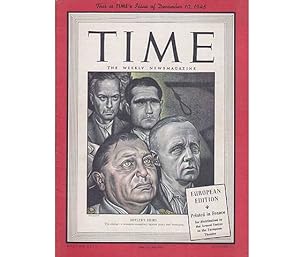
Zeitschriften-Sammlung "Time. The Weekly Newsmagazine". 8 Titel. 1.) Time, Atlantic Overseas Edition, Ausgabe vom 26. November 1945. 2.) Time, Atlantic Overseas Edition, Ausgabe vom 10. Dezember 1945 (Foto). 3.) Time, Atlantic Overseas Edition, Ausgabe vom 17. Dezember 1945. 4.) Time, Atlantic Overseas Edition, Ausgabe vom 31. Dezember 1945. 5.) Time, Atlantic Overseas Edition, Ausgabe vom 29. Juli 1946. 6.) Time, Atlantic Overseas Edition, Ausgabe vom 6. Januar 1947. 7.) Time, Atlantic Overseas Edition, Ausgabe vom 24. Februar 1947. 8.) Time, Atlantic Overseas Edition, Ausgabe vom 3. März 1947
Verlag: Printed by Curial-Archereau Paris
Anbieter: Agrotinas VersandHandel, Fredersdorf-Vogelsdorf, Deutschland
Verkäuferbewertung 3 von 5 Sternen

1.) Time, Atlantic Overseas Edition, Ausgabe vom 26. November 1945. 2.) Time, Atlantic Overseas Edition, Ausgabe vom 10. Dezember 1945 (Foto). 3.) Time, Atlantic Overseas Edition, Ausgabe vom 17. Dezember 1945. 4.) Time, Atlantic Overseas Edition, Ausgabe vom 31. Dezember 1945. 5.) Time, Atlantic Overseas Edition, Ausgabe vom 29. Juli 1946. 6.) Time, Atlantic Overseas Edition, Ausgabe vom 6. Januar 1947. 7.) Time, Atlantic Overseas Edition, Ausgabe vom 24. Februar 1947. 8.) Time, Atlantic Overseas Edition, Ausgabe vom 3. März 1947, Editorial offices Time & Life Building Rockefeller Center New York 20 U.S.A., in englischer Sprache, 32 Seiten/Heft, reich illustriert mit Abbildungen, geklammerte Hefte, Heft vom 26. November 1945 mit kleinen Einrissen, Papier bedingte leichte Bräunung der Seiten, sonst sonst gut erhalten, Format 24,5 x 18 cm/28 x 21 cm; wie angegeben.
-
![Bild des Verkäufers für Time April [Apr.] 20, 1959, Vol. LXXIII No. 16 - Dalai Lama Cover zum Verkauf von RareNonFiction, IOBA](https://pictures.abebooks.com/inventory/md/md30881215693.jpg)
Time April [Apr.] 20, 1959, Vol. LXXIII No. 16 - Dalai Lama Cover
Verlag: Time, Inc., USA, 1959
Anbieter: RareNonFiction, IOBA, Ladysmith, BC, Kanada
Verbandsmitglied: IOBA
Verkäuferbewertung 5 von 5 Sternen
Magazin / Zeitschrift Erstausgabe
Single Issue Magazine. Zustand: Good. Illustrated by Chaliapin, Boris (illustrator). First Edition. Iconic color cover illustration of the Dalai Lama by Boris Chaliapin. Cover story, 'The Escape That Rocked The Reds', describes the Dalai Lama's dramatic two-week flight from the Red Chinese as he travelled from Lhasa to the sanctuary of northern India. Included is a map of the escape route and three photos. An additional article entitled 'Buddhism - The Dalai Lama's Faith' includes a map showing Buddha's hold on Asia. Also of interest is an article on the marriage of Japan's Prince Akihito to the commoner Michiko Shoda, which includes two photos. Complete and unmarked with moderate wear. A sound copy of this special issue.; 4to - over 9¾" - 12" tall; Dalai Lama, Royal Wedding - Japan, Dalai Lama - Escape, Michiko Shoda, Prince Akihito, Kensetsu Nakayama.


