

Gesamtpreis (1 Artikel Artikel):
Versandziel:

brown rolston (2 Ergebnisse)
Direkt zu den wichtigsten Suchergebnissen
Suchfilter
Produktart
- Alle Product Types
- Bücher (2)
- Magazine & Zeitschriften (Keine weiteren Ergebnisse entsprechen dieser Verfeinerung)
- Comics (Keine weiteren Ergebnisse entsprechen dieser Verfeinerung)
- Noten (Keine weiteren Ergebnisse entsprechen dieser Verfeinerung)
- Kunst, Grafik & Poster (Keine weiteren Ergebnisse entsprechen dieser Verfeinerung)
- Fotografien (Keine weiteren Ergebnisse entsprechen dieser Verfeinerung)
- Karten (Keine weiteren Ergebnisse entsprechen dieser Verfeinerung)
- Manuskripte & Papierantiquitäten (Keine weiteren Ergebnisse entsprechen dieser Verfeinerung)
Zustand Mehr dazu
- Neu (Keine weiteren Ergebnisse entsprechen dieser Verfeinerung)
- Wie Neu, Sehr Gut oder Gut Bis Sehr Gut (Keine weiteren Ergebnisse entsprechen dieser Verfeinerung)
- Gut oder Befriedigend (1)
- Ausreichend oder Schlecht (Keine weiteren Ergebnisse entsprechen dieser Verfeinerung)
- Wie beschrieben (1)
Einband
Weitere Eigenschaften
- Erstausgabe (1)
- Signiert (Keine weiteren Ergebnisse entsprechen dieser Verfeinerung)
- Schutzumschlag (Keine weiteren Ergebnisse entsprechen dieser Verfeinerung)
- Angebotsfoto (2)
Sprache (2)
Gratisversand
- Kostenloser Versand nach USA (Keine weiteren Ergebnisse entsprechen dieser Verfeinerung)
Land des Verkäufers
Verkäuferbewertung
-

If You're Thinking of Building
Verlag: Charles Scribner's Sons, NEW YORK, 1947
Boards. Zustand: Very Good with no dust jacket. Illustrated by Brown Rolston (illustrator). First Ediition. edgewear, orange spoine, gray boards, black lettering bottom edge, 136 pgs., pages clean, binding very good, bookplate front paste down; 8vo - over 7¾" - 9¾" tall A1.
-
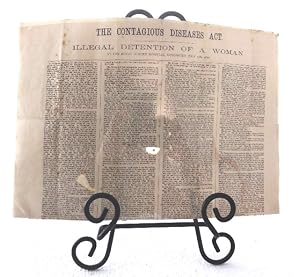
Illegal Detention of a Woman at the Royal Albert Hospital, Devonport, July 13th, 1870
Sprache: Englisch
Verlag: Devonport Petty Sessions, 1870
Anbieter: Structure, Verses, Agency Books, Spray, OR, USA
Verkäuferbewertung 5 von 5 Sternen

Erstausgabe
Softcover. Zustand: Good. First Edition. Unique in the trade, emanating from the Royal Albert Hospital's supervision over the Lock Hospital in Devonport, England, regarding the "Illegal Detention of Woman." The case was held at the Devonport Petty Sessions on July 13, 1870 in front of Mayor Dr. Rolston, Dr. Row, Colonel Brown, and Mr. Adams, Solicitor. The report involves Harriet Hicks (her real name) and the invocation of the dictates of The Contagious Diseases Act. Single-page broadsheet, folded singly, but cut off at the end of page two, "The decision was greeted with applause by those in court, but the demonstration was immediately suppressed . . . Small hole in the second paragraph resulting in loss of perhaps 15 words but to no great detriment. Protected in Mylar sheet. The Acts were introduced in England to attempt to regulate "common prostitutes," in order allegedly to reduce the prevalence of sexually transmitted diseases within the British army and navy and close kindred. Their inspiration followed long and faulty and misogynist associations of sex and sin and disease and regulation with women and girls, stretching from ancient Hebrews and Grecians and Romans and thenceforward. Applied also to military encampments and to garrison towns and ports, expanding eventually throughout the Commonwealth, India to Australia and to all manner of public spaces. The provisions of the Acts made unlawful, women who were suspected of engaging in prostitution and who failed to register as such with the police in any given locale. They were made to submit to an invasive medical examination allegedly to clear her of infection with an STD. The Act empowered police and ministers, businessmen and tavern-owners, eventually, the right to define who was and who was not a prostitute. If the woman was found to be suffering from a venereal disease, typically either syphilis or gonorrhoea, she would be confined to a "lock hospital" until pronounced "clean," that is, putatively uninfected. The only alternative for such a woman hemmed in so was to agree to three months' imprisonment (extended to six months in the 1869 Act) or ditto, at hard labor. The Acts did not enforce the examination of men, nor were men ever considered vectors of infection as such. The unjust nature of the Act and its unequal application evoked outrage among the British public and Christian societies. It was eventually repealed through the efforts of Josephine Butler and others, she having founded the Ladies' National Association (L.N.A.) to campaign against the implementation of the Act. This broadside is a perfect exemplar of all that was inspired by and wrong with the Act. The detention was found to be illegal under the dictates of the Act, but yet Ms Hicks was not remunerated for her pain and discomfort or the legal wrongs done to her.Member, I.O.B.A., C.B.A., and adherent to the highest ethical standards. Additional postage may be required for oversize or especially heavy volumes, and for sets.
