

Gesamtpreis (1 Artikel Artikel):
Versandziel:

blyth reginald (26 Ergebnisse)
Direkt zu den wichtigsten Suchergebnissen
Suchfilter
Produktart
- Alle Product Types
- Bücher (26)
- Magazine & Zeitschriften (Keine weiteren Ergebnisse entsprechen dieser Verfeinerung)
- Comics (Keine weiteren Ergebnisse entsprechen dieser Verfeinerung)
- Noten (Keine weiteren Ergebnisse entsprechen dieser Verfeinerung)
- Kunst, Grafik & Poster (Keine weiteren Ergebnisse entsprechen dieser Verfeinerung)
- Fotografien (Keine weiteren Ergebnisse entsprechen dieser Verfeinerung)
- Karten (Keine weiteren Ergebnisse entsprechen dieser Verfeinerung)
- Manuskripte & Papierantiquitäten (Keine weiteren Ergebnisse entsprechen dieser Verfeinerung)
Zustand Mehr dazu
- Neu (Keine weiteren Ergebnisse entsprechen dieser Verfeinerung)
- Wie Neu, Sehr Gut oder Gut Bis Sehr Gut (3)
- Gut oder Befriedigend (14)
- Ausreichend oder Schlecht (3)
- Wie beschrieben (6)
Einband
Weitere Eigenschaften
- Erstausgabe (1)
- Signiert (Keine weiteren Ergebnisse entsprechen dieser Verfeinerung)
- Schutzumschlag (6)
- Angebotsfoto (6)
Sprache (3)
Gratisversand
Land des Verkäufers
Verkäuferbewertung
-

Zen in English Literature and Oriental Classics
Anbieter: Better World Books: West, Reno, NV, USA
Verkäuferbewertung 5 von 5 Sternen

Zustand: Good. Former library copy. Pages intact with minimal writing/highlighting. The binding may be loose and creased. Dust jackets/supplements are not included. Includes library markings. Stock photo provided. Product includes identifying sticker. Better World Books: Buy Books. Do Good.
-
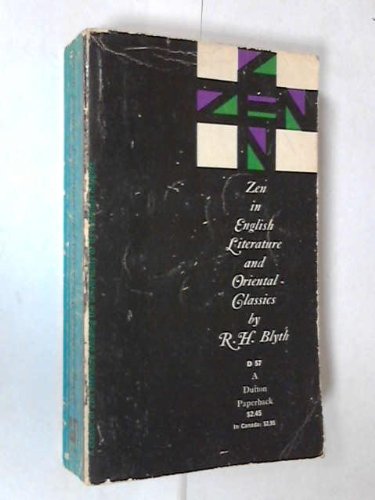
Zen in English Literature and Oriental Classics
Anbieter: World of Books (was SecondSale), Montgomery, IL, USA
Verkäuferbewertung 5 von 5 Sternen
Zustand: Good. Item in good condition. Textbooks may not include supplemental items i.e. CDs, access codes etc.
-
Zen in English Literature and Oriental Classics
Anbieter: ThriftBooks-Phoenix, Phoenix, AZ, USA
Verkäuferbewertung 5 von 5 Sternen
Paperback. Zustand: As New. No Jacket. Pages are clean and are not marred by notes or folds of any kind. ~ ThriftBooks: Read More, Spend Less.
-
Zen in English Literature and Oriental Classics
Anbieter: ThriftBooks-Dallas, Dallas, TX, USA
Verkäuferbewertung 5 von 5 Sternen
Paperback. Zustand: Fair. No Jacket. Readable copy. Pages may have considerable notes/highlighting. ~ ThriftBooks: Read More, Spend Less.
-
Zen in English Literature and Oriental Classics
Anbieter: ThriftBooks-Atlanta, AUSTELL, GA, USA
Verkäuferbewertung 5 von 5 Sternen
Paperback. Zustand: As New. No Jacket. Pages are clean and are not marred by notes or folds of any kind. ~ ThriftBooks: Read More, Spend Less.
-

A history of haiku. Volume one (only), From the beginnings up to Issa
Sprache: Englisch
Verlag: Hokuseido Press, [Tokyo], 1963
Anbieter: Carothers and Carothers, Albany, CA, USA
Verkäuferbewertung 5 von 5 Sternen
Hardcover. Zustand: Good. No Jacket. ix, 1 blank, 427 pages. This is a good, solid copy of the first volume of Blyth's History of Haiku. The publisher's linen-covered boards are goods though slightly dusty, extremities mildly age-toned; offsetting to endpapers, contents age-toned but unmarked and attractive. The dust jacket is not present. 480 grams.
-
Zen in English Literature and Oriental Classics
Verlag: Dutton
Anbieter: ThriftBooks-Atlanta, AUSTELL, GA, USA
Verkäuferbewertung 5 von 5 Sternen
Paperback. Zustand: Good. No Jacket. Pages can have notes/highlighting. Spine may show signs of wear. ~ ThriftBooks: Read More, Spend Less.
-
Zen in English Literature and Oriental Classics
Verlag: Hokuseido Press, Tokyo, 1948
Anbieter: Carothers and Carothers, Albany, CA, USA
Verkäuferbewertung 5 von 5 Sternen
Hardcover. Zustand: Good. Zustand des Schutzumschlags: Good. xiii, 446 pages. Publisher's binding sturdy, light wear to corners; front inner hinge cracked. contents age-toned but unmarked. The dust jacket is age-toned, with wear and minor chipping at edges. 390 grams.
-
Haiku. Volume 3 (only), Summer-autumn
Sprache: Englisch
Verlag: Hokuseido Press, Hokuseido, 1952
Anbieter: Carothers and Carothers, Albany, CA, USA
Verkäuferbewertung 5 von 5 Sternen
Hardcover. Zustand: Fair. Zustand des Schutzumschlags: Fair. xv, 1 blank, 443 pages. This is a fair copy of the third volume of Blyth's four-volume series Haiku. The publisher's linen-covered boards are good, the corners sharp; contents age-toned but unmarked. The dust jacket is dust-soiled and worn, with short tears at its top and bottom edges. 410 grams.
-

Haiku 3: Blyth/Heian
Sprache: Japanisch
Verlag: Nippon Shuppan Hanbai Deutschland GmbH, 1986
ISBN 10: 4590005743 ISBN 13: 9784590005744
Anbieter: ThriftBooks-Atlanta, AUSTELL, GA, USA
Verkäuferbewertung 5 von 5 Sternen
Hardcover. Zustand: Very Good. No Jacket. May have limited writing in cover pages. Pages are unmarked. ~ ThriftBooks: Read More, Spend Less.
-
Haiku. Volume 2 (only), Spring.
Sprache: Englisch
Verlag: Hokuseido Press, Hokuseido, 1950
Anbieter: Carothers and Carothers, Albany, CA, USA
Verkäuferbewertung 5 von 5 Sternen
Hardcover. Zustand: Good. Zustand des Schutzumschlags: Good. iv, 1 leaf, 382 pages. This is a good, solid copy of the second volume of Blyth's four-volume series Haiku. The publisher's linen-covered boards are good, the corners sharp; contents unmarked and attractive. The dust jacket is worn at ts edges, the spine sunned and lightly chipped at its head and foot. 420 grams.
-
Haiku. Volume 4 (only), Autumn-winter.
Sprache: Englisch
Verlag: Hokuseido Press, Hokuseido, 1952
Anbieter: Carothers and Carothers, Albany, CA, USA
Verkäuferbewertung 5 von 5 Sternen
Hardcover. Zustand: Very Good. Zustand des Schutzumschlags: Fair. [liii], 1 blank, 1 leaf, 396 pages, folding chart. This is a pleasing copy of the fourth volume of Blyth's four-volume series Haiku. The publisher's linen-covered boards are good, the corners sharp; contents unmarked and attractive. The dust jacket is worn at ts edges, with short tears at the head and foot of the spine. 420 grams.
-

The Genius of Haiku: Readings from R.H. Blyth on Poetry, Life and Zen
Sprache: Englisch
Verlag: The British Haiku Society, 1994
ISBN 10: 0952239701 ISBN 13: 9780952239703
Anbieter: Anybook.com, Lincoln, Vereinigtes Königreich
Verkäuferbewertung 5 von 5 Sternen
EUR 66,53
EUR 15,69 Versand
Versand von Vereinigtes Königreich nach USAAnzahl: 1 verfügbar
In den WarenkorbZustand: Good. This is an ex-library book and may have the usual library/used-book markings inside.This book has soft covers. In good all round condition. Please note the Image in this listing is a stock photo and may not match the covers of the actual item,350grams, ISBN:9780952239703.
-
Buddhist Sermons on Christian Texts
Anbieter: Southampton Books, Sag Harbor, NY, USA
Verkäuferbewertung 5 von 5 Sternen
Paperback. Zustand: Like New. FIRST THUS. First Edition Thus, First Printing. Not price-clipped. Published by Heian Intl Pub Co, 1976. Octavo. Paperback. Book is like new. A lovely copy of this title on Zen Buddhism.100% positive feedback. 30 day money back guarantee. NEXT DAY SHIPPING! Excellent customer service. Please email with any questions. All books packed carefully and ship with free delivery confirmation/tracking. All books come with free bookmarks. Ships from Sag Harbor, New York.
-

Haiku (Spring, Summer-Autumn, Autumn, Autumn-Winter, Volumes 1-4)
Anbieter: ThriftBooks-Dallas, Dallas, TX, USA
Verkäuferbewertung 5 von 5 Sternen
Paperback. Zustand: Good. No Jacket. Pages can have notes/highlighting. Spine may show signs of wear. ~ ThriftBooks: Read More, Spend Less.
-
Haiku (Spring, Summer-Autumn, Autumn, Autumn-Winter, Volumes 1-4)
Anbieter: ThriftBooks-Atlanta, AUSTELL, GA, USA
Verkäuferbewertung 5 von 5 Sternen
Paperback. Zustand: Good. No Jacket. Former library book; Pages can have notes/highlighting. Spine may show signs of wear. ~ ThriftBooks: Read More, Spend Less.
-
Haiku (Spring, Summer-Autumn, Autumn, Autumn-Winter, Volumes 1-4)
Anbieter: ThriftBooks-Dallas, Dallas, TX, USA
Verkäuferbewertung 5 von 5 Sternen
Paperback. Zustand: Very Good. No Jacket. May have limited writing in cover pages. Pages are unmarked. ~ ThriftBooks: Read More, Spend Less.
-
Haiku (Spring, Summer-Autumn, Autumn, Autumn-Winter, Volumes 1-4)
Anbieter: ThriftBooks-Atlanta, AUSTELL, GA, USA
Verkäuferbewertung 5 von 5 Sternen
Paperback. Zustand: Fair. No Jacket. Readable copy. Pages may have considerable notes/highlighting. ~ ThriftBooks: Read More, Spend Less.
-
ORIENTAL HUMOUR.
Sprache: Englisch
Verlag: Hokuseido Press, Tokyo, Japan, 1959
Anbieter: Bookfever, IOBA (Volk & Iiams), Ione, CA, USA
Verkäuferbewertung 5 von 5 Sternen
Erstausgabe
Zustand: VERY GOOD. First printing. Rather uncommon first edition of this classic and comprehensive English-language work on Japanese, Chinese & Korean humor from all periods (India is not included, although the introduction describes India as the chief origin of world humour.) Among the topics are Chinese classics and poetry, ghost stories, Liehtse, proverbs, Taoism, Zen, short stories, Korean humor and proverbs, Chinese influence on Japan, Japanese caricature, old and modern Senryu, Yanagidaru, and more. Illustrated with a color frontispiece, 26 rather striking inserted plates (7 in color), each with a tissue guard imprinted with notations about the plate, by Kang Hi An, Li Am, Sengai, Hakuin, Tosa Minsunaga and others, and 6 en texte illustrations. Chronological chart, bibliography, index. 582 pp. Very good in a good only dustjacket - a solid, clean copy in orange cloth with just a hint of dampness/crinkling to the upper edges of the first few pages, previous owner's name, in a fragile dustacket with rubbing along the folds, and one fold partially split (now protected by an archival cover.).
-
Oriental Humor
Verlag: The Hokuseido Press, Tokyo, 1963
Anbieter: HJP VERSANDBUCHHANDLUNG, WEDEL, SH, Deutschland
Verkäuferbewertung 4 von 5 Sternen

Cloth. Zustand: Good. Zustand des Schutzumschlags: Good. 3rd Printing. 582 p; Many Ills.
-
ORIENTAL HUMOUR
Anbieter: RARE ORIENTAL BOOK CO., ABAA, ILAB, Aptos, CA, USA
Verkäuferbewertung 5 von 5 Sternen
[Tokyo 1963], Hokuseido. Mustard cloth, very good, 582p., 35 color & b.w. illustrations, biblioigraphy, index, very crisp copy, dust jacket mylar protector, & original slipcase.RARE! Classic work on Japanese, Chinese & Korean humor from all periods. Covering poetry, ghost stories, Liehtse, proverbs, Taoism, Zen, short stories, Chinese influence on Japan, mod- ern & old Senryu, Yanagidaru &c. Excellent reference source. This fascinating and erudite work includes a vast amount of literary,moral & religious experience enshrined in the three languages. Reginald Horace Blyth is always R A R E ! *** A very well written, readable set of books. The celebrated Zen master D.T. Suzuki described Blyth as "one of the most eminent exponents of Japanese culture." **** ZEN AND HAIKU: Blyth's studies on Haiku, Japanese humor and Zen are "unique contributions towards East-West understanding." Blyth lived & worked in the east 40 years, until his death in 1964. The history of Zen is the history of moments. It cannot be, like the history of ideas, or even the history of the freedom of thought, an account of development, systematization, criticism, modification, replacement and so forth. Zen seems to become deeper sometimes, shallower, broader, narrower sometimes, but there is no progress of the ordinary kind. It is a history only in the sense of being a list of names of great men in the attainment of great and so forth. Zen seems to become deeper sometimes, shallower, broader, narrower sometimes, but there is no progress of the ordinary kind. It is a history only in the sense of being a list of names of great men in the attainment of great Buddha-hood. * BLYTH'S CONTRIBUTION: Blyth lived and worked in the East for forty years, until his death in 1964 at the age of sixty-six. From the time of his internment in Japan during World War II, Blyth wrote assiduously. In the 1950's, his "ZEN IN ENGLISH LITERATURE" and "ORIENTAL CLASSICS" and "HAIKU" reached enthusiastic readers in America and Europe. Aldous Huxley describes Blyth's work as "illuminating." As William J. Higginson writes in his "HAIKU HANDBOOK," thanks to Blyth "a new interest in Japanese Haiku began to grow among poets of the immediate post World War II generation." . Blyth's Contribution to cross-cultural understanding was manifold. In 1945, Blyth assumed a post as professor of English at Tokyo's Gakushuin University, the former Peers' School. For almost twenty years he tutored Crown Prince Akihito, the present Emperor. Blyth played a leading role in Emperor Hirohito's historical declaration of January 1, 1946, that he was a human being rather than a god. Blyth edited numerous writings from English and American literature, making them available to avid Japanese readers. **** BIBLIOGRAPHY: * Zen in English Literature and Oriental Classics, The Hokuseido Press, 1942 Haiku, 1949-1952, in four volumes: Vol.1: Eastern Culture. Vol.2: Spring. Vol.3: Summer-Autumn. Vol.4: Autumn-Winter. The Hokuseido Press . Japanese Satirical Verses, The Hokuseido Press, 1949 Japanese Humour, Japan Travel Bureau, 1957 Japanese Life and Character in Senryu, 1959. Oriental Humor, 1959. . Zen and Zen Classics, in five volumes: Vol.1: General Introduction,from the Upanishads to . Huineng.1960. Vol.2: History of Zen.1964. Vol.3: History of Zen.1970. Vol.4: Mumonkan.1966. Vol.5: Twenty-Five Zen Essays.1962. The Hokuseido Press. [Note: this set's numbering is complicated, see us for complete information on what comprises a full set.] . Edo Satirical Verse Anthologies, 1961. The Hokuseido Press. A History of Haiku in two volumes: Vol.1: From the Beginnings up to Issa. Vol.2: From Issa up to the Present.1963.The Hokuseido Press. Games Zen Masters Play: Writings of R. H. Blyth, 1976. * For more on Blyth see Wikipedia:.
-
EDO SATIRICAL VERSE ANTHOLOGIES
Anbieter: RARE ORIENTAL BOOK CO., ABAA, ILAB, Aptos, CA, USA
Verkäuferbewertung 5 von 5 Sternen
[Tokyo 1961], Hokuseido. Brown cloth, very good, 312p.,11 bw photos, color frontispiece & folding photos, index, biblio- graphy, dj., copy in collector's condition. SCARCE FIRST EDITION This excellent monograph begins with a history of Oriental Humour, European Satire, and 18th century Edo satirical ver- se. The he leads in to Mutamagawa for 18 chapters, and on to Mankuawase, Yanagidaru, Parodies of Hyakunin Isshu, Suetsu- muhana, Kawasoe Yanagi, Yanagidaru Shui &c. This is a serious work on Senryu verse. Well done, with may Japanese texts translated expertly into English by the author. Zen master D.T. Suzuki described Blyth as "one of the most emi- nent exponents of Japanese culture." Blyth's studies on Haiku, Japanese humor, and Zen are "unique contributions towards East-West understanding." Blyth lived and worked in the East for 40 years, until his death in 1964. ALWAYS RARE! Reginald Horace Blyth. **** A very well written, readable set of books. The celebrated Zen master D.T. Suzuki described Blyth as "one of the most eminent exponents of Japanese culture." **** ZEN AND HAIKU: Blyth's studies on Haiku, Japanese humor and Zen are "unique contributions towards East-West understanding." Blyth lived & worked in the east 40 years, until his death in 1964. The history of Zen is the history of moments. It cannot be, like the history of ideas, or even the history of the freedom of thought, an account of development, systematization, criticism, modification, replacement and so forth. Zen seems to become deeper sometimes, shallower, broader, narrower sometimes, but there is no progress of the ordinary kind. It is a history only in the sense of being a list of names of great men in the attainment of great and so forth. Zen seems to become deeper sometimes, shallower, broader, narrower sometimes, but there is no progress of the ordinary kind. It is a history only in the sense of being a list of names of great men in the attainment of great Buddha-hood. * BLYTH'S CONTRIBUTION: Blyth lived and worked in the East for forty years, until his death in 1964 at the age of sixty-six. From the time of his internment in Japan during World War II, Blyth wrote assiduously. In the 1950's, his "ZEN IN ENGLISH LITERATURE" and "ORIENTAL CLASSICS" and "HAIKU" reached enthusiastic readers in America and Europe. Aldous Huxley describes Blyth's work as "illuminating." As William J. Higginson writes in his "HAIKU HANDBOOK," thanks to Blyth "a new interest in Japanese Haiku began to grow among poets of the immediate post World War II generation." . Blyth's Contribution to cross-cultural understanding was manifold. In 1945, Blyth assumed a post as professor of English at Tokyo's Gakushuin University, the former Peers' School. For almost twenty years he tutored Crown Prince Akihito, the present Emperor. Blyth played a leading role in Emperor Hirohito's historical declaration of January 1, 1946, that he was a human being rather than a god. Blyth edited numerous writings from English and American literature, making them available to avid Japanese readers. **** BIBLIOGRAPHY: * Zen in English Literature and Oriental Classics, The Hokuseido Press, 1942 Haiku, 1949-1952, in four volumes: Vol.1: Eastern Culture. Vol.2: Spring. Vol.3: Summer-Autumn. Vol.4: Autumn-Winter. The Hokuseido Press . Japanese Satirical Verses, The Hokuseido Press, 1949 Japanese Humour, Japan Travel Bureau, 1957 Japanese Life and Character in Senryu, 1959. Oriental Humor, 1959. . Zen and Zen Classics, in five volumes: Vol.1: General Introduction,from the Upanishads to . Huineng.1960. Vol.2: History of Zen.1964. Vol.3: History of Zen.1970. Vol.4: Mumonkan.1966. Vol.5: Twenty-Five Zen Essays.1962. The Hokuseido Press. [Note: this set's numbering is complicated, see us for complete information on what comprises a full set.] . Edo Satirical Verse Anthologies, 1961. The Hokuseido Press. A History of Haiku in two volumes: Vol.1: From the Beginnings up to Issa. Vol.2: From Issa up to the Present.1963.The Hokuseido Press. Games Zen Masters Play: Writings of R. H. Blyth, 1976. * For more on Blyth see Wikipedia:.
-
JAPANESE LIFE AND CHARACTER IN SENRYU
Anbieter: RARE ORIENTAL BOOK CO., ABAA, ILAB, Aptos, CA, USA
Verkäuferbewertung 5 von 5 Sternen
[Tokyo 1960,] Hokuseido. Brown cloth, very good, 630p., color frontis, 5 color, 13 b.w. plates, index, bibliography, epilogue, exceptionally crisp, clean, nice copy, 5.5 x 21.5 cm., dj. in mylar protector. FIRST & ONLY EDITION SCARCE This excellent monograph covers the chronologicl survey of Senryu, from Genroku to Meiji, Taisho, Showa, a Year of Sen- ryu, and subject matter of the Senryu, with full text in English, Japanese characters & Romanized characters. Blyth rightlyi claims Senryu as true poetry & truly representative of the Japanese spirit. The whole of Japanese life is revea- led in these pages.Way cool. Reginald Horace Blyth is always R A R E ! **** A very well written, readable set of books. The celebrated Zen master D.T. Suzuki described Blyth as "one of the most eminent exponents of Japanese culture." **** ZEN AND HAIKU: Blyth's studies on Haiku, Japanese humor and Zen are "unique contributions towards East-West understanding." Blyth lived & worked in the east 40 years, until his death in 1964. The history of Zen is the history of moments. It cannot be, like the history of ideas, or even the history of the freedom of thought, an account of development, systematization, criticism, modification, replacement and so forth. Zen seems to become deeper sometimes, shallower, broader, narrower sometimes, but there is no progress of the ordinary kind. It is a history only in the sense of being a list of names of great men in the attainment of great and so forth. Zen seems to become deeper sometimes, shallower, broader, narrower sometimes, but there is no progress of the ordinary kind. It is a history only in the sense of being a list of names of great men in the attainment of great Buddha-hood. * BLYTH'S CONTRIBUTION: Blyth lived and worked in the East for forty years, until his death in 1964 at the age of sixty-six. From the time of his internment in Japan during World War II, Blyth wrote assiduously. In the 1950's, his "ZEN IN ENGLISH LITERATURE" and "ORIENTAL CLASSICS" and "HAIKU" reached enthusiastic readers in America and Europe. Aldous Huxley describes Blyth's work as "illuminating." As William J. Higginson writes in his "HAIKU HANDBOOK," thanks to Blyth "a new interest in Japanese Haiku began to grow among poets of the immediate post World War II generation." . Blyth's Contribution to cross-cultural understanding was manifold. In 1945, Blyth assumed a post as professor of English at Tokyo's Gakushuin University, the former Peers' School. For almost twenty years he tutored Crown Prince Akihito, the present Emperor. Blyth played a leading role in Emperor Hirohito's historical declaration of January 1, 1946, that he was a human being rather than a god. Blyth edited numerous writings from English and American literature, making them available to avid Japanese readers. **** BIBLIOGRAPHY: * Zen in English Literature and Oriental Classics, The Hokuseido Press, 1942 Haiku, 1949-1952, in four volumes: Vol.1: Eastern Culture. Vol.2: Spring. Vol.3: Summer-Autumn. Vol.4: Autumn-Winter. The Hokuseido Press . Japanese Satirical Verses, The Hokuseido Press, 1949 Japanese Humour, Japan Travel Bureau, 1957 Japanese Life and Character in Senryu, 1959. Oriental Humor, 1959. . Zen and Zen Classics, in five volumes: Vol.1: General Introduction,from the Upanishads to . Huineng.1960. Vol.2: History of Zen.1964. Vol.3: History of Zen.1970. Vol.4: Mumonkan.1966. Vol.5: Twenty-Five Zen Essays.1962. The Hokuseido Press. [Note: this set's numbering is complicated, see us for complete information on what comprises a full set.] . Edo Satirical Verse Anthologies, 1961. The Hokuseido Press. A History of Haiku in two volumes: Vol.1: From the Beginnings up to Issa. Vol.2: From Issa up to the Present.1963.The Hokuseido Press. Games Zen Masters Play: Writings of R. H. Blyth, 1976. * For more on Blyth see Wikipedia:.
-
ZEN AND ZEN CLASSICS
Anbieter: RARE ORIENTAL BOOK CO., ABAA, ILAB, Aptos, CA, USA
Verkäuferbewertung 5 von 5 Sternen
[Tokyo 1966-1982], Hokuseido. 5 Volume set: vols.:2-4 cloth, vols.1 & 5 wrs.,123+211+185+340+225pp.,index,illustrated,all clean,dust jackets on vols. 2-4 mylar protector,mixed dates: 1982,1970,1976,1966,1979], vol.5 First Edition. A NICE SET . *** **** *** . . . . R.H. BLYTH'S MASTERPIECE . * This illusive title has been out of print for a long time, only a couple of the volumes were reprinted, the complete work consisting of 5 volumes is rare and seldom found complete regardless of edition. . * ONE OF THE MOST IMPORTANT WORKS IN ENGLISH ON ZEN: This is a comprehensive set of writings on Zen, Zen arts, the Zen masters and historical background. A wonderful set of works, with English, Japanese characters & Romanized texts. . * A very well written, readable set of books. The celebrated Zen master D.T. Suzuki described Blyth as "one of the most eminent exponents of Japanese culture." . **** OTHER RELATED WRITINGS BY BLYTH ON ZEN & HAIKU: ZEN AND HAIKU: Blyth's studies on Haiku, Japanese humor and Zen are "unique contributions towards East-West understanding." Blyth lived & worked in the east 40 years, until his death in 1964. The history of Zen is the history of moments. It cannot be, like the history of ideas, or even the history of the freedom of thought, an account of development, systematization, criticism, modification, replacement and so forth. Zen seems to become deeper sometimes, shallower, broader, narrower sometimes, but there is no progress of the ordinary kind. It is a history only in the sense of being a list of names of great men in the attainment of great and so forth. Zen seems to become deeper sometimes, shallower, broader, narrower sometimes, but there is no progress of the ordinary kind. It is a history only in the sense of being a list of names of great men in the attainment of great Buddha-hood. . * BLYTH'S CONTRIBUTION: Blyth lived and worked in the East for forty years, until his death in 1964 at the age of sixty-six. From the time of his internment in Japan during World War II, Blyth wrote assiduously. In the 1950's, his "ZEN IN ENGLISH LITERATURE" and "ORIENTAL CLASSICS" and "HAIKU" reached enthusiastic readers in America and Europe. Aldous Huxley describes Blyth's work as "illuminating." As William J. Higginson writes in his "HAIKU HANDBOOK," thanks to Blyth "a new interest in Japanese Haiku began to grow among poets of the immediate post World War II generation." . Blyth's Contribution to cross-cultural understanding was manifold. In 1945, Blyth assumed a post as professor of English at Tokyo's Gakushuin University, the former Peers' School. For almost twenty years he tutored Crown Prince Akihito, the present Emperor. Blyth played a leading role in Emperor Hirohito's historical declaration of January 1, 1946, that he was a human being rather than a god. Blyth edited numerous writings from English and American literature, making them available to avid Japanese readers. . **** FIRST EDITIONS: Following is a list of the First Editions: Vol. 1: 1960; vol. 2: 1964; vol. 3: 1970; vol. 4: 1966; vol. 5: 1962; vol. 7: 1962. [vol. 5, 7 are same contents] see additional notes below. There was no volume six ever published nor issued. . *** IMPORTANT NOTE ABOUT WHAT A COMPLETE SET IS: COMPLETE IN 5 VOLUMES. Blyth originally planned this work to be an 8 volume set, but due to his untimely death, it only went to 5 volumes [per dust jacket notes found on volume 2]. The back of the dust jacket on volume one [First Edition] shows the list planning on a total of 8 volumes in all. . The whole set now actually consists of 5 volumes only and is complete in that state. It contains the below list of volumes, the list is based on our primary observation of each volume in addition to the publisher's notice of the series found on the dust jackets of several volumes. . *** The set is complete with volumes 1-5, there can be an acceptable variant in the last volume which can either be numbered volume 5 or 7, contents remains the same, it was merely the publisher's error. The value the a set with either volume 5 or 7 remains the same in our eyes, both issued in 1962 as the First Edition. . THE COMPLETE SET OF 5 VOLUMES: . Vol. I: GENERAL INTRODUCTION, FROM THE UPANISHADS TO HUINENG also WHAT I ZEN ? THE HISTORY OF ZEN, THE BELIEVING MIND, SONG OF TRHE WAY [THE CHENGTAOKE], THE PLATFORM SUTRA. . Vol. II: HISTORY OF ZEN, 713-867 also THE FIVE SECTS, GOZU ZEN AND ROAN ZEN, ENO AND HIS DISCIPLES, SEKITO'S DISCIPLES, SEPPO, SEPPO'S DISCIPLES, HOGEN & DISCIPLES, YAKUSAN TO SEKISO, SENSU, KASSAN, SHOZAN, TOZAN, SOZAN & UNGO, UMMON I, II, III THE SANDOKAI, HOKYOZAMMAI, POEMS OF HANSHAN I, II, ZEN MYSTICISM, EXISTENTIALISM, WAYS AND THE WAY, NATURE, HUMAN NATURE, THE BUDDHA NATURE THE POETIC NATURE, DEFECTS OF ZEN. . Vol. III: HISTORY OF ZEN 867-1260 also THE DISCIPLES OF TOZAN, NANGAKU AND BASHO, JOSHU, HYAKUJO RINZAI AND OBAKU THEIR DISCIPLES. . Vol. IV: MUMONKAN, HISTORY OF KOREAN ZEN, WUMENKUAN &c. . Vol. V: TWENTY-FIVE ZEN ESSAYS: WUMENKAUAN. . ! Note: vol. 5 and 7 are the same contents, simply a . numbering error on the part of the publisher. . Vol. VI: HISTORY OF JAPANESE ZEN, DOGEN HAKUIN, ETC. To our knowledge, this volume was never published. The contents were likely incorporated into other volumes with variant titles. . Vol. VII: ZEN ESSAYS, CHRISTIANITY, SEX, SOCIETY, ETC. . !! Note: vol. 5 and 7 have the same contents, simply a . numbering error on the part of the publisher. . * NEVER ISSUED: Vol. VIII: BUDDHIST SERMONS ON CHRISTIAN TEXTS. The publisher never issued this title as part of this series, but issued it as a monograph in 1952, several years predating this series, then again in 1976 posthumously. Neither editions ever had any markings to indicate it to be a part of this series, we can only assume Blyth made a simple error when discussing this title as part of the current series. . * PUBLISHER'S ERROR: Hokuseido press made an error in the numbering of this set. volumes 5 & 7 are id.
-
ZEN AND ZEN CLASSICS
Anbieter: RARE ORIENTAL BOOK CO., ABAA, ILAB, Aptos, CA, USA
Verkäuferbewertung 5 von 5 Sternen
[Tokyo 1960-1974], Hokuseido. 5 Vol. SET. Brown cloth, very clean,125+211+185+340+225p., vols.: 1-5, index, illustrated, vol.3, 1974 1st ed.,4th ptg, FIRST Editions,dust jackets on 2 & 3 in mylar protectors, all clean & solid, complete set ! . *** **** *** . . . . R.H. BLYTH'S MASTERPIECE . * This illusive title has been out of print for a long time, only a couple of the volumes were reprinted, the complete work consisting of 5 volumes is rare and seldom found complete regardless of edition. . * ONE OF THE MOST IMPORTANT WORKS IN ENGLISH ON ZEN: This is a comprehensive set of writings on Zen, Zen arts, the Zen masters and historical background. A wonderful set of works, with English, Japanese characters & Romanized texts. . * A very well written, readable set of books. The celebrated Zen master D.T. Suzuki described Blyth as "one of the most eminent exponents of Japanese culture." . **** OTHER RELATED WRITINGS BY BLYTH ON ZEN & HAIKU: ZEN AND HAIKU: Blyth's studies on Haiku, Japanese humor and Zen are "unique contributions towards East-West understanding." Blyth lived & worked in the east 40 years, until his death in 1964. The history of Zen is the history of moments. It cannot be, like the history of ideas, or even the history of the freedom of thought, an account of development, systematization, criticism, modification, replacement and so forth. Zen seems to become deeper sometimes, shallower, broader, narrower sometimes, but there is no progress of the ordinary kind. It is a history only in the sense of being a list of names of great men in the attainment of great and so forth. Zen seems to become deeper sometimes, shallower, broader, narrower sometimes, but there is no progress of the ordinary kind. It is a history only in the sense of being a list of names of great men in the attainment of great Buddha-hood. . * BLYTH'S CONTRIBUTION: Blyth lived and worked in the East for forty years, until his death in 1964 at the age of sixty-six. From the time of his internment in Japan during World War II, Blyth wrote assiduously. In the 1950's, his "ZEN IN ENGLISH LITERATURE" and "ORIENTAL CLASSICS" and "HAIKU" reached enthusiastic readers in America and Europe. Aldous Huxley describes Blyth's work as "illuminating." As William J. Higginson writes in his "HAIKU HANDBOOK," thanks to Blyth "a new interest in Japanese Haiku began to grow among poets of the immediate post World War II generation." . Blyth's Contribution to cross-cultural understanding was manifold. In 1945, Blyth assumed a post as professor of English at Tokyo's Gakushuin University, the former Peers' School. For almost twenty years he tutored Crown Prince Akihito, the present Emperor. Blyth played a leading role in Emperor Hirohito's historical declaration of January 1, 1946, that he was a human being rather than a god. Blyth edited numerous writings from English and American literature, making them available to avid Japanese readers. . **** FIRST EDITIONS: Following is a list of the First Editions: Vol. 1: 1960; vol. 2: 1964; vol. 3: 1970; vol. 4: 1966; vol. 5: 1962; vol. 7: 1962. [vol. 5, 7 are same contents] see additional notes below. There was no volume six ever published nor issued. . *** IMPORTANT NOTE ABOUT WHAT A COMPLETE SET IS: COMPLETE IN 5 VOLUMES. Blyth originally planned this work to be an 8 volume set, but due to his untimely death, it only went to 5 volumes [per dust jacket notes found on volume 2]. The back of the dust jacket on volume one [First Edition] shows the list planning on a total of 8 volumes in all. . The whole set now actually consists of 5 volumes only and is complete in that state. It contains the below list of volumes, the list is based on our primary observation of each volume in addition to the publisher's notice of the series found on the dust jackets of several volumes. . *** The set is complete with volumes 1-5, there can be an acceptable variant in the last volume which can either be numbered volume 5 or 7, contents remains the same, it was merely the publisher's error. The value the a set with either volume 5 or 7 remains the same in our eyes, both issued in 1962 as the First Edition. . THE COMPLETE SET OF 5 VOLUMES: . Vol. I: GENERAL INTRODUCTION, FROM THE UPANISHADS TO HUINENG also WHAT I ZEN ? THE HISTORY OF ZEN, THE BELIEVING MIND, SONG OF TRHE WAY [THE CHENGTAOKE], THE PLATFORM SUTRA. . Vol. II: HISTORY OF ZEN, 713-867 also THE FIVE SECTS, GOZU ZEN AND ROAN ZEN, ENO AND HIS DISCIPLES, SEKITO'S DISCIPLES, SEPPO, SEPPO'S DISCIPLES, HOGEN & DISCIPLES, YAKUSAN TO SEKISO, SENSU, KASSAN, SHOZAN, TOZAN, SOZAN & UNGO, UMMON I, II, III THE SANDOKAI, HOKYOZAMMAI, POEMS OF HANSHAN I, II, ZEN MYSTICISM, EXISTENTIALISM, WAYS AND THE WAY, NATURE, HUMAN NATURE, THE BUDDHA NATURE THE POETIC NATURE, DEFECTS OF ZEN. . Vol. III: HISTORY OF ZEN 867-1260 also THE DISCIPLES OF TOZAN, NANGAKU AND BASHO, JOSHU, HYAKUJO RINZAI AND OBAKU THEIR DISCIPLES. . Vol. IV: MUMONKAN, HISTORY OF KOREAN ZEN, WUMENKUAN &c. . Vol. V: TWENTY-FIVE ZEN ESSAYS: WUMENKAUAN. . ! Note: vol. 5 and 7 are the same contents, simply a . numbering error on the part of the publisher. . Vol. VI: HISTORY OF JAPANESE ZEN, DOGEN HAKUIN, ETC. To our knowledge, this volume was never published. The contents were likely incorporated into other volumes with variant titles. . Vol. VII: ZEN ESSAYS, CHRISTIANITY, SEX, SOCIETY, ETC. . !! Note: vol. 5 and 7 have the same contents, simply a . numbering error on the part of the publisher. . * NEVER ISSUED: Vol. VIII: BUDDHIST SERMONS ON CHRISTIAN TEXTS. The publisher never issued this title as part of this series, but issued it as a monograph in 1952, several years predating this series, then again in 1976 posthumously. Neither editions ever had any markings to indicate it to be a part of this series, we can only assume Blyth made a simple error when discussing this title as part of the current series. . * PUBLISHER'S ERROR: Hokuseido press made an error in the numbering of this set. volumes 5 & 7 are id.
-
BUDDHIST SERMONS ON CHRISTIAN TEXTS
Anbieter: RARE ORIENTAL BOOK CO., ABAA, ILAB, Aptos, CA, USA
Verkäuferbewertung 5 von 5 Sternen
[Tokyo] 1952, Kokudosha. Stiff pictorial wraps. 3-page color fold out map,English & Japanese texts, 12.5 x 18 cm., bit of of the usual paper toning, else clean and solid, 93 pages. *AUTHOR'S SIGNED PRESENTATION-RARE & OBSCURE FIRST EDITION * . *** **** *** . . BLYTH'S TREATISE & IMPRESSIONS ON . . . CHRISTIAN TEXTS VS. BUDDHISM IN JAPAN . . . RARE EXAMPLE: BLYTH'S SIGNED PRESENTATION COPY . * This highly RARE & OBSCURE example was a signed presentation copy from Blyth to his Japanese colleague, "Mr. Nabeshima," penned in his typical 'flowery' flamboyant ink signature. . Blyth signed examples are EXCEPTIONALLY RARE, in our 65 years plus tenure we have had less than five examples. . *** THE BOOK: "An interpretation of Christian intuitions by the Mahayana concepts, and NOT visa-versa, is that Buddhism, in China and Japan, has realized how inexpressive, how crude, how treacherous words are. Only a mind free of intellectual bondage, yet exactly conscious of what it is doing in overstepping the laws of thought is capable of holding fast to conflicting facts, of grasping the inner essence of paradox." Very cool stuff ! . * Per the dust jacket on ZEN AND ZEN CLASSICS, this title was supposed to be volume 8 of the set. While that may be correct, this work predates that set by 8 years for the first edition ! This title was never issued as part of ZEN AND ZEN CLASSICS even though its content should be kept together with that set. It does complete the set as this was Blyth's choice. . *** A very well written, readable set of books. The celebrated Zen master D.T. Suzuki described Blyth as "one of the most eminent exponents of Japanese culture." . *** REGINALD HORACE BLYTH [1898-1964]: He was an English writer and devotee of Japanese culture. He is most famous for his writings on Zen and on Japanese Haiku poetry. . Korea (1925-1935) In 1925, the Blyths moved to Korea (then under Japanese rule), where Blyth became assistant professor of English at Keijo Imperial University in Keijo (now Seoul). While in Korea, Blyth began to learn Japanese and Chinese, and studied Zen under the master Hanayama Taigi of Myoshin-ji Keijo Betsuin (Seoul). In Korea he started to read D. T. Suzuki's books about Zen. In 1933, D.T. Suzuki became his mentor. . Having returned to Seoul in 1936, Blyth remarried in 1937, to a Japanese woman named Kijima Tomiko, with whom he had two daughters. In 1940 they moved to Kanazawa, Japan, which was D. T. Suzuki's home town, and Blyth took a job as an English teacher at the Fourth Higher School (later Kanazawa University). . When Britain declared war on Japan in December 1941 following the Japanese attack on Pearl Harbor, Blyth was interned as a British enemy alien . By 1946, Blyth had become Professor of English at Gakushuin University, and became private tutor to the Crown Prince (later emperor) Akihito until the end of his [Blyth's] life.[6] He did much to popularize Zen philosophy and Japanese poetry (particularly haiku) in the West. In 1954, he was awarded a doctorate in literature from Tokyo University, and, in 1959, he received the Zuihosho (Order of Merit) Fourth Grade. . *** ZEN AND HAIKU: Blyth's studies on Haiku, Japanese humor and Zen are "unique contributions towards East-West understanding." Blyth lived & worked in the east 40 years, until his death in 1964. The history of Zen is the history of moments. It cannot be, like the history of ideas, or even the history of the freedom of thought, an account of development, systematization, criticism, modification, replacement and so forth. Zen seems to become deeper sometimes, shallower, broader, narrower sometimes, but there is no progress of the ordinary kind. It is a history only in the sense of being a list of names of great men in the attainment of great and so forth. Zen seems to become deeper sometimes, shallower, broader, narrower sometimes, but there is no progress of the ordinary kind. It is a history only in the sense of being a list of names of great men in the attainment of great Buddha-hood. . *** BLYTH'S CONTRIBUTION: Blyth lived and worked in the East for forty years, until his death in 1964 at the age of sixty-six. From the time of his internment in Japan during World War II, Blyth wrote assiduously. In the 1950's, his "ZEN IN ENGLISH LITERATURE" and "ORIENTAL CLASSICS" and "HAIKU" reached enthusiastic readers in America and Europe. Aldous Huxley describes Blyth's work as "illuminating." As William J. Higginson writes in his "HAIKU HANDBOOK," thanks to Blyth "a new interest in Japanese Haiku began to grow among poets of the immediate post World War II generation." . Blyth's Contribution to cross-cultural understanding was manifold. In 1945, Blyth assumed a post as professor of English at Tokyo's Gakushuin University, the former Peers' School. For almost twenty years he tutored Crown Prince Akihito, the present Emperor. Blyth played a leading role in Emperor Hirohito's historical declaration of January 1, 1946, that he was a human being rather than a god. Blyth edited numerous writings from English and American literature, making them available to avid Japanese readers. . *** INDIVIDUAL COPY DETAILS: . COPY 1: FIRST EDITION SIGNED PRESENTATION BY BLYTH: . This copy was flat-signed by Blyth to a Japanese colleague & friend, in Romanized alphabet [not in Japanese characters]. This is bound in the publisher's color scenic stiff card covers with front & back 'flaps.' . Excellent example, no marks or damage, contents ditto, no issues. The paper as usual for a book printed in Japan during the first few years after the end of World War II [1945] have been printed on sub-standard paper, which tends to 'toning' which is common. . SELDOM FOUND FIRST & OBSCURE edition, even more so when signed by the author. Blyth signed very few copies of his books. In most cases to friends or colleagues. He did not sign and distribute to fans or average buyers. . * COPY 2: This is the trade edition of the 1976 edition, in blue pictorial wrap.


