

Gesamtpreis (1 Artikel Artikel):
Versandziel:

bertelli ferrando (5 Ergebnisse)
Direkt zu den wichtigsten Suchergebnissen
Suchfilter
Produktart
- Alle Product Types
- Bücher (2)
- Magazine & Zeitschriften (Keine weiteren Ergebnisse entsprechen dieser Verfeinerung)
- Comics (Keine weiteren Ergebnisse entsprechen dieser Verfeinerung)
- Noten (Keine weiteren Ergebnisse entsprechen dieser Verfeinerung)
- Kunst, Grafik & Poster (Keine weiteren Ergebnisse entsprechen dieser Verfeinerung)
- Fotografien (Keine weiteren Ergebnisse entsprechen dieser Verfeinerung)
- Karten (3)
- Manuskripte & Papierantiquitäten (Keine weiteren Ergebnisse entsprechen dieser Verfeinerung)
Zustand Mehr dazu
- Neu (Keine weiteren Ergebnisse entsprechen dieser Verfeinerung)
- Wie Neu, Sehr Gut oder Gut Bis Sehr Gut (Keine weiteren Ergebnisse entsprechen dieser Verfeinerung)
- Gut oder Befriedigend (Keine weiteren Ergebnisse entsprechen dieser Verfeinerung)
- Ausreichend oder Schlecht (Keine weiteren Ergebnisse entsprechen dieser Verfeinerung)
- Wie beschrieben (5)
Einband
- alle Einbände
- Hardcover (Keine weiteren Ergebnisse entsprechen dieser Verfeinerung)
- Softcover (Keine weiteren Ergebnisse entsprechen dieser Verfeinerung)
Weitere Eigenschaften
- Erstausgabe (1)
- Signiert (Keine weiteren Ergebnisse entsprechen dieser Verfeinerung)
- Schutzumschlag (Keine weiteren Ergebnisse entsprechen dieser Verfeinerung)
- Angebotsfoto (5)
Sprache (1)
Preis
- Beliebiger Preis
- Weniger als EUR 20 (Keine weiteren Ergebnisse entsprechen dieser Verfeinerung)
- EUR 20 bis EUR 45 (Keine weiteren Ergebnisse entsprechen dieser Verfeinerung)
- Mehr als EUR 45
Gratisversand
- Kostenloser Versand nach USA (Keine weiteren Ergebnisse entsprechen dieser Verfeinerung)
Land des Verkäufers
Verkäuferbewertung
-

Genova
Verlag: Genova
Anbieter: Sergio Trippini, Gavirate, VA, Italien
Verkäuferbewertung 5 von 5 Sternen

Erstausgabe
Veduta prospettica della città di Genova ripresa dal mare ed animata dalla presenza di svariati navigli che solcano le acque del Mar Ligure. L'incisione segue il modello proposto da Paolo Forlani nel 1567; si noti in particolare, oltre alla rappresentazione della città, l'orientazione della stessa determinata dall'indicazione dei quadranti di una semplice rosa dei venti. L'attribuzione e datazione è determinata dalla presenza in alcuni esemplari della prima edizione dell'opera "Civitatum aliquot insigniorum et locorum, magis munitorum exacta delineatio." pubblicata a Venezia proprio da Ferrando Bertelli nel 1568. Ottimo lo stato di conservazione generale. Autore: Ferrando Bertelli edit. Luogo: Genova. Anno: 1568. Tecnica: incisione in rame. Dimensioni: 162x293 mm.Rif: Valerio 1998: 43; Bifolco, Ronca 2018: III, 21.
-

Britania Insula Quae Duo Regna Continet Angliam Et Scotiam Cum Hibernia Adiacente
Verlag: Ferrando Bertelli, Venice, 1562
Anbieter: Clive A. Burden Ltd., Chalfont St. Giles, BUCKS, Vereinigtes Königreich
Verkäuferbewertung 5 von 5 Sternen
Karte
EUR 23.258,27
EUR 25,65 Versand
Versand von Vereinigtes Königreich nach USAAnzahl: 1 verfügbar
In den WarenkorbNo binding. 480 x 350 mm., cut close with original extended margins as usually issued, with light water stain to upper right margin, otherwise in good condition. This map is derived from the extremely rare two-sheet one by George Lily (c.1510-59) printed in Rome in 1546. That was the first separately published map of the British Isles and is recognised as the first modern map of the Isles. Its sources were numerous with many up to date. The big improvement was in the depiction of Scotland. Lily was a son of the famous grammarian, or linguist, William Lily and was under the patronage of Reginald Pole, with whom he returned from Italy in 1556. He was a noted historian and Catholic exile in Rome. Unfortunately, that map is of remarkable rarity with just 14 examples currently recorded, only two of which are in private hands. Of the original highly influential map there were more than a dozen later derivatives, all separately published. In 1549 two woodcut maps were published in Antwerp both of which survive in just one known example. Similarly, one by Matteo Pagano in Venice, also a woodcut, is known in just one example. The first copper plate version was published in Rome in 1556, which is unsigned and bears the newly formed Jesuit Society insignia 'IHS' lower right, by which monogram it is usually known. Shortly after in 1562, Ferrando Bertelli (fl.1556-72) published this similarly orientated map in Venice. A simple title within a lined panel appears on the right side which is concluded with the imprint. A further panel on the left bears more text with the imprint of 'Ferando de Berteli exc. 1561'. The second 'I' in the date of the right cartouche appears added which likely is a last minute addition as the Bertelli imprint is dated 1561. Degrees of longitude and latitude are marked but the scale of miles is omitted. All four cardinals are named and are placed inside the border. The engraving itself is the work of the renowned Paolo Forlani (fl.1560-71), we know little about him. David Woodward expended considerable effort to catalogue his works. Forlani, or Furlani, came from Verona and died it is assumed in Venice in the mid-1570s, quite possible in one of the outbreaks of the plague which claimed thirty percent of the population. Caraci claimed his career began in 1558 without providing supporting evidence. The earliest dated map he signed is 1560, one of the world for Giovanni Camocio. Along with Giacomo Gastaldi he worked in Venice and produced some of the most attractive maps of the period. Provenance: private English collection. Bifolco & Ronca (2018) I p. 760; Karrow (1993) pp. 226 & 270; Lynam (1934); Meurer (2004) no. 6; Shirley (1991) 70; Tooley (1939) 272; Tooley (1999-2004); Woodward (1990) no. 12.
-
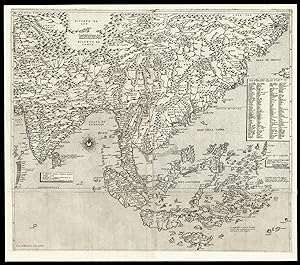
Il disegno della terza parte dell'Asia.
Verlag: 1562 and c1568]., [Venice,, 1562
Anbieter: Daniel Crouch Rare Books Ltd, London, Vereinigtes Königreich
Verbandsmitglied: ABA ILAB PBFA
Verkäuferbewertung 5 von 5 Sternen
Karte
EUR 149.091,47
EUR 23,16 Versand
Versand von Vereinigtes Königreich nach USAAnzahl: 1 verfügbar
In den WarenkorbGastaldi's seminal map of Southeast Asia Engraved map on three sheets joined, bearing three watermarks, upper left sheet with ladder in shield under cross pommy B (Woodward 256), upper right with lamb, paschal with straight standard C (Woodward 48), lower sheet, only lower half of ladder in shield under six-pointed star K (Woodward 253). A fine example of Gastaldi's map Southeast Asia, the most influential map of the region published in the sixteenth century, and the first map to name Singapore; here present with the rare southern extension sheet, incorporating the Java and the lucrative Spice Islands. Giacomo Gastaldi (c1500-1567), originally from Piedmont, established himself as a cartographer in Venice, where he was given the notable title of 'Cosmographer to the Republic'. He was a prolific mapmaker, with a body of work numbering at least 109 pieces, including contributions to the 1548 Venice edition of Ptolemy's 'Geogra a', and Ramusio's 'Navigationi et viaggi'. Gastaldi's maps of Asia are considered amongst the most significant representations of the continent, as the first pieces of cartography to name, and even show, many of the areas depicted. Originating from Venice, they also reflect the Republic's dominance of early exploration, particularly in Asia. The city's crucial position allowed for Western contact with the East, although this relationship was becoming progressively threatened by the expansion of the Ottoman Empire. The present map bears the same scale bar as Gastaldi's first and second parts of Asia, and matches with their latitudes and longitudes. It has been dubbed the most influential map of the region published in the sixteenth century and, as noted by Schilder, 'in the representation of the coastlines, his maps are superior to all previous known maps of Asia, either drawn by hand or printed'. After Gastaldi's death, it was augmented by two further sheets, as in the present example, narrower in size, and with the imprint 'To be sold at the San Marco bookshop in Venice' (transl.). The map extends from central Asia to China and is particularly important for its depiction of the islands below the Equator. Alongside the Moluccas, labelled the "Isole di Ambon", Gastaldi includes a note explaining that "in these islands there are cloves, cinnamon, nutmeg, pepper, sandalwood, ambergris, and many spices" (transl.), reflecting the importance of these resources to Venetian trade. e Philippines appear as "Philippina" and Borneo in its present nomenclature; found below these is Java, labelled "Giava Magiore" to distinguish it from the fictitious "Giava Minore" added by Forlani. Significantly, this is the first map to name Singapore and Cambodia. Gastaldi's sources vary from Venetian explorers, such as Marco Polo and Pigafetta, to the records of Spanish and Portuguese voyages, most notably that of Magellan. As noted by Nordenskjöld, it is likely that he had access to the extensive library of the Fugger family, since Marcus Fugger was an acquaintance and the sole dedicatee of this map, as well as to the maps in the Sala dello Scudo, which he was commissioned to paint, thanks to his close connection with the Venetian Secretary of State. Gastaldi's maps set a new standard in cartographic representations of Asia, and formed the basis of those subsequently published by Ortelius, De Jode and Mercator. Although Bifolco records 41 examples of this map held in institutions worldwide, this map is extremely rare on the market. We have been able to trace only two examples appearing in the last 50 years. Bifolco 74 state 2; Nordenskjöld, pp. 396- 406, The Geographical Journal vol. 13, April 1899; Schilder p.7, The Map Collector 17, December 1981; Suárez, The early mapping of Southeast Asia, pp.130-157, 1999; Tooley pp.20, 21.
-
Crescentino
Verlag: Crescentino - (VC)
Anbieter: Sergio Trippini, Gavirate, VA, Italien
Verkäuferbewertung 5 von 5 Sternen
Pianta della città di Crescentino nel vercellese. Nell'angolo in basso a sinistra il monogramma FB, con ogni probabilità Ferrando Bertelli. Nel saggio di Marcel Destombes " Les cartes de Lafreri et assimilées." a p. 5, si legge:" Nous avons découvert dans différents portefeuilles une quinzaine de petites cartes qui semblent dues au burin de Ferrando Bertelli, l'une d'elles est datée de 1567. Ces plans, dont quelque uns seulement se trouvent au British Museum ne semblent appartenir à aucun atlas connu et peut-etre s'agit-il d'un jeu d'épreuves". La pianta di Crescentino fa parte di questa lista (p. 23, n° 188). Molto rara, ottima conservazione.
-

Venetia.
Anbieter: Daniel Crouch Rare Books Ltd, London, Vereinigtes Königreich
Verbandsmitglied: ABA ILAB PBFA
Verkäuferbewertung 5 von 5 Sternen
Karte
EUR 23.854,63
EUR 23,16 Versand
Versand von Vereinigtes Königreich nach USAAnzahl: 1 verfügbar
In den WarenkorbPossibly an entirely new view of Venice Etched bird's-eye view of Venice, laid paper without watermark, corners renewed. An apparently unrecorded map of Venice, the capital of a vast empire, a mercantile centre, and a departure point for travellers to the East. Located at the crossroads between East and West, Venice was a destination for foreign merchants and pilgrims. Bertelli's view is stylised, and not directly based on any previous view, being slightly oriented with the north-northeast to the top. It is probably closest in perspective to Benedetto di Bordone's 'Venice' (1528), than Jacopo de' Barbari's (1500). It almost certainly precedes that of Paolo Forlani (1565), and given that Bertelli was one of three prominent Venetian publishers to employ Forlani (the others were Giovanni Francesco Camocio and Bolgnini Zaltieri) during his time in Venice (1560-1574), it is entirely likely that Bertelli's own small map inspired the production of Forlani's much larger and more detailed map, and was then outclassed by it, resulting in its swift redundancy, and current scarcity. Ferrando Bertelli (c1525-1572), is best known as a Venetian publisher of prints, after Titian, Farinati, Giulio Romano, Battista del Moro, and Dürer; and maps. Some he engraved himself, others were engraved for him by Paolo Forlani, Giovanni Francesco Camocio, Mario Cartaro, Sanuto, Cavalieri, and Domenico Zenoi. Karrow records Bertelli as having signed at least one other map, a copy of Giacomo Gastaldi's map 'Li'Isola Cuba e piu Setentrional dela Spagnola', (c1566), as "F.B.", although he usually signed his name in full, and with a flourish, as is evident on the other maps of islands he engraved in about 1566. Provenance: 1. With Helmut Rumbler Kunsthandel, Frankfurt am Main, 2010 Bury, 'The Print in Italy 1550-1625', British Museum, London 2001, page 222; not in Bifalco; not in Karrow.

