Gesamtpreis (1 Artikel Artikel):
Versandziel:

aquin philippe (8 Ergebnisse)
Direkt zu den wichtigsten Suchergebnissen
Suchfilter
Produktart
- Alle Product Types
- Bücher (8)
- Magazine & Zeitschriften (Keine weiteren Ergebnisse entsprechen dieser Verfeinerung)
- Comics (Keine weiteren Ergebnisse entsprechen dieser Verfeinerung)
- Noten (Keine weiteren Ergebnisse entsprechen dieser Verfeinerung)
- Kunst, Grafik & Poster (Keine weiteren Ergebnisse entsprechen dieser Verfeinerung)
- Fotografien (Keine weiteren Ergebnisse entsprechen dieser Verfeinerung)
- Karten (Keine weiteren Ergebnisse entsprechen dieser Verfeinerung)
- Manuskripte & Papierantiquitäten (Keine weiteren Ergebnisse entsprechen dieser Verfeinerung)
Zustand Mehr dazu
- Neu (2)
- Wie Neu, Sehr Gut oder Gut Bis Sehr Gut (1)
- Gut oder Befriedigend (1)
- Ausreichend oder Schlecht (Keine weiteren Ergebnisse entsprechen dieser Verfeinerung)
- Wie beschrieben (4)
Einband
Weitere Eigenschaften
- Erstausgabe (2)
- Signiert (1)
- Schutzumschlag (Keine weiteren Ergebnisse entsprechen dieser Verfeinerung)
- Angebotsfoto (6)
Sprache (2)
Gratisversand
- Kostenloser Versand nach USA (Keine weiteren Ergebnisse entsprechen dieser Verfeinerung)
Land des Verkäufers
Verkäuferbewertung
-

Les Sentences Et Proverbes Des Anciens Rabins (French Edition)
Anbieter: Ria Christie Collections, Uxbridge, Vereinigtes Königreich
Verkäuferbewertung 5 von 5 Sternen

EUR 15,63
EUR 13,85 Versand
Versand von Vereinigtes Königreich nach USAAnzahl: Mehr als 20 verfügbar
In den WarenkorbZustand: New. In.
-

Interprétation de l'arbre de la Cabale - Suivie d'une étude inédite de Daniel Nazir sur La porte étroite de la Kabbale.
Verlag: Editions Des Cahiers Astrologiques, 1946
Anbieter: Tiré à Part, Marseille, Frankreich
Verkäuferbewertung 5 von 5 Sternen
In-8 ( 225 X 145 mm ) de 59 pages, broché sous couverture imprimée. Collection "Les Maîtres de l'Occultisme, XII", préface du Dr Marc Haven, illustrations dont "Le Grand Arbre Kabbalistique" d'après Kircher ( sur 2 pages ). Bel exemplaire. Esotérisme Occultisme Hermétisme Symbolisme Religion.
-

INTERPRETATION DE L'ARBRE.
Verlag: Cahiers Astrologiques, 1946
Anbieter: Tiré à Part, Marseille, Frankreich
Verkäuferbewertung 5 von 5 Sternen
In-8 ( 225 X 140 mm ) de 59 pages, broché sous couverture illustrée . Intérieur frais. Bel exemplaire. Religion,Symbolisme,Hermétisme,Occultisme,Esotérisme,
-

Les fins de la vie religieuse selon Saint Thomas d'Aquin
Verlag: Edition de la Fraternité de la Très Sainte Vierge Marie. Non-daté (XXe siècle)., Athènes - Rome.
Anbieter: Librairie KOEGUI, BAYONNE, Frankreich
Verbandsmitglied: ILAB
Verkäuferbewertung 5 von 5 Sternen
Broché. 1 volume. In-8. 85 pp. Couverture crème souple et imprimée. Marque brune englobant le dos et les mors. Petits accrocs sur les bords de la couverture. Contenu désolidarisé de la couverture. Salissures sur les pages de garde. Bel état du contenu orné de bandes et lettrines en noir et blanc. Annotations manuscrites sur certaines pages. En bon état.
-

EUR 21,84
EUR 48,99 Versand
Versand von Deutschland nach USAAnzahl: Mehr als 20 verfügbar
In den WarenkorbZustand: New.
-

INTERPRÉTATION DE L'ARBRE DE LA CABALE. Préfacée par le Dr. Marc Haven et suivie d'une étude inédite de Daniel Nazir sur la porte étroite de la Kabbale
Sprache: Französisch
Verlag: Editions des Cahiers Astrologiques, Nice, 1946
Anbieter: Librairie Rouchaleou, Saint-André-de-Sangonis, FR, Frankreich
Verkäuferbewertung 5 von 5 Sternen
Broché. Zustand: Très bon. 1 volume broché, couverture illustrée, 59 pages [2], avec des figures dans le texte. Collection ''Les Maîtres de l'occultisme'', VII. Première édition. Bel exemplaire.
-
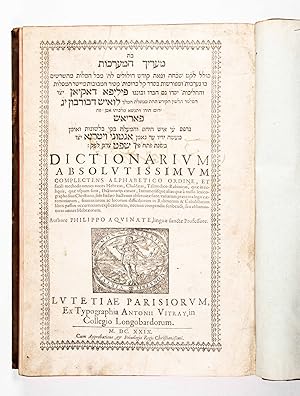
Ma'arikh ha-ma'arakhot (Survey of the Orders): Dictionarium absolutissimum
Verlag: Antoine Vitré, Paris, 1629
Anbieter: ERIC CHAIM KLINE, BOOKSELLER (ABAA ILAB), Santa Monica, CA, USA
Verkäuferbewertung 4 von 5 Sternen

Erstausgabe Signiert
Hardcover. Zustand: Good+. First edition. Folio. Signed: a4, e2, A-3B6, 3C4 (= 298 leaves). [12], 584pp. Paginated from right to left. Full title and imprint in both Hebrew and Latin, with woodcut printer's device; title within decorative letterpress border; woodcut lettrines and head-pieces; printed marginalia. Text in two columns. Eighteenth-century calf, scuffed, especially at front cover; spine with raised bands and gilt morocco morocco labels; edges stained red; green silk ribbon marker. Title leaf skilfully mounted on eighteenth-century paper. Text crisp and clean, with ample borders. Only edition of this rare and highly unusual Hebrew and Aramaic dictionary, composed by the formerly Jewish convert to Catholicism, Mordechai Cresque of Carpentras, who derived his new name Philippus d'Aquin (or Aquinas; 1578-1650) from the place of his baptism in Aquino (Italy). Printed almost entirely in the fine bold rashi characters ("grosse glose hebraicque") cut by Guillaume I Le Bé in 1592, only the vocalised quotations and the lemmata are in Le Bé's square Hebrew script. Apart from the Latin title, dedication, approbations, a poetic encomium, and the alpha-numeric leaf signatures, the work is printed entirely in Hebrew characters. It ends with a short notice in Latin and Hebrew on the printing errors, which are corrected on the last three pages. The author announces at the title that all Hebrew (biblical and rabbinic-talmudic) and Aramaic terms are to be found in Ma'arikh ha-Ma'arakhot, including many that do not appear in any existing lexicons, among Jews or Christians. D'Aquin notes in particular that rare and difficult terms in rabbinic and cabalistic literature, along with obscure abbreviations are all clearly explained. "The work is called in Hebrew Maarik ha-maarikot, i. e. "Survey of the orders", a term which in the plural is also applied to "battle-lines" (Wolf 140 translates Disponens ordines sive acies). One cannot help wonder if there is not a connection with the political situation at the time, when the Huguenot town of La Rochelle had to submit to the French Crown in 1628. The privilege for our book has "Données au Camp devant la Rochelle le 19. Septembre 1628" and the work is dedicated to Cardinal Richelieu whose conquest of La Rochelle is also extolled in a Hebrew poem by the author. But the types are also reminiscent of war: did not Le Bé cut them "après le siège de Paris, pour passer l'ennui"? (see Carter & Vervliet p. 15). They were prominently displayed afterwards in Vitray's type-specimen of 1636" (Smitskamp). Among the eleven scholars whose approbations grace the present volume are Gabriel Sionita (1577-1645; professor of Arabic and Syriac at the College de France); Gilbert Gaulmin (1585-1665; Orientalist); Denis Petau (1583-1652; Jesuit theologian); and Jean Morin (1591-1659; theologian and Orientalist). Morin offers quite extravagent praise: "nihil hactenus in eo studii genere comparandum vidit Europa." Provenance: A morocco label on the spine reads Me-izabin. Hirsch. Wolf Kola, i. e. From the legacy of Hirsch. References: Baillet, Jugement de Scavans 3 (1685): 729. Fürst 1:47-48. Gesenius, Geschichte, 113: "umfasst auch das Chadaïsche und Rabbinische" (Hebrew title incorrectly transcribed without the definite article and indication of plural). Smitskamp, Cat. no. 611 (but, notably, not in Philologia Orientalis). Steinschneider (Handbuch) 129: "Früher sehr gesucht und selten. Heidenheim wollte se zuerst wieder ediren, s. Catal. p. 739." Wolf, Historia lexicorum, 140. For the interest of Richelieu in typographical matters, and his foundation of the Imprimerie Royale in 1640, see Updike 1:238-40. Not in Goldsmith Hebrew title: ????? ???????.
-
Veterum rabbinorum in exponendo Pentateucho modi tredecim. Quorum explicatio lucem maximam afferet iis qui legem accurate volunt interpretari, & scripta Rabbinorum facile intelligere.
Anbieter: Librairie de l'Amateur, Strasbourg, Frankreich
Verbandsmitglied: ILAB
Verkäuferbewertung 5 von 5 Sternen
Erstausgabe
Paris, Sébastien Cramoisy, 1620 ; petit in-4, 15 feuillets + 81 pp., vélin souple de l'époque, titre manuscrit au dos (vélin un peu ridé). Bibliographisches Handbuch über die theoretische und praktische Literatur für hebräische Sprachkunde, n° 129 ; Cat. Bodl. col. 739. Édition originale rare. Dans ce traité, Philippe d?Aquin (ca. 1578?1650) expose en latin les treize règles herméneutiques traditionnelles des rabbins pour l?interprétation du Pentateuque. Destiné aux savants chrétiens, ce texte ouvre un accès méthodique aux procédés exégétiques juifs et constitue l?un des premiers manuels occidentaux pour comprendre les écrits rabbiniques. L'auteur, né Mordekhaï Crescas à Carpentras, converti au catholicisme en Italie, fut médecin et professeur d?hébreu au Collège royal. Orientaliste érudit, il participa notamment à la grande Bible polyglotte de Le Jay (1628?1645), traduisant le Nouveau Testament en hébreu. Bon exemplaire malgré la présence de galeries de vers présentes dans les marges, sans atteinte au texte. 1620.