

Gesamtpreis (1 Artikel Artikel):
Versandziel:

anthony kramers (14 Ergebnisse)
Direkt zu den wichtigsten Suchergebnissen
Suchfilter
Produktart
- Alle Product Types
- Bücher (14)
- Magazine & Zeitschriften (Keine weiteren Ergebnisse entsprechen dieser Verfeinerung)
- Comics (Keine weiteren Ergebnisse entsprechen dieser Verfeinerung)
- Noten (Keine weiteren Ergebnisse entsprechen dieser Verfeinerung)
- Kunst, Grafik & Poster (Keine weiteren Ergebnisse entsprechen dieser Verfeinerung)
- Fotografien (Keine weiteren Ergebnisse entsprechen dieser Verfeinerung)
- Karten (Keine weiteren Ergebnisse entsprechen dieser Verfeinerung)
- Manuskripte & Papierantiquitäten (Keine weiteren Ergebnisse entsprechen dieser Verfeinerung)
Zustand Mehr dazu
- Neu (4)
- Wie Neu, Sehr Gut oder Gut Bis Sehr Gut (Keine weiteren Ergebnisse entsprechen dieser Verfeinerung)
- Gut oder Befriedigend (8)
- Ausreichend oder Schlecht (Keine weiteren Ergebnisse entsprechen dieser Verfeinerung)
- Wie beschrieben (2)
Einband
Weitere Eigenschaften
- Erstausgabe (5)
- Signiert (Keine weiteren Ergebnisse entsprechen dieser Verfeinerung)
- Schutzumschlag (1)
- Angebotsfoto (5)
Sprache (4)
Gratisversand
Land des Verkäufers
Verkäuferbewertung
-

Quantum Mechanics
Anbieter: ThriftBooks-Atlanta, AUSTELL, GA, USA
Verkäuferbewertung 5 von 5 Sternen

Paperback. Zustand: Very Good. No Jacket. May have limited writing in cover pages. Pages are unmarked. ~ ThriftBooks: Read More, Spend Less.
-

The Atom And The Bohr Theory Of Its Structure: An Elementary Presentation
Anbieter: Ria Christie Collections, Uxbridge, Vereinigtes Königreich
Verkäuferbewertung 5 von 5 Sternen
EUR 17,28
EUR 13,80 Versand
Versand von Vereinigtes Königreich nach USAAnzahl: Mehr als 20 verfügbar
In den WarenkorbZustand: New. In.
-

Quantum mechanics
Verlag: Dover Publications
Anbieter: Wonder Book, Frederick, MD, USA
Verkäuferbewertung 5 von 5 Sternen
Zustand: Good. Good condition. Owner's name on inside. Slightly dampstained. (Vintage books, science, quantum theory, physics).
-

Quantum Mechanics
Sprache: Englisch
Verlag: Dover Publications, Incorporated, 2003
ISBN 10: 0486495337 ISBN 13: 9780486495330
Anbieter: Better World Books, Mishawaka, IN, USA
Verkäuferbewertung 5 von 5 Sternen
Zustand: Good. Former library copy. Pages intact with minimal writing/highlighting. The binding may be loose and creased. Dust jackets/supplements are not included. Includes library markings. Stock photo provided. Product includes identifying sticker. Better World Books: Buy Books. Do Good.
-

The Atom and the Bohr Theory of its Structure, an Elementary Presentation;
Anbieter: Ria Christie Collections, Uxbridge, Vereinigtes Königreich
Verkäuferbewertung 5 von 5 Sternen
EUR 33,22
EUR 13,80 Versand
Versand von Vereinigtes Königreich nach USAAnzahl: Mehr als 20 verfügbar
In den WarenkorbZustand: New. In.
-
Das Atom und die Bohrsche Theorie seines Baues
Verlag: Verlag von Julius Springer / Berlin, 1925
Anbieter: Antiquariat WIE, Lollar, Deutschland
Verkäuferbewertung 5 von 5 Sternen
Erstausgabe
Hardcover. Zustand: Gut. Ohne Schutzumschlag. 1. Auflage. Gemeinverständlich dargestellt. Deutsch von F. Arndt. Mit 35 Abbildungen, 1 Bildnis und 1 farbigen Tafel. Ehemaliges Bibliotheksexemplar mit entsprechenden Stempeln und Vermerken, gut erhaltenes Exemplar, 192 Seiten.
-

The Atom and the Bohr Theory of Its Structure : an Elementary Presentation
Sprache: Englisch
Verlag: Creative Media Partners, LLC Sep 2021, 2021
ISBN 10: 1013602862 ISBN 13: 9781013602863
Anbieter: AHA-BUCH GmbH, Einbeck, Deutschland
Verkäuferbewertung 5 von 5 Sternen
Taschenbuch. Zustand: Neu. Neuware.
-

The Atom and the Bohr Theory of its Structure, an Elementary Presentation;
Sprache: Englisch
Verlag: Creative Media Partners, LLC Aug 2024, 2024
ISBN 10: 1019600713 ISBN 13: 9781019600719
Anbieter: AHA-BUCH GmbH, Einbeck, Deutschland
Verkäuferbewertung 5 von 5 Sternen
Buch. Zustand: Neu. Neuware - This book is a clear and concise account of the Bohr model of the atom and its implications. Hendrik Kramers explains the principles of atomic structure, energy levels, and radiation in an accessible way, making this book perfect for students and professionals alike.This work has been selected by scholars as being culturally important, and is part of the knowledge base of civilization as we know it.This work is in the 'public domain in the United States of America, and possibly other nations. Within the United States, you may freely copy and distribute this work, as no entity (individual or corporate) has a copyright on the body of the work.Scholars believe, and we concur, that this work is important enough to be preserved, reproduced, and made generally available to the public. We appreciate your support of the preservation process, and thank you for being an important part of keeping this knowledge alive and relevant.
-
The foundations of quantum theory
Verlag: Interscience Publishers, 1957
Anbieter: Zubal-Books, Since 1961, Cleveland, OH, USA
Verkäuferbewertung 5 von 5 Sternen
Zustand: Very Good. *Price HAS BEEN REDUCED by 10% until Monday, June 22 (weekend SALE item)* First edition, first printing, 228 pp., Hardcover, spine LIGHTLY faded, previous owner's name to front free endpaper else very good (lacks dust jacket). - If you are reading this, this item is actually (physically) in our stock and ready for shipment once ordered. We are not bookjackers. Buyer is responsible for any additional duties, taxes, or fees required by recipient's country.
-

Discussion On Magnetism: Ferromagnetism And Hysteresis. (Reprinted From The Proceedings Of The Royal Society, August 1930)
Sprache: Englisch
Verlag: The Physical Society / Cambridge University Press, Cambridge, 1930
Anbieter: Arroyo Seco Books, Pasadena, Member IOBA, Pasadena, CA, USA
Verbandsmitglied: IOBA
Verkäuferbewertung 4 von 5 Sternen

Erstausgabe
Soft cover. Zustand: Good. Photographs, Graphs (illustrator). First Separate Edition. Pp355-365 Extracted From The Proceedings, In Tan Wrappers Printed In Black, A Publisher's Offprint. Covers Worn And Browned, Tears At Spine Edges And 1/2" Chips At Top And Bottom Of Spine Panel. Pencil Ownership Name Of Hendrik Antoon Kramers, Dutch Physicist (Who Worked Primarily In Studies Of Magnetism), At Top Of Front Cover, As Was Kramers' Custom With His Library. Sir James Alfred Ewing Kcb (27 March 1855 ? 7 January 1935) Was A Scottish Physicist And Engineer, Best Known For His Work On The Magnetic Properties Of Metals And, In Particular, For His Discovery Of, And Coinage Of The Word, Hysteresis. It Was Said Of Ewing That He Was 'Careful At All Times Of His Appearance, His Suits Were Mostly Grey, Added To Which He Generally Wore - Whatever The Fashion - A White Piqué Stripe To His Waistcoat, A Mauve Shirt, A White Butterfly Collar And A Dark Blue Bow Tie With White Spots.' He Was Regarded As Brilliant And Successful, But Was Conscious Of His Dignity And Position. On Appointment To Head The Newly Created Admiralty Codebreaking Department, The Director Of Naval Intelligence, Henry Oliver, Described Him As 'Too Distinguished A Man To Be Placed Officially Under The Orders Of The Director Of Intelligence Or Chief Of Staff'. His First Wife, Annie, Was An American, A Great Great Niece Of George Washington. In 1890, Ewing Took Up The Post Of Professor Of Mechanism And Applied Mechanics At The University Of Cambridge, Initially At Trinity College, Though He Later Moved To King's College. At Cambridge, Ewing's Research Into The Magnetisation Of Metals Led Him To Criticise The Conventional Account Of Wilhelm Weber. In 1890, He Observed That Magnetisation Lagged Behind An Applied Alternating Current. He Described The Characteristic Hysteresis Curve And Speculated That Individual Molecules Act As Magnets, Resisting Changes In Magnetising Potential. (Note: According To The Book Sir Alfred Ewing: A Pioneer In Physics And Engineering (1946) By Professor Bates, The Discovery Of Magnetic Hysteresis Probably Occurred Before Ewing. However, Ewing Re-Discovered It, Studied It In Detail And Coined The Word Hysteresis). Ewing Also Researched Into The Crystalline Structure Of Metals And, In 1903, Was The First To Propose That Fatigue Failures Originated In Microscopic Defects Or Slip Bands In Materials. In 1895 He Was Awarded The Gold Medal Of The Royal Society For His Work On Magnetic Induction In Iron And Other Metals. Ewing Was A Close Friend Of Sir Charles Algernon Parsons And Collaborated With Him On The Development Of The Steam Turbine [And He Later Married Parsons' Surviving Daughter]. During This Time, Ewing Published The Steam Engine And Other Heat Engines Around This Time. In 1897 He Took Part In The Sea-Trials Of The Experimental Vessel Turbinia, Which Set A New Speed Record Of 35 Knots. During World War I, From 1914 To May 1917, Ewing Managed Room 40, The Admiralty Intelligence Department Of Cryptanalysis, Responsible Predominantly For The Decryption Of Intercepted German Naval Messages. In This Capacity, He Achieved Considerable Fame In The Popular Press When Room 40 Deciphered The Zimmermann Telegram In 1917 (Which Suggested A German Plot To Assist Mexico In Recovering The Southwestern United States). The Publication Of The Zimmermann Telegram Is Generally Credited As The Trigger Event Which Brought American Into The Great War. In May 1916 Ewing Accepted An Invitation To Become Principal Of The University Of Edinburgh, In The Course Of Which He Instituted An Extensive Series Of Effective Reforms And Which He Held Until His Retirement In 1929. In 1927 He Gave A Lecture To The Edinburgh Philosophical Institution Which Contained The First Semi-Official Disclosure Of The Work Done By Room 40. Worldcat Shows Only One Institutional Holding, In Scotland.
-
Die Grundlagen der Quantentheorie. Quantentheorie des Elektrons und der Strahlung.
Verlag: Leipzig, Akademische Verlagsgesellschaft., 1938
Anbieter: Universitätsbuchhandlung Herta Hold GmbH, Berlin, Deutschland
Verbandsmitglied: GIAQ ILAB VDA
Verkäuferbewertung 4 von 5 Sternen
Gr.-8°. 14 Fig. im Text, S. (223)-502, X, 1 Bl. Unbeschnittene Original-Broschur (gebräunt, leicht angerändert, gelöste Vorderseite mit transparentem Klebeband fixiert). Umschlag und erste Seite mit Namenszug von Otto Singer. Innen sauber und gut erhalten. Hand- und Jahrbuch der chemischen Physik, Band 1, Abschnitt II. Sprache: Deutsch.
-

Wetenschap, Mensch En Maatschappij [Science, Man And Society) (Offprint From Avro, Het Kouter Vol 4, 22 Jan 1939)
Sprache: Niederländisch
Verlag: Radiorede Auro, 1939
Anbieter: Arroyo Seco Books, Pasadena, Member IOBA, Pasadena, CA, USA
Verbandsmitglied: IOBA
Verkäuferbewertung 4 von 5 Sternen
Erstausgabe
Soft cover. Zustand: Good. 1st Edition. Pp 93-99. Offprint Extracted From The Journal Avro, In Plain Card Wrappers. Covers Browned; 1/4" Crease At Top Free Corner Edge. We Find No Institutional Holding Except For The Journal; This Offprint From The Library One Of Kramers' Students And Later Assistant, Jan Korringa.
-
Zur kinetischen Herleitung des Fermi-schen Verteilungsgestzes.
Verlag: Julius Springer, 1927., In: Zeitschrift fur physik, Vol. 42, 1927. Berlin:, 1927
Anbieter: Jeff Weber Rare Books, Neuchatel, NEUCH, Schweiz
Verkäuferbewertung 5 von 5 Sternen
Erstausgabe
232 x 152 mm. 8vo. Pages 481-486. [Entire volume: viii, 917 pp.] Navy cloth, gilt spine. Blind-stamps of the Carnegie Institution of Washington, Mount Wilson Observatory. FINE. FIRST EDITION. In this joint paper by the veteran investigator (Orntsein) and the junior faculty member (Kramers) on atomic theory, the authors investigated how the classical collision formula in the kinetic-theory of gases has to be modified in order that the molecules shall be distributed according to the Fermi-law. In 1914, Leonard Ornstein succeeded Peter Debye as the chair of theoretical physics at the University of Utrecht. Later, Ornstein became director of the physical institute there in 1925. As director of the Institute, Ornstein's work shifted decisively into experiments, and his organizational talent began to unfold. In the preceding dozen years Ornstein had published about fifty papers; in the following twenty years over two hundred bore his own name, and almost five hundred additional papers were published from his institute, which underwent three substantial enlargements in this period. See: DSB, X, pp. 235-236. L. S. At the time that Ornstein became director of the institute, Kramers was appointed to the faculty of the University of Utrecht and had an office at the Institute. Kramers delivered an Obituary on Ornstein in 1941. Dresden, H. A. Kramers, pp. 310-313, 485. Kramers, Collected scientific papers, pp. 375-380; L. S. Ornstein, a survey of his work from 1908 to 1933, p. 94.
-
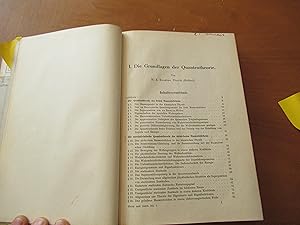
Die Grundlagen Der Quantentheorie: Quantentheorie Des Elektrons Und Der Strahlung
Sprache: Deutsch
Verlag: Akademische Verlagsgesellschaft M. B. H., Leipzig, 1938
Anbieter: Arroyo Seco Books, Pasadena, Member IOBA, Pasadena, CA, USA
Verbandsmitglied: IOBA
Verkäuferbewertung 4 von 5 Sternen
Erstausgabe
Half Leather. Zustand: Good. First Edition. 502 Pp. Richard C. Tolman's Copy, Specially Bound In Green Cloth With Tan Leather Spine And Tips, His Name In Gilt At Foot Of Spine. With His Signature "R. C. Tolman" On Top Of First Page Of Table Of Contents. First Printing, 1938. Clean, Spine Chipped Away 1/4" At Top, , With A Few Cal Tech Ex-Library Marks, Blindstamps, Label And A Few Traces Of Removed Labels. Richard Chace Tolman (1881 -1948) Was An American Mathematical Physicist And Physical Chemist Who Made Many Contributions To Statistical Mechanics. He Also Made Important Contributions To Theoretical Cosmology In The Years Soon After Einstein's Discovery Of General Relativity. He Was A Professor Of Physical Chemistry And Mathematical Physics At The California Institute Of Technology (Caltech). Tolman Studied Chemical Engineering At The Massachusetts Institute Of Technology, Receiving His Bachelor's Degree In 1903 And Ph.D. In 1910 Under A. A. Noyes. In 1912, He Conceived Of The Concept Of Relativistic Mass, Writing That "The Expression Is Best Suited For The Mass Of A Moving Body. In A 1916 Experiment With Thomas Dale Stewart, Tolman Demonstrated That Electricity Consists Of Electrons Flowing Through A Metallic Conductor. A By-Product Of This Experiment Was A Measured Value Of The Mass Of The Electron.[4] Overall, However, He Was Primarily Known As A Theorist.Tolman Was A Member Of The Technical Alliance In 1919, A Forerunner Of The Technocracy Movement Where He Helped Conduct An Energy Survey Analyzing The Possibility Of Applying Science To Social And Industrial Affairs.Tolman Was Elected A Fellow Of The American Academy Of Arts And Sciences In 1922. The Same Year, He Joined The Faculty Of The California Institute Of Technology, Where He Became Professor Of Physical Chemistry And Mathematical Physics And Later Dean Of The Graduate School. One Of Tolman's Early Students At Caltech Was The Theoretical Chemist Linus Pauling, To Whom Tolman Taught The Old Quantum Theory.In 1927, Tolman Published A Text On Statistical Mechanics Whose Background Was The Old Quantum Theory Of Max Planck, Niels Bohr And Arnold Sommerfeld.[9] In 1938, He Published A New Detailed Work That Covered The Application Of Statistical Mechanics To Classical And Quantum Systems. It Was The Standard Work On The Subject For Many Years And Remains Of Interest Today.In The Later Years Of His Career, Tolman Became Increasingly Interested In The Application Of Thermodynamics To Relativistic Systems And Cosmology. An Important Monograph He Published In 1934 Titled Relativity, Thermodynamics, And Cosmology[12] Demonstrated How Black Body Radiation In An Expanding Universe Cools But Remains Thermal - A Key Pointer Toward The Properties Of The Cosmic Microwave Background.[13] Also In This Monograph, Tolman Was The First Person To Document And Explain How A Closed Universe Could Equal Zero Energy. He Explained How All Mass Energy Is Positive And All Gravitational Energy Is Negative And They Cancel Each Other Out, Leading To A Universe Of Zero Energy.[13] His Investigation Of The Oscillatory Universe Hypothesis, Which Alexander Friedmann Had Proposed In 1922, Drew Attention To Difficulties As Regards Entropy And Resulted In Its Demise Until The Late 1960S. During World War Ii, Tolman Served As Scientific Advisor To General Leslie Groves On The Manhattan Project. At The Time Of His Death In Pasadena, He Was Chief Advisor To Bernard Baruch, The U.S. Representative To The United Nations Atomic Energy Commission.Each Year, The Southern California Section Of The American Chemical Society Honors Tolman By Awarding Its Tolman Medal "In Recognition Of Outstanding Contributions To Chemistry. Tolman's Brother Was The Behavioral Psychologist Edward Chace Tolman.


