Gesamtpreis (1 Artikel Artikel):
Versandziel:

anselm marisco (1 Ergebnisse)
Direkt zu den wichtigsten Suchergebnissen
Suchfilter
Produktart
- Alle Product Types
- Bücher (1)
- Magazine & Zeitschriften (Keine weiteren Ergebnisse entsprechen dieser Verfeinerung)
- Comics (Keine weiteren Ergebnisse entsprechen dieser Verfeinerung)
- Noten (Keine weiteren Ergebnisse entsprechen dieser Verfeinerung)
- Kunst, Grafik & Poster (Keine weiteren Ergebnisse entsprechen dieser Verfeinerung)
- Fotografien (Keine weiteren Ergebnisse entsprechen dieser Verfeinerung)
- Karten (Keine weiteren Ergebnisse entsprechen dieser Verfeinerung)
- Manuskripte & Papierantiquitäten (Keine weiteren Ergebnisse entsprechen dieser Verfeinerung)
Zustand Mehr dazu
- Neu (Keine weiteren Ergebnisse entsprechen dieser Verfeinerung)
- Wie Neu, Sehr Gut oder Gut Bis Sehr Gut (Keine weiteren Ergebnisse entsprechen dieser Verfeinerung)
- Gut oder Befriedigend (1)
- Ausreichend oder Schlecht (Keine weiteren Ergebnisse entsprechen dieser Verfeinerung)
- Wie beschrieben (Keine weiteren Ergebnisse entsprechen dieser Verfeinerung)
Einband
- alle Einbände
- Hardcover (1)
- Softcover (Keine weiteren Ergebnisse entsprechen dieser Verfeinerung)
Weitere Eigenschaften
- Erstausgabe (Keine weiteren Ergebnisse entsprechen dieser Verfeinerung)
- Signiert (Keine weiteren Ergebnisse entsprechen dieser Verfeinerung)
- Schutzumschlag (Keine weiteren Ergebnisse entsprechen dieser Verfeinerung)
- Angebotsfoto (1)
Sprache (1)
Preis
- Beliebiger Preis
- Weniger als EUR 20 (Keine weiteren Ergebnisse entsprechen dieser Verfeinerung)
- EUR 20 bis EUR 45 (Keine weiteren Ergebnisse entsprechen dieser Verfeinerung)
- Mehr als EUR 45
Gratisversand
- Kostenloser Versand nach USA (Keine weiteren Ergebnisse entsprechen dieser Verfeinerung)
Land des Verkäufers
Verkäuferbewertung
-
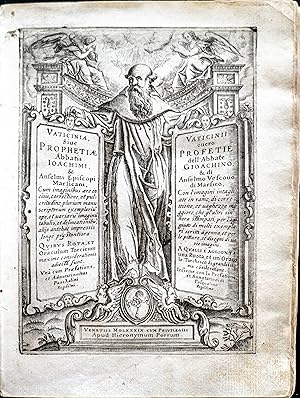
Vaticinia, sive Prophetiae abbatis Ioachimi & Anselmi episcopi Marsicani, cum imaginibus aere incisis. Quibus Rota, et Oraculum turcicum maxime considerationis adiecta sunt.
Verlag: Girolamo Porro, Venice, 1589
Anbieter: Rodger Friedman Rare Book Studio, ABAA, Tuxedo, NY, USA
Verkäuferbewertung 5 von 5 Sternen

Zustand: Very Good. First printing of some material. Quarto (21 cm); [140] pages, including 34 allegorical copperplate engravings with facing-page explanations. Text within typographical borders; in Latin and Italian. Woodcut decorated initials and tail-pieces. Manuscript marginalia in very neat and readable contemporary hand. Bound in plain vellum, titled in ink on spine (faded). Lower portion of spine ruptured in two places and along joint. Pages thumbed but unblemished, plates are crisp and contrasty. References: Adams J-213; Landwehr, French, Italian, Spanish and Portuguese emblem books 415. A first-wave example of baroque book illustration, and a stylistic breakthrough for the illustrator (and printer) Girolamo Porro, this strange book occupies an undefined space between emblem book and prophecy, between folklore and political propaganda. Although the text is attributed to Joachim of Fiore, a 12th-century cleric, there is no connection, and the life of Joachim by the Neapolitan humanist Gabriele Barrio is equally fanciful. The text relies rather on a manuscript tradition of "prophecies" that always postdated the events they predict (but were attributed to an earlier speaker, such as Joachim, to make them seem premonitory), apocalyptic warnings, and moral advice couched in oracular statements by the popes of the Church. The allegorical emblems by Girolamo Porro are truly imaginative and mystifying. The series of illustrated "prophecies" also includes an "Oraculum Turcicum," predicting the fall of the Turkish empire, engraved with a caption in Turkish characters, transliterated into the Roman alphabet in the lower part of the plate, and translated on the facing page. Commentary on each prophecy is provided by Pasqualino Regiselmo, who also wrote the dedicatory letter (in Latin and Italian).