Gesamtpreis (1 Artikel Artikel):
Versandziel:

american conductor composer (27 Ergebnisse)
Direkt zu den wichtigsten Suchergebnissen
Suchfilter
Produktart
- Alle Product Types
- Bücher (5)
- Magazine & Zeitschriften (Keine weiteren Ergebnisse entsprechen dieser Verfeinerung)
- Comics (Keine weiteren Ergebnisse entsprechen dieser Verfeinerung)
- Noten (Keine weiteren Ergebnisse entsprechen dieser Verfeinerung)
- Kunst, Grafik & Poster (Keine weiteren Ergebnisse entsprechen dieser Verfeinerung)
- Fotografien (Keine weiteren Ergebnisse entsprechen dieser Verfeinerung)
- Karten (Keine weiteren Ergebnisse entsprechen dieser Verfeinerung)
- Manuskripte & Papierantiquitäten (22)
Zustand Mehr dazu
- Neu (Keine weiteren Ergebnisse entsprechen dieser Verfeinerung)
- Wie Neu, Sehr Gut oder Gut Bis Sehr Gut (4)
- Gut oder Befriedigend (3)
- Ausreichend oder Schlecht (Keine weiteren Ergebnisse entsprechen dieser Verfeinerung)
- Wie beschrieben (20)
Einband
Weitere Eigenschaften
Sprache (2)
Gratisversand
- Kostenloser Versand nach USA (Keine weiteren Ergebnisse entsprechen dieser Verfeinerung)
Land des Verkäufers
Verkäuferbewertung
-

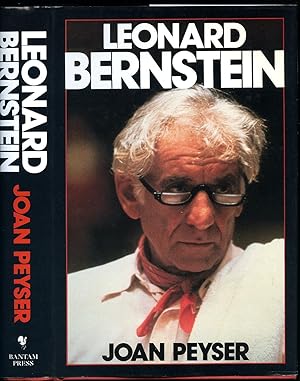
Leonard Bernstein
Verlag: Published by Bantam Press A Division of Transworld Publishers, 61-63 Uxbridge Road, London First Edition . 1987., 1987
Anbieter: Little Stour Books PBFA Member, Canterbury, Vereinigtes Königreich
Verbandsmitglied: PBFA
Verkäuferbewertung 5 von 5 Sternen

Erstausgabe
EUR 13,12
EUR 34,75 Versand
Versand von Vereinigtes Königreich nach USAAnzahl: 1 verfügbar
In den WarenkorbZustand: Very Good. First edition hard back binding in publisher's original scarlet cloth covers, gilt title and author lettering to the spine. 8vo. 9½'' x 6¼''. Contains 430 printed pages of text with archive monochrome photographs throughout. Dusty page edges. Very Good condition book in Fine condition dust wrapper, not price clipped. Member of the P.B.F.A. MUSIC [Classical].
-
Leonard Bernstein
Verlag: Published by Bantam Press A Division of Transworld Publishers, 61-63 Uxbridge Road, London First Edition . 1987., 1987
Anbieter: Little Stour Books PBFA Member, Canterbury, Vereinigtes Königreich
Verbandsmitglied: PBFA
Verkäuferbewertung 5 von 5 Sternen
Erstausgabe
EUR 14,92
EUR 34,75 Versand
Versand von Vereinigtes Königreich nach USAAnzahl: 1 verfügbar
In den WarenkorbZustand: Fine. First edition hard back binding in publisher's original scarlet cloth covers, gilt title and author lettering to the spine. 8vo. 9½'' x 6¼''. Contains 430 printed pages of text with archive monochrome photographs throughout. Fine condition book in Fine condition dust wrapper, not price clipped, unused new book. Dust wrapper supplied in archive acetate film protection, it does not adhere to the book or to the dust wrapper. Member of the P.B.F.A. ISBN 0593014545 MUSIC [Classical].
-

The Infinite Variety of Music
Verlag: Published by Simon and Schuster, Rockefeller Center, 630 Fifth Avenue, New York Book Club Edition . 1966., 1966
Anbieter: Little Stour Books PBFA Member, Canterbury, Vereinigtes Königreich
Verbandsmitglied: PBFA
Verkäuferbewertung 5 von 5 Sternen
EUR 17,90
EUR 34,75 Versand
Versand von Vereinigtes Königreich nach USAAnzahl: 1 verfügbar
In den WarenkorbZustand: Good. Book Club edition hard back binding in publisher's original striking red cloth covered boards, blocked and lettered gilt back and front. 8vo. 9½'' x 6¼''. Contains 287 pp with monochrome illustrations and photographs throughout. Fine condition book in Good condition dust wrapper with short closed tear to the top front gutter, spine sun faded. Dust wrapper protected. Member of the P.B.F.A. MUSIC [Classical].
-

LORIN MAAZEL (1930-2014) amerikanischer Dirigent und Komponist / american conductor and composer
Anbieter: Herbst-Auktionen, Detmold, Deutschland
Verkäuferbewertung 3 von 5 Sternen

Manuskript / Papierantiquität Signiert
Konzertprogramm (8 to) des RSO Berlin 1967 mit Unterschrift und Unterschrift des bulgarischen Tenor Margarita Lilowa (1935) (dito : Großes Porträtfoto 8° quer, beim dirigieren, eigenhändig signiert, mit Kurzbiografie Euro 60,-) (dito : s/w-Fotoporträtpostkarte, eigenhändig signiert Euro 48,-).
-
Lorin Maazel (1930-2014) - Signed page 1988 + Photo
Sprache: Französisch
Erscheinungsdatum: 1988
Anbieter: PhP Autographs, Hastière, Belgien
Verkäuferbewertung 5 von 5 Sternen
Manuskript / Papierantiquität Signiert
Pas de couverture. Zustand: Assez bon. Rare - Album page signed in person in Paris in 1988. + Photo 15x15 cm (recent print). Size : 20.5x14.5 cm. Condition : please see scans. Certificate of Authenticity and lifetime guarantee. Signé par l'auteur.
-
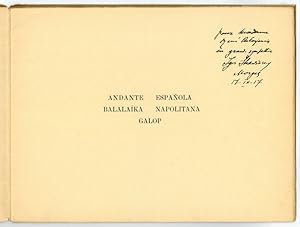
Inscribed copy of: Cinq Pièces Faciles pour piano a quatre mains (main droite facile) Andante, Española, Balalaïka, Napolitana, Galop.
Verlag: Geneva, Ad. Henn, 1917., 1917
Anbieter: Antiquariat INLIBRIS Gilhofer Nfg. GmbH, Vienna, A, Österreich
Verbandsmitglied: ILAB PADA VDA VDAO
Verkäuferbewertung 5 von 5 Sternen
Manuskript / Papierantiquität Erstausgabe
Oblong 4to. 19 pp. Original wrappers. First edition, inscribed "pour Madame René Auberjonois, en grande sympathie, Igor Strawinsky, Morges 17-IX-17". - The present volume constitutes an impressive document of Stravinsky's life during the October Revolution. A composition for his children, this work was penned in 1914/15, shortly after leaving Russia forever and settling down into Swiss exile, all connections to his Russian homeland having been severed by the Great War. The events of the war also meant that Stravinsky was unable to solicit commissions, receive royalties, or even contact his publishers; his collaboration with Djaghilev had more or less ground to a halt, their tour having returned hardly any profit. It was at this time that Stravinsky had to rely upon the generosity of wealthy Swiss patrons such as Madame Auberjonois, who was the first wife of the post-Impressionist Swiss painter René Auberjonois, mother of author Fernand Auberjonois, and later grandmother of the American actor René Murat Auberjonois. Stravinsky had met René Auberjonois in the fall of 1917, during the planning stages of "Histoire du Soldat", and he later became an important acquaintance of Stravinsky's. The present copy must have been presented during the early years of their friendship.
-

Marvin Hamlisch (1944-2012) - Signed photo
Sprache: Französisch
Anbieter: PhP Autographs, Hastière, Belgien
Verkäuferbewertung 5 von 5 Sternen
Manuskript / Papierantiquität Signiert
Pas de couverture. Zustand: Très bon. Authentic signed large photo. Size : 20x25 cm. Certificate of Authenticity and lifetime guarantee. Signé par l'auteur.
-
Stanislaw Skrowaczewski (1923-2017) - Signed card + Photo - 1998
Sprache: Französisch
Erscheinungsdatum: 1998
Anbieter: PhP Autographs, Hastière, Belgien
Verkäuferbewertung 5 von 5 Sternen
Manuskript / Papierantiquität Signiert
Pas de couverture. Zustand: Très bon. Rare - Card signed in June 1998. + Large photo 20x25 cm (recent print). Size : 10x15 cm. Condition : please see scans. Provenance : PhP Autographs collection. Certificate of Authenticity and lifetime guarantee. Signé par l'auteur.
-
ROGER NEILL (1963) US-amerikanischer Filmkomponist / American composer, arranger, orchestrator, conductor, guitarist and educator. He is best known for his scores for the films 20th Century Women, Don't Think Twice, and Beginners.
Anbieter: Herbst-Auktionen, Detmold, Deutschland
Verkäuferbewertung 3 von 5 Sternen
Signiert
STRING QUARTET IN FOUR MOVEMENTS Notes on the RETROFLEXIVE CANON Partitur (23 SS. Pb. 4 to, in Klarsichtmappe mit Spiralheftung), auf dem Titelblatt mit eigenhändiger Widmung, Unterschrift signiert For Frau Streicher, ROGER NEILL.
-

Autograph signature.
Verlag: No place or date.
Anbieter: Antiquariat INLIBRIS Gilhofer Nfg. GmbH, Vienna, A, Österreich
Verbandsmitglied: ILAB PADA VDA VDAO
Verkäuferbewertung 5 von 5 Sternen
Manuskript / Papierantiquität
12mo (99 x 78 mm). Black ink on cardboard. With a minimal stain and a pinch fold to the lower right margin.
-

Signed program of the Essen Philharmoniker 5. Sinfoniekonzert" by Tan Dun.
Verlag: Essen, 17. I. 1999., 1999
Anbieter: Kotte Autographs GmbH, Roßhaupten, Deutschland
Verbandsmitglied: ILAB PADA VDA
Verkäuferbewertung 5 von 5 Sternen
Manuskript / Papierantiquität Signiert
4to. Program of the 5th symphony concert by Tan Dun at the Saalbau, Großer Saal Essen. Signed and inscribed by the composer To my music friend". They performed Orchestral Theatre I-III" the premiere of the Gesamtzyklus". A leading figure of contemporary classical music, he draws from a variety of Western and Chinese influences, a dichotomy which has shaped much of his life and music. Having collaborated with leading orchestras around the world, Tan is the recipient of numerous awards, including a Grawemeyer Award for his opera Marco Polo (1996) and both an Academy Award and Grammy Award for his film score in Ang Lee's Crouching Tiger, Hidden Dragon (2000). His oeuvre as a whole includes operas, orchestral, vocal, chamber, solo and film scores, as well as genres that Tan terms "organic music" and "music ritual."Born in Hunan, China, Tan grew up during the Cultural Revolution and received musical education from the Central Conservatory of Music. His early influences included both Chinese music and 20th-century classical music. Since receiving a DMA from Columbia University in 1993, Tan has been based in New York City. His compositions often incorporate audiovisual elements; use instruments constructed from organic materials, such as paper, water, and stone; and are often inspired by traditional Chinese theatrical and ritual performance.
-
Portrait photograph signed.
Verlag: [Mailand, November/December 1953]., 1953
Anbieter: Antiquariat INLIBRIS Gilhofer Nfg. GmbH, Vienna, A, Österreich
Verbandsmitglied: ILAB PADA VDA VDAO
Verkäuferbewertung 5 von 5 Sternen
Manuskript / Papierantiquität
145 x 103 mm. Taken at time when Maria Callas conquered La Scala. The picture was shot by Erio Piccagliani, who served as the opera's in-house photographer for more than thirty years.
-

Autograph musical quotation signed.
Verlag: Paris, 2. II. 1936., 1936
Anbieter: Antiquariat INLIBRIS Gilhofer Nfg. GmbH, Vienna, A, Österreich
Verbandsmitglied: ILAB PADA VDA VDAO
Verkäuferbewertung 5 von 5 Sternen
Manuskript / Papierantiquität
Oblong 8vo (100 x 160 mm). 1 page. 3 bars on two staves of the solo piano part from the third movement of his "Concerto for Piano and Wind Instruments", written in 1923/24 and revised in 1950. The concerto was to prove one of Stravinsky's most important works of the 1920s, by virtue of the fact that he played it almost everywhere he went. It therefore became the one genuinely modern score of his that was widely known in that decade. The music is notated on staves drawn by Stravinsky on a blank sheet. For this purpose, the composer used "a certain instrument with little wheels invented by him for drawing the stave lines" (C. F. Ramuz, Souvenirs sur I. Stravinsky, 1946, p. 77). - Minor creasing and a few light marks.
-

Portrait photograph with autograph inscription signed.
Verlag: Rome, 23. II. 1923., 1923
Anbieter: Antiquariat INLIBRIS Gilhofer Nfg. GmbH, Vienna, A, Österreich
Verbandsmitglied: ILAB PADA VDA VDAO
Verkäuferbewertung 5 von 5 Sternen
Manuskript / Papierantiquität
160 x 235 mm (photograph). Mounted on cardboard backing bearing the inscription and signature (250 x 350 mm). To his friend Osio: "Ricordo al amico Osio e alla villetta". - Cardboard somewhat spotted; inscription slightly faded.
-

Signed head and shoulders half-profile photograph.
Verlag: no place, 26. I. 2000., 2000
Anbieter: Kotte Autographs GmbH, Roßhaupten, Deutschland
Verbandsmitglied: ILAB PADA VDA
Verkäuferbewertung 5 von 5 Sternen
Manuskript / Papierantiquität Signiert
127 : 185 mm. A nice head and shoulders half-profile photograph signed in in silver ink.A leading figure of contemporary classical music, he draws from a variety of Western and Chinese influences, a dichotomy which has shaped much of his life and music. Having collaborated with leading orchestras around the world, Tan is the recipient of numerous awards, including a Grawemeyer Award for his opera Marco Polo (1996) and both an Academy Award and Grammy Award for his film score in Ang Lee's Crouching Tiger, Hidden Dragon (2000). His oeuvre as a whole includes operas, orchestral, vocal, chamber, solo and film scores, as well as genres that Tan terms "organic music" and "music ritual."Born in Hunan, China, Tan grew up during the Cultural Revolution and received musical education from the Central Conservatory of Music. His early influences included both Chinese music and 20th-century classical music. Since receiving a DMA from Columbia University in 1993, Tan has been based in New York City. His compositions often incorporate audiovisual elements; use instruments constructed from organic materials, such as paper, water, and stone; and are often inspired by traditional Chinese theatrical and ritual performance.
-

Signed head and shoulders half-profile photograph.
Verlag: no place, 26. I. 2000., 2000
Anbieter: Kotte Autographs GmbH, Roßhaupten, Deutschland
Verbandsmitglied: ILAB PADA VDA
Verkäuferbewertung 5 von 5 Sternen
Manuskript / Papierantiquität Signiert
127 : 185 mm. A nice head and shoulders half-profile photograph signed in in silver ink.A leading figure of contemporary classical music, he draws from a variety of Western and Chinese influences, a dichotomy which has shaped much of his life and music. Having collaborated with leading orchestras around the world, Tan is the recipient of numerous awards, including a Grawemeyer Award for his opera Marco Polo (1996) and both an Academy Award and Grammy Award for his film score in Ang Lee's Crouching Tiger, Hidden Dragon (2000). His oeuvre as a whole includes operas, orchestral, vocal, chamber, solo and film scores, as well as genres that Tan terms "organic music" and "music ritual."Born in Hunan, China, Tan grew up during the Cultural Revolution and received musical education from the Central Conservatory of Music. His early influences included both Chinese music and 20th-century classical music. Since receiving a DMA from Columbia University in 1993, Tan has been based in New York City. His compositions often incorporate audiovisual elements; use instruments constructed from organic materials, such as paper, water, and stone; and are often inspired by traditional Chinese theatrical and ritual performance.
-

Autograph musical quotation signed together with a signed original photograph nicely presented in a folding card.
Verlag: Essen, 15. I. 1999., 1999
Anbieter: Kotte Autographs GmbH, Roßhaupten, Deutschland
Verbandsmitglied: ILAB PADA VDA
Verkäuferbewertung 5 von 5 Sternen
Manuskript / Papierantiquität Signiert
EUR 1.500,00
EUR 20,00 Versand
Versand von Deutschland nach USAAnzahl: 1 verfügbar
In den Warenkorb8vo. 2 pp. An original head and shoulders photograph of the composer, signed and dated by the Tan Dun during a visit to Essen (26.1.2000) mounted loosly with an autograph musical quotation signed and inscribed from his work Orchestral Theatre I-III., which was premiered in Essen that date, Jan. 15, 1999. Rare in that format. A leading figure of contemporary classical music, he draws from a variety of Western and Chinese influences, a dichotomy which has shaped much of his life and music. Having collaborated with leading orchestras around the world, Tan is the recipient of numerous awards, including a Grawemeyer Award for his opera Marco Polo (1996) and both an Academy Award and Grammy Award for his film score in Ang Lee's Crouching Tiger, Hidden Dragon (2000). His oeuvre as a whole includes operas, orchestral, vocal, chamber, solo and film scores, as well as genres that Tan terms "organic music" and "music ritual."Born in Hunan, China, Tan grew up during the Cultural Revolution and received musical education from the Central Conservatory of Music. His early influences included both Chinese music and 20th-century classical music. Since receiving a DMA from Columbia University in 1993, Tan has been based in New York City. His compositions often incorporate audiovisual elements; use instruments constructed from organic materials, such as paper, water, and stone; and are often inspired by traditional Chinese theatrical and ritual performance.
-

Signed head and shoulders half-profile photograph.
Verlag: no place, 26. I. 2000., 2000
Anbieter: Kotte Autographs GmbH, Roßhaupten, Deutschland
Verbandsmitglied: ILAB PADA VDA
Verkäuferbewertung 5 von 5 Sternen
Manuskript / Papierantiquität Signiert
127 : 185 mm. A nice head and shoulders half-profile photograph signed in in silver ink.A leading figure of contemporary classical music, he draws from a variety of Western and Chinese influences, a dichotomy which has shaped much of his life and music. Having collaborated with leading orchestras around the world, Tan is the recipient of numerous awards, including a Grawemeyer Award for his opera Marco Polo (1996) and both an Academy Award and Grammy Award for his film score in Ang Lee's Crouching Tiger, Hidden Dragon (2000). His oeuvre as a whole includes operas, orchestral, vocal, chamber, solo and film scores, as well as genres that Tan terms "organic music" and "music ritual."Born in Hunan, China, Tan grew up during the Cultural Revolution and received musical education from the Central Conservatory of Music. His early influences included both Chinese music and 20th-century classical music. Since receiving a DMA from Columbia University in 1993, Tan has been based in New York City. His compositions often incorporate audiovisual elements; use instruments constructed from organic materials, such as paper, water, and stone; and are often inspired by traditional Chinese theatrical and ritual performance.
-
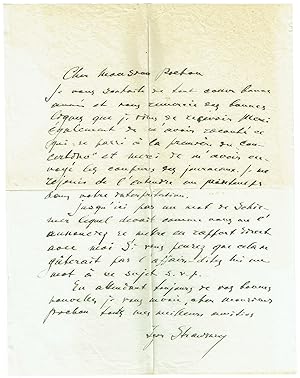
Important archive of 6 autograph letters signed and 3 autograph postcards signed.
Verlag: Morges, Garches, Biarritz, 1915-1920, 1920
Anbieter: Kotte Autographs GmbH, Roßhaupten, Deutschland
Verbandsmitglied: ILAB PADA VDA
Verkäuferbewertung 5 von 5 Sternen
Manuskript / Papierantiquität
EUR 25.000,00
EUR 20,00 Versand
Versand von Deutschland nach USAAnzahl: 1 verfügbar
In den WarenkorbGr.-4to. und 8vo. 12 pp. Important correspondence with Alfred Pochon (1878-1959), a Swiss violinist and member of the New York-based Flonzaley Quartet, concerning the first performance of Strawinsky's Three Pieces for String Quartet, K19 in 1915 and the commission, composition, and premiere of his Concertino for String Quartet, K35 between 1919 and 1922. The earliest postcard of the correspondence from 29. Mai 1915 is an invitation for dinner in Strawinsky's house in Morges. Strawinsky asks Pochon to bring the sheet music of the string quartet so that they can look at it together. This was only weeks after the not very successful premiere of the composition in Paris on 13 or 19 May 1915 by an ensemble surrounding Darius Milhaud. Pochon's Flonzaley Quartet first performed the composition on 8 November 1915 in Chicago, a few months after the proposed meeting. On 25 January 1917, Strawinsky wrote another postcard from Morges, asking Pochon to give "all of the material (sheet music for the ensemble and parts)" to Edward Bernays, his representative in America. Strawinsky thought "that this affair had been settled for a long time" and thanks Pochon for "taking care of the numerous proofs" of his quartet. Before 1918, the sheet music for the Three Pieces for String Quartet only circulated in manuscript-form. Although Strawinsky considered dedicating the second piece to Pochon, who had originally suggested the composition to him, he ultimately decided against it. Strawinsky's connection to the journalist, press agent, and theorist Edward Bernays (1891-1995), who is considered to be the father of public relations, was previously unknown. He certainly knew Bernays through Sergei Diaghilev who had hired Bernays as a press agent for his Ballets Russes on their American tours. - The larger part of the correspondence, stretching from 1919-22, concerns the Concertino for String Quartet that was commissioned by Alfred Pochon on behalf of the Flonzaley Quartet in a letter dated 17 August 1919. On 1 September 1919, Strawinsky responded to the request, accepting an offer of 500$ for "composing something" for the quartet and the exclusive performance rights for the United States for at least 1 year or until the publication. The piece should be dedicated to the musicians of the quartet and the American banker and collector André de Coppet. Strawinsky also gives condolences for the death of Pochon's infant son and thanks him for his "interest in the difficult situation" that him and his family found themselves in, "thanks to the war and the revolution" in Russia. In a curious remark, Strawinsky stresses that he has "always considered the exchange of musical production (like any other production) for money to be an entirely natural thing", thus explaining the "somewhat 'business-like' character" of his letter. - Over four months went by until Strawinsky responded to a letter from 14 October 1919 with apologies for his "long silence" and the reaffirmation of his "promise to compose a piece [une musique]" for Pochon's "marvelous ensemble", reassuring him: "Not only do I constantly think about it but I'm also, from time to time, accumulating material, bringing to paper some things that come to me 'through the ears', 'through the fingers', through the head". What he lacked was time but he announces to work on the composition during the summer. Strawinsky then addresses a "somewhat delicate subject", asking Pochon to pay the agreed-upon sum already, given his difficult financial situation following the Russian revolution: "I'm the only support not only of my own family but also of that of my sister who came here without any means of subsistence and of relatives that are very close to me and my wife who come from Russia one after the other [.]". In a short postscript, he agrees to extend the performance rights for the composition to all countries. (Morges, 25.02.1919). - On 3 May 1920, Strawinsky announces the reception of the sum and his plans to move to Italy, first Positano and then Rome, in order to safe expenses. He also mentions his departure to Paris for the premiere of Pulcinella by the Ballets Russes at the Paris Opera and invites Ponchon to visit him in Positano, where he plans to work on the quartet. - While the plans to move to Italy never materialized, Strawinsky did start the composition in the late summer of 1920. On 16 September 1920, he wrote a postcard from Coco Chanel's villa in Garches near Paris to schedule a meeting in Paris. Strawinsky explains: "I'm living temporarily in the house of a friend who offered her villa to me until I find accommodation, which is very difficult here". In two short postscripts he adds: "My children thank you in any case for the post stamps, the craze of which has not yet ebbed for them" and, more importantly: "The composition of the quartet is in full swing [bat son plein]". - Strawinsky completed the piece on 24 September and it was first performed on 3 November 1920 by the Flonzaley Quartet in New York. Strawinsky's first letter following the premiere didn't touch upon it, rather discussing a potential publication deal with the New York based publisher G. Schirmer. It seems that Schirmer's "new proposition" didn't include the Concertino, considering Strawinsky's somewhat cryptic remark: "I expected the answer with respect to the Concertino", which is also the first time that the title Concertino appears in the correspondence. Strawinsky does, however, accept an alternative deal with the demand of three changes to the contract: "I. I will gladly compose 3 small pieces for piano but without guarantee that they will be based on 'Russian folk-lore', I cannot do such a thing on command. - II. Instead of 5 little pieces for voice and piano, I propose to him to compose the same number of small pieces for flute and piano or violin and piano or flute and violin or two violins (something that I have wanted to do for a long time). - III. For the payment (for the 10 small piec.
-
Visiting card with holograph addition.
Verlag: Garches, no year
Anbieter: Kotte Autographs GmbH, Roßhaupten, Deutschland
Verbandsmitglied: ILAB PADA VDA
Verkäuferbewertung 5 von 5 Sternen
Manuskript / Papierantiquität
EUR 1.200,00
EUR 20,00 Versand
Versand von Deutschland nach USAAnzahl: 1 verfügbar
In den WarenkorbOblong-32mo. 2 pp. Pencil. Addressed to Alfred Pochon (1878-1959), a Swiss violinist and member of the New York-based Flonzaley Quartet, concerning the first performance of Strawinsky's Three Pieces for String Quartet, K19 in 1915 and the commission, composition, and premiere of his Concertino for String Quartet, K35 between 1919 and 1922. IGOR STRAWINSKY prie M. Pochon de ne pas oublier qu'il l'attend avec ses collegues à son attelier (22, rue Roche chouard) à 9 heurs du soire pas plus tard car à 10 1/2 il doit prendre le train pour rentrer à Garches".
-
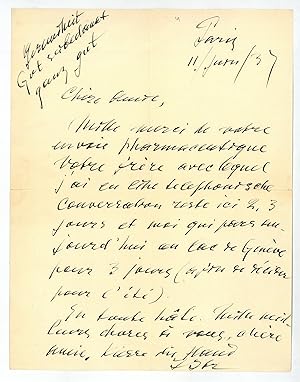
Autograph letter signed ("I. Str.").
Verlag: Paris, 11. VI. 1937., 1937
Anbieter: Antiquariat INLIBRIS Gilhofer Nfg. GmbH, Vienna, A, Österreich
Verbandsmitglied: ILAB PADA VDA VDAO
Verkäuferbewertung 5 von 5 Sternen
Manuskript / Papierantiquität
4to. 1 p. With an autograph envelope. Charming letter in French and German to the silent film star Dagmar Godowsky, thanking her for a "pharmaceutical package" and informing her about a conversation with her brother and his imminent departure for Lake Geneva: "Mille merci de votre envoi pharmaceutique votre frère avec lequel j'ai eu eine telephonische conversation reste ici 2, 3 jours et moi qui pars aujourd'hui au Lac de Genève pour 3 jours (afin de décider pour l'été). En toute hâte. Mille meilleures choses à vous, chère amie, küsse die Hand". Above the text, Stravinsky adds in German that he is in sufficient health: "Gesundheit Got [!] sei bedankt ganz gut". - In her memoir, Dagmar Godowsky (1897-1975) named Stravinsky as one of her great lovers. Little is known of the relationship, but the letter bears beautiful testimony to Stravinsky's familiarity with the actress. Her younger brother Leopold Godowsky Jr. was a violinist and chemist who, together with Leopold Mannes, created the first practical colour transparency film, Kodachrome. - Traces of folds. With tears to the folds and minimal browning.
-
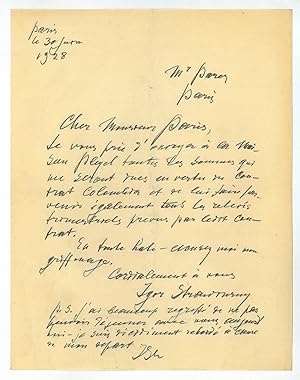
Autograph manuscript signed.
Verlag: Paris, 30. VI. 1928., 1928
Anbieter: Antiquariat INLIBRIS Gilhofer Nfg. GmbH, Vienna, A, Österreich
Verbandsmitglied: ILAB PADA VDA VDAO
Verkäuferbewertung 5 von 5 Sternen
Manuskript / Papierantiquität Signiert
4to. 1 page, watermarked 'Victory Extra Strong'. Written in pencil. A note for a hasty departure and a missed luncheon, addressed to "Monsieur Paris" and signed by Strawinsky. Strawinsky writes to ask that matters of sums and business be sent "à la Maison Pleyel". Somewhat unusually, while in Paris Strawinsky earned extra income by writing arrangements for the piano design company Pleyel, and was particularly interested in their player pianos. To his recipient, Strawinsky apologizes, "excusez moi mon griffonage" and concludes, "P.S. J'ai beaucoup regretté que ne pas pouvoir déjeuner avec vous aujourdhui", ending with a second abbreviated signature. - Gently creased along folds.
-

Autograph musical quotation signed.
Verlag: Prague, 12. XI. 1924., 1924
Anbieter: Antiquariat INLIBRIS Gilhofer Nfg. GmbH, Vienna, A, Österreich
Verbandsmitglied: ILAB PADA VDA VDAO
Verkäuferbewertung 5 von 5 Sternen
Manuskript / Papierantiquität
Oblong small 8vo. 1 page. Three bars of his "Octuor for Wind Instruments" as a "petit souvenir de Igor Strawinsky". - Mounted.
-

Autograph letter signed "IStr".
Verlag: Voreppe, 3. IX. 1933., 1933
Anbieter: Antiquariat INLIBRIS Gilhofer Nfg. GmbH, Vienna, A, Österreich
Verbandsmitglied: ILAB PADA VDA VDAO
Verkäuferbewertung 5 von 5 Sternen
Manuskript / Papierantiquität
8vo. 1 p. on bifolium. In pencil. To his friend, the patron, music critic, and tenor Pyotr Suvchinsky (1892-1985), correcting a note in the score of "Perséphone". As Stravinsky demonstrates with the help of two short musical notations of the "6th measure of the beginning", the last syllable of the word "mois-son" (crops) was to be sung in B and not in a higher D. The notations with French captions are followed by a short explanation in Russian, starting with the exclamation "For God's sake". - Stravinsky had invited his friend and fellow expatriate Suvchinsky to sing the part of Eumolphe in the production of the theatrical ballet "Perséphone". In a letter from 23 July 1933 Suvchinsky wrote to thank Stravinsky: "Your promise [of the part in "Perséphone"] is the first gift that I have received in Paris" (Levitz, p. 321). Nevertheless, the role was created by René Maison at the premiere at the Paris Opera on 30 April 1934. - "Perséphone" was a collaboration between Igor Stravinsky and the Nobel laureate André Gide. The famous dancer Ida Rubinstein had initiated the project in 1933 and later danced the lead role. For the libretto Gide revised a sketch from 1912, but the collaboration proved difficult, as Stravinsky took liberties in adapting the text to his musical vision. Ahead of the premiere, Gide distanced himself from the project, as he was dissatisfied with Jacques Copeau's staging and Kurt Jooss's choreography. Only much later did Gide acknowledge the quality of Stravinsky's composition. - Well preserved. - Tamara Levitz, Modernist Mysteries: Persephone (Oxford: Oxford University Press, 2012).
-
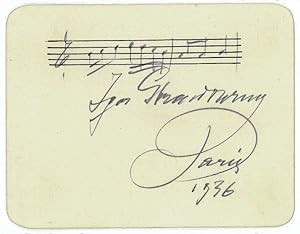
Autograph musical quotation signed.
Verlag: Paris, 1936., 1936
Anbieter: Antiquariat INLIBRIS Gilhofer Nfg. GmbH, Vienna, A, Österreich
Verbandsmitglied: ILAB PADA VDA VDAO
Verkäuferbewertung 5 von 5 Sternen
Manuskript / Papierantiquität
Small oblong 8vo (114 x 88 mm). 1 p. A particularly fine quotation from his second ballet "Petrushka", first performed by Sergei Diaghilev's "Ballets Russes" at the Théâtre du Châtelet in Paris on 13 June 1911. - In pencil; small traces of mounting on reverse.
-
Marius Constant (1925-2004) - Rare signed card + Photo - 1996
Sprache: Französisch
Erscheinungsdatum: 1996
Anbieter: PhP Autographs, Hastière, Belgien
Verkäuferbewertung 5 von 5 Sternen
Manuskript / Papierantiquität Signiert
Pas de couverture. Zustand: Bon. RARE - Authentic card signed in December 1996. + Photo 11.5x15 cm (recent print). Size : 7.5x12.5 cm. Condition : please see scans. Certificate of Authenticity and lifetime guarantee. Signé par l'auteur.
-

MORTON GOULD (1913-96) US-amerikanischer Komponist, Dirigent und Pianist, 1995 Pulitzer-Preis für seine Komposition Stringmusic / US-american composer, conductor and pianist
Anbieter: Herbst-Auktionen, Detmold, Deutschland
Verkäuferbewertung 3 von 5 Sternen
Signiert
Autogrammkarte mit eigenhändiger Empfehlung, Datum 9/3/91, Unterschrift signiert, mit s/w-Reproporträtfoto unter dunkelblaues Passepartout (4°) gerahmt.