Gesamtpreis (1 Artikel Artikel):
Versandziel:

773 (8 Ergebnisse)
Direkt zu den wichtigsten Suchergebnissen
Suchfilter
Produktart
- Alle Product Types
- Bücher (7)
- Magazine & Zeitschriften (Keine weiteren Ergebnisse entsprechen dieser Verfeinerung)
- Comics (Keine weiteren Ergebnisse entsprechen dieser Verfeinerung)
- Noten (1)
- Kunst, Grafik & Poster (Keine weiteren Ergebnisse entsprechen dieser Verfeinerung)
- Fotografien (Keine weiteren Ergebnisse entsprechen dieser Verfeinerung)
- Karten (Keine weiteren Ergebnisse entsprechen dieser Verfeinerung)
- Manuskripte & Papierantiquitäten (Keine weiteren Ergebnisse entsprechen dieser Verfeinerung)
Zustand Mehr dazu
- Neu (Keine weiteren Ergebnisse entsprechen dieser Verfeinerung)
- Wie Neu, Sehr Gut oder Gut Bis Sehr Gut (2)
- Gut oder Befriedigend (4)
- Ausreichend oder Schlecht (Keine weiteren Ergebnisse entsprechen dieser Verfeinerung)
- Wie beschrieben (2)
Einband
Weitere Eigenschaften
- Erstausgabe (1)
- Signiert (Keine weiteren Ergebnisse entsprechen dieser Verfeinerung)
- Schutzumschlag (Keine weiteren Ergebnisse entsprechen dieser Verfeinerung)
- Angebotsfoto (5)
Sprache (3)
Gratisversand
- Kostenloser Versand nach USA (Keine weiteren Ergebnisse entsprechen dieser Verfeinerung)
Land des Verkäufers
Verkäuferbewertung
-

Dshamila
Verlag: Leipzig:, Insel-Verlag,, 1986
Anbieter: Antiquariat B - Steffen Böttcher, Wernigerode, Deutschland
Verkäuferbewertung 4 von 5 Sternen

0. 3. Aufl., 75 S., 8°, Pbd. Insel-Bücherei Nr. 746. Kleiner schwacher Fleck auf dem Titelschild. (HKRSch3) Band: 0.
-

Fortgesetzte Versuch - Aufsätze, Gespräche, Essays
Verlag: Reclam, Leipzig, 1980
Anbieter: Bücherpanorama am Johannisbad, Zwickau, Deutschland
Verkäuferbewertung 3 von 5 Sternen

Taschenbuch. Zustand: Gut. aus RUB 773 (illustrator). S. 343.
-

Dshamilja
Verlag: Insel - Verlag, Leipzig, 1986
Anbieter: Bücherpanorama am Johannisbad, Zwickau, Deutschland
Verkäuferbewertung 3 von 5 Sternen
Hardcover. Zustand: sehr Gut. aus Inselbücherei 773 (illustrator). S. 75.
-
GEOLOGY AND GROUND-WATER RESOURCES OF THE ELIZABETH CITY AREA, NORTH CAROLINA
Verlag: GPO, Washington, D.C., 1937
Anbieter: Hoffman Books, ABAA, IOBA, Columbus, OH, USA
Verbandsmitglied: ABAA ILAB IOBA
Verkäuferbewertung 3 von 5 Sternen
Softcover. Zustand: Very Good. USGS, 1936 Wrappers, very good condition, Complete with all maps and plates.
-

Zustand: very good. Gut/Very good: Buch bzw. Schutzumschlag mit wenigen Gebrauchsspuren an Einband, Schutzumschlag oder Seiten. / Describes a book or dust jacket that does show some signs of wear on either the binding, dust jacket or pages.
-
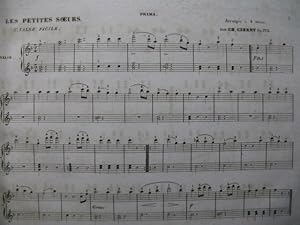
CZERNY Ch. Les Petites Soeurs 2e Valse op 773 Piano 4 mains 1846
Erscheinungsdatum: 1874
Anbieter: partitions-anciennes, Blois, Frankreich
Verkäuferbewertung 5 von 5 Sternen

Noten
Zustand: 1830-1850. CZERNY Ch. Les Petites Soeurs 2e Valse facile arrangée pour Piano 4 mains par Charles Czerny op 773 Paris, E. Troupenas et Cie Editeurs E. T. et Cie(2) XIXe siècle 1846 11 pages 25.6 x 33.8 cm Bon état, page de titre manquante 024225 Nouveau.
-
Kitab al-Amthal. Proverbiorum Arabicorum centuriae duae, ab anonymo quodam Arabe collectae & explicata: cum interpretatione Latina & scholiis
Sprache: Latein
Verlag: Ex Typographia Erpeniana, Linguarum Orientalium, prostant apud J. Maire, Leyde, 1623
Anbieter: FOLIOS LIMITED, Oxford, Vereinigtes Königreich
Verkäuferbewertung 5 von 5 Sternen
EUR 4.157,89
EUR 34,60 Versand
Versand von Vereinigtes Königreich nach USAAnzahl: 1 verfügbar
In den WarenkorbHardcover. Zustand: Good. Second Edition. [14], 134 pp., [1 leaf with printer's mark], Arabic & Latin text edited & introduced by Joseph Juste Scaligeri & Thomas Erpenius, contemporary calf with letters 'G.W.' embossed on both covers, title gilt on spine, skilfully rebacked, title vignette, margins a bit browned, occasional foxing, Ex Typographia Erpeniana. Second edition of this collection of 200 Arabic proverbs, first published in 1614. The dedicatory epistle to Meric Casaubon, signed: 'Thomae Erpenius' is followed by a letter to Isaac Casaubon, dated 'Calendis Martiis anni a nato Messia M.D.C.X1V.' (date of the first, 4o edition), and 'Praefatio Thomae Erpenii ad Lectorem'; two lettersto the author from Isaac Casaubon precede the main text; preliminary pages all in Latin; main text in Arabic and Latin; printer's device of a palm tree and the motto: 'Assurgo Pressa' on recto of final leaf; the 1614 edition was printed 'In Officina Raphelengiana'. The celebrated Dutch orientalist, Thomas van Erpen, Professor of Oriental Languages in the University of Leyden, was not content merely to produce works for facilitating the study of Oriental languages; 'il comprit que pour que leur connaissance ne se bornat pas uniquement a rendre plus aisee les relations politiques et commerciales, et put devenir d'une utilite reelle pour la litterature, il fallait reproduire par la presse et repandre les oeuvres des ecrivains de l'Orient. Aide par des secours accordespar les Etats-Generaux, il etablit a Leyde, bientot apres son retour en Hollande, une imprimerie arabe, qu'il surveilla et qu'il dirigea lui-meme.' [NBG] A selection from Abu 'Ubayd ibn Sallam's famous collection of Arabic proverbs, with Latin version by the great classical scholar Joseph Scaliger, prepared for publication by the pioneering Arabist Thomas Erpenius, and printed at the press of Frans Raphelengius the Elder. Abu 'Ubayd ibn Sallam, an eighth-century scholar who studied at the grammatical schools of Basra, Kufa, and Baghdad, wrote standard works on a number of linguistic subjects, including his famous compilation of proverbs- his only known work on adab. As such, this book represents the first printing of any Arabic "literary" work. It is also one of the first Arabic publications from the Dutch university town of Leiden, famous for its Arabic studies and publications throughout the Golden Age of the seventeenth century and down to the present day. The Orientalist scholar-printer, Raphelengius (son-in-law of the great Antwerp printer, Plantin) had already in 1595 produced a specimen of Arabic types which included examples of maghribi letter forms; but it was not until the second decade of the seventeenth century that he produced any Arabic texts - Epistles from the New Testament, Erpenius' great grammar of Arabic, his own Arabic-Latin Lexicon (the first such publication), and this edition of Arabic proverbs. The original manuscript copy of the proverbs had been acquired in Rome by a Frenchman, David Rivault Sieur de Fleurance, who gave it at first to a Maronite for translating, and then took it back with him to Paris for the towering figure of French scholarship, Isaac Casaubon who, in turn, passed the manuscript to the other great scholar of the period, Joseph Scaliger in Leiden, who applied his rudimentary knowledge of Arabic to translating the proverbs. But it was Thomas Erpenius who prepared the edition and tactfully added notes to the great scholar's work. The printed dedication is to Casaubon, by then a Huguenot exile in London and near the end of his life. A second edition, dedicated by Erpenius to Isaac Casaubon's son, appeared in 1623. Bibliographic references: Smitskamp, PO, 67; Fück, 61-62; Schnürrer, 217; Breugelmans, 200. #35131.
-
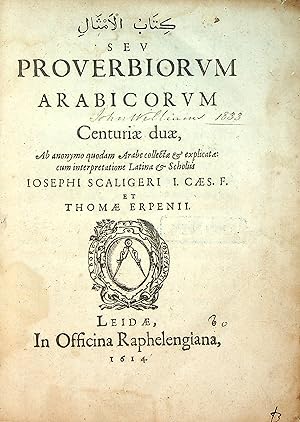
Kitab al-Amthal. Seu Proverbiorum Arabicorum Centuriae Duae. ab anonymo quodam Arabe collectæ & explicatæ. Cum interpretatione Latina et scholiis.
Sprache: Latein
Verlag: Raphalengius, Leiden, 1614
Anbieter: FOLIOS LIMITED, Oxford, Vereinigtes Königreich
Verkäuferbewertung 5 von 5 Sternen
Erstausgabe
EUR 6.533,82
EUR 34,60 Versand
Versand von Vereinigtes Königreich nach USAAnzahl: 1 verfügbar
In den WarenkorbHardcover. Zustand: Fine. First Edition. 8 vo. [7], 116 pages, Arabic & Latin text, modern half calf binding with marbled boards, raised gilt spine, gilt title, title page with ownership entry and faint stamp, last ten leaves with water stain at top margin, occasional spotting and browning, complete copy with the last blank leaf. RARE, first edition. Collection of 200 Arabic proverbs, compiled anonymously by the Islamic jurist Abu Ubaid al-Qasim Ibn Sallam (773 -837), translated into Latin and commented by Joseph Justus Scaliger and Thomas Erpenius, dedicated to Isaac Casaubonus. This work is a milestone in the history of occidental Arabic studies. "The edition of these proverbs took a long time to crystallize. Originally the Arabic text was acquired in Rome by the French scholar Florens Christianus, who asked a Lebanese Arab to translate the text into Latin. He then gave the work to Casaubonus at whose instigation the Dutch scholar Adrian Willemsz and after his early death, Scaliger started a revision, which was finally published by Erpenius. In the translation and the commentary Erpenius is careful to denote what is Scaliger's, his own, or of both" (Smitskamp). Bibliographic reference: Schnurrer 216. Smitskamp 267. #34104.