Gesamtpreis (1 Artikel Artikel):
Versandziel:

INCUNABLE (46 Ergebnisse)
Direkt zu den wichtigsten Suchergebnissen
Suchfilter
Produktart
- Alle Product Types
- Bücher (38)
- Magazine & Zeitschriften (Keine weiteren Ergebnisse entsprechen dieser Verfeinerung)
- Comics (Keine weiteren Ergebnisse entsprechen dieser Verfeinerung)
- Noten (Keine weiteren Ergebnisse entsprechen dieser Verfeinerung)
- Kunst, Grafik & Poster (8)
- Fotografien (Keine weiteren Ergebnisse entsprechen dieser Verfeinerung)
- Karten (Keine weiteren Ergebnisse entsprechen dieser Verfeinerung)
- Manuskripte & Papierantiquitäten (Keine weiteren Ergebnisse entsprechen dieser Verfeinerung)
Zustand Mehr dazu
- Neu (2)
- Wie Neu, Sehr Gut oder Gut Bis Sehr Gut (6)
- Gut oder Befriedigend (9)
- Ausreichend oder Schlecht (Keine weiteren Ergebnisse entsprechen dieser Verfeinerung)
- Wie beschrieben (29)
Einband
Weitere Eigenschaften
- Erstausgabe (6)
- Signiert (1)
- Schutzumschlag (Keine weiteren Ergebnisse entsprechen dieser Verfeinerung)
- Angebotsfoto (27)
Sprache (5)
Gratisversand
Land des Verkäufers
Verkäuferbewertung
-

paperback. Zustand: New. 1st.
-

Introduction à la poésie française. Poémes choisis avec la collaboration de Dominique Aury.
Sprache: Französisch
Verlag: Paris. N. R. F. , 1940., 1940
Anbieter: Librairie Jean-Michel Belle, Nice, Frankreich
Verkäuferbewertung 1 von 5 Sternen

Couverture rigide. Zustand: Assez bon. In 8° soleil. Reliure de toile bleue, sigle NRF en lettres dorées sur le premier plat, dos orné de filets dorés. Dos passé. Filets dédorés. Plats et dos conservés. Ouvrage tiré à 320 héliona Navarre. Il porte le n° 94. Cet ouvrage ne sera pas repris dans la collection Bonet - Prassinos. J. E. Huret dans sa bibliographie des cartonnages N. R. F. le qualifie de Cartonnage non repris et lui attribue le numéro INR 9 (Huret, page 18).
-

Der Hamburger Rettungsdienst und seine Geschichte: 160 Jahre zwischen Behörde und Ehrenamt (German Edition)
Anbieter: Ria Christie Collections, Uxbridge, Vereinigtes Königreich
Verkäuferbewertung 5 von 5 Sternen

EUR 36,63
EUR 13,83 Versand
Versand von Vereinigtes Königreich nach USAAnzahl: Mehr als 20 verfügbar
In den WarenkorbZustand: New. In.
-
Incunable 1488. Facsímil 1981.
Verlag: Salta, Biblioteca de San Francisco, 1981., 1981
Anbieter: AQUILANTI. Libros Antiguos & Modernos (A.L.A.D.A), Ciudad De Buenos Aires, CABA, Argentinien
Verbandsmitglied: ALADA
Verkäuferbewertung 4 von 5 Sternen

Sin foliar. 8vo., cartoné. Falta portada.
-

Super titulo De accusationibus, inquisitionibus et denunciationibus. OR Super titulo De accusationibus, inquisitionibus et denunciationibus (Decretal. V,1)
Sprache: Englisch
Verlag: Pescia : Laurentius and Franciscus de Cennis, for Bastianus and Raphael de Orlandis, 21 Oct. 1486. OR Milan : Jacobus de Sancto Nazario, de Ripa, 19 Mar. 1495., 1495
Anbieter: Roger J Treglown, ABA., MILNTHORPE, CUMBR, Vereinigtes Königreich
Verbandsmitglied: ABA ILAB PBFA
Verkäuferbewertung 2 von 5 Sternen

EUR 101,04
EUR 26,55 Versand
Versand von Vereinigtes Königreich nach USAAnzahl: 1 verfügbar
In den WarenkorbNo Binding. Zustand: Fine. Single folio leaf (403 x 288mm). Ff 144, sig.E iiii. Printed on recto and verso. Latin text in two columns, 81 lines, recto with centre block of two 33 line columns. Verso with centre block of two 59 line columns. Rubricated capitals and significant passages. An attractive large single incunable leaf in a fine and clean condition. Both books are well held in institutional libraries in the USA and Europe. Accoltis, Franciscus de, was born in Arezzo, Italy about 1418, Franciscus spent his life as a wandering scholar of great renown with a high income. He taught law at Bologna (1440-45), Ferrara (1448-54, 1457-61), Siena (1454, 1466-79), and Pisa (1479-84), where he died in 1485/86. He served Francesco Sforza at Milan between 1461 and 1466 and wrote consilia upon various requests, including one against the excommunication of Lorenz de Medici and Florence after the attempt on Lorenzo's life in 1478' - Bio-Bibliographical Guide to Medieval and Early Modern Jurists. (1481) Hain40; (1495) Hain 41.
-
Sammelband of ten works.
Verlag: Rome, Stephan Plannck and Eucharius Silber, c.14811491., 1481
Anbieter: Bernard Quaritch Ltd ABA ILAB, London, Vereinigtes Königreich
Verbandsmitglied: ABA ILAB PBFA
Verkäuferbewertung 5 von 5 Sternen
EUR 29.718,93
EUR 36,93 Versand
Versand von Vereinigtes Königreich nach USAAnzahl: 1 verfügbar
In den WarenkorbTen works in one volume, 4to; occasional light staining, a few small spots; nonetheless very good copies; binding retaining panels of contemporary (German or Flemish?) blind-stamped sheep, laid down on a later calf binding, boards blind-tooled to a panel design, central panel diapered with fleur-de-lys tool, outer panels with two alternating floral tools, edges stained purple; somewhat rubbed, with a few superficial cracks, tailcap chipped; early signature 'Gentonis' in a French hand at foot of annotation on final leaf verso, early sixteenth-century annotations to a further c.27pp. in the same hand, nineteenth-century French list of contents loosely inserted.A sammelband of ten Roman incunables, nine of which printed by Stephan Plannck, covering subjects from astronomy to usury, holy water to marriage, and ending with St Antoninus's manual for confessors; with annotations showing the early ownership of a scholar/practitioner of canon law or a confessor, and partially preserving its original binding. Stephan Plannck, of Passau (c.14571501), began his printing career probably as an apprentice in the workshop of Ulrich Han in Rome (active from 1467), which he then took over in 14789. He became the most prolific printer in Rome in the fifteenth century, in particular producing works for the Curia, a practical business decision as the papal bureaucracy then formed the primary market for books in Rome. The first item of the present sammelband, the Lunarium of Bernat de Granollachs (14211485), contains lunar tables for the years 14901550, indicating the phases of the moon, the dates of moveable feasts, and details of eclipses visible from Barcelona. These tables were first issued in around 1484 and reprinted in various languages (including Catalan) and in various locations in Spain and Italy, as well as Lyons, up to the 1520s. This is a reprint of the 1487 Plannck edition, which was most likely the first Latin printing, though without the (then-redundant) years of 14889. The other works in the volume, by authors including Aquinas, Seneca, Antoninus Florentinus, and Johannes de Turrecremata, are of practical use to canon lawyers and confessors, dealing with the Penitential Canons, the cardinal virtues and moral theology, and the sacraments. These were for the most part printed in Rome regularly in the 1470s and 1480s, indicating their utility for the workings of the Curia. This volume, a rare survival preserving fragments of its original binding, indicates subjects of interest to the original owner. The annotations, spanning the entire volume in a single early hand, attest to an engagement with a wide variety of subject matter: for the most part they pick out phrases from the text or expand upon them, from usury to consanguinity to exorcism, with a note (to the first work) on the page with an almanack for 1535, about the death of Andreas Terbolan(?) on the penultimate day of December. Comprising:i. GRANOLLACHS, Bernardus de. Lunarium ab anno 1490 ad annum 1550. [Rome, Stephan Plannck, 1490.] Ff.[33] (of 34, without initial blank), last leaf blank, gothic letter, numerous small woodcut diagrams of the moon, early marginalia to 1p. ISTC ig00339000 (listing six copies: Dillingen, Munich, Västerås, Basel, Harvard, and the Vatican); Sander 3224. ii. ROSELLIS, Antonius de. De ieiuniis. Rome, Stephan Plannck, 21 January 1486. Ff.[6], gothic letter. ISTC ir00324000. iii. ESCOBAR, Andreas de. Canones poenitentiales. [Rome, Eucharius Silber, c.1491.] Ff.[8], gothic letter. ISTC ia00658000. iv. ROSELLIS, Antonius de. De usuris. [Rome, Stephan Plannck, c.1488.] Ff.[6]; gothic letter. Small loss to lower margin of [a]5, not affecting text. ISTC ir00332000. v. ANDREAE, Johannes. Summa de sponsalibus et matrimoniis. [Rome, Stephan Plannck, c.1490.] Ff.[8]; gothic letter; marginal paper-flaw to f.[2]. ISTC ia00643000. vi. 'SENECA, Lucius Annaeus' [but Martinus DUMIENSIS, Archbishop of Braga]. De quattuor virtutibus cardinalibus, sive de formula honestae vitae. [Rome, Stephan Plannck, 1490.] Ff.[4]; gothic letter. ISTC is00413000. vii. TURRECREMATA, Johannes de. De efficacia aquae benedictae. [Rome, Stephan Plannck, c.14811487.] Ff.[10]; gothic letter. ISTC it00511000. viii. THOMAS AQUINAS. De articulis fidei et ecclesiae sacramentis. [Rome, Stephan Plannck, c.1488.] Ff.[12], gothic letter. ISTC it00279000. ix. DEFECTUS IN MISSA OCCURRENTES. [Rome, Stephan Plannck, c.1490]. Ff.[6]; slight loss to lower corner of final leaf, some staining to first leaf not affecting legibility. ISTC id00130000. x. ANTONINUS FLORENTINUS. Confessionale: Defecerunt scrutantes scrutinio. Titulus de restitutionibus. Rome, Stephan Plannck, 19 November 1490. Ff.143 (of 144, without final blank), gothic letter, some deckle edges; closed tear to f.xxxix, staining to f.xvii. ISTC ia00824000. Language: Latin.
-
Speculu[m] artis bene morie[n]di [= Ars moriendi].
Verlag: Heinrich Quentell,, [Cologne,, 1495
Anbieter: Antiquariaat FORUM BV, Houten, Niederlande
Verkäuferbewertung 5 von 5 Sternen
Erstausgabe Signiert
EUR 8.500,00
EUR 25,00 Versand
Versand von Niederlande nach USAAnzahl: 1 verfügbar
In den WarenkorbQuentell's second quarto edition of the well-known manual on the art of dying, in the original Latin, matching his ca. 1493 quarto edition almost line for line and using the same woodcut, quite different from any used with this text before that date. Quentell's quarto editions contain the original long version of the text, known as Speculum artis bene moriendi, often attributed to Matthaeus de Cracovia or Albertus Magnus (editions in Italian are often attributed to Dominicus de Capranica, Cardinal of Fermo). The Ars moriendi was one of the earliest incunabula printed and consists of two related Latin texts written around 1415 and 1450, offering guidance on how to have a good death according to Christian beliefs of the late Middle Ages. The texts were written in response to the Black Death and social upheavals of the 15th century, with the earliest versions likely composed in southern Germany. The highly popular Ars moriendi was translated into many West European languages, and was the first in a tradition of guides to death and dying. The first edition in the original Latin appeared ca. 1474, but was preceded by a German edition in 1473 and perhaps by an edition in Italian described as ca. 1471/75. Quentell published the Latin text together with other works in a folio edition described as ca. 1484/89, but he published four quarto editions of the Ars moriendi alone, described as ca. 1493, the present ca. 1495, ca. 1498 and another probably after 1500. He published no Ars moriendi editions in vernacular languages. His first three quarto editions have the same collation, but the present edition matches the ca. 1493 edition almost line for line and uses the same woodcut, while the ca. 1498 edition differs considerably and uses a different woodcut.Heinrich Quentell, one of the greatest early Cologne printer-publishers, issued many theological and philosophical texts for university use, but also liturgical texts, working both alone and with Johann Helman, who may have also jointly employed contract printers and dispatched servants to sell books. Quentell was one of the first printers to consistently provide his books with title-pages, with approximately 91% of his over 380 publications including one.Quentell used the present "Magister cum discipulis"-woodcut in several other editions, including the Heymericus de Campo, Promptuarium argumentorum (1492, GW 12406) and Jacobus van Gruitrode, Speculum aureum animae peccatricis (1493, GW M10728). Wynkyn de Worde used a copy in his Parabolarum Alani cum commento (1508, STC 254.3), and other printers copied it as well.All Quentell's Ars moriendi editions are undated and the present one used his types 7 and 10 and initials e, which all apeared in his books in the period 1488 to 1500. The present edition is probably dated ca. 1495 in the literature because it appears to fall between the two quarto editions thought to date from ca. 1493 and ca. 1498.The bookbinder Jean-Luc Honegger, still active today, is best known for his bindings for the Bibliothèque Nationale de France in Paris and the Bodmer Foundation near Geneva. With the bookplate of the Bibliotheca Philosophia Hermetica (Joost Ritman) in Amsterdam and probably bound for them. Slightly browned, water stains at the foot of a few leaves (not approaching the text), some smudges in the margins and on the blank final page. The binding slightly worn at the extremities and with a few unobtrusive scratches on the back board. Otherwise in very good condition and only slightly trimmed (about 5 mm at the head and probably no more at the fore-edge and foot), giving generous margins (about 2, 3 and 4 cm at the head, fore-edge and foot respectively) and some leaves with tranchefiles at the foot.l Bibliothèque Nationale, Catalogue des incunables A598; BMC I, p. 294; Bod-Inc A449; Bohonos Szandorowska, Incunabula quae in bibliothecis Poloniae asservantur 562; BSB-Ink A766; Buffévent VIII 45; Goff A1098; Günther, Wiegendrucke der Leipziger Sammlungen 781; GW 02610; HC 14911; ISTC ia01098000; Madsen, Kongelige Biblioteks inkunabler 352; Ohly-Sack 274; ÖNB-Ink A483; Pell 1339; Polain 972; Proctor 1425; Sack Freiburg 306; Sallander Uppsala 2046; Schramm VIII 484; Schreiber, Manuel de l'amateur de la gravure sur bois et sur métal au XVe siècle 3671; Thienen, Incunabula in Dutch libraries 425; UBL-Ink A354; USTC 739947; Voulliéme, Die Buhdrucker Kölns 305; Voulliéme, Inkunabeln der Königlichen Bibliothek 1011; Voulliéme, Trier 697. Recent marbled paper over boards by the Geneva bookbinder Jean-Luc Honegger (b. 1953) who set up his atelier ca. 1978 (signed with his "honegger" stamp in blue ink at the foot of the back paste-down), sewn on 3 recessed supports, the marbled paper in an antique spot pattern (see Wolfe 162-163) with black spots on unusually fine-grained grey Stormont spots and with veins in red, turquoise, orange, dark blue and white, black morocco spine label with the title in gold roman capitals, reading up the spine. With a large woodcut (10.0 x 8.8 cm) on the title page: depicting a teacher (Pope Gregory the Great ca. 600 CE, declared a saint in 1295) with a dove on his shoulder (his attribute), seated behind a lectern with an open book, instructing two of his pupils, seated before him, each with a book in his hands, with above them a scroll, inscribed "Accipies tanti doctoris dogmata sancti". Set in a single column, with 36 lines to the page, in a rotunda gothic type (Quentell type 7, here 79G, though in the Typenrepertorium 80G), with a larger textura gothic for the first line of the title (Quentell type 10, 155G), though the only capital in that line is the 8 mm lombardic initial S (Quentell initials e, described as 6/7 mm, but noting that they are used with type 10). With spaces left for manuscript initials (1 6-line and many 3-line, a few - mostly on b1v and b2r - with manuscript guide letters in black ink. Most pages with a few words underscored in black ink. Pages: [31], [1 blank] pp.
-
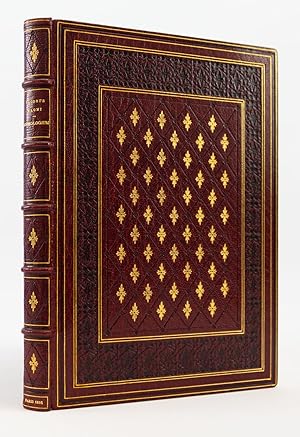
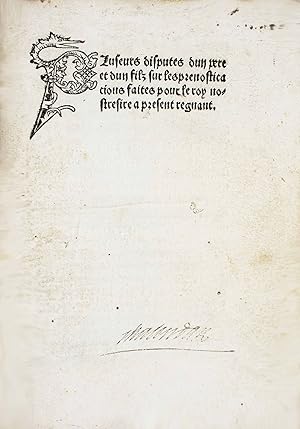
Pluseurs disputes dun pere et dun filz sur les prenosticacions faites pour le roy nostresire a present regnant
Verlag: Jean Du Pré), (Lyon, 1492
Anbieter: Hugues de Latude, Villefranche de Lauragais, Frankreich
Verbandsmitglied: ILAB
Verkäuferbewertung 5 von 5 Sternen
EUR 51.000,00
EUR 35,00 Versand
Versand von Frankreich nach USAAnzahl: 1 verfügbar
In den WarenkorbIn-4, [192 x 137 mm] de (22) ff. [Signatures : [a-b]6 c10] Maroquin rouge, dos à nerfs muet orné de petits fleurons dorés encadrés de doubles filets dorés, encadrement d'un triple filet doré sur les plats, filet doré sur les coupes, roulette dorée intérieure, tranches dorées. (Reliure ancienne.). INCUNABLE EN VERS FRANÇAIS, INCONNU DES BIBLIOGRAPHES. L'impression est datable d'après le préambule qui précise que ces prédications ont été "nouvellement faites à Lyon le quinziesme jour de février Mil quatrecens quatre vingtz et unze" (c'est-à-dire le 15 février 1492, compte tenu de la réforme du calendrier). Cette date correspond à celle de la reconnaissance de la nullité du mariage d'Anne de Bretagne avec Maximilien d'Autriche, et entérine donc la légitimité de son mariage, le 6 décembre 1491 à Langeais, avec le roi de France, Charles VIII. L'analyse du matériel typographique permet d'attribuer cette édition à l'imprimeur du Champion des Dames et de la Complainte de l'âme damnée, c'est-à-dire à Jean Du Pré selon l'identification de la British Library. Jean Du Pré, imprimeur parisien, exerça effectivement son art à Lyon entre 1491 et 1495 et imprima à cette époque plusieurs livrets populaires, tous anonymes et sans nom d'imprimeur, notamment Le Champion des Dames, La Belle Dame sans Mercy, la Complainte de l'âme damnée, L'Hospital d'Amour etc. Le texte, après un court préambule en prose, se présente sous la forme d'un dialogue entre un père et son fils, en vers décasyllabes. L'auteur, est resté anonyme mais donne quelques indications (cf. f. c8 r°) : on y apprend qu'il est étranger, et n'a fréquenté en France d'autre province que le Lyonnais. L'essentiel des pièces d'actualité imprimées sous le règne de Charles VIIII ne nous sont connues que par trois recueils conservés à la bibliothèque de Nantes, à la Bibliothèque Nationale de France et à la bibliothèque Sainte-Geneviève à Paris. Jean-Pierre Seguin en a dressé un inventaire en 1957 (L'Information à la fin du XVe siècle en France : pièces d'actualité imprimées sous le règne de Charles VIII, Arts et Traditions populaires, 5e année, n°1, pp. 46-74). Cet inventaire recense 62 pièces imprimées entre 1488 et 1495. Notre texte n'y figure pas et aucune version n'est enregistrée dans les répertoires bibliographiques d'incunables. Il semble que ce soit le seul exemplaire parvenu jusqu'à nous. Par ailleurs, ce texte inconnu revêt un intérêt particulier : il fut imprimé peu de temps après le mariage de Charles VIII avec Anne de Bretagne, événement qui fut d'une conséquence majeure par la suite pour la rattachement de la Bretagne au royaume de France, entérinée définitivement en 1532 sous François Ier. L'auteur, très élogieux envers Charles VIII, étale au fil des vers les qualités du jeune roi, son amour pour son peuple, sa clémence, son courage et ses succès militaires, notamment en qui concerne la conquête de la Bretagne : "Ainsi je vis par raisons evidentes / qu'assès a fait pour le commencement / Si n'estoit ja que la cité de Nantes / Dont il a eu Bretaigne aisément" (cf. b6 v°). A la fin du volume, il insite sur l'alliance de la Bretagne avec la France et conclut ainsi : "Or sont françoys et bretons aliez / Et tellement quoy qu'il doive avenir / qu'au grant jamais n'en seront desliez / Dieu par sa grace y veuille maintenir / le triumphant et hault roy valeureux / qu'en tous ses faitz bien luy puisse venir / Et soit tousjours en la grace des deux". D'une certaine manière, cette pièce en vers semble répondre à quelques années d'intervalle au "Testament de monseigneur des Barres, capitaine des Bretons" (Lyon, Jean du Pré, 1488) sur la guerre des Bretons contre les Français (cf. Seguin n°1 et 2). Ce fascicule est revêtu deux fois de l'ex-libris manuscrit "Chalendar", une vieille famille de la noblesse du Vivarais. In-4, [192 x 137 mm] de (22) ff. [Signatures : [a-b]6 c10] Maroquin rouge, dos à nerfs muet orné de petits fleurons dorés encadrés de doubles filets dorés, encadrement d'un triple filet doré sur les plats, filet doré sur les coupes, roulette dorée intérieure, tranches dorées. (Reliure ancienne.) - - - - - - - - - - - - - - - - - - - - INCUNABLE IN FRENCH VERSE, UNKNOWN TO BIBLIOGRAPHERS. The printing can be dated according to the preamble, which states that these predictions were newly made in Lyon on 15 February 1491 (i.e. 15 February 1492, taking into account the calendar reform). Analysis of the typographical material allows us to attribute this edition to Jean Du Pré, who printed several popular booklets in Lyon between 1491 and 1495, all anonymous and without a printer's name. Jean-Pierre Seguin drew up an inventory of 62 pieces of the actuality booklets printed between 1488 and 1495. Our text does not appear in this inventory and no version is recorded in the bibliographies of incunabula. This is the only known copy -.
-
Opera cum quibusdam.
Verlag: Argentina [Estrasburgo], Iohanis Reinhardt, qrto idus marzo, 1498, 1498
Anbieter: Delirium Books · Susana Bardón, Madrid, M, Spanien
Verkäuferbewertung 4 von 5 Sternen
Encuadernación de tapa dura. Zustand: Muy bien. Folio (28,7 x 20 cm.) 6 h. inc. port. grabada en madera, CCVII fol., al vuelto del último el colofón, 1 h. bl., 6 h. sin num. Numerosos grabados en madera dentro del texto. Plena piel del XVII, doble hilo dorado en planos, lomo con nervios, hierros dorados, y tejuelo. Primera edición ilustrada de las obras de Horacio, editada por Jacob Lochner. La ilustración, con ciento sesenta y ocho tacos xilográficos a lo largo del texto, muestra personajes y escenas de la Roma clásica; son especialmente curiosos los bloques que también fueron empleados en la edición de 1497 de la Stultifera navis de Brant. Impresión a tres columnas, con el texto al centro y la glosa con los comentarios de Nicolaus Perottus a ambos lados. Incluye las Sátiras, los Épodos, las Odas y las Epístolas. Anotación manuscrita del XVII al pie de portada: "Exlibris de Galli, Catalogo mscriptis" Pequeño injerto al pie del margen interno de la última hoja de preliminares, sin afectar texto. Cerco de humedad en el margen inferior de las últimas hojas, desde el fol. CXCVIII hasta el final. LL8 (blanca) presente. Ejemplar algo corto de margen superior. Fairfax Murray, German, 205; Goff H-461; Hain 8898; Polain, 1989; Proctor, 485.
-
De Officiis cum commentariis Petri Marsi. De amicitia. De senectute. Paradoxa.
Verlag: Venetiss, Philippum Pinzium Mantuanum, 1493. xvi mensis Iulii, 1493
Anbieter: Delirium Books · Susana Bardón, Madrid, M, Spanien
Verkäuferbewertung 4 von 5 Sternen
Encuadernación de tapa dura. Zustand: Muy bien. Folio (29,2 x 19,8 cm.) clxviii fol. (i.e. clxix) , 1 h. sin num. de registro. Capitulares miniadas en rojo, azul, verde y amarillo, alguna marginalia puntual. Título en primera hoja enmarcado por orla miniada con motivos vegetales. Pequeño dibujo del siglo XIX iluminado al final del texto, en recto de clxviii. El texto de Cicerón al centro, con los comentarios alrededor: De Officiis comentados por Petri Marsi, De Amicitia por Omnibonus Leonicenus, De Senectute por Martinus Phileticus. Encuadernación del siglo XX en pergamino rígido, sobre tabla, con título gofrado y decoración en relieve. Procedencia: 1. Jacobus Maximilianus, conde de Collalto y San Salvatore, y conde del Sacro Imperio Romano Germánico, ex libris grabado en 1771 por T. Viero en primera hoja de respeto. 2. Nelly Vaccatezza de Vaccarezza, ex libris grabado por Claudio Bonacini, también en primera hoja de respeto. HC, 5275; Goff, C-607; BMC, V, 495; Pell, 3758; GW 6962.
-
![Bild des Verkäufers für ACUTISSIMI DIVINORUM ARCHANORUM SCRUTATORIS MAGISTRI IACOBI ALMAIN IN TERTIUM SENTE[N]TIARUM UTILIS EDITIO: cum omni adnotandorum literario indice q[uod] diligenter collecto. zum Verkauf von FARRÉ Libreria Anticuaria](https://pictures.abebooks.com/inventory/md/md9212568648.jpg)
ACUTISSIMI DIVINORUM ARCHANORUM SCRUTATORIS MAGISTRI IACOBI ALMAIN IN TERTIUM SENTE[N]TIARUM UTILIS EDITIO: cum omni adnotandorum literario indice q[uod] diligenter collecto.
Verlag: Imp. Ioanne Granion (Jean Granjon). París, 1516, 1516
Anbieter: FARRÉ Libreria Anticuaria, Barcelona, B, Spanien
Verkäuferbewertung 5 von 5 Sternen
Erstausgabe
. 20 cm. [8], CLVII fol. (sign. a8, a-t8-v4). Texto con apostillas marginales. Marca de impresor en portada, capitulares. Enc. en pergamino, cierres. * Rara primera edición de In tertium sententiarum de Jaques Almain (1480-1515). Alumno del teólogo John Major, fue un destacado profesor de teología en la Universidad de París, de la que fue rector en 1507. Cultivó una gran variedad de géneros en el ámbito del saber académico, aunque sus primeras obras estaban dedicadas a la lógica y la física de Aristóteles. Además de la teología, Almain escribió también sobre política, en concreto acerca del poder papal a partir de la discusión de las opiniones de Guillermo de Ockham. Máximo exponente del conciliarismo, el autor hace una clara distinción entre el poder absoluto y el poder ordenado de Dios. De moral aristotélica, su pensamiento político sugería la necesidad de orden pero dejaba margen para frenar las ambiciones de cualquier gobernante cuya conducta pusiera en peligro la supervivencia de la comunidad. Almain dejó en sus Opuscula (obra póstuma editada en París en 1518) una clara crítica al tratado de Cajetan sobre el papado, pues sostenía que la Iglesia y el Estado son de naturaleza paralela, ambos capaces de actuar contra un líder errante, ya fuera el Papa o el rey. La edición que presentamos fue a cargo de Nicolas Maillard. Biblioteca Nacional de Francia FRBNF 30012484. Books published in France before 1601 in Latin and Languages other than French (ed. Andrew Pettegree y Malcolm Walsby), 52691. B. Moreau, Inventaire chronologique des éditions parisiennes du XVIe siècle, II, 1247.
-
Jahrbuch für Buch- und Bibliotheksgeschichte 1 | 2016
Sprache: Deutsch
Verlag: Universitätsverlag Winter GmbH, 2016
ISBN 10: 3825367002 ISBN 13: 9783825367008
Zustand: Hervorragend. Zustand: Hervorragend | Sprache: Deutsch | Produktart: Bücher | Mit der Entstehung von Schrift vor rund 5000 Jahren kam es auch zur Herausbildung von Institutionen, die sich der Pflege und Bewahrung des Schriftguts widmeten. Faßt man die materiellen Gestalten der Schriftmedien unter dem Namen »Buch« und die Ausprägungen ihrer Tradierungsinstitutionen unter dem Namen »Bibliothek« zusammen, kommt eine seit 5000 Jahren währende Symbiose von Buch und Bibliothek in den Blick, deren Relevanz für die Kulturgeschichte gar nicht überschätzt werden kann. Das ¿Jahrbuch für Buch- und Bibliotheksgeschichte¿ möchte dieser Symbiose in ihren historischen Spielräumen nachgehen, eine Brücke zwischen (bibliothekarischer) Praxis und (kulturwissenschaftlicher) Medientheorie und -geschichte schlagen und einen Dialog zwischen allen an buch- und bibliothekshistorischen Fragen Interessierten ermöglichen. Die Herausgeber setzen darauf, daß sich wieder ein Bewußtsein dafür entwickeln kann, wie sehr jedes geborgene historische Faktum nicht nur unseren Blick auf die Geschichte selbst verändert, sondern wie gut auch die bibliothekarische Praxis in ihren mannigfachen Alltagsbezügen beraten wäre, ihre Wurzeln und die Relevanz von fünf Jahrtausenden Tradition nicht zu vergessen.
-
Jahrbuch für Buch- und Bibliotheksgeschichte 1 | 2016
Sprache: Deutsch
Verlag: Universitätsverlag Winter GmbH, 2016
ISBN 10: 3825367002 ISBN 13: 9783825367008
Zustand: Sehr gut. Zustand: Sehr gut | Sprache: Deutsch | Produktart: Bücher | Mit der Entstehung von Schrift vor rund 5000 Jahren kam es auch zur Herausbildung von Institutionen, die sich der Pflege und Bewahrung des Schriftguts widmeten. Faßt man die materiellen Gestalten der Schriftmedien unter dem Namen »Buch« und die Ausprägungen ihrer Tradierungsinstitutionen unter dem Namen »Bibliothek« zusammen, kommt eine seit 5000 Jahren währende Symbiose von Buch und Bibliothek in den Blick, deren Relevanz für die Kulturgeschichte gar nicht überschätzt werden kann. Das ¿Jahrbuch für Buch- und Bibliotheksgeschichte¿ möchte dieser Symbiose in ihren historischen Spielräumen nachgehen, eine Brücke zwischen (bibliothekarischer) Praxis und (kulturwissenschaftlicher) Medientheorie und -geschichte schlagen und einen Dialog zwischen allen an buch- und bibliothekshistorischen Fragen Interessierten ermöglichen. Die Herausgeber setzen darauf, daß sich wieder ein Bewußtsein dafür entwickeln kann, wie sehr jedes geborgene historische Faktum nicht nur unseren Blick auf die Geschichte selbst verändert, sondern wie gut auch die bibliothekarische Praxis in ihren mannigfachen Alltagsbezügen beraten wäre, ihre Wurzeln und die Relevanz von fünf Jahrtausenden Tradition nicht zu vergessen.
-
LE GRANT KALENDRIER ET COMPOST DES BERGIERS AVECQ LEUR ASTROLOGIE. Et plusieurs aultres choses. [Calendrier des bergers].
Erscheinungsdatum: 1925
Anbieter: LIBRAIRIE ÉRIC CASTÉRAN, TOULOUSE, MP, Frankreich
Verbandsmitglied: ILAB
Verkäuferbewertung 5 von 5 Sternen
Paris, Payot, 1925. In-quarto (245 X 194 mm) demi-basane aubergine à coins, dos à nerfs, titre doré, couverture conservée (Reliure de l'époque) ; (56) ff. dont 2 blancs. Couverture conservée, brunie, avec rousseurs au second plat. Quelques rousseurs dans le corps d'ouvrage, plus marquées en lisière d'un feuillet. Ex-libris collé en contreplat. RÉIMPRESSION en fac-similé sur papier vergé d'alfa de l'édition incunable du PLUS VIEIL ALMANACH FRANÇAIS, publié en 1480 à Troyes par Nicolas LE ROUGE. Il a été transcrit en 1925 par Bertrand GUÉGAN. Nombreuses reproductions de GRAVURES SUR BOIS dans le texte. Les 12 mois de l'année sont illustrés de scènes de la vie et des travaux des paysans à la campagne, avec en médaillon leurs auspices astrologiques. Le calendrier est accompagné d'aphorismes et de descriptions poétiques en quatrains, latins et français : moralités, bestiaires, scènes infernales, dits des morts, recettes de cuisine et remèdes de sages et bonnes femmes. (Grand-Carteret, n°2, pour l'édition de 1600 - Caillet, 4699). De la BIBLIOTHÈQUE DE «J.J.M.S. de MARLIAVE » avec son ex-libris héraldique en couleurs. AGRÉABLE EXEMPLAIRE relié à l'époque. PLEASANT COPY. PICTURES AND MORE DETAILS ON REQUEST.
-
[Leaf Printed in Gothic types by Georg Husner in Strasbourg 1496 : from Regnier's Casus Longi Sexti Et Clementinarum].
Verlag: Strasbourg 1496., 1496
Anbieter: Adam Mills Rare Books, Cambridge, Vereinigtes Königreich
Verkäuferbewertung 5 von 5 Sternen
EUR 148,59
EUR 28,85 Versand
Versand von Vereinigtes Königreich nach USAAnzahl: 1 verfügbar
In den WarenkorbWith Fine Early Manuscript Notes.* Folio Leaf 28 x 20.5 cms printed in Gothic types. Recto & verso printed with double columns of 52 lines, with headlines in the text, and with running page headline. In fine condition. Printed leaf with many neat marginal notes in ink in a very fine early manuscript hand. Husner was a goldsmith who became a leading Strasbourg printer active during the period 1479 - 1505. He 'struck a new note in providing roman capitals for a text in round gothic'. See Clair : European Printing; and see Chrismann : Lay Culture. **** To confirm availability before ordering, please click the link Ask Bookseller A Question.
-
[Leaf Printed in Gothic types by Georg Husner in Strasbourg 1489 : from Ferrerius' Sermones De Tempore Et De Sanctis].
Verlag: Strasbourg 1489., 1489
Anbieter: Adam Mills Rare Books, Cambridge, Vereinigtes Königreich
Verkäuferbewertung 5 von 5 Sternen
EUR 148,59
EUR 28,85 Versand
Versand von Vereinigtes Königreich nach USAAnzahl: 1 verfügbar
In den WarenkorbFolio Leaf 29.5 x 20.5 cms printed in Gothic types. Recto & verso printed with double columns of 53 lines, with headlines in the text, and with running page headline. In fine condition. Husner was a goldsmith who became a leading Strasbourg printer active during the period 1479 - 1505. He 'struck a new note in providing roman capitals for a text in round gothic'. See Clair : European Printing; and see Chrismann : Lay Culture. **** To confirm availability before ordering, please click the link Ask Bookseller A Question.
-

Comoediae.
Verlag: Lyon., 1493
Anbieter: Michael Steinbach Rare Books, Wien, Österreich
Verbandsmitglied: ILAB VDA VDAO
Verkäuferbewertung 5 von 5 Sternen
22,5 : 15,5 cm. One leaf with one woodcut. Leaf 223 shows the Terenz editor Calliopius in front of a polygonal building. The woodcut was also attributed to the master of the Lübeck bible.' - Hain/Copinger 15424; Goff T-91; GW M45397.
-
Filature de M[essieu]rs. Zimmermann Frères & Bäumlin, à Issenheim. [Mühlhausen, Godefroy Engelmann] 1823. Plate xxiv. Incunable of lithography.
Verlag: Engelmann
Anbieter: Hünersdorff Rare Books ABA ILAB, London, Vereinigtes Königreich
Verkäuferbewertung 2 von 5 Sternen
Kunst / Grafik / Poster
EUR 297,19
EUR 25,97 Versand
Versand von Vereinigtes Königreich nach USAAnzahl: 1 verfügbar
In den WarenkorbNo Binding. Zustand: Good. Filature de M[essieu]rs. Zimmermann Frères & Bäumlin, à Issenheim. [Mühlhausen, Godefroy Engelmann] 1823. Plate xxiv. Incunable of lithography. The cotton mill owned by Zimmermann Frères & Bäumlin at Issenheim; lavish vegetation and a meadow with two cows and a cowherd in the foreground.
-

Comoediae.
Verlag: Straßburg, Grüninger, I.XI. ,, 1496
Anbieter: Michael Steinbach Rare Books, Wien, Österreich
Verbandsmitglied: ILAB VDA VDAO
Verkäuferbewertung 5 von 5 Sternen
30,5 : 21 cm. One leaf with one woodcut. Leaf LXX 'Secundus actus' from the "Heautontimorumenos". The woodcut shows the two protagonists of the play. - With some old annotations. - Hain/Copinger 15431; Goff T-94; GW M45481.
-
Filature de M[essieu]rs. Zimmermann Frères & Bäumlin, à Issenheim. [Mühlhausen, Godefroy Engelmann] 1823. Plate xxiv. Lithograph.
Verlag: Engelmann
Anbieter: Hünersdorff Rare Books ABA ILAB, London, Vereinigtes Königreich
Verkäuferbewertung 2 von 5 Sternen
Kunst / Grafik / Poster
EUR 356,63
EUR 25,97 Versand
Versand von Vereinigtes Königreich nach USAAnzahl: 1 verfügbar
In den WarenkorbNo Binding. Zustand: Good. Filature de M[essieu]rs. Zimmermann Frères & Bäumlin, à Issenheim. [Mühlhausen, Godefroy Engelmann] 1823. Plate xxiv. Incunable of lithography after a drawing by the Mühlhausen painter Jean Mieg (1791-1862). The cotton mill owned by Zimmermann Frères & Bäumlin at Issenheim; lavish vegetation and a meadow with two cows and a cowherd in the foreground.
-
Fabrique de Papiers peints de M[essieu]rs J[ean] Zuber & Cie. à Rixheim (pres de Mulhausen) [Mühlhausen, Godefroy Engelmann 1823] Plate xxi. Incunable of lithography
Verlag: Godefroy Engelmann, 1823
Anbieter: Hünersdorff Rare Books ABA ILAB, London, Vereinigtes Königreich
Verkäuferbewertung 2 von 5 Sternen
Kunst / Grafik / Poster
EUR 416,07
EUR 25,97 Versand
Versand von Vereinigtes Königreich nach USAAnzahl: 1 verfügbar
In den WarenkorbNo Binding. Zustand: Good. Fabrique de Papiers peints de M[essieu]rs J[ean] Zuber & Cie. à Rixheim (pres de Mulhausen) [Mühlhausen, Godefroy Engelmann 1823] Plate xxi. The palatial wallpaper factory of Jean Zuber was installed at the former commandry of the Teutonic Knights at Rixheim (Reichsheim) near Mühlhausen for its spaciousness. Zuber, a former textile printer from Mülhausen, became sole owner of the factory in 1802; he became famous in 1804 for producing here the first scenic wallpapers in France using outstanding artists to produce murals for an international clientele. The lithograph shows the manor house with adjoining buildings behind trees planted in the centre; in the foreground 2 workers are cleaning matrixes at a trough while 3 others are busy loading stone roller printers on to a cart. Visitors are greeted in the central lawn. Small repair without loss in tailend edge of blank margin.
-
Fabrique de Papiers peints de M[essieu]rs J[ean] Zuber & Cie. à Rixheim (pres de Mulhausen) [Mühlhausen, Godefroy Engelmann 1823] Plate xxi. Lithograph.
Verlag: Godefroy Engelmann, 1823
Anbieter: Hünersdorff Rare Books ABA ILAB, London, Vereinigtes Königreich
Verkäuferbewertung 2 von 5 Sternen
Kunst / Grafik / Poster
EUR 416,07
EUR 25,97 Versand
Versand von Vereinigtes Königreich nach USAAnzahl: 1 verfügbar
In den WarenkorbNo Binding. Zustand: Good. Fabrique de Papiers peints de M[essieu]rs J[ean] Zuber & Cie. à Rixheim (pres de Mulhausen) [Mühlhausen, Godefroy Engelmann 1823] Plate xxi. The palatial wallpaper factory of Jean Zuber was installed at the former commandry of the Teutonic Knights at Rixheim (Reichsheim) near Mühlhausen for its spaciousness. Zuber, a former textile printer from Mülhausen, became sole owner of the factory in 1802; he became famous in 1804 for producing here the first scenic wallpapers in France using outstanding artists to produce murals for an international clientele. The lithograph shows the manor house with adjoining buildings behind trees planted in the centre; in the foreground 2 workers are cleaning matrixes at a trough while 3 others are busy loading stone roller printers on to a cart. Visitors are greeted in the central lawn. Small repair without loss in tailend edge of blank margin.
-
Fabrique de Siamoises de M[essieu]rs Blech Frères à Ste Marie aux mines. [Mühlhausen, Godefroy Engelmann] 1823. Plate xviii. Coloured lithograph.
Verlag: Godefroy Engelmann, 1823
Anbieter: Hünersdorff Rare Books ABA ILAB, London, Vereinigtes Königreich
Verkäuferbewertung 2 von 5 Sternen
Kunst / Grafik / Poster
EUR 416,07
EUR 25,97 Versand
Versand von Vereinigtes Königreich nach USAAnzahl: 1 verfügbar
In den WarenkorbNo Binding. Zustand: Very Good. Fabrique de Siamoises de M[essieu]rs Blech Frères à Ste Marie aux mines. [Mühlhausen, Godefroy Engelmann] 1823. Plate xviii. Coloured lithograph. The cotton mill at Sainte-Marie-aux-Mines producing plain white and coloured cloth, best known for its production of textiles printed on linen warp and cotton weft and decorated with small painted bouquets of flowers, known as 'Siamoises'. In the foreground workers are seen washing and hanging up strands to dry on lines. The original painted Siamoises were imported to France following a treaty by Louis XIV with the King of Siam in 1685 and became fashionable as a bed decor following the prohibition to import the Indiennes (chintzes) in 1688. The Mill founded in 1755 by Jean Georges Reber of Mühlhausen, changed its name in 1818 to 'Blech Frères'. In fresh condition.
-
Fabrique d Indiennes a Filature de Coton de M[essie]rs Dollfus Mieg & Cie. À Dornach (près Mulhausen) [Mühlhausen, Godefroy Engelmann] 1822. Plate xiv. Lithograph with trees tinted in green.
Verlag: Godefroy Engelmann, 1822
Anbieter: Hünersdorff Rare Books ABA ILAB, London, Vereinigtes Königreich
Verkäuferbewertung 2 von 5 Sternen
Kunst / Grafik / Poster
EUR 416,07
EUR 25,97 Versand
Versand von Vereinigtes Königreich nach USAAnzahl: 1 verfügbar
In den WarenkorbNo Binding. Zustand: Good. Fabrique d Indiennes a Filature de Coton de M[essie]rs Dollfus Mieg & Cie. À Dornach (près Mulhausen) [Mühlhausen, Godefroy Engelmann] 1822. Plate xiv. Trees tinted in green. The mill and printed cotton factory for producing cloth in the Indian manner (chintzes) built by Dollfus Mieg & Co at Dornach near Mühlhausen c1800 shows parts of the town situated on the brook Steinbaechlein for washing and rinsing bleached cotton strands; in the foreground a large cart is being loaded with bundles of cotton; to the right workers are pegging cloth for bleaching and drying in the fields. Dollfus Mieg was established in Mühlhausen in 1746 to become one of the largest producers of printed cottons in the region. Small tear in edges of tail-end margin, otherwise in good condition.
-
Filature de Mr. J[a]ques Hartmann à Munster [Muhlhausen, Godefroy Engelmann] dated 1822. Plate IX. Coloured lithograph.
Verlag: Engelmann, 1822
Anbieter: Hünersdorff Rare Books ABA ILAB, London, Vereinigtes Königreich
Verkäuferbewertung 2 von 5 Sternen
Kunst / Grafik / Poster
EUR 416,07
EUR 25,97 Versand
Versand von Vereinigtes Königreich nach USAAnzahl: 1 verfügbar
In den WarenkorbNo Binding. Zustand: Very Good. Filature de Mr. J[a]ques Hartmann à Munster. [Mülhausen, Godefroy Engelmann] dated 1822. Plate IX. Coloured lithograph. The gigantic cotton mill and outlying buildings owned by Jacques Hartmann at Munster near Colmar which employed some 3000 workers. In the foreground a heavily loaded cart drawn by two horses is guided towards the mill by the coachman running with a whip in hand, a cow is grazing in the large meadow in front. Hartmann (1794-1876) worked for Dollfus Mieg until 1820, when he joined Messrs. Liebach-Sche[u]rer at Thann. In 1822 he married Emily Liebach and acquired his father-in-law s firm which was re-named Liebach-Hartmann et Cie in 1824. Fresh copy.
-
PAULINA DE RECTA PASCHAE CELEBRATIONE: ET DE DIE PASSIONIS DOMINI NOSTRI IESU CHRISTI
Verlag: Ottaviano Petrucci, Fossombrone, 1513
Anbieter: Phillip J. Pirages Rare Books (ABAA), McMinnville, OR, USA
Verkäuferbewertung 4 von 5 Sternen
Erstausgabe
FIRST EDITION. 325 x 210 mm. (12 3/4 x 8 1/4"). [394] leaves. Old (18th century?) stiff vellum (with later endpapers), flat spine (tips neatly reinforced). With metalcut arms of Pope Leo X on verso of title, three full metalcut borders and numerous decorative initials generally attributed to Francesco Griffo, and a full-page woodcut of the Crucifixion. Printed in red and black. Occasional ink underlining and marginal notes. Early ownership washed out on title page. Mortimer "Italian" 363; Essling III, 1776; Adams P-504; Sabin 59232.; Brunet IV, 452; EDIT16 CNCE 34292; USTC 847069. A little soiling to vellum, one-inch wormtrail to rear joint, but the binding entirely sound and inoffensive. Quires a-e, k, l, and GG repaired at gutter (with resultant glue stains to some of the leaves), intermittent minor browning, staining, or smudges, other trivial imperfections, but nothing approaching a major defect, and the vast majority of leaves clean and fresh, with remarkably ample margins. The work of two major figures in 16th century book production, this large and attractive publication of a work that helped bring about major calendar reform also includes an early reference to American exploration. Our author, Zeeland-born Paulus de Middelburgo, also known as Paul van Middelburg (1446-1534), was a scientist, astrologer, and physician who in 1494 became bishop of Fossombrone (an ancient town approximately 100 miles east of Florence). By the time of our publication, he had been concerned with calendar reform for some time, with a particular aim of stabilizing the date of Easter. In "De Recta Paschae Celebratione" ("On the Correct Celebration of Easter"), Middelburg proposes that this be accomplished by aligning the civil calendar equinox with the actual astronomical equinox and by dropping one day every 134 years. His arguments were well-respected, and he was invited to present this text at the Fifth Lateran Council (1512-17). Although actual reform was not enacted at or in the immediate aftermath of the Lateran Council, the Lateran discussions helped Aloysius Lilius build the proposal that went on to become the Gregorian Calendar implemented in 1582. Our volume was printed by Ottaviano Petrucci (1466-1539), who was educated in Urbino and printed in Venice and his native Fossombrone, an early printing center, where Geronimo Soncino (also called Hieronymus de Soncino) was issuing books by 1475. Petrucci is best known for his contributions to the printing of musical notation with movable type; he was the first to print polyphonic music, and printed music in larger quantities than any of his contemporaries. In the present (non-musical) publication, the text is accompanied by striking metalcut borders, inhabited with a variety of figures, including mermaids, satyrs, birds, and cherubs, connected with dramatic scrolls of flowers and foliage, each border with a pair of angels or putti flanking a coat of arms. These, the similar metalcut of angels with the arms of Pope Leo X, and the attractive woodcut capitals have been attributed to Francesco Griffo (1450-1518), the typecutter and designer who was responsible for a number of Aldus Manutius' types and who worked with Petrucci in Fossombrone from 1511-13. The dramatic woodcut depicting the crucifixion, probably the work of a different artist, is an arresting scene, particularly given the size of the page and its widespread tumult, including a crowded earthly landscape and a heaven inhabited by three dozen doleful popes. There is an additional historical gem hidden amongst the dense theological and astronomical discussions of the text: on FF4r, Middelburg mentions the voyages of Christopher Columbus and Amerigo Vespucci and the peoples living in the "torrid region" they encountered. This major work is uncommon: USTC finds only six copies in North American institutional collections, and it appears infrequently at auction (we could trace just three copies sold since 1920).
-
Historia septem sapientiu[m] Rom[a]e.
Verlag: Gheraert Leeu,, [Gouda,, 1480
Anbieter: Antiquariaat FORUM BV, Houten, Niederlande
Verkäuferbewertung 5 von 5 Sternen
Erstausgabe
EUR 250.000,00
EUR 25,00 Versand
Versand von Niederlande nach USAAnzahl: 1 verfügbar
In den WarenkorbThe first illustrated edition in any language of one of the oldest and most popular texts of early European literature. It is also the first illustrated book printed by Gheraert Leeu, just before his better-known Dialogus creaturarum. No copy of any edition before 1483 in any language is recorded in a Dutch library. Known in English as The seven sages of Rome, it is a series of educational short stories within a "frame story", in the tradition of the Indian Panchatantra, the Arabian Nights, etc., and some of the stories are variations on stories told there. These stories were first published in Latin at Cologne in 1472. Leeu probably published the first edition in the Low Countries, in Dutch with only a single woodcut, dated 25 July 1479. That edition is known only from two incomplete copies. His present Latin edition must date between that and 3 June 1480, so it is not clear whether it preceded the unillustrated Deventer edition of 1479 or later. Our copy is preserved in its original limp parchment and only very slightly trimmed, giving wide margins (1.5, 4 and 5 cm). With 8 early owners' inscriptions, one dated 1579 and others clearly older, four small and mostly marginal worm holes running through the first leaves and the usual traces of age and handling. The parchment is stained and slightly wrinkled. Nearly untrimmed and in good condition.l Campbell 947; Goff S-448; Goudriaan, Een Drukker zoekt publiek. Gheraert Leeu te Gouda, 1477-1484, list of publications no. 46; Hain 3000; ILC 1952; ISTC is00448000 (7 copies); Klebs, Incunabula 906.4; Kok, Woodcuts in Incunabula printed in the Low Countries 69. 1-4; Polain 1970; Van Thienen & Goldfinch 1952 (same 7 copies); Vijfhonderste Verjaring Boekdrukkunst Nederlanden 127 (with. ill.); not in BMC STC Dutch; Incunabula in Dutch Libraries; Gheraert Leeuw exhibition at Gouda, 1992; cf. Lexicon des Mittelalters VII, pp. 1836-1839. Contemporary limp sheepskin parchment without a spine, so that the sewing is completely visible. Kept in a modern brown half morocco clamshell box. With 4 full-page woodcuts plus 14 repeats. The first shows King Pontianus on his throne, the Queen standing next to the throne, and the seven wise men standing before them, with one telling a story. The last shows the same group but with the king's son Diocletianus telling his story, The other two show in one case a wise man and in the other the queen telling a story to the king and are used for various stories. That with a wise man has scroll with an opening where type is set to indicate which wise man is speaking. Pages: [79], [1 blank] ll.
-
SUMMA ROSELLE DE CASIBUS CONSCIENTIAE
Verlag: Johann Knobloch, Argentine [Strassburg], 1516
Anbieter: Phillip J. Pirages Rare Books (ABAA), McMinnville, OR, USA
Verkäuferbewertung 3 von 5 Sternen

315 x 210 mm. (12 1/2 x 8 1/4"). 10 p.l., CCLXV leaves (without final blank).Edited by Ottmar Nachtigall. Contemporary German blind-stamped pigskin, covers with several blind-ruled panels, center panel on upper cover with three columns of blind-stamped knotwork (EBDB r000519), framed with a roll of repeating stags (Kyriss Hirsch-Rolle IV, EBDB r000520), head of front cover stamped with the letters "S rosela," lower cover with a central panel of four ruled X's framed by a roll of flowers with swirling vines, raised bands, head panel lettered in ink, two original brass clasps. Title page with stately wood-engraved border by Hans Baldung Grien depicting Holy Roman Emperor Maximilian I on his throne (Johnson, "German Renaissance Title-Borders," no. 3). Title printed in red and black. Title page with ink stamp of the library of Buxheim Charterhouse. Adams T-1002; VD16 B 308; USTC 694895. For the binding: Kyriss 79, plates 161, 162; EBDB r000519 and r000520, workshop w002121. âPigskin a bit soiled, with a number of marks and quite a few small, round wormholes, but the binding completely sound and in very good shape overall; first half of contents with several small wormholes (though worming in second half quite minor), other trivial imperfections, but the text clean and crisp, and the margins ample. From a renowned monastic library, this is a copy of the first accurate edition of an influential manual on canon law which comes in a binding by a long-lived Augsburg workshop. Composed in 1483 by Franciscan monk Baptista de Salis Trovamala (d. 1496) and first printed in 1484, the alphabetically arranged "Summa" was intended to be a reference guide for students of canon law and for priests hearing confessions. It covers subjects from adultery to property rights, from Abbas (abbot) to Uxor (wives), drawing primarily from the writings of Nicolaus de Ausmo. The incunabular printings of the Summas were plagued with errors, corrected here by Strassburg humanist and professor of Greek Ottmar Nachtigall, who in his introductory poem compares his efforts to the labors of Hercules. Our copy was bound in Augsburg in a workshop said by Kyriss to have flourished from 1482-1532. The binder can be identified by the stag (Kyriss' "Hirsch") roll used to frame the front cover panel. The blind-stamped bindings database of the Staatsbibliothek zu Berlin (EBDB) finds another binding featuring both the knotwork design and the stag roll on an unidentified book (Cultural Object k005529) held by Herzog August Bibliothek in Wolfenbüttel. Our volume was once in the famed library of the Buxheim Charterhouse, the largest Cistercian monastery in Germany, which had extensive manuscript and incunabular holdings, the latter numbering more than 3,000. When the monastery was secularized in 1802, its property and library became the possessions of the Count of Ostein. After his death in 1809, it was inherited by Count Friedrich Waldbott von Bassenheim, whose son's extravagant spending forced the family to sell many of their assets, including the Buxheim library, which went to auction in Munich in 1883. OCLC shows only two locations of our edition of Trovamala's "Summa" in North America, and we could trace just two copies at auction (selling for â 2,784 in 2006 and $2,829 in 2019).
-
XII CAESARES, CUM PHILIPPI BEROALDI ET MARCI ANTONII SABELLICI COMMENTARIIS, CUM FIGURIS NUPER ADDITIS
Verlag: Johannes Rubeus Vercellensis] 8 January 1506, [Venice, 1506
Anbieter: Phillip J. Pirages Rare Books (ABAA), McMinnville, OR, USA
Verkäuferbewertung 3 von 5 Sternen
318 x 218 mm. (12 1/2 x 8 1/2"). 4 p.l., [16], 17-358 leaves. Contemporary vellum, flat spine with hand-inked lettering, later endpapers. With large title "Magister" woodcut, and 80 WOODCUTS IN THE TEXT, among them the first depiction of a Caesarean section. Front pastedown with early ink inscription marked through, front free endpaper with ink inscription "Del Tem[illegible]"; two round blue ink stamps featuring a dove. STC Italian 651; Sander III, 7143; Essling I, 208; Ebert 21895; Wellcome I, 6139; EDIT16 CNCE 29626; USTC 857783. Not in Adams, Durling, or Mortimer. âGeneral wear and soiling to the vellum, but the binding solid. Title page with a prominent repair (with small loss to recto and to a dozen words on verso), gutter open at folio 1, faint triangular dampstain with small spots of mildew to the lower inner quadrant on first 100 or so leaves (not affecting legibility), light dampstain to last 20 leaves, other minor defects, but the final 250 leaves clean, fresh, and very bright. This is the folio-sized original illustrated version of the celebrated biographies of the first 12 Roman emperors, written in 121 A.D. and featuring the first depiction in a printed book of a Caesarean birth. The Roman biographer Suetonius (69-140?) served for some years as a secretary to Hadrian, but he was dismissed for an indiscretion involving the emperor's wife, after which he retired from public life in order to devote himself to literature. He wrote a considerable number of biographies as well as works on antiquities, natural science, and even linguistics, but all that have survived are his "Lives of Famous Men" (in part) and the present "Lives of the 12 Caesars." Our work contains biographies of the Roman rulers from Julius Caesar through Domitian, with formulaic descriptions of family history, public career, physical appearance, private life, and vices and virtues. The work is of great interest to us mainly because of its material relating to the emperors' often scandalous private lives, material to which Suetonius had access in the imperial archives, and material that would otherwise have been lost. The numerous woodcuts are the real highlight here, depicting key scenes from the life of each emperor--from Julius Caesar's birth by Caesarean section (fo. a1r) to Caligula's assassination by the Praetorian Guard (fo. 205), along with the scenes of battles, torture, banquets, and conflagrations that have kept Suetonius in print for centuries. First Illustrated Edition. Suetonius' text surrounded by the extensive commentary of Philip Beroaldus and Marcantonio Sabellico.
-
SOPHOLOGIUM . . . NOVITER AUCTUM ET RECOGNITUM ET VITA EIUSDEM CUM EPISTOLA BERNARDI PRO RE FAMILIARI GUBERNANDA. ET REGULIS JOANNIS GERSONIS DE MODO VIVENDI
Verlag: Wolfgang Hopyl [for himself and Franciscus Birckmann in London], Paris, 1516
Anbieter: Phillip J. Pirages Rare Books (ABAA), McMinnville, OR, USA
Verkäuferbewertung 3 von 5 Sternen
242 x 168 mm. (9 1/2 x 6 1/2"). 4 p.l. C [100] leaves. HANDSOME MAROON CRUSHED MOROCCO DECORATED IN GILT AND BLIND BY SANGORSKI & SUTCLIFFE (stamp-signed on front turn-in), covers with central panel diapered in blind, the compartments with a gilt Maltese cross, this framed by gilt rules, a wide blind-tooled foliate border enclosed by gilt and blind rules, raised bands, spine compartments with gilt Maltese cross within a blind-tooled lozenge, gilt lettering, turn-ins with gilt and blind rules, all edges gilt. In matching morocco-lipped, felt-lined slipcase. Title page with full-page woodcut of the Virgin Mary being crowned Queen of Heaven, final page with Brinkmann's unusual full-page device featuring three scenes: the Virgin and Child enthroned, St. Ursula sheltering the 11,000 virgins under her cloak, and the Martyrdom of the seven Maccabee brothers and their mother (for their refusal to eat pork). Front pastedown with bookplate of the Paolino Gerli Collection at Manhattan College and with fabric library shelf label, verso of title page with library number stamped to tail margin in blue ink. USTC 144650; not in Adams or Mortimer. Text perhaps lightly washed, but still quite fresh, touch of rubbing to front joint, but A LOVELY COPY, with almost no signs of use. This is a rare edition of the French Augustinian's compilation of moral philosophy in elaborately decorated morocco by one of the great English binderies. Composed by Jacques Legrand (d. 1425) in the early 15th century, this work first appeared in print, in Strassburg, around 1468--a publication date sufficiently early to suggest the work's importance. Legrand drew on the writings of a wide variaty of ancient philosophers from Aristotle and Augustine to Avicenna and Averroes, with considerable amounts Scripture thrown in. Very popular in the 15th and 16th centuries, the work is divided into three parts--arts and sciences, vice and virtue, and good manners and personal conduct. Our edition incorporates the "rules for living" of the major theologian Jean Gerson (1363-1429), Chancellor of the University of Paris. It was printed in Paris by Wolfgang Hopyl, who operated a press there between 1489 and 1523. Hopyl was one of several Parisian printers who made books for Franz Birckmann (d. 1530; fl. 1504-30), a publisher and bookseller with offices in Cologne, Antwerp, and London, specializing in liturgical supplied to the English and Dutch. Our copy was bound in a retrospective style by one of the great English workshops to emerge from the Arts & Crafts Movement. After studying under, and then working for, Douglas Cockerell, Francis Sangorski and George Sutcliffe founded their own bindery in 1901 and continued in a successful partnership until 1912. During that year, the firm suffered three major blows: their famously splendid jewelled binding, dubbed the "Great Omar," was lost on the Titanic; a few weeks after this accident, Francis himself drowned; and Francis' brother, Alberto, who had been a central figure in producing the firm's vellum illuminated manuscripts, went over to Riviere. Despite these losses, the firm grew and prospered, employing a staff of 80 by the mid-1920s and becoming perhaps the most successful English bindery of the 20th century. Our copy was owned by American silk manufacturer Paolino Gerli (1890-1982) who donated a number of works from his library to Manhattan College, which had bestowed an honorary degree on him.


![Bild des Verkäufers für Speculu[m] artis bene morie[n]di [= Ars moriendi]. zum Verkauf von Antiquariaat FORUM BV](https://pictures.abebooks.com/inventory/md/md32213240218.jpg)


![Bild des Verkäufers für LE GRANT KALENDRIER ET COMPOST DES BERGIERS AVECQ LEUR ASTROLOGIE. Et plusieurs aultres choses. [Calendrier des bergers]. zum Verkauf von LIBRAIRIE ÉRIC CASTÉRAN](https://pictures.abebooks.com/inventory/md/md32411109186.jpg)

![Bild des Verkäufers für Historia septem sapientiu[m] Rom[a]e. zum Verkauf von Antiquariaat FORUM BV](https://pictures.abebooks.com/inventory/md/md32213232741.jpg)