Inhaltsangabe
Since its inception in 1915, the Best American series has become the premier annual showcase for the country's finest short fiction and nonfiction. For each volume, a series editor reads pieces from hundreds of periodicals, then selects between fifty and a hundred outstanding works. That selection is pared down to twenty or so very best pieces by a guest editor who is widely recognized as a leading writer in his or her field. This unique system has helped make the Best American series the most respected -- and most popular -- of its kind.
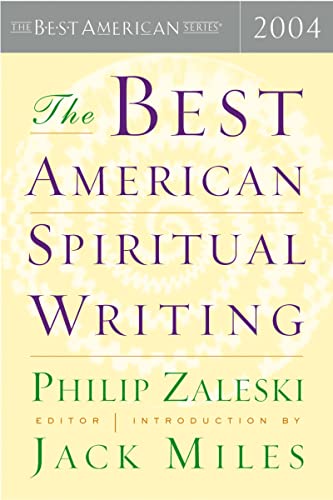
The latest addition to the esteemed Best American series is a collection of the best spiritual writing of the year, introduced by Pulitzer Prize-winning author Jack Miles and including both prose and poetry. Series editor Philip Zaleski has chosen the volume's pieces with an eye to spirituality's many guises, from its impact on personal relationships and the environment to politics, creativity, and literature. Christian, Muslim, Jewish, secular, and pan-Hindu perspectives are all represented in these pieces, which have been selected from both mainstream and more specialized periodicals.
Auszug. © Genehmigter Nachdruck. Alle Rechte vorbehalten.
The Best American Spiritual Writing 2004
By Philip ZaleskiHoughton Mifflin Company
Copyright © 2004 Philip Zaleski
All right reserved.
ISBN: 9780618443031
Introduction
"Who is the greatest in the kingdom of heaven?" And calling to him a child,
he put him in the midst of them, and said, "Truly I say to you, unless you turn
and become like children, you will never enter the kingdom of heaven.
Whoever humbles himself like this child, he is the greatest in the kingdom of
heaven."
— Matthew 18:2–4
By now the word spirituality ought not embarrass me, but like the
word mommy, it still does. Mommy has its place and, especially, its
time; but we cringe a bit, don"t we, when we hear an adult unselfconsciously
say, "Mommy phoned this morning." The word is out
of place, or past its time. Adults don"t talk that way. Or shouldn"t.
Or so we think. Perhaps adults suf?ciently serene in their adulthood
do not blush at mommy. But because spirituality is a word that I
?rst heard in a little world that shaped me as powerfully as a second
family, a world that I left behind only after a struggle, this word carries
for me some of the same baggage as mommy. The contributions
to this year"s Best Spiritual Writing are varied, authentic, engaging,
and repeatedly surprising, yet for me, I confess, they summon up
the memory of a time when spirituality and adulthood seemed antithetical.
I was introduced to spirituality at the age of fourteen as a brother
in the devotional fraternity called the sodality (from the Latin
sodalis, companion) that was a part of life at all Jesuit secondary
schools. Starting in freshman year, we sodalists were introduced to
the school of spirituality called Ignatian — techniques of prayer
and meditation developed by Ignatius Loyola, the founder of the
Society of Jesus (the Jesuits). Back in 1956, our initiation into men-
tal prayer, as the beginner"s exercise in Ignatian spirituality was then
called, began in much the same way an introduction to Pilates
training might now — that is, in a group and under the direction
of a trainer.
The ?rst step, once we had gathered in the chapel at the appointed
hour, was the recitation of one of the Roman Catholic
prayers that we all knew by heart. This in itself created a mild sense
of fraternity, relocated us, and brought us to a kind of preliminary
focus. The second step was a minute or two of silence. The third
step was the instruction "Place yourself in the presence of God,"
about which more below. The fourth step was another interlude of
silence — still brief, but a little longer than the ?rst one. The ?fth
step was the leader"s presentation in a ?ve-minute talk of a subject
suitable for meditation. A typical subject would be Christ"s prayer
during his agony in the Garden of Gethsemane: "Father, if it be
possible, let this cup pass from me, but not my will but thine be
done." The priest — the leader was always a priest on the faculty of
the school — might evoke darkness, the chill of the night, the danger,
and so forth, and direct our attention to Christ"s honesty and
his courage. Then would begin the sixth step in the exercise, the
central period of silence or mental prayer proper. Rather than asking
God for something, mental prayer was simply thinking about
something in the presence of God and awaiting what might ensue
within the mind. After the lapse of nearly ?fty years, I cannot recall
the exit formula — there was one — that was spoken after perhaps
?fteen minutes to signal the end of the central exercise. Coming
out of mental prayer felt a bit like awakening from hypnosis. Returned
to ourselves, we recited a concluding prayer in unison and
tramped out of the chapel for the rest of the school day.
What transpires in the minds of fourteen-year-old boys instructed
to place themselves in the presence of God? Twenty years
later, a friend"s son told us of a study allegedly proving that sixteen-year-
olds experience a sex-related thought every thirty seconds. My
friend was surprised. I was not. And to me, the chapel at St.
Ignatius High School was, in memory, the place where I seemed
most aware of the intervals. Yet I testify that the command "Place
yourself in the presence of God" produced a shift of consciousness
that the succession of tumescence and detumescence did not undermine.
Did we even believe in God? At one point in John Updike"s ?rst
novel, The Centaur, an inspired high school teacher is preaching —
no other verb will quite do — the grand sweep of evolution from
the Big Bang to the rise of human consciousness. The novelist directs
our attention to a boy in a back seat whose gross sex-preoccupation
seems to undercut the nobility of the lecture. But behind
the character in the novel, there broods the novelist himself.
Updike is a Christian inspired in spite of himself by this godless vision.
Were he an atheist, he would be inspired in spite of himself by
the Christian vision. The text of belief and unbelief seems so often
to read like a giant palindrome.
Rather than by the Christian vision per se, I myself was entranced
by the esprit de corps of the Jesuit order. Over a ten-year period beginning
with my eighteenth year, the Jesuits turned me into an intellectual
of sorts, but they ?rst turned me into a fellow Jesuit
through two full years of an intense initiation into Ignatian spirituality.
This was an experience that, as I would later conclude, reversed
my normal movement from adolescence to adulthood and
turned me, powerfully albeit temporarily, from an adolescent back
into a child. And though I was, to say the least, confused and embarrassed
by the reversal, I return to it in memory with a kind of
longing.
A month after entering the order, I was led through the Spiritual
Exercises of St. Ignatius — a month of silence interrupted by only a
few hours of conversation every six or seven days. For the remainder
of that two-year novitiate, I rose at ?ve every morning and meditated
in silence for an hour at a desk provided with a kneeler before
walking silently to the chapel for Mass and then from the
chapel to the refectory for a silent breakfast. My life included no
television, no radio, no newspapers or magazines, and no reading
material other than books on, what else, spirituality. All my needs
— food, shelter, clothing, health care, recreation, and companionship
— were provided for. In all those regards, I had, as never since
early childhood, literally nothing to worry about; and for long minutes
— in the chapel, for example, after the morning"s meditation
had ended but before daily Mass began — nothing to think about,
either. And I began to like it that way. Against the predictions of
some, I began to like having nothing on my mind.
Besides practicing Ignatian meditation every morning, a novice
attended more general lectures on Christian spirituality. One
learned about the history of monasticism and about the various
schools of spirituality. One read classics in the related literature.
One learned of the via purgativa, the via contemplativa, and, for the
sainted few, the via unitiva. As beginners, we were on the via
purgativa. Purgative asceticism — fasting, mild (and closely controlled)
self-?agellation, and the use of the "discipline," a kind of
barbed bracelet worn for an hour or two around...
„Über diesen Titel“ kann sich auf eine andere Ausgabe dieses Titels beziehen.