
Verwandte Artikel zu The Social Contract & Emile
Inhaltsangabe
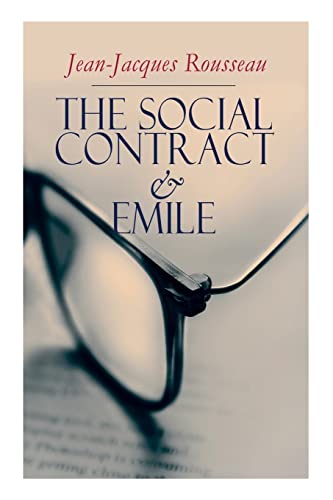
The Social Contract, originally published as On the Social Contract; or, Principles of Political Rights, is a book in which Rousseau theorized about the best way to establish a political community in the face of the problems of commercial society, which he had already identified in his Discourse on Inequality (1754). The Social Contract helped inspire political reforms or revolutions in Europe, especially in France. The Social Contract argued against the idea that monarchs were divinely empowered to legislate. Rousseau asserts that only the people, who are sovereign, have that all-powerful right. Emile, or On Education is a treatise on the nature of education and on the nature of man. Jean-Jacques Rousseau considered it to be the "best and most important" of all his writings. Due to a section of the book entitled "Profession of Faith of the Savoyard Vicar", Emile was banned in Paris and Geneva and was publicly burned in 1762, the year of its first publication. During the French Revolution, Emile served as the inspiration for what became a new national system of education.
Die Inhaltsangabe kann sich auf eine andere Ausgabe dieses Titels beziehen.
Weitere beliebte Ausgaben desselben Titels

Suchergebnisse für The Social Contract & Emile

Beispielbild für diese ISBN
The Social Contract & Emile
Anbieter: Ria Christie Collections, Uxbridge, Vereinigtes Königreich
Verkäuferbewertung 5 von 5 Sternen

Zustand: New. In. Artikel-Nr. ria9788027332052_new
Neu kaufen
EUR 16,46
EUR 13,96 Versand
Versand von Vereinigtes Königreich nach USA
Versand von Vereinigtes Königreich nach USA
Anzahl: Mehr als 20 verfügbar
Foto des Verkäufers
The Social Contract & Emile
Anbieter: moluna, Greven, Deutschland
Verkäuferbewertung 5 von 5 Sternen
Zustand: New. Artikel-Nr. 599069778
Neu kaufen
EUR 20,50
EUR 48,99 Versand
Versand von Deutschland nach USA
Versand von Deutschland nach USA
Anzahl: Mehr als 20 verfügbar
Foto des Verkäufers
The Social Contract & Emile
Verlag:
Chicago Review Press Inc DBA Indepe Apr 2019, 2019
ISBN 10: 8027332052
ISBN 13: 9788027332052
Neu
Taschenbuch
Anbieter: AHA-BUCH GmbH, Einbeck, Deutschland
Verkäuferbewertung 5 von 5 Sternen
Taschenbuch. Zustand: Neu. Neuware - The Social Contract, originally published as On the Social Contract; or, Principles of Political Rights, is a book in which Rousseau theorized about the best way to establish a political community in the face of the problems of commercial society, which he had already identified in his Discourse on Inequality (1754). The Social Contract helped inspire political reforms or revolutions in Europe, especially in France. The Social Contract argued against the idea that monarchs were divinely empowered to legislate. Rousseau asserts that only the people, who are sovereign, have that all-powerful right. Emile, or On Education is a treatise on the nature of education and on the nature of man. Jean-Jacques Rousseau considered it to be the 'best and most important' of all his writings. Due to a section of the book entitled 'Profession of Faith of the Savoyard Vicar', Emile was banned in Paris and Geneva and was publicly burned in 1762, the year of its first publication. During the French Revolution, Emile served as the inspiration for what became a new national system of education. Artikel-Nr. 9788027332052
Neu kaufen
EUR 25,63
EUR 62,84 Versand
Versand von Deutschland nach USA
Versand von Deutschland nach USA
Anzahl: 2 verfügbar