
Verwandte Artikel zu Teaching Children Compassionately: How Students and...
Teaching Children Compassionately: How Students and Teachers Can Succeed with Mutual Understanding (Nonviolent Communication Guides) - Softcover
Buch 3 von 17: Nonviolent Communication Guides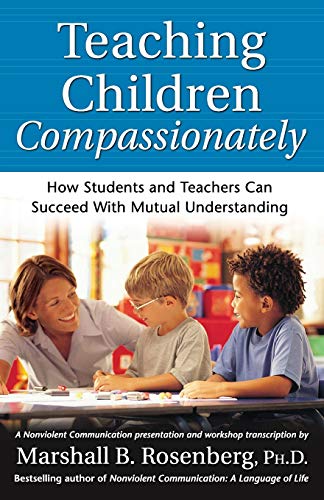
Inhaltsangabe
In this keynote address to a national conference of Montessori educators, Marshall Rosenberg describes his progressive, radical approach to teaching that centers on compassionate connection. Marshall describes the counterproductive role that power and punishment play in our schools, and challenges educators to motivate students instead "by a reverence for life." This practical application of Rosenberg's Nonviolent Communication (NVC) process offers educators the tools to create exceptional learning environments. This is an exceptional resource for teachers, school counselors, school administrators, child care providers and more!
Nonviolent Communication will help you:
- Maximize the individual potential of all students
- Improve trust and connection in your classroom community
- Strengthen student interest, retention and connection to their work
- Find cooperation without using demands
- Improve classroom teamwork, efficiency and results
Nonviolent Communication will help you:
- Maximize the individual potential of all students
- Improve trust and connection in your classroom community
- Strengthen student interest, retention and connection to their work
- Find cooperation without using demands
- Improve classroom teamwork, efficiency and results
Die Inhaltsangabe kann sich auf eine andere Ausgabe dieses Titels beziehen.
Über die Autorin bzw. den Autor
Marshall Rosenberg, Ph.D. (1934&;2015), was the founder and educational director of the Center for Nonviolent Communication (CNVC). He travelled throughout the world mediating conflict and promoting peace.
Auszug. © Genehmigter Nachdruck. Alle Rechte vorbehalten.
Teaching Children Compassionately
How Students and Teachers Can Succeed With Mutual Understanding
By Marshall B. RosenbergPuddleDancer Press
Copyright © 2005 PuddleDancer Press
All rights reserved.
ISBN: 978-1-892005-11-3All rights reserved.
Contents
Language of the Heart,
A Heart-to-Heart Talk,
How You Can Use the NVC Process,
Some Basic Feelings and Needs We All Have,
About PuddleDancer Press,
About CNVC and NVC,
Trade Books from PuddleDancer Press,
Trade Booklets from PuddleDancer Press,
CHAPTER 1
Language of the Heart
* * *
Introduction
The following is excerpted from a 1999 Keynote Address to the National Conference of Montessori Educators, given by Marshall Rosenberg in San Diego, California. In it he describes the basic features of Nonviolent Communication (NVC), and offers illustrations of how they might be used in school, at work, and in everyday life. In particular, Marshall describes the language of giraffes and jackals, the vocabulary of feelings and needs, the difference between observation and evaluation and between requests and demands, the role of power, punishment, and the vital skill of Empathic connection.
In many countries, Nonviolent Communication is popularly known as "Giraffe Language." Marshall picked the Giraffe, the land animal with the largest heart, as a symbol for NVC, a language that inspires compassion and joyful relationships in all areas of life. As a language that stresses the expression of feelings and needs, NVC invites vulnerability and transforms it into strength.
Marshall often uses a Jackal puppet to represent that part of ourselves that thinks, speaks, or acts in ways that disconnect us from our awareness of our feelings and needs, as well as the feelings and needs of others. "Jackal" language makes it very hard for a person who uses it to get the connection they want with others, making life much less wonderful than it otherwise could be. The NVC practice is to recognize and befriend "Jackals" by receiving those less-than-life-enriching thoughts and habits compassionately — and free from moral judgment — while we retrain ourselves to experience life in increasingly more wonderful ways. In this booklet, the word Giraffe is used interchangeably with NVC — and may also refer to a practitioner of NVC — while Jackal refers to thinking and speaking in ways that do not reflect the practices of NVC.
* * *
On Jackals and Giraffes
This is a great thrill for me to be here today and share some ideas with you. I'm glad to do it to give something back, because I'm very grateful for what my children received from Montessori education. They received many gifts. One of the gifts they received was to be exposed at a very young age to other languages. And I don't think it's accidental that as a result of that, my oldest son is now head of a language program teaching English as a Second Language in Sao Paulo, Brazil, and my youngest son is now about to get his doctorate in Spanish, and will accompany me next month when we begin a new project in Colombia, as my translator. So it's a great joy for me to share with you some things that I hope will contribute to your teaching and your personal lives as well.
I'm interested in learning that's motivated by reverence for life, that's motivated by a desire to learn skills, to learn new things that help us to better contribute to our own well-being and the well-being of others.
And what fills me with great sadness is any learning that I see motivated by coercion. By coercion I mean the following: Any student that's learning anything out of a fear of punishment, out of a desire for rewards in the form of grades, to escape guilt or shame, or out of some vague sense of "ought" or "must" or "should." Learning is too precious, I believe, to be motivated by any of these coercive tactics.
So I have been interested in studying those people that have the ability to influence people to learn, but learning again that is motivated by this reverence for life, and not out of some coercive tactics.
And one of the things that I've found by studying such people is that they spoke a language that helps people to learn motivated by reverence for life.
As I've studied people who have this ability, I've noticed that they spoke a different language than the language that I was educated to speak. And this language that contributes to helping people learn by reverence for life I call, officially, Nonviolent Communication. But for fun and teaching purposes I like calling it "Giraffe Language."
Unfortunately, giraffe language is not the language that I was educated to speak. I did not go to Montessori schools. I went to "jackal" schools. And in jackal schools, as you might guess, the teachers spoke the language of jackal, not the language of giraffe. I hope none of you have ever heard the language of jackal. I wish it were outlawed in all schools throughout the world, but the teachers at the schools I went to spoke jackal.
So let me give you an idea of what a jackal-speaking teacher sounds like. Let's imagine that you are my students and I'm the teacher, and I happen to observe one of you doing something that's not in harmony with my values. I see you sitting at your seat, and instead of doing what I'm asking the class to do, you're drawing a picture of me with a knife in my back and blood spurting out.
Now, how do I evaluate you if I am a jackal-speaking teacher? It's obvious: You're emotionally disturbed. This is how jackal-speaking people have been trained to think. When there is a conflict, they think in terms of what is wrong with the person who's behaving in a way that is in conflict with their values.
Or let's say that you don't understand something I've said. "You're a slow learner." But what if you say some things that I don't understand? "You're rude and socially inappropriate."
What if I speak so rapidly you can't follow me? "You have an auditory problem." What if you speak so rapidly I can't follow you? "You have an articulation problem."
So you see, jackal education is a very strange experience. Let me give you an example of what happens in jackal schools. Imagine that you are a car salesman. And you're not selling any cars. Well, you fire the customers. That might seem like a strange experience, but in the jackal schools that I went to, that's what happened. This language of jackal was the primary language used. And if you didn't measure up, you were not promoted, not rewarded, and so forth.
So I saw that the language that really helped people to teach in a way that I valued was a very different language from the language that I was educated to speak. And why did I call it giraffe language? Well, giraffes have the largest heart of any land animal. And, as I'll try to show you in our time together this morning, the language of Nonviolent Communication is a language of the heart. It requires knowing how to speak always from your heart, and since giraffes have the largest heart of any land animal, what better name for a language of the heart than "giraffe?"
Now, let me share with you this language of giraffe, or Nonviolent Communication, and I'll try to show you how it might apply in conflict resolution with students, or with other teachers or parents.
NVC requires us to be continually conscious of the beauty within ourselves and other people. There's a song I'd like to sing for you to help get us in the mood for understanding the mechanics of Nonviolent Communication....
„Über diesen Titel“ kann sich auf eine andere Ausgabe dieses Titels beziehen.
Suchergebnisse für Teaching Children Compassionately: How Students and...

Beispielbild für diese ISBN
Teaching Children Compassionately: How Students and Teachers Can Succeed with Mutual Understanding (Nonviolent Communication Guides)
Anbieter: World of Books (was SecondSale), Montgomery, IL, USA
Verkäuferbewertung 5 von 5 Sternen

Zustand: Good. Item in good condition. Textbooks may not include supplemental items i.e. CDs, access codes etc. Artikel-Nr. 00096302308
Gebraucht kaufen
EUR 3,49
Versand gratis
Versand innerhalb von USA
Versand innerhalb von USA
Anzahl: 10 verfügbar
Beispielbild für diese ISBN
Teaching Children Compassionately: How Students and Teachers Can Succeed with Mutual Understanding (Nonviolent Communication Guides)
Anbieter: World of Books (was SecondSale), Montgomery, IL, USA
Verkäuferbewertung 5 von 5 Sternen
Zustand: Very Good. Item in very good condition! Textbooks may not include supplemental items i.e. CDs, access codes etc. Artikel-Nr. 00098660462
Gebraucht kaufen
EUR 3,49
Versand gratis
Versand innerhalb von USA
Versand innerhalb von USA
Anzahl: 6 verfügbar
Beispielbild für diese ISBN
Teaching Children Compassionately : How Students and Teachers Can Succeed with Mutual Understanding
Anbieter: Better World Books, Mishawaka, IN, USA
Verkäuferbewertung 5 von 5 Sternen
Zustand: Good. Pages intact with minimal writing/highlighting. The binding may be loose and creased. Dust jackets/supplements are not included. Stock photo provided. Product includes identifying sticker. Better World Books: Buy Books. Do Good. Artikel-Nr. 5806053-6
Gebraucht kaufen
EUR 6,04
Versand gratis
Versand innerhalb von USA
Versand innerhalb von USA
Anzahl: 1 verfügbar
Beispielbild für diese ISBN
Teaching Children Compassionately : How Students and Teachers Can Succeed with Mutual Understanding
Anbieter: Better World Books: West, Reno, NV, USA
Verkäuferbewertung 5 von 5 Sternen
Zustand: Good. Pages intact with minimal writing/highlighting. The binding may be loose and creased. Dust jackets/supplements are not included. Stock photo provided. Product includes identifying sticker. Better World Books: Buy Books. Do Good. Artikel-Nr. 5806053-6
Gebraucht kaufen
EUR 6,04
Versand gratis
Versand innerhalb von USA
Versand innerhalb von USA
Anzahl: 1 verfügbar
Beispielbild für diese ISBN
Teaching Children Compassionately : How Students and Teachers Can Succeed with Mutual Understanding
Anbieter: Better World Books, Mishawaka, IN, USA
Verkäuferbewertung 5 von 5 Sternen
Zustand: Good. Former library copy. Pages intact with minimal writing/highlighting. The binding may be loose and creased. Dust jackets/supplements are not included. Includes library markings. Stock photo provided. Product includes identifying sticker. Better World Books: Buy Books. Do Good. Artikel-Nr. GRP70924409
Gebraucht kaufen
EUR 6,04
Versand gratis
Versand innerhalb von USA
Versand innerhalb von USA
Anzahl: 1 verfügbar
Beispielbild für diese ISBN
Teaching Children Compassionately : How Students and Teachers Can Succeed with Mutual Understanding
Anbieter: Better World Books, Mishawaka, IN, USA
Verkäuferbewertung 5 von 5 Sternen
Zustand: Very Good. Pages intact with possible writing/highlighting. Binding strong with minor wear. Dust jackets/supplements may not be included. Stock photo provided. Product includes identifying sticker. Better World Books: Buy Books. Do Good. Artikel-Nr. 4204716-6
Gebraucht kaufen
EUR 6,04
Versand gratis
Versand innerhalb von USA
Versand innerhalb von USA
Anzahl: 1 verfügbar
Beispielbild für diese ISBN
Teaching Children Compassionately: How Students and Teachers Can Succeed with Mutual Understanding
Anbieter: ThriftBooks-Atlanta, AUSTELL, GA, USA
Verkäuferbewertung 5 von 5 Sternen
Paperback. Zustand: Very Good. No Jacket. May have limited writing in cover pages. Pages are unmarked. ~ ThriftBooks: Read More, Spend Less. Artikel-Nr. G1892005115I4N00
Gebraucht kaufen
EUR 6,07
Versand gratis
Versand innerhalb von USA
Versand innerhalb von USA
Anzahl: 1 verfügbar
Beispielbild für diese ISBN
Teaching Children Compassionately: How Students and Teachers Can Succeed with Mutual Understanding
Anbieter: ThriftBooks-Dallas, Dallas, TX, USA
Verkäuferbewertung 5 von 5 Sternen
Paperback. Zustand: As New. No Jacket. Pages are clean and are not marred by notes or folds of any kind. ~ ThriftBooks: Read More, Spend Less. Artikel-Nr. G1892005115I2N00
Gebraucht kaufen
EUR 6,07
Versand gratis
Versand innerhalb von USA
Versand innerhalb von USA
Anzahl: 1 verfügbar
Beispielbild für diese ISBN
Teaching Children Compassionately: How Students and Teachers Can Succeed with Mutual Understanding
Anbieter: ThriftBooks-Dallas, Dallas, TX, USA
Verkäuferbewertung 5 von 5 Sternen
Paperback. Zustand: Good. No Jacket. Pages can have notes/highlighting. Spine may show signs of wear. ~ ThriftBooks: Read More, Spend Less. Artikel-Nr. G1892005115I3N00
Gebraucht kaufen
EUR 6,07
Versand gratis
Versand innerhalb von USA
Versand innerhalb von USA
Anzahl: 1 verfügbar
Beispielbild für diese ISBN
Teaching Children Compassionately: How Students and Teachers Can Succeed with Mutual Understanding
Anbieter: ThriftBooks-Dallas, Dallas, TX, USA
Verkäuferbewertung 5 von 5 Sternen
Paperback. Zustand: Very Good. No Jacket. May have limited writing in cover pages. Pages are unmarked. ~ ThriftBooks: Read More, Spend Less. Artikel-Nr. G1892005115I4N00
Gebraucht kaufen
EUR 6,07
Versand gratis
Versand innerhalb von USA
Versand innerhalb von USA
Anzahl: 1 verfügbar