
Sailor's Start-Up: A Beginner's Guide to Sailing (Start-Up Sports) - Softcover
Buch 3 von 11: Start-Up Sports series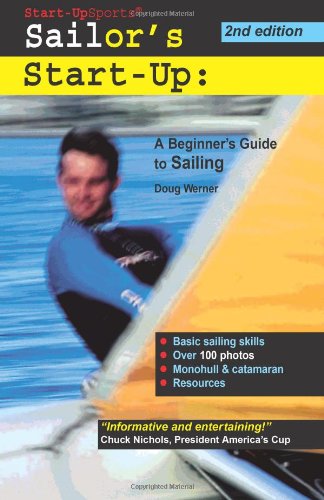
Inhaltsangabe
This beginner&;s sailing instructional guide covers both monohull and catamaran sailing with an emphasis on basic technique, safety, and fun. Skipping complicated sailing jargon that can stymie most novices, this book goes straight to the very basic questions, such as How do I leave the dock? and Where are the brakes? Technique and simple theory are illustrated in plain detail, including the basic physics behind sailing in all four directions.
Die Inhaltsangabe kann sich auf eine andere Ausgabe dieses Titels beziehen.
Über die Autorin bzw. den Autor
Doug Werner is the author of the 13 books in the Start-Up Sports series, which includes In-Line Skater&;s, Bowler&;s, Golfer&;s, Fencer&;s, Boxer&;s, Backpacker&;s, and Skateboarder&;s Start-Up. He lives in San Diego, California.
Auszug. © Genehmigter Nachdruck. Alle Rechte vorbehalten.
Sailor's Start-Up
A Beginner's Guide to Sailing
By Doug Werner, Craig McClainTracks Publishing
Copyright © 2001 Doug Werner
All rights reserved.
ISBN: 978-1-884654-01-5All rights reserved.
Contents
Title Page,
Copyright Page,
Dedication,
Acknowledgements:,
Preface: Joy,
Introduction: A place to begin,
Chapter 1: What to wear,
Chapter 2: The right boat,
Chapter 3: Parts,
Chapter 4: Conditions,
Chapter 5: Classwork,
Chapter 6: Launch!,
Chapter 7: On a reach,
Chapter 8: Downwind sailing,
Chapter 9: Upwind sailing,
Chapter 10: Docking,
Chapter 11: Rules of the road,
Chapter 12: Physics,
Chapter 13: Rigging and knots,
Chapter 14: Safety,
Chapter 15: Bligh syndrome,
Chapter 16: Catamarans,
Chapter 17: Tacking in a cat,
Chapter 18: How cats go,
Glossary,
Resources,
Bibliography,
About the author,
CHAPTER 1
What to wear
The boat you should be in will not tip over easily so you needn't worry about getting wet. Dress like you would if you were just strolling the water's edge — warm or cool enough so that you're comfortable.
Hat with visor or brim
The sun is bad news. If you're thinning on top, caps are a must.
Sunglasses
Unless you enjoy viewing the waterscape in a white-out with a headache, wear eye protection — with a strap.
Sunscreen
The water magnifies sunny conditions.
Sneakers
You'll be scrambling so something with a grip is required.
Life preservers
This is the law. One for each sailor. Not necessarily worn but in the boat.
As you progress and try tippier boats you will capsize. You'll need to consider wet suits or dry suits in cooler water and weather — but that's later.
CHAPTER 2The right boat
One of the major factors involved in happy beginnings.
Sailboats are like cars, computers and portable heaters — there are a billion makes and models. What makes sailboats different is that boat builders have had 2,000 years or so to refine the confusion.
But the right boat for you is easy to describe and easy to find. I suggest a 14 — foot monohull. Monohull means one hull, as opposed to two (or three), like a catamaran. It's a model that's available most places that have sailing. They are built by several different manufacturers the world over.
These boats are big enough for up to four people, yet quite manageable for one. The common version is wide and steady (it won't capsize easily), simple to rig and easy to handle. They are also relatively inexpensive and reliable (they last forever). In short, they're a good, basic sailboat for all levels of expertise.
Stay away from anything much bigger. There's usually more stuff to confuse and they can be intimidating. It's less frightening to feel out of control on a 14 — foot boat than a 22 — foot boat.
Smaller boats are OK but avoid the tippy ones. Certain models may seem dorky or too cramped for adults. You want something that's comfy enough to spend some time in, steady enough that you can concentrate on your sailing, and dry enough that you don't have to worry about getting wet.
Learn the basics in a monohull. Catamarans are sexy but a bit tricky. Learn how to walk, then you can fly. Mind you, this is a vast simplification of what's what in sailboats — but simple is good for now.
Rent
Find a place that rents. That way all you have to do is show up in your yachting ensemble. No trailers, no ramps, no parking your boat in the alley. Buy when you know more and you're sure you want to try backing boat and trailer into the garage.
CHAPTER 3Parts
This is your boat
Sailboats are simple once you get down to basics.
Sails
Every sailboat has at least one sail. Our boat has two — a big one called a mainsail and a little one called a jib. A boat with this configuration is called a sloop. The way sails work is interesting, but we'll get into theory later.
Why two sails? More sail means more area for the wind, which means faster sailing. You don't need two sails. Just make sure you have one.
Mast
And every sailboat has one of these. It holds up the sails.
Boom
This is the wooden or metal beam attached to the mast and the bottom of the mainsail. It stabilizes the sail. It's called a boom because it swings back and forth when you turn. If it hits you, it goes boom!
Sheets
Not the billowy part of the sails. Strangely enough, this is the name for the ropes attached to the sails. The sheets allow you to adjust the tension in the sails, which in turn helps adjust the speed of your boat. The mainsheet sprouts from a swivel gizmo (cleat) in the middle and bottom of the hull. The jib has two sheets, angling in from cleats on either side of the boat.
Cleats
The gizmos that tie down the sheets have teeth that always let you pull in. The teeth prevent the sails from pulling out. A yank up or down frees the sheet. A yank the other way sets the teeth.
Daggerboard or centerboard
This is the thing jutting out from underneath the boat. If it pops in and out, it's called a daggerboard. If it pivots, it's called a centerboard. Both serve the same functions. They stabilize the craft and play a major role in the physics of sailing. Just remember you need one or the other.
Tiller and rudder
The tiller is your steering wheel and the rudder acts as your tires. You hold on to the tiller which is attached to the rudder. The rudder is the part in the water. Push or pull one way and you turn in the opposite direction. Don't even try to visualize it. Once you get out there it'll come together without much thought.
Hull
The boat part of the boat.
Luff
Believe it or not, there are up to a dozen parts to a sail. For now just commit this to memory: The luff is the leading edge of the jib and mainsails. The luff indicates sail tension.
Telltails and shrouds
Telltails are strips of fabric attached to the sails or to the shrouds on either side of the boat. They indicate wind direction. Shrouds are the wires that hold up the mast.
Bow
The front of the boat.
Stern
The back of the boat.
Port
As you face forward inside your boat, this is the left side.
Starboard
The right side.
You know, even if someone had an explanation for these last two terms (I refuse to research it) there is little defense for the use of these words. I can't think of any other human endeavor that deliberately confuses the left and right. I mean, this is ridiculous! Along with green pasta, detergent commercials and California's incomprehensible sales tax laws.
No sheet! or Introducing The Code
Grab the sheet! he shouted as our boat headed into the first leg of the race.
I was along for fun, in a "fun" race, although I knew nothing about sailing and less about sailing terminology — as I was about to prove.
We were tacking around the first marker and the boom had just swung around. Sails were flapping and...
„Über diesen Titel“ kann sich auf eine andere Ausgabe dieses Titels beziehen.
Weitere beliebte Ausgaben desselben Titels

Suchergebnisse für Sailor's Start-Up: A Beginner's Guide to Sailing...

Beispielbild für diese ISBN
Sailor's Start-Up : A Beginner's Guide to Sailing
Anbieter: Better World Books, Mishawaka, IN, USA
Verkäuferbewertung 5 von 5 Sternen

Zustand: Good. Second edition. Former library copy. Pages intact with minimal writing/highlighting. The binding may be loose and creased. Dust jackets/supplements are not included. Includes library markings. Stock photo provided. Product includes identifying sticker. Better World Books: Buy Books. Do Good. Artikel-Nr. 45900704-6
Gebraucht kaufen
EUR 7,09
Versand gratis
Versand innerhalb von USA
Versand innerhalb von USA
Anzahl: 1 verfügbar