
Verwandte Artikel zu Geometric Algebra for Computer Graphics
Inhaltsangabe
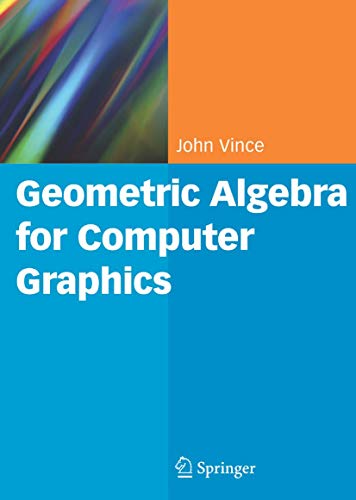
The author tackles this complex subject of Geometric algebra (a Clifford Algebra) with inimitable style, and provides an accessible and very readable introduction. The book is filled with lots of clear examples and is very well illustrated.
Die Inhaltsangabe kann sich auf eine andere Ausgabe dieses Titels beziehen.
Über die Autorin bzw. den Autor
Professor John Vince began working in computer graphics at Middlesex Polytechnic in 1968. His research activities centered on computer animation software and resulted in the PICASO and PRISM animation systems. Whilst at Middlesex, he designed the UK's first MSc course in Computer Graphics and developed a popular program of short courses in computer animation for television designers. In 1986 he joined Rediffusion Simulation as a Research Consultant and worked on the development of real-time computer systems for commercial flight simulators. In 1992 he was appointed Chief Scientist of Thomson Training Simulation Ltd. In 1995 he was appointed Professor of Digital Media at the National Centre for Computer Animation at Bournemouth University and in 1999 he was made Head of Academic Group for Computer Animation. He was awarded a DSc by Brunel University in recognition of his work in computer graphics. He has written and edited over 45 books on computer graphics, computer animation, computer science and virtual reality, including the following Springer titles: ¿ Calculus for Computer Graphics, 2nd edition (2019) ¿ Mathematics for Computer Graphics, 5th edition (2017) ¿ Imaginary Mathematics for Computer Science, (2018) ¿ Foundation Mathematics for Computer Science, 2nd edition (2015) ¿ Matrix Transforms for Computer Games and Animation (2012) ¿ Expanding the Frontiers of Visual Analytics and Visualization (2012) ¿ Quaternions for Computer Graphics (2011) ¿ Rotation Transforms for Computer Graphics (2011) ¿ Geometric Algebra: An Algebraic System for Computer Animation and Games (2009) ¿ Geometric Algebra for Computer Graphics (2008)
Von der hinteren Coverseite
Since its invention, geometric algebra has been applied to various branches of physics such as cosmology and electrodynamics, and is now being embraced by the computer graphics community where it is providing new ways of solving geometric problems. It took over two thousand years to discover this algebra, which uses a simple and consistent notation to describe vectors and their products.
John Vince (best-selling author of a number of books including ‘Geometry for Computer Graphics’ and ‘Vector Analysis for Computer Graphics’) tackles this new subject in his usual inimitable style, and provides an accessible and very readable introduction.
The first five chapters review the algebras of real numbers, complex numbers, vectors, and quaternions and their associated axioms, together with the geometric conventions employed in analytical geometry. As well as putting geometric algebra into its historical context, John Vince provides chapters on Grassmann’s outer product and Clifford’s geometric product, followed by the application of geometric algebra to reflections, rotations, lines, planes and their intersection. The conformal model is also covered, where a 5D Minkowski space provides an unusual platform for unifying the transforms associated with 3D Euclidean space.
Filled with lots of clear examples and useful illustrations, this compact book provides an excellent introduction to geometric algebra for computer graphics.
„Über diesen Titel“ kann sich auf eine andere Ausgabe dieses Titels beziehen.
Suchergebnisse für Geometric Algebra for Computer Graphics

Beispielbild für diese ISBN
Geometric Algebra for Computer Graphics
Anbieter: Ria Christie Collections, Uxbridge, Vereinigtes Königreich
Verkäuferbewertung 5 von 5 Sternen

Zustand: New. In English. Artikel-Nr. ria9781849966979_new
Neu kaufen
EUR 67,02
EUR 13,13 Versand
Versand von Vereinigtes Königreich nach USA
Versand von Vereinigtes Königreich nach USA
Anzahl: Mehr als 20 verfügbar
Foto des Verkäufers
Geometric Algebra for Computer Graphics
Anbieter: AHA-BUCH GmbH, Einbeck, Deutschland
Verkäuferbewertung 5 von 5 Sternen
Taschenbuch. Zustand: Neu. Druck auf Anfrage Neuware - Printed after ordering - Geometric algebra (a Clifford Algebra) has been applied to different branches of physics for a long time but is now being adopted by the computer graphics community and is providing exciting new ways of solving 3D geometric problems.John Vince (author of numerous books including 'Geometry for Computer Graphics' and 'Vector Analysis for Computer Graphics') has tackled this complex subject in his usual inimitable style, and provided an accessible and very readable introduction.As well as putting geometric algebra into its historical context, John tackles complex numbers and quaternions; the nature of wedge product and geometric product; reflections and rotations (showing how geometric algebra can offer a powerful way of describing orientations of objects and virtual cameras); and how to implement lines, planes, volumes and intersections. Introductory chapters also look at algebraic axioms, vector algebra and geometric conventions and the book closes with a chapter on how the algebra is applied to computer graphics. Artikel-Nr. 9781849966979
Neu kaufen
EUR 90,04
EUR 35,00 Versand
Versand von Deutschland nach USA
Versand von Deutschland nach USA
Anzahl: 1 verfügbar
Foto des Verkäufers
Geometric Algebra for Computer Graphics
Anbieter: preigu, Osnabrück, Deutschland
Verkäuferbewertung 5 von 5 Sternen
Taschenbuch. Zustand: Neu. Geometric Algebra for Computer Graphics | John Vince | Taschenbuch | xvi | Englisch | 2010 | Springer | EAN 9781849966979 | Verantwortliche Person für die EU: Springer Verlag GmbH, Tiergartenstr. 17, 69121 Heidelberg, juergen[dot]hartmann[at]springer[dot]com | Anbieter: preigu. Artikel-Nr. 107124376
Neu kaufen
EUR 74,60
EUR 70,00 Versand
Versand von Deutschland nach USA
Versand von Deutschland nach USA
Anzahl: 5 verfügbar