
Verwandte Artikel zu Just One Thing: Developing A Buddha Brain One Simple...
Inhaltsangabe
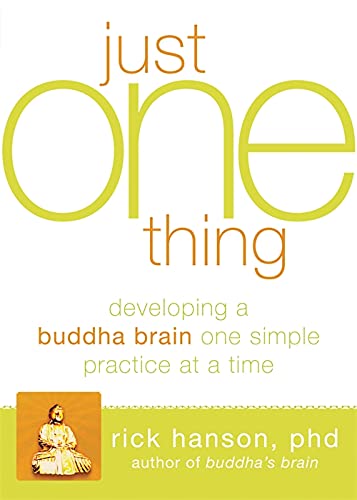
50 simple exercises for increased happiness, positive thinking and wisdom from the bestselling author of The Buddha's Brain.
Die Inhaltsangabe kann sich auf eine andere Ausgabe dieses Titels beziehen.
Über die Autorin bzw. den Autor
Rick Hanson, PhD, is a neuropsychologist, founder of the Wellspring Institute for Neuroscience and Contemplative Wisdom, and author of Buddha's Brain. His work has been featured on the BBC and NPR, and he has been invited to present at Oxford, University of California Berkeley, Stanford University, and other universities.
Von der hinteren Coverseite
You've heard the expression, "It's the little things that count." Research has shown that little daily practices can change the way your brain works, too. This book offers simple brain-training practices you can do every day to protect against stress, lift your mood, and find greater emotional resilience. "Just One Thing" is a treasure chest of over fifty practices created specifically to deepen your sense of well-being and unconditional happiness.
Just one practice each day can help you: Be good to yourselfEnjoy life as it isBuild on your strengthsBe more effective at home and workMake peace with your emotions
Auszug. © Genehmigter Nachdruck. Alle Rechte vorbehalten.
introduction
Using Your Mind to Change Your BrainThis is a book of practices'simple things you can do routinely, mainly inside your mind, that will support and increase your sense of security and worth, resilience, effectiveness, well-being, insight, and inner peace. For example, they include taking in the good, protecting your brain, feeling safer, relaxing anxiety about imperfection, not knowing, enjoying your hands, taking refuge, and filling the hole in your heart.
At first glance, you may be tempted to underestimate the power of these seemingly simple practices. But they will gradually change your brain through what's called experience-dependent neuroplasticity.
Moment to moment, whatever you're aware of'sounds, sensations, thoughts, or your most heartfelt longings'is based on underlying neural activities; the same goes for unconscious mental processes such as the consolidation of memory or the control of breathing. Exactly how the physical brain produces nonphysical consciousness remains a great mystery. But apart from the possible influence of transcendental factors'call them God, Spirit, the Ground, or by no name at all'there is a one-to-one mapping between mental and neural activities.
It's a two-way street: as your brain changes, your mind changes; and as your mind changes, your brain changes. This means'remarkably'that what you pay attention to, what you think and feel and want, and how you work with your reactions to things all sculpt your brain in multiple ways:
•Busy regions get more blood flow, since they need more oxygen and glucose.•The genes inside neurons get more or less active; for example, people who routinely relax have improved expression of genes that calm down stress reactions, making them more resilient (Dusek et al. 2008).
•Neural connections that are relatively inactive wither away; it's a kind of neural Darwinism, the survival of the busiest: use it or lose it.
•"Neurons that fire together, wire together." This saying from the work of the psychologist Donald Hebb means that active synapses'the connections between neurons'get more sensitive, plus new synapses grow, producing thicker neural layers. For example, cab drivers who have to memorize the spaghetti snarl of streets in London have a thicker hippocampus'a part of the brain that helps make visual-spatial memories'at the end of their training (Maguire et al. 2000). Similarly, people who routinely practice mindfulness meditation develop thicker layers of neurons in the insula'a region that activates when you tune in to your body and your feelings'and in parts of the prefrontal cortex (in the front of your brain) that control attention (Lazar et al. 2005).
The details are complex, but the key point is simple: how you use your mind changes your brain'for better or worse.
There's a traditional saying that the mind takes the shape it rests upon; the modern update is that the brain takes the shape the mind rests upon. For instance, you regularly rest your mind upon worries, self-criticism, and anger, then your brain will gradually take the shape'will develop neural structures and dynamics'of anxiety, low sense of worth, and prickly reactivity to others. On the other hand, if you regularly rest your mind upon, for example, noticing you're all right right now, seeing the good in yourself, and letting go'three of the practices in this book'then your brain will gradually take the shape of calm strength, self-confidence, and inner peace.
You can't stop your brain from changing. The only question is: Are you getting the changes you want?
All It Takes Is PracticeThat's where practice comes in, which simply means taking regular action'in thought, word, or deed'to increase positive qualities in yourself and decrease negative ones. For example, studies have shown that being mindful (chapter 22) increases activation of the left prefrontal cortex and thus lifts mood (since that part of the brain puts the brakes on negative emotions) (Davidson 2004), and it decreases activation of the amygdala, the alarm bell of the brain (Stein, Ives-Deliperi, and Thomas 2008). Similarly, having compassion for yourself (chapter 3) builds up resilience and lowers negative rumination (Leary et al. 2007).
Basically, practice pulls weeds and plants flowers in the garden of your mind'and thus in your brain. That improves your garden, plus it makes you a better gardener: you get more skillful at directing your attention, thinking clearly, managing your feelings, motivating yourself, getting more resilient, and riding life's roller-coaster.
Practice also has built-in benefits that go beyond the value of the particular practice you're doing. For example, doing any practice is an act of kindness toward yourself; you're treating yourself like you matter'which is especially important and healing if you have felt as a child or an adult that others haven't respected or cared about you. Further, you're being active rather than passive'which increases optimism, resilience, and happiness, and reduces the risk of depression. At a time when people often feel pushed by external forces'such as financial pressures, the actions of others, or world events'and by their reactions to these, it's great to have at least some part of your life where you feel like a hammer instead of a nail.
Ultimately, practice is a process of personal transformation, gradually pulling the roots of greed, hatred, heartache, and delusion'broadly defined'and replacing them with contentment, peace, love, and clarity. Sometimes this feels like you're making changes inside yourself, and at other times it feels like you're simply uncovering wonderful, beautiful things that were always already there, like your natural wakefulness, goodness, and loving heart.
Either way, you're in the process of developing what one could call a "buddha brain," a brain that understands, profoundly, the causes of suffering and its end'for the root meaning of the word "buddha," is "to know, to awake." (I'm not capitalizing that word here in order to distinguish my general focus from the specific individual, the great teacher called the Buddha.) In this broad sense, anyone engaged in psychological growth or spiritual practice'whether Christian, Jewish, Muslim, Hindu, agnostic, atheist, or none of these'is developing a buddha brain and its related qualities of compassion, virtue, mindfulness, and wisdom.
The Law of Little ThingsNow, if a practice is a hassle, most people (including me) are not going to do it. So the practices in this book involve either brief actions a few times a day'like finding beauty (chapter 17)'or simply a general attitude or perspective, such as relaxing anxiety about imperfection (chapter 46) or not taking life so personally (chapter 48).
Each moment of practice is usually small in itself, but those moments really add up. It's the law of little things: because of slowly accumulating changes in neural structure due to mental activity, lots of little things can wear down your well-being'and lots of little things can get you to a better place. It's like exercise: any single time you run, do Pilates, or lift weights won't make much difference'but over time, you'll build up your muscles. In the same way, small efforts made routinely will gradually build up the "muscle" of your brain. You really can have confidence, grounded in the latest brain science, that practice will pay off.
How to Use This BookBut you have to stick with it'so it really helps to focus on one main practice at a time. Life these days is so busy and complicated that it's great to have just one thing to keep in mind.
Of course, it's got to be the right...
„Über diesen Titel“ kann sich auf eine andere Ausgabe dieses Titels beziehen.
Suchergebnisse für Just One Thing: Developing A Buddha Brain One Simple...

Beispielbild für diese ISBN
Just One Thing: Developing A B
Verlag:
New Harbinger Publications, 2011
ISBN 10: 1608820319
ISBN 13: 9781608820313
Gebraucht
Softcover
Anbieter: World of Books (was SecondSale), Montgomery, IL, USA
Verkäuferbewertung 5 von 5 Sternen

Zustand: Acceptable. Item in acceptable condition! Textbooks may not include supplemental items i.e. CDs, access codes etc. Artikel-Nr. 00094147495
Gebraucht kaufen
EUR 3,66
Versand gratis
Versand innerhalb von USA
Versand innerhalb von USA
Anzahl: 2 verfügbar
Beispielbild für diese ISBN
Just One Thing: Developing A Buddha Brain One Simple Practice at a Time
Verlag:
New Harbinger Publications, 2011
ISBN 10: 1608820319
ISBN 13: 9781608820313
Gebraucht
Paperback
Anbieter: World of Books (was SecondSale), Montgomery, IL, USA
Verkäuferbewertung 5 von 5 Sternen
Paperback. Zustand: Very Good. 50 simple exercises for increased happiness, positive thinking and wisdom from the bestselling author of The Buddha's Brain. Artikel-Nr. 00100481502
Gebraucht kaufen
EUR 3,66
Versand gratis
Versand innerhalb von USA
Versand innerhalb von USA
Anzahl: 17 verfügbar
Beispielbild für diese ISBN
Just One Thing: Developing A Buddha Brain One Simple Practice at a Time
Verlag:
New Harbinger Publications, 2011
ISBN 10: 1608820319
ISBN 13: 9781608820313
Gebraucht
Paperback
Anbieter: World of Books (was SecondSale), Montgomery, IL, USA
Verkäuferbewertung 5 von 5 Sternen
Paperback. Zustand: Good. 50 simple exercises for increased happiness, positive thinking and wisdom from the bestselling author of The Buddha's Brain. Artikel-Nr. 00098249460
Gebraucht kaufen
EUR 3,66
Versand gratis
Versand innerhalb von USA
Versand innerhalb von USA
Anzahl: Mehr als 20 verfügbar
Beispielbild für diese ISBN
Just One Thing: Developing a Buddha Brain One Simple Practice at a Time
Verlag:
New Harbinger Publications, 2011
ISBN 10: 1608820319
ISBN 13: 9781608820313
Gebraucht
Paperback
Anbieter: ThriftBooks-Atlanta, AUSTELL, GA, USA
Verkäuferbewertung 5 von 5 Sternen
Paperback. Zustand: Good. No Jacket. Pages can have notes/highlighting. Spine may show signs of wear. ~ ThriftBooks: Read More, Spend Less. Artikel-Nr. G1608820319I3N00
Gebraucht kaufen
EUR 5,87
Versand gratis
Versand innerhalb von USA
Versand innerhalb von USA
Anzahl: 3 verfügbar
Beispielbild für diese ISBN
Just One Thing: Developing a Buddha Brain One Simple Practice at a Time
Verlag:
New Harbinger Publications, 2011
ISBN 10: 1608820319
ISBN 13: 9781608820313
Gebraucht
Paperback
Anbieter: ThriftBooks-Atlanta, AUSTELL, GA, USA
Verkäuferbewertung 5 von 5 Sternen
Paperback. Zustand: Very Good. No Jacket. May have limited writing in cover pages. Pages are unmarked. ~ ThriftBooks: Read More, Spend Less. Artikel-Nr. G1608820319I4N00
Gebraucht kaufen
EUR 5,87
Versand gratis
Versand innerhalb von USA
Versand innerhalb von USA
Anzahl: 1 verfügbar
Beispielbild für diese ISBN
Just One Thing: Developing a Buddha Brain One Simple Practice at a Time
Verlag:
New Harbinger Publications, 2011
ISBN 10: 1608820319
ISBN 13: 9781608820313
Gebraucht
Paperback
Anbieter: ThriftBooks-Reno, Reno, NV, USA
Verkäuferbewertung 5 von 5 Sternen
Paperback. Zustand: Very Good. No Jacket. May have limited writing in cover pages. Pages are unmarked. ~ ThriftBooks: Read More, Spend Less. Artikel-Nr. G1608820319I4N00
Gebraucht kaufen
EUR 5,87
Versand gratis
Versand innerhalb von USA
Versand innerhalb von USA
Anzahl: 1 verfügbar
Beispielbild für diese ISBN
Just One Thing: Developing a Buddha Brain One Simple Practice at a Time
Verlag:
New Harbinger Publications, 2011
ISBN 10: 1608820319
ISBN 13: 9781608820313
Gebraucht
Paperback
Anbieter: ThriftBooks-Dallas, Dallas, TX, USA
Verkäuferbewertung 5 von 5 Sternen
Paperback. Zustand: Very Good. No Jacket. May have limited writing in cover pages. Pages are unmarked. ~ ThriftBooks: Read More, Spend Less. Artikel-Nr. G1608820319I4N00
Gebraucht kaufen
EUR 5,87
Versand gratis
Versand innerhalb von USA
Versand innerhalb von USA
Anzahl: 1 verfügbar
Beispielbild für diese ISBN
Just One Thing: Developing a Buddha Brain One Simple Practice at a Time
Verlag:
New Harbinger Publications, 2011
ISBN 10: 1608820319
ISBN 13: 9781608820313
Gebraucht
Paperback
Anbieter: ThriftBooks-Atlanta, AUSTELL, GA, USA
Verkäuferbewertung 5 von 5 Sternen
Paperback. Zustand: Good. No Jacket. Former library book; Pages can have notes/highlighting. Spine may show signs of wear. ~ ThriftBooks: Read More, Spend Less. Artikel-Nr. G1608820319I3N10
Gebraucht kaufen
EUR 5,87
Versand gratis
Versand innerhalb von USA
Versand innerhalb von USA
Anzahl: 1 verfügbar
Beispielbild für diese ISBN
Just One Thing: Developing a Buddha Brain One Simple Practice at a Time
Verlag:
New Harbinger Publications, 2011
ISBN 10: 1608820319
ISBN 13: 9781608820313
Gebraucht
Paperback
Anbieter: ThriftBooks-Reno, Reno, NV, USA
Verkäuferbewertung 5 von 5 Sternen
Paperback. Zustand: Good. No Jacket. Pages can have notes/highlighting. Spine may show signs of wear. ~ ThriftBooks: Read More, Spend Less. Artikel-Nr. G1608820319I3N00
Gebraucht kaufen
EUR 5,87
Versand gratis
Versand innerhalb von USA
Versand innerhalb von USA
Anzahl: 3 verfügbar
Beispielbild für diese ISBN
Just One Thing: Developing a Buddha Brain One Simple Practice at a Time
Verlag:
New Harbinger Publications, 2011
ISBN 10: 1608820319
ISBN 13: 9781608820313
Gebraucht
Paperback
Anbieter: ThriftBooks-Phoenix, Phoenix, AZ, USA
Verkäuferbewertung 5 von 5 Sternen
Paperback. Zustand: Very Good. No Jacket. May have limited writing in cover pages. Pages are unmarked. ~ ThriftBooks: Read More, Spend Less. Artikel-Nr. G1608820319I4N00
Gebraucht kaufen
EUR 5,87
Versand gratis
Versand innerhalb von USA
Versand innerhalb von USA
Anzahl: 1 verfügbar