
Verwandte Artikel zu Masters Running: A Guide To Running And Staying Fit...
Inhaltsangabe
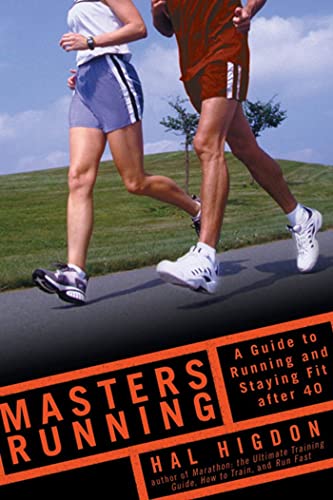
A championship runner describes the techniques and methods needed to become a competitive runner after age forty, with information on intelligent training, developing fitness and flexibility, maintaining a healthy diet, and much more. Original. 20,000 first printing.
Die Inhaltsangabe kann sich auf eine andere Ausgabe dieses Titels beziehen.
Über die Autorin bzw. den Autor
HAL HIGDON is the author of Run Fast, Marathon, and Fitness After Forty. In one of his wins, he set a world record that a quarter of a century later remains the American masters record. He lives in Long Beach, Indiana.
Auszug. © Genehmigter Nachdruck. Alle Rechte vorbehalten.
1
BEGINNINGS
It Is Easy to Improve as a Runner. All You Need to Do Is Start
At the end of my junior year at Carleton College, I traveled to California to compete in the NCAA Track and Field Championships. My focus until that time had been more on getting decent enough grades to graduate and squiring good-looking females to Saturday-night dances rather than in achieving success as an athlete. Thus, it was no surprise that I ran poorly, finishing a nonscoring ninth in the 3000-meter steeplechase. I actually finished last the next day in the 5000 meters. One week later at the National AAU Championships I predictably did no better, placing 15th in a 10,000-meter race that also served as the Olympic trials race for that distance.
Despite such poor performances, I persisted as a runner after graduation in an era when few others did. Why? Because I loved running. I loved to feel the wind in my hair. I loved not only the competitive aspects of the sport, but also the opportunity to socialize with fellow competitors and the solitude running provided: the so-called loneliness of the long-distance runner that those of us who run know is more positive than negative.
And as I continued, I improved. I trained harder, but more important, I trained smarter! Thus, at a period of life when my performances should have begun to deteriorate because of aging, I got better. My confidence in my ability to compete also improved. In my 41st year, I traveled to Europe for a series of masters track meets, "masters" being a separate competitive category for older runners. During a period of 4 days, I ran 3000-meter steeplechase and 5000-meter races at the Crystal Palace Sports Centre in London, England, and a 10,000-meter race in the Olympic Stadium in Helsinki, Finland. I came away with a pair of firsts and one fourth, but more intriguing were my fast times. One was a world masters record; the other two were American masters records. Had I run those same times 2 decades earlier, I would have won one race and placed third in two others at the same NCAA Championships where I had failed so badly as a college junior.
As the years passed, I achieved much more success as a masters runner than I had in high school or college or as an aspiring Olympian. After turning 40, I won four gold medals and five silver and bronze medals at the World Masters Championships. In one of my wins, I set a world M45 record that a quarter-century later remains the American masters record. I also ran more than 100 marathons, the 100th coming at the 100th Boston Marathon in 1996. On my 70th birthday, I set my goal as running seven marathons in 7 months and raising $700,000 for seven separate charities. I not only finished all seven marathons, but more than matched my charity goal.
Thus, if you ask me if you can succeed as a masters runner, I am going to respond with a rousing Yes!
DEFINING SUCCESS
You define your own level of success. It's not necessary to win races and break records to succeed as a masters runner. I've done both, but I take greater pride in the fact that at what to some might be considered an advanced age, I enjoy life. I look good. I feel good. If I no longer run every day, it's because I'm engaged in some other activity, whether swimming or cycling or lifting weights or attending a performance of the Chicago Symphony Orchestra. You can't attend concerts or enjoy other activities unless you're alive--and running keeps me alive. I live to run; I run to live.
Sometimes the bonuses come away from the track. While writing this book, I attended my college's fiftieth reunion. The first evening on campus my wife, Rose, and I attended a reception for the hundred or so of my classmates in attendance and our spouses. One of the women in the class approached to say hello. Her name was Jean. She had been one of the most beautiful women on campus during our 4 years on the Carleton campus in Northfield, Minnesota. And although few sports were offered for women back in that Dark Ages for female athletics, Jean had been an all-state high- school basketball player in Iowa, where girls played that game. Jean and I had dated once or twice, but the competition was pretty tough for this campus queen's attention.
Jean smiled and said to me: "You're better-looking now than you were 50 years ago, Hal." Both our spouses were standing nearby, so I accepted her statement as it was intended: a compliment to my physical fitness. And while I forgot to ask Jean if she was still playing basketball or exercising in some other way, I confess she looked pretty good, too.
Significant scientific research suggests that if we exercise regularly and follow other good health practices, we'll live longer. Epidemiologist Ralph S. Paffenbarger Jr., M.D., of the Stanford University School of Medicine, proved through his study of Harvard University alumni that those who exercised even a minimal amount (gardening, for example) lived more than 2 years longer than those who did not. That was early epidemiological research. With access to more and better data, Kenneth H. Cooper, M.D., founder of the Cooper Institute, the research arm of his medical clinic and fitness center in Dallas, Texas, now suggests that a prudent lifestyle focused on physical fitness might extend life 6 to 9 years! Whether or not we live longer, common sense suggests we can live better by becoming runners. By "better," I mean not having to spend your final years in a nursing home, a burden to your children. A comedian once joked that all runners achieve by their frantic exercising is to ensure that they will die in good health. Okay, I'll buy that.
You can't attend concerts or enjoy other activities unless you're alive-- and running can keep you alive.
Good health advantages notwithstanding, I know many of you reading these words would like to nibble a few minutes off your 5-K and 10-K times, or maybe even qualify for the Boston Marathon. I'm here to tell you how to do so.
Theoretically, improving performance should prove impossible once you near or pass the age of 40. Although people peak in terms of performance at different points of their life, research with runners suggests that most individuals approach their physical peak in their early twenties and remain near that "best" into their late thirties. After that comes a decline.
According to those who monitor performance, we all should run our fastest 5- K and 10-K times at about age 25. That's when I set personal records for those distances on the track. Ten years later at age 34, I was on the same performance plateau when I ran my fastest marathon time. But 10 years after that, at age 44, I still hadn't lost much. I was that age in Toronto when I won my first World Masters Championships in the 3000-meter steeplechase, my time less than 5 seconds slower than my all-time best from 2 decades before.
I also know masters competitors who achieved peak performances in their forties, fifties, sixties, and even seventies. Norm Green, Paul Heitzman, and Warren Utes come to mind. Of course, they started their running careers later in life, so were able to defeat the decline simply by increasing their training. Warren Utes claims never to have run a step in his life, except to catch the commuter train, until he turned 58. Ten years later, he was still improving while setting age-group records and winning world titles.
THE 30/30 PLAN
If you are a beginner who never ran a step in your life, you probably need to start gently. And even if you were a track or cross-country runner in school, but haven't run a step in 20 years, you also need to act like a beginner. In fact, you may be more at risk than the newest newbie, because you remember how you used to train and may push too hard too soon.
Here's a simple 30/30 plan to get you going, featuring 30 minutes of exercise for the first...
„Über diesen Titel“ kann sich auf eine andere Ausgabe dieses Titels beziehen.
Suchergebnisse für Masters Running: A Guide To Running And Staying Fit...

Beispielbild für diese ISBN
Masters Running: A Guide to Running and Staying Fit After 40
Anbieter: World of Books (was SecondSale), Montgomery, IL, USA
Verkäuferbewertung 5 von 5 Sternen

Zustand: Very Good. Item in very good condition! Textbooks may not include supplemental items i.e. CDs, access codes etc. Artikel-Nr. 00108027577
Gebraucht kaufen
EUR 3,99
Versand gratis
Versand innerhalb von USA
Versand innerhalb von USA
Anzahl: 1 verfügbar
Beispielbild für diese ISBN
Masters Running: A Guide to Running and Staying Fit After 40
Anbieter: World of Books (was SecondSale), Montgomery, IL, USA
Verkäuferbewertung 5 von 5 Sternen
Zustand: Acceptable. Item in acceptable condition! Textbooks may not include supplemental items i.e. CDs, access codes etc. Artikel-Nr. 00110688087
Gebraucht kaufen
EUR 3,99
Versand gratis
Versand innerhalb von USA
Versand innerhalb von USA
Anzahl: 1 verfügbar
Beispielbild für diese ISBN
Masters Running: A Guide to Running and Staying Fit After 40
Anbieter: World of Books (was SecondSale), Montgomery, IL, USA
Verkäuferbewertung 5 von 5 Sternen
Zustand: Good. Item in good condition. Textbooks may not include supplemental items i.e. CDs, access codes etc. Artikel-Nr. 00090688370
Gebraucht kaufen
EUR 3,99
Versand gratis
Versand innerhalb von USA
Versand innerhalb von USA
Anzahl: 10 verfügbar
Beispielbild für diese ISBN
Masters Running: A Guide to Running and Staying Fit After 40
Verlag:
Rodale Books (edition First Edition), 2005
ISBN 10: 1594860211
ISBN 13: 9781594860218
Gebraucht
Paperback
Erstausgabe
Anbieter: BooksRun, Philadelphia, PA, USA
Verkäuferbewertung 5 von 5 Sternen
Paperback. Zustand: Very Good. First Edition. It's a well-cared-for item that has seen limited use. The item may show minor signs of wear. All the text is legible, with all pages included. It may have slight markings and/or highlighting. Artikel-Nr. 1594860211-11-1
Gebraucht kaufen
EUR 4,57
Versand gratis
Versand innerhalb von USA
Versand innerhalb von USA
Anzahl: 1 verfügbar
Foto des Verkäufers
Masters Running: A Guide to Running and Staying Fit After 40
Anbieter: Dream Books Co., Denver, CO, USA
Verkäuferbewertung 5 von 5 Sternen
Zustand: acceptable. This copy has clearly been enjoyedâ"expect noticeable shelf wear and some minor creases to the cover. Binding is strong, and all pages are legible. May contain previous library markings or stamps. Artikel-Nr. DBV.1594860211.A
Gebraucht kaufen
EUR 5,83
Versand gratis
Versand innerhalb von USA
Versand innerhalb von USA
Anzahl: 1 verfügbar
Beispielbild für diese ISBN
Masters Running: A Guide to Running and Staying Fit After 40
Anbieter: ThriftBooks-Phoenix, Phoenix, AZ, USA
Verkäuferbewertung 5 von 5 Sternen
Paperback. Zustand: Good. No Jacket. Pages can have notes/highlighting. Spine may show signs of wear. ~ ThriftBooks: Read More, Spend Less. Artikel-Nr. G1594860211I3N00
Gebraucht kaufen
EUR 6,09
Versand gratis
Versand innerhalb von USA
Versand innerhalb von USA
Anzahl: 1 verfügbar
Beispielbild für diese ISBN
Masters Running: A Guide to Running and Staying Fit After 40
Anbieter: ThriftBooks-Reno, Reno, NV, USA
Verkäuferbewertung 5 von 5 Sternen
Paperback. Zustand: Good. No Jacket. Pages can have notes/highlighting. Spine may show signs of wear. ~ ThriftBooks: Read More, Spend Less. Artikel-Nr. G1594860211I3N00
Gebraucht kaufen
EUR 6,09
Versand gratis
Versand innerhalb von USA
Versand innerhalb von USA
Anzahl: 1 verfügbar
Beispielbild für diese ISBN
Masters Running: A Guide to Running and Staying Fit After 40
Anbieter: ThriftBooks-Dallas, Dallas, TX, USA
Verkäuferbewertung 5 von 5 Sternen
Paperback. Zustand: Very Good. No Jacket. May have limited writing in cover pages. Pages are unmarked. ~ ThriftBooks: Read More, Spend Less. Artikel-Nr. G1594860211I4N00
Gebraucht kaufen
EUR 6,10
Versand gratis
Versand innerhalb von USA
Versand innerhalb von USA
Anzahl: 1 verfügbar
Beispielbild für diese ISBN
Masters Running: A Guide to Running and Staying Fit After 40
Anbieter: ThriftBooks-Atlanta, AUSTELL, GA, USA
Verkäuferbewertung 5 von 5 Sternen
Paperback. Zustand: Good. No Jacket. Pages can have notes/highlighting. Spine may show signs of wear. ~ ThriftBooks: Read More, Spend Less. Artikel-Nr. G1594860211I3N00
Gebraucht kaufen
EUR 6,10
Versand gratis
Versand innerhalb von USA
Versand innerhalb von USA
Anzahl: 1 verfügbar
Beispielbild für diese ISBN
Masters Running: A Guide to Running and Staying Fit After 40
Anbieter: ThriftBooks-Dallas, Dallas, TX, USA
Verkäuferbewertung 5 von 5 Sternen
Paperback. Zustand: Good. No Jacket. Pages can have notes/highlighting. Spine may show signs of wear. ~ ThriftBooks: Read More, Spend Less. Artikel-Nr. G1594860211I3N00
Gebraucht kaufen
EUR 6,10
Versand gratis
Versand innerhalb von USA
Versand innerhalb von USA
Anzahl: 1 verfügbar