
Verwandte Artikel zu HR Scorecard: Linking People, Strategy, and Performance
Inhaltsangabe
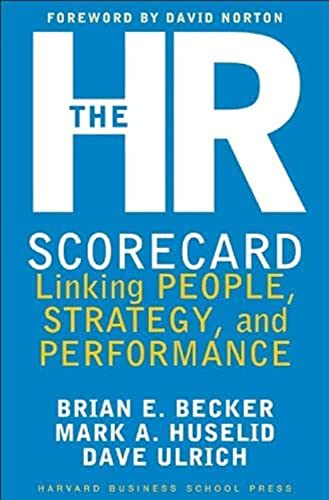
Three experts in Human Resources introduce a measurement system that convincingly showcases how HR impacts business performance.
Drawing from the authors' ongoing study of nearly 3,000 firms, this book describes a seven-step process for embedding HR systems within the firm's overall strategy—what the authors describe as an HR Scorecard—and measuring its activities in terms that line managers and CEOs will find compelling. Analyzing how each element of the HR system can be designed to enhance firm performance and maximize the overall quality of human capital, this important book heralds the emergence of HR as a strategic powerhouse in today's organizations.
Die Inhaltsangabe kann sich auf eine andere Ausgabe dieses Titels beziehen.
Über die Autorin bzw. den Autor
Mark Huselid is an Associate Professor of Human Resource Management at Rutgers University.
Brian Becker is a Professor and Department Chair of Organizations and Human Resources at the State University of New York at Buffalo.
Dave Ulrich is a Professor at the University of Michigan School of Business.
Auszug. © Genehmigter Nachdruck. Alle Rechte vorbehalten.
THE HR SCORECARD
Linking People, Strategy, and Performance
By Brian E. Becker - Mark A. Huselid - Dave Ulrich
HARVARD BUSINESS SCHOOL PRESS
Copyright © 2001 President and Fellows of Harvard College.
All rights reserved.
ISBN: 1-57851-136-4
Chapter One
HR AS A STRATEGIC PARTNER
The Measurement Challenge
How can we ensure that HR is at the table?and
not on the table?
As you begin to read this book, take a moment to reflect on your firm's human resources "architecture"?the sum of the HR function, the broader HR system, and the resulting employee behaviors. Why are these three features important? How does the HR architecture help your company to excel in the marketplace?
If your organization is like most, you're probably finding it difficult to answer these questions. In our experience, many HR management teams have a well-developed vision of their department's strategic value (at least from the perspective of HR), but the CEO and senior line managers are at best skeptical of HR's role in the firm's success. Worse, in many firms, executives want to believe that "people are our most important asset," but they just can't understand how the HR function makes that vision a reality.
What explains this situation? We believe that these problems have the same root cause: HR's influence on firm performance is difficult to measure. Consider the elements and outcomes of your firm's human resources architecture that are tracked on a regular basis. You might have included total compensation, employee turnover, cost per hire, the percentage of employees who had a performance appraisal in the last twelve months, and employee attitudes such as job satisfaction. Now consider those HR attributes that you believe are crucial to the implementation of your firm's competitive strategy. Here you might mention a capable and committed workforce, development of essential employee competencies, or a training system that helps your employees learn faster than your competitors.
How well do your existing HR measures capture the "strategic HR drivers" that you identified in your second list? For most firms there won't be a very close match. More important, even in firms where HR professionals think there is a close match, frequently the senior executives do not agree that this second list actually describes how HR creates value. In either case, there is a disconnect between what is measured and what is important.
These questions are fundamental, because new economic realities are putting pressure on HR to widen its focus from the administrative role it has traditionally played to a broader, strategic role. As the primary source of production in our economy has shifted from physical to intellectual capital, senior HR managers have come under fire to demonstrate exactly how they create value for their organizations. More important, they have been challenged to serve increasingly as strategic partners in running the business.
But what does it mean to be a strategic asset? The literature defines the term as "the set of difficult to trade and imitate, scarce, appropriable, and specialized resources and capabilities that bestow the firm's competitive advantage." Think about the difference between the ability to align every employee's efforts with the company's overall vision, and an innovative policy such as 360-degree performance appraisals. The first is a strategic capability whose cause is largely invisible to competitors; the second is a policy that, although initially innovative, is visible to competitors?and thus quickly copied. Simply put, strategic assets keep a firm's competitive edge sharp for the long haul?but by definition they are difficult to copy.
Thus HR's problem?that its impact on firm strategy is difficult to see?is the very quality that also makes it a prime source of sustainable competitive potential. But to realize this potential, human resource managers must understand the firm's strategy; that is, its plan for developing and sustaining an advantage in the marketplace. Then, they must grasp the implications of that strategy for HR. In short, they must move from a "bottom-up" perspective (emphasizing compliance and traditional HR) to a "top-down" perspective (emphasizing the implementation of strategy). Finally, they need innovative assessment systems that will let them demonstrate their influence on measures that matter to CEOs, namely, firm profitability and shareholder value.
THE EVOLVING PICTURE OF HR:
FROM PROFESSIONAL TO STRATEGIC PARTNER
Recent decades have witnessed dramatic shifts in the role of HR. Traditionally, managers saw the human resource function as primarily administrative and professional. HR staff focused on administering benefits and other payroll and operational functions and didn't think of themselves as playing a part in the firm's overall strategy.
Efforts to measure HR's influence on the firm's performance reflected this mind-set. Specifically, theorists examined methodologies and practices that are focused at the level of the individual employee, the individual job, and the individual practice (such as employee selection, incentive compensation, and so forth). The idea was that improvements in individual employee performance would automatically enhance the organization's performance.
Although such research attempted to extend the range of HR's influence, it did little to advance HR as a new source of competitive advantage. It provided scant insight into the complexities of a strategic HR architecture. And simply put, it didn't encourage HR managers to think differently about their role.
In the 1990s, a new emphasis on strategy and the importance of HR systems emerged. Researchers and practitioners alike began to recognize the impact of aligning those systems with the company's larger strategy implementation effort?and assessing the quality of that fit. Indeed, although many kinds of HR models are in use today, we can think of them as representing the following evolution of human resources as a strategic asset:
The personnel perspective: The firm hires and pays people but doesn't focus on hiring the very best or developing exceptional employees.
The compensation perspective: The firm uses bonuses, incentive pay, and meaningful distinctions in pay to reward high and low performers.
This is a first step toward relying on people as a source of competitive advantage, but it doesn't fully exploit the benefits of HR as a strategic asset.
The alignment perspective: Senior managers see employees as strategic assets, but they don't invest in overhauling HR's capabilities. Therefore, the HR system can't leverage management's perspective.
The high-performance perspective: HR and other executives view HR as a system embedded within the larger system of the firm's strategy implementation. The firm manages and measures the relationship between these two systems and firm performance.
We're living in a time when a new economic paradigm?characterized...
„Über diesen Titel“ kann sich auf eine andere Ausgabe dieses Titels beziehen.
Suchergebnisse für HR Scorecard: Linking People, Strategy, and Performance

Beispielbild für diese ISBN
The HR Scorecard: Linking People, Strategy, and Performance
Verlag:
Harvard Business Review Press, 2001
ISBN 10: 1578511364
ISBN 13: 9781578511365
Gebraucht
Hardcover
Anbieter: World of Books (was SecondSale), Montgomery, IL, USA
Verkäuferbewertung 5 von 5 Sternen

Hardback. Zustand: Fair. Three experts in Human Resources introduce a measurement system that convincingly showcases how HR impacts business performance. Drawing from the authors' ongoing study of nearly 3,000 firms, this book describes a seven-step process for embedding HR systems within the firm's overall strategy--what the authors describe as an HR Scorecard--and measuring its activities in terms that line managers and CEOs will find compelling. Analyzing how each element of the HR system can be designed to enhance firm performance and maximize the overall quality of human capital, this important book heralds the emergence of HR as a strategic powerhouse in today's organizations. Artikel-Nr. 00105747651
Gebraucht kaufen
EUR 4,04
Versand gratis
Versand innerhalb von USA
Versand innerhalb von USA
Anzahl: 1 verfügbar
Beispielbild für diese ISBN
The HR Scorecard: Linking People, Strategy, and Performance
Verlag:
Harvard Business Review Press, 2001
ISBN 10: 1578511364
ISBN 13: 9781578511365
Gebraucht
Hardcover
Anbieter: World of Books (was SecondSale), Montgomery, IL, USA
Verkäuferbewertung 5 von 5 Sternen
Hardback. Zustand: Good. Three experts in Human Resources introduce a measurement system that convincingly showcases how HR impacts business performance. Drawing from the authors' ongoing study of nearly 3,000 firms, this book describes a seven-step process for embedding HR systems within the firm's overall strategy--what the authors describe as an HR Scorecard--and measuring its activities in terms that line managers and CEOs will find compelling. Analyzing how each element of the HR system can be designed to enhance firm performance and maximize the overall quality of human capital, this important book heralds the emergence of HR as a strategic powerhouse in today's organizations. Artikel-Nr. 00099159432
Gebraucht kaufen
EUR 4,04
Versand gratis
Versand innerhalb von USA
Versand innerhalb von USA
Anzahl: Mehr als 20 verfügbar
Beispielbild für diese ISBN
The HR Scorecard: Linking People, Strategy, and Performance
Verlag:
Harvard Business Review Press, 2001
ISBN 10: 1578511364
ISBN 13: 9781578511365
Gebraucht
Hardcover
Anbieter: World of Books (was SecondSale), Montgomery, IL, USA
Verkäuferbewertung 5 von 5 Sternen
Hardback. Zustand: Very Good. Three experts in Human Resources introduce a measurement system that convincingly showcases how HR impacts business performance. Drawing from the authors' ongoing study of nearly 3,000 firms, this book describes a seven-step process for embedding HR systems within the firm's overall strategy--what the authors describe as an HR Scorecard--and measuring its activities in terms that line managers and CEOs will find compelling. Analyzing how each element of the HR system can be designed to enhance firm performance and maximize the overall quality of human capital, this important book heralds the emergence of HR as a strategic powerhouse in today's organizations. Artikel-Nr. 00105543402
Gebraucht kaufen
EUR 4,04
Versand gratis
Versand innerhalb von USA
Versand innerhalb von USA
Anzahl: 3 verfügbar
Beispielbild für diese ISBN
The HR Scorecard: Linking People, Strategy, and Performance
Verlag:
Harvard Business Review Press (edition 1), 2001
ISBN 10: 1578511364
ISBN 13: 9781578511365
Gebraucht
Hardcover
Anbieter: BooksRun, Philadelphia, PA, USA
Verkäuferbewertung 5 von 5 Sternen
Hardcover. Zustand: Very Good. 1. With dust jacket. It's a well-cared-for item that has seen limited use. The item may show minor signs of wear. All the text is legible, with all pages included. It may have slight markings and/or highlighting. Artikel-Nr. 1578511364-11-18-29
Gebraucht kaufen
EUR 5,44
Versand gratis
Versand innerhalb von USA
Versand innerhalb von USA
Anzahl: 1 verfügbar
Beispielbild für diese ISBN
The HR Scorecard: Linking People, Strategy, and Performance
Verlag:
Harvard Business Review Press (edition 1), 2001
ISBN 10: 1578511364
ISBN 13: 9781578511365
Gebraucht
Hardcover
Anbieter: BooksRun, Philadelphia, PA, USA
Verkäuferbewertung 5 von 5 Sternen
Hardcover. Zustand: Very Good. 1. With dust jacket. It's a well-cared-for item that has seen limited use. The item may show minor signs of wear. All the text is legible, with all pages included. It may have slight markings and/or highlighting. Artikel-Nr. 1578511364-8-1-29
Gebraucht kaufen
EUR 5,78
Versand gratis
Versand innerhalb von USA
Versand innerhalb von USA
Anzahl: 1 verfügbar
Beispielbild für diese ISBN
The HR Scorecard: Linking People, Strategy, and Performance
Verlag:
Harvard Business Review Press, 2001
ISBN 10: 1578511364
ISBN 13: 9781578511365
Gebraucht
Hardcover
Anbieter: ThriftBooks-Phoenix, Phoenix, AZ, USA
Verkäuferbewertung 5 von 5 Sternen
Hardcover. Zustand: Good. No Jacket. Pages can have notes/highlighting. Spine may show signs of wear. ~ ThriftBooks: Read More, Spend Less. Artikel-Nr. G1578511364I3N00
Gebraucht kaufen
EUR 5,99
Versand gratis
Versand innerhalb von USA
Versand innerhalb von USA
Anzahl: 1 verfügbar
Beispielbild für diese ISBN
The HR Scorecard: Linking People, Strategy, and Performance
Verlag:
Harvard Business Review Press, 2001
ISBN 10: 1578511364
ISBN 13: 9781578511365
Gebraucht
Hardcover
Anbieter: ThriftBooks-Reno, Reno, NV, USA
Verkäuferbewertung 5 von 5 Sternen
Hardcover. Zustand: Good. No Jacket. Pages can have notes/highlighting. Spine may show signs of wear. ~ ThriftBooks: Read More, Spend Less. Artikel-Nr. G1578511364I3N00
Gebraucht kaufen
EUR 5,99
Versand gratis
Versand innerhalb von USA
Versand innerhalb von USA
Anzahl: 1 verfügbar
Beispielbild für diese ISBN
The HR Scorecard: Linking People, Strategy, and Performance
Verlag:
Harvard Business Review Press, 2001
ISBN 10: 1578511364
ISBN 13: 9781578511365
Gebraucht
Hardcover
Anbieter: ThriftBooks-Dallas, Dallas, TX, USA
Verkäuferbewertung 5 von 5 Sternen
Hardcover. Zustand: Good. No Jacket. Missing dust jacket; Pages can have notes/highlighting. Spine may show signs of wear. ~ ThriftBooks: Read More, Spend Less. Artikel-Nr. G1578511364I3N01
Gebraucht kaufen
EUR 5,99
Versand gratis
Versand innerhalb von USA
Versand innerhalb von USA
Anzahl: 1 verfügbar
Beispielbild für diese ISBN
The HR Scorecard: Linking People, Strategy, and Performance
Verlag:
Harvard Business Review Press, 2001
ISBN 10: 1578511364
ISBN 13: 9781578511365
Gebraucht
Hardcover
Anbieter: ThriftBooks-Atlanta, AUSTELL, GA, USA
Verkäuferbewertung 5 von 5 Sternen
Hardcover. Zustand: Good. No Jacket. Missing dust jacket; Pages can have notes/highlighting. Spine may show signs of wear. ~ ThriftBooks: Read More, Spend Less. Artikel-Nr. G1578511364I3N01
Gebraucht kaufen
EUR 5,99
Versand gratis
Versand innerhalb von USA
Versand innerhalb von USA
Anzahl: 1 verfügbar
Beispielbild für diese ISBN
The HR Scorecard: Linking People, Strategy, and Performance
Verlag:
Harvard Business Review Press, 2001
ISBN 10: 1578511364
ISBN 13: 9781578511365
Gebraucht
Hardcover
Anbieter: ThriftBooks-Phoenix, Phoenix, AZ, USA
Verkäuferbewertung 5 von 5 Sternen
Hardcover. Zustand: Very Good. No Jacket. May have limited writing in cover pages. Pages are unmarked. ~ ThriftBooks: Read More, Spend Less. Artikel-Nr. G1578511364I4N00
Gebraucht kaufen
EUR 5,99
Versand gratis
Versand innerhalb von USA
Versand innerhalb von USA
Anzahl: 3 verfügbar