
Verwandte Artikel zu Emotional Value: Creating Strong Bonds with Your Customers
Inhaltsangabe
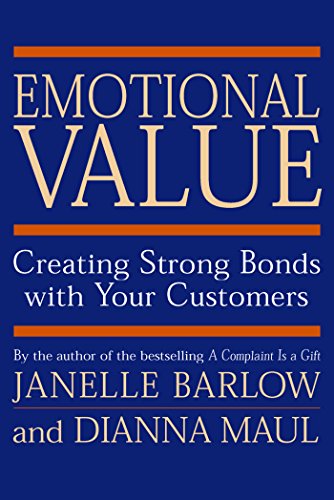
Today's consumers demand not only services and products that are of the highest quality, but also positive, memorable experiences. This essential guide shows how organizations can leapfrog their competitors by learning how to add emotional value -the economic value of customers' feelings when they positively experience products and services -to their customers' experiences.
Janelle Barlow and Dianna Maul, with more than forty years combined experience in the service industry, detail five practices for adding emotional value to customer and staff experiences.
Die Inhaltsangabe kann sich auf eine andere Ausgabe dieses Titels beziehen.
Über die Autorin bzw. den Autor
Janelle Barlow, Ph.D., is president of TMI, USA, a partner with Time Manager International, a Denmark-based multinational training and consulting group. Her keen sense of diverse ideas and approaches to management has been shaped by working extensively in Asia for the past fifteen years.
Janelle speaks on the subjects of customer service, complaint handling, strategic planning, stress management, and creativity. Her decades of moving audiences to implement behavioral changes have ignited her passion to look at the emotional demands that the shift to an experience economy will have on customer service. A member of the National Speaker’s Association, she has earned the designation of Certified Speaking Professional.
Dianna Maul is vice president of marketing for TMI, USA, and man- ages TMI’s Pacific Northwest office. Dianna’s ability to assist clients in implementing practical solutions to customer service needs is the result of over twenty years of operational experience. Dianna gained her footing in customer service working with Nordstrom and studying with W. Edwards Deming and Disney University. A founding director of Emotional Value
Horizon Airlines, widely regarded for its outstanding customer service, Dianna conceptualized and directed the Horizon Air Training Academy in her role as vice president of customer service.
Dianna is coauthor of “Maintaining Superior Customer Service during Periods of Peak Demand” in Best Practices in Customer Service, edited by Ron Zemke and John Woods. Dianna has honed her emotional abilities managing a full-time career while raising five children, including a set of triplets.
Auszug. © Genehmigter Nachdruck. Alle Rechte vorbehalten.
ADDING EMOTIONAL VALUE TO YOUR CUSTOMERS’ EXPERIENCE
Janelle’s dentist recently moved to another town some distance from her home. Nonetheless, she travels to see him because of how she emotionally feels under his care. His rates are higher, and she has to drive almost fifteen miles farther to his office. Does the emotional connection that Janelle feels to her dentist and his assistants contribute to his bottom line? It is difficult, if not impossible, to exactly measure the monetary worth of emotional value, but it is definitely part of what service providers and organizations offer—and it is one of the largest drivers of customer loyalty. The ability to retain customers and sell more to them is, according to many business experts, the single most important predictor of economic success today.
Why does Nordstrom, the big Seattle, Washington–based department store chain, do so well, even with higher prices and fewer special sales, earning more per square foot than other similar operations? Talk with “Nordies” and they will tell you that it is not just their liberal return policy. Actually, many department stores have copied the Nordstrom guarantee on 2returned merchandise. It’s the way customers feel when they return items to Nordstrom. There are few hassles and limited negative emotions.
Emotional value is the economic worth of feelings.
We define emotional value as the economic value or monetary worth of feelings when customers positively experience an organization’s products and/or services. Emotional value, as much as quality or any other dimension of an organization’s worth, can make or break a business. It is as concrete as that. Cathay Pacific, the Hong Kong–based airline, found that the specific words used to settle lost luggage claims or handle other complaints were more important than the timeliness, accuracy, or compensation of the settlement in determining whether passengers would fly with the airline again.1 This is a finding that should make everyone involved in business sit up and pay attention.
Emotional value refers to the feelings that customers experience or anticipate experiencing when they deal with organizations and their representatives. These feelings create a desire in customers to want to return to a place of business or go away and never come back. Emotional value is a concept that is ultimately more connected to customer retention than anything else. It is also the value that a company possesses when staff prefer to stay with their employers because of the feelings they have while working. Both staff and customers tend to stay with organizations that enable them to experience positive, meaningful, and personally important feelings, even if the organizations cannot always provide everything they want or solve all their problems.2
Most customers know instantly how they are emotionally impacted and how they feel about that, if not precisely, then generally, from the moment they walk into a place of business until they leave—with or without a purchase. In order to match the growing and inherent emotional sophistication of customers, service providers must upgrade their own emotional offerings to maintain a distinct competitive advantage.
The Experience Economy
Within easy historical memory, we have seen an evolution from an agricultural to a manufacturing economy. The manufacturing economy, still 3struggling with quality issues, has given way to the service economy. The service economy is in its early phases, and as we look closely at the service economy and its implications, we see that there are levels and nuances of service that most businesses have yet to attain. These include the careful introduction of competent emotional sensitivity. At one extreme end, service will have to support the orchestrated theatrical experiences referred to by Joseph Pine and James Gilmore in their new and groundbreaking book, The Experience Economy. One of the major characteristics of the experience economy, according to Pine and Gilmore, is that customers become engaged in a “personal way,” requiring high levels of emotional competency from experience providers.
Customers want and expect to be positively, emotionally, and memorably impacted at every level of their commercial existence.
Pine and Gilmore distinguish the products of the different types of economies in the following way: “While commodities are fungible, goods tangible, and services intangible, experiences are memorable.” 3 They make a compelling case that more and more of today’s customers want and expect to be positively, emotionally, and memorably impacted at every level of their commercial existence. Whether or not most products or services in the future will be offered as themed experiences, as Pine and Gilmore use the term, a higher level of emotional competence will be required for the service economy also.
Pine and Gilmore argue that the shift to the experience economy is happening, in part, because large numbers of products run the risk of becoming “commoditized,” and commodities in a free-market economy do not enjoy high profit margins. To prevent products from becoming commodities, they contend, it is not enough for an organization to focus on products or services alone. In this book, we suggest that most companies haven’t yet fully taken advantage of the power of emotionally sensitive service, let alone evolved to themed productions for customers. Perhaps it will be to an organization’s advantage to create themed experiences for its customers, but it first needs to master service that is emotionally competent. It is our assessment that most companies have not 4taken full advantage of the economic possibilities stemming from retaining customers by adding emotional value.
Customers always form judgments when they interact with organizations and staff. By filtering and processing sensory information, customers form emotional impressions (popularly referred to as Moments of Truth [MOTs]) that help them to remember and distinguish one experience from another.4 These sensory service clues, many of which have a strong emotional component, need to be understood, managed, and ultimately delivered by individuals. This book focuses on the role of emotions in the customer experience and how individuals can provide emotional value to their customers so they are inclined to return. We assert that adding emotional value to customers’ experiences is one of the strongest competitive advantages and requires not only upgrading staff emotional competency but also upgrading business operations so they positively impact emotions within organizations.
If we are to move to an experience economy for customers, we have to create an “experience” work environment for staff.
If we are to move to an experience economy for customers, we have to create an “experience” work environment for staff. In the 1980s, the quality concept quickly included personal quality, once organizations understood it was very difficult for workers to produce high quality goods if they did not have high personal quality standards. Likewise, service, as a concept, dramatically shifted once the concept of “customer” included both internal and external customers. Once businesses understood that external customers were treated pretty much the same way as internal customers, they began to focus on “internal service.” Retention of external customers has a lot to do with retaining internal staff.
Most jobs in the developed world today are service positions. By the early 2000s, a stunning 80 percent of jobs in the United States will be service related—from fast-food workers, support staff, retail workers, and hospitality and...
„Über diesen Titel“ kann sich auf eine andere Ausgabe dieses Titels beziehen.
Suchergebnisse für Emotional Value: Creating Strong Bonds with Your Customers

Beispielbild für diese ISBN
Emotional Value: Creating Strong Bonds with Your Customers
Anbieter: World of Books (was SecondSale), Montgomery, IL, USA
Verkäuferbewertung 5 von 5 Sternen

Hardback. Zustand: Good. Today's consumers demand not only services and products that are of the highest quality, but also positive, memorable experiences. This essential guide shows how organizations can leapfrog their competitors by learning how to add emotional value -the economic value of customers' feelings when they positively experience products and services -to their customers' experiences. Janelle Barlow and Dianna Maul, with more than forty years combined experience in the service industry, detail five practices for adding emotional value to customer and staff experiences. Artikel-Nr. 00109583772
Gebraucht kaufen
EUR 4,59
Versand gratis
Versand innerhalb von USA
Versand innerhalb von USA
Anzahl: 1 verfügbar
Beispielbild für diese ISBN
Emotional Value : Creating Strong Bonds with Your Customers
Verlag:
Berrett-Koehler Publishers, Incorporated, 2000
ISBN 10: 1576750795
ISBN 13: 9781576750797
Gebraucht
Hardcover
Anbieter: Better World Books, Mishawaka, IN, USA
Verkäuferbewertung 5 von 5 Sternen
Zustand: Good. 1 Edition. Former library copy. Pages intact with minimal writing/highlighting. The binding may be loose and creased. Dust jackets/supplements are not included. Includes library markings. Stock photo provided. Product includes identifying sticker. Better World Books: Buy Books. Do Good. Artikel-Nr. 3984791-6
Gebraucht kaufen
EUR 6,36
Versand gratis
Versand innerhalb von USA
Versand innerhalb von USA
Anzahl: 2 verfügbar
Beispielbild für diese ISBN
Emotional Value: Creating Strong Bonds with Your Customers
Verlag:
Berrett-Koehler Publishers, 2000
ISBN 10: 1576750795
ISBN 13: 9781576750797
Gebraucht
Hardcover
Anbieter: ThriftBooks-Dallas, Dallas, TX, USA
Verkäuferbewertung 5 von 5 Sternen
Hardcover. Zustand: Very Good. No Jacket. May have limited writing in cover pages. Pages are unmarked. ~ ThriftBooks: Read More, Spend Less. Artikel-Nr. G1576750795I4N00
Gebraucht kaufen
EUR 6,60
Versand gratis
Versand innerhalb von USA
Versand innerhalb von USA
Anzahl: 1 verfügbar
Beispielbild für diese ISBN
Emotional Value: Creating Strong Bonds with Your Customers
Verlag:
Berrett-Koehler Publishers, 2000
ISBN 10: 1576750795
ISBN 13: 9781576750797
Gebraucht
Hardcover
Anbieter: ThriftBooks-Atlanta, AUSTELL, GA, USA
Verkäuferbewertung 5 von 5 Sternen
Hardcover. Zustand: Very Good. No Jacket. May have limited writing in cover pages. Pages are unmarked. ~ ThriftBooks: Read More, Spend Less. Artikel-Nr. G1576750795I4N00
Gebraucht kaufen
EUR 6,60
Versand gratis
Versand innerhalb von USA
Versand innerhalb von USA
Anzahl: 1 verfügbar
Foto des Verkäufers
Emotional Value: Creating Strong Bonds with Your Customers (AGENCY/DISTRIBUTED)
Anbieter: WeBuyBooks, Rossendale, LANCS, Vereinigtes Königreich
Verkäuferbewertung 5 von 5 Sternen
hardcover. Zustand: Good. Most items will be dispatched the same or the next working day. A copy that has been read but remains in clean condition. All of the pages are intact and the cover is intact and the spine may show signs of wear. The book may have minor markings which are not specifically mentioned. Artikel-Nr. rev5205728355
Gebraucht kaufen
EUR 16,33
EUR 9,28 Versand
Versand von Vereinigtes Königreich nach USA
Versand von Vereinigtes Königreich nach USA
Anzahl: 1 verfügbar
Beispielbild für diese ISBN
Emotional Value: Creating Strong Bonds with Your Customers: Taking Customer Service to a New Level
Verlag:
Berrett-Koehler Publishers 17.04.2000, 2000
ISBN 10: 1576750795
ISBN 13: 9781576750797
Gebraucht
Hardcover
Anbieter: Sigrun Wuertele buchgenie_de, Altenburg, Deutschland
Verkäuferbewertung 5 von 5 Sternen
Zustand: wie neu - gebraucht. Gebundene Ausgabe 336 S. Sehr guter Zustand, ohne Namenseintrag, Original-Schutzumschlag Ansichtsexemplar aus Buchladen Zustand: 1, wie neu - gebraucht, Gebundene Ausgabe Berrett-Koehler Publishers , 2000-04-17 336 S. , Emotional Value: Creating Strong Bonds with Your Customers: Taking Customer Service to a New Level, Barlow, Janelle. Artikel-Nr. BU266676
Gebraucht kaufen
EUR 26,22
EUR 37,99 Versand
Versand von Deutschland nach USA
Versand von Deutschland nach USA
Anzahl: 1 verfügbar
Beispielbild für diese ISBN
Emotional Value: Creating Strong Bonds With Your Customers
Anbieter: Revaluation Books, Exeter, Vereinigtes Königreich
Verkäuferbewertung 5 von 5 Sternen
Hardcover. Zustand: Brand New. 310 pages. 9.50x6.75x1.40 inches. In Stock. Artikel-Nr. 1576750795
Neu kaufen
EUR 58,65
EUR 14,93 Versand
Versand von Vereinigtes Königreich nach USA
Versand von Vereinigtes Königreich nach USA
Anzahl: 1 verfügbar
Beispielbild für diese ISBN
Emotional Value: Creating Strong Bonds with Your Customers
Verlag:
Berrett-Koehler Publishers 17.04.2000, 2000
ISBN 10: 1576750795
ISBN 13: 9781576750797
Gebraucht
Hardcover
Anbieter: Sigrun Wuertele buchgenie_de, Altenburg, Deutschland
Verkäuferbewertung 5 von 5 Sternen
Zustand: Sehr gut - gebraucht. Gebundene Ausgabe 336 S. Sehr guter Zustand, ohne Namenseintrag, Original-Schutzumschlag Zustand: 2, Sehr gut - gebraucht, Gebundene Ausgabe Berrett-Koehler Publishers , 2000-04-17 336 S. , Emotional Value: Creating Strong Bonds with Your Customers, Janelle Barlow. Artikel-Nr. BU303022
Gebraucht kaufen
EUR 51,55
EUR 37,99 Versand
Versand von Deutschland nach USA
Versand von Deutschland nach USA
Anzahl: 1 verfügbar