
Verwandte Artikel zu Your Call Is (Not That) Important to Us: Customer Service...
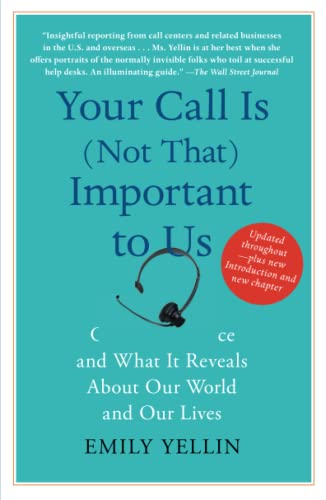
Your Call Is (Not That) Important to Us: Customer Service and What It Reveals About Our World and Our Lives - Softcover
Inhaltsangabe
Journalist Emily Yellin pens a lively narrative exploring the very human stories behind the often-inhuman face of call-center customer service.
Whether it’s the interminable hold times, the multitude of buttons to press, or the automated voices before reaching someone with a measurable pulse—who hasn’t felt exasperated at the abuse, neglect, and wasted time when all we want is help, and maybe a little human kindness?
Your Call Is (not that) Important to Us is journalist Emily Yellin’s highly entertaining and far-reaching exploration of the multibillion-dollar customer service industry and its surprising inner-workings. Since customer service has a role in just about every industry on earth, Yellin travels the country and the world, meeting a wide range of customer service reps, corporate decision makers, industry watchers, and Internet-based consumer activists.
She shows the myriad forces that converge to create these aggravating experiences and the people inside and outside the globalized corporate world crusading to make customer service better for us all.
For the first time, Yellin gets reveals the heart behind the never-seen faces of call-center customer service—and why customer service doesn’t have to be this bad.
Die Inhaltsangabe kann sich auf eine andere Ausgabe dieses Titels beziehen.
Über die Autorin bzw. den Autor
Emily Yellin is the author of Our Mothers’ War, and was a longtime contributor to the New York Times. She has also written for Time, the Washington Post, the International Herald Tribune, Newsweek, Smithsonian Magazine, and other publications. She graduated from the University of Wisconsin—Madison with a degree in English literature and received a master’s degree in journalism from Northwestern University. She currently lives in Memphis, Tennessee.
Auszug. © Genehmigter Nachdruck. Alle Rechte vorbehalten.
Your Call Is (Not That) Important to Us
Customer Service and What It Reveals About Our World and Our LivesBy Emily YellinFree Press
Copyright © 2010 Emily YellinAll right reserved.
ISBN: 9781416546900
1. Random Acts of Rudeness
As the twenty-first century dawned, most people were feeling fed up. A public opinion poll in 2001 reported that 80 percent of Americans believed the constant coarseness, disrespect, and lack of consideration they encountered in society was such a "serious, pervasive problem" that it affected them "on a personal, gut level" and had grown into "a daily assault on their sensibilities and the quality of their lives." At the same time, it seemed people didn't believe they had much power to change things, so they simply resigned themselves to all the insidious incivility they encountered.
The Pew Charitable Trusts sponsored the poll, called "Aggravating Circumstances: A Status Report on Rudeness in America." Public Agenda, a national policy research group, conducted it. And in their introduction, the authors made sure to justify their examination of how we get along with each other in public every day: "At first, it might seem that conducting a survey on courtesy and rudeness is less serious or important than exploring citizens' views on, say, health care or education or retirement policy. Yet how people treat each other in their daily interactions -- whether they take steps to be respectful of one another, whether they are willing to moderate their own desires and comfort to accommodate the needs of others -- seems to us to be profoundly important and indeed central to the definition of a 'civilized' society."
The report immediately zeroed in on one area of society that most respondents agreed offers perhaps the ripest examples of rude and infuriating public behavior. "Americans say that the way they are treated by business and customer service employees is frequently exasperating, and sometimes even insulting." One particular customer service channel came under the heaviest fire. "When it goes wrong, perhaps nothing embodies greater exasperation than customer service by phone."
According to the survey, 67 percent of Americans sometimes have to "make a fuss to get a problem resolved." And nearly everyone -- 94 percent -- finds it "very frustrating to call a company and get a recording instead of a human being." And even if callers do finally speak to a live customer service agent, the irritation doesn't always end. In a Florida focus group, one man said, "Half the time they have no idea what they're talking about. And they don't care. They'll tell you anything just to get you off the phone."
To be fair, the report also notes that "it seems the rudeness cuts both ways. Disgruntled customers bring frayed nerves, previous frustrations and their own personal shortcomings when they deal with those responsible for helping them." A Connecticut customer service representative told her focus group, "They think you're at their beck and call. They may want something, and they're not getting it as rapidly as they think they should. I answer the phone, and they just immediately go off on me."
It probably doesn't take a scientifically conducted public opinion poll to find evidence of the contempt most Americans harbor toward bad customer service or to elicit testimony about the effects of that kind of antipathy in their lives. Merely bringing up the subject at any gathering will generate at least one horror story from just about everyone. But in the years since that survey officially highlighted and validated the displeasure bubbling just under the surface of our everyday dealings with customer service, a few of those tensions have boiled over in very public ways. The news media, in tandem with various Web sites, have played increasingly larger roles in amplifying them. Just ask Comcast, for example.
Trouble for the nation's largest cable television and broadband provider started in earnest with the story of LaChania Govan, a mother of two in her mid-twenties who inadvertently became a public symbol of mistreated customers everywhere. Govan lives in suburban Chicago. She goes to work all week and attends church every Sunday. She has a pleasant and welcoming voice. She also has a strong sense of fairness.
In July 2005, Govan's digital video recorder wouldn't work. She called Comcast's customer service line in Chicago but couldn't get through. During the course of four weeks, she called more than forty times. She was repeatedly disconnected, put on hold, or transferred to inept or inert representatives and technicians. One customer service representative transferred her to the Spanish-speaking line. Govan knows only English. She just wanted someone to resolve her seemingly simple case.
She says she never raised her voice, but she was resolute. "Calling Comcast became my second job," Govan said. "I had to ensure the cordless phone was fully charged and the kids were content. And I sat and called. I cooked and called. I cleaned and called, and just called." Almost every day, Govan prodded the big company's customer service department as best she could. Finally, she found a rep who heard her out and took her case in hand. A technician was sent to replace her cable box at no charge, and she was credited with a free month of service. Govan's perseverance paid off. Her headaches seemed to be over.
Then Govan's August cable bill arrived. Her name did not appear on the bill. Instead it was addressed to "Bitch Dog." Someone at Comcast had changed her account name. Govan said, "I was so mad I couldn't even cuss."
Instead of becoming just another unnoticed casualty in the adversarial relationship between many companies and their customers, Govan went public. The Chicago Tribune ran her story. Within days, the mainstream news media, bloggers, and consumer advocates from everywhere were spreading her tale of woe. She appeared as the number-one story on MSNBC's Countdown with Keith Olbermann. A Comcast executive left an apology on Govan's home voice mail. The company claimed it identified and fired two employees responsible for changing the name on Govan's bill. She was offered all sorts of free service, which she refused. She wanted nothing more to do with Comcast.
Govan, who also happens to be a customer service representative for a major credit card company, is studying criminal justice with plans to go to law school one day. Eventually, she says, she hopes to become a judge. Her inherent sense of justice is what drove her to persevere. So she was speaking with conviction when she told the Washington Post that she believes customer service means "being friendly, helpful and respectful. I know how it feels to be a customer service rep and a consumer on the other end. You do not have to settle for less, and you do not have to be mistreated."
In 2006, Comcast was dealing with another public display of customer service missteps. A subscriber in the Washington, D.C., area found the technician that Comcast sent to fix his cable system had fallen asleep on his couch. The worker was kept on hold for so long by his own company when he called for help that he dozed off. The customer shot video of the napping technician and posted it on the Internet, where it went viral. Comcast issued another apology, and again said the worker in question had been fired.
Then in August 2007, Comcast suffered what was perhaps its worst embarrassment to date when seventy-six-year-old Mona Shaw took her outrage with its customer service a few steps further than any disgruntled customer had done before. As she has told the story, it...
„Über diesen Titel“ kann sich auf eine andere Ausgabe dieses Titels beziehen.
Suchergebnisse für Your Call Is (Not That) Important to Us: Customer Service...

Beispielbild für diese ISBN
Your Call Is (Not That) Important to Us: Customer Service and What It Reveals about Our World and Our Lives
Anbieter: World of Books (was SecondSale), Montgomery, IL, USA
Verkäuferbewertung 5 von 5 Sternen

Paperback. Zustand: Fair. "Updated throughout plus new introduction and new chapter"--Cover. Artikel-Nr. 00102324322
Gebraucht kaufen
EUR 4,59
Versand gratis
Versand innerhalb von USA
Versand innerhalb von USA
Anzahl: 1 verfügbar
Beispielbild für diese ISBN
Your Call Is (Not That) Important to Us: Customer Service and What It Reveals about Our World and Our Lives
Anbieter: World of Books (was SecondSale), Montgomery, IL, USA
Verkäuferbewertung 5 von 5 Sternen
Paperback. Zustand: Good. "Updated throughout plus new introduction and new chapter"--Cover. Artikel-Nr. 00101345056
Gebraucht kaufen
EUR 4,59
Versand gratis
Versand innerhalb von USA
Versand innerhalb von USA
Anzahl: 2 verfügbar
Beispielbild für diese ISBN
Your Call Is (Not That) Important to Us: Customer Service and What It Reveals About Our World and Our Lives
Verlag:
Free Press (edition Updated ed.), 2010
ISBN 10: 1416546901
ISBN 13: 9781416546900
Gebraucht
Paperback
Anbieter: BooksRun, Philadelphia, PA, USA
Verkäuferbewertung 5 von 5 Sternen
Paperback. Zustand: Fair. Updated ed. The item might be beaten up but readable. May contain markings or highlighting, as well as stains, bent corners, or any other major defect, but the text is not obscured in any way. Artikel-Nr. 1416546901-7-1
Gebraucht kaufen
EUR 4,71
Versand gratis
Versand innerhalb von USA
Versand innerhalb von USA
Anzahl: 1 verfügbar
Beispielbild für diese ISBN
Your Call Is (Not That) Important to Us: Customer Service and What It Reveals about Our World and Our Lives
Anbieter: ThriftBooks-Atlanta, AUSTELL, GA, USA
Verkäuferbewertung 5 von 5 Sternen
Paperback. Zustand: Good. No Jacket. Pages can have notes/highlighting. Spine may show signs of wear. ~ ThriftBooks: Read More, Spend Less. Artikel-Nr. G1416546901I3N00
Gebraucht kaufen
EUR 6,67
Versand gratis
Versand innerhalb von USA
Versand innerhalb von USA
Anzahl: 1 verfügbar
Beispielbild für diese ISBN
Your Call Is (Not That) Important to Us : Customer Service and What It Reveals about Our World and Our Lives
Anbieter: Better World Books, Mishawaka, IN, USA
Verkäuferbewertung 5 von 5 Sternen
Zustand: Fine. Used book that is in almost brand-new condition. May contain a remainder mark. Better World Books: Buy Books. Do Good. Artikel-Nr. 55021998-6
Gebraucht kaufen
EUR 7,09
Versand gratis
Versand innerhalb von USA
Versand innerhalb von USA
Anzahl: 1 verfügbar
Beispielbild für diese ISBN
Your Call Is (Not That) Important to Us : Customer Service and What It Reveals about Our World and Our Lives
Anbieter: Better World Books, Mishawaka, IN, USA
Verkäuferbewertung 5 von 5 Sternen
Zustand: Very Good. Former library copy. Pages intact with possible writing/highlighting. Binding strong with minor wear. Dust jackets/supplements may not be included. Includes library markings. Stock photo provided. Product includes identifying sticker. Better World Books: Buy Books. Do Good. Artikel-Nr. 17417881-6
Gebraucht kaufen
EUR 7,09
Versand gratis
Versand innerhalb von USA
Versand innerhalb von USA
Anzahl: 1 verfügbar
Beispielbild für diese ISBN
Your Call Is (Not That) Important to Us: Customer Service and What It Reveals About Our World and Our Lives
Anbieter: Books From California, Simi Valley, CA, USA
Verkäuferbewertung 4 von 5 Sternen

paperback. Zustand: Very Good. Artikel-Nr. mon0003827380
Gebraucht kaufen
EUR 4,92
EUR 4,38 Versand
Versand innerhalb von USA
Versand innerhalb von USA
Anzahl: 1 verfügbar
Foto des Verkäufers
Your Call Is (Not That) Important to Us: Customer Service and What It Reveals About Our World and Our Lives
Anbieter: WeBuyBooks, Rossendale, LANCS, Vereinigtes Königreich
Verkäuferbewertung 5 von 5 Sternen
paperback. Zustand: Good. Most items will be dispatched the same or the next working day. A copy that has been read but remains in clean condition. All of the pages are intact and the cover is intact and the spine may show signs of wear. The book may have minor markings which are not specifically mentioned. Artikel-Nr. rev5657098246
Gebraucht kaufen
EUR 16,93
EUR 6,48 Versand
Versand von Vereinigtes Königreich nach USA
Versand von Vereinigtes Königreich nach USA
Anzahl: 1 verfügbar
Beispielbild für diese ISBN
Your Call Is (Not That) Important to Us: Customer Service and What It Reveals About Our World and Our Lives
Anbieter: Revaluation Books, Exeter, Vereinigtes Königreich
Verkäuferbewertung 5 von 5 Sternen
Paperback. Zustand: Brand New. reprint edition. 301 pages. 8.50x5.75x0.75 inches. In Stock. Artikel-Nr. x-1416546901
Neu kaufen
EUR 17,78
EUR 11,63 Versand
Versand von Vereinigtes Königreich nach USA
Versand von Vereinigtes Königreich nach USA
Anzahl: 2 verfügbar
Beispielbild für diese ISBN
Your Call Is (Not That) Important to Us
Anbieter: Kennys Bookstore, Olney, MD, USA
Verkäuferbewertung 5 von 5 Sternen
Zustand: New. "Updated throughout plus new introduction and new chapter"--Cover. BIC Classification: KJSU. Category: (G) General (US: Trade). Dimension: 220 x 163 x 21. Weight in Grams: 268. . 2010. Paperback / so. . . . . Books ship from the US and Ireland. Artikel-Nr. V9781416546900
Neu kaufen
EUR 22,08
EUR 9,22 Versand
Versand innerhalb von USA
Versand innerhalb von USA
Anzahl: Mehr als 20 verfügbar