
Verwandte Artikel zu The Large Egyptian Pyramids: Modelling a Complex Engineering...
The Large Egyptian Pyramids: Modelling a Complex Engineering Project (BAR International Series, Band 2057) - Softcover
Inhaltsangabe
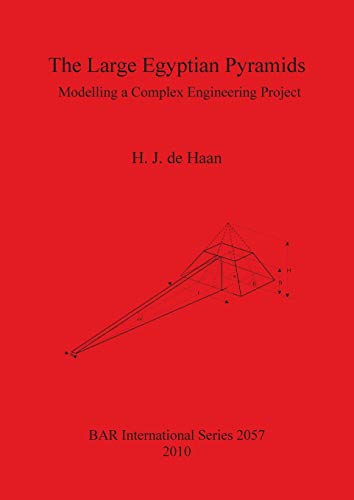
The building process of the Egyptian pyramids has been the subject of many publications. However, a thorough review of this literature reveals that only certain aspects of this process have been studied in isolation, without taking into account the interaction between various activities involved, such as quarrying, transportation and building and without a sound quantitative basis. The present study aims at filling this gap by means of an integrated mathematical model. Attention is focussed on the largest pyramid, the one built by Cheops. The model simulates an efficient project co-ordination by balancing supply and demand of the building material, with all the activities related to the growth of the pyramid and by assuming a constant total workforce. It enables the reader to determine the effects of different building methods and of the productivity of the workers. Three building methods have been studied, successively making use of a linear ramp, of a spiral ramp and of levers. These methods are compared in terms of the number of men and man-years required. Calculations have been carried out for two sets of input data, indicated as base case and maximum case. In addition to the development of a comprehensive model for the construction of the pyramids,this work also contains a comparative analysis of other publications dealing with this subject.
Die Inhaltsangabe kann sich auf eine andere Ausgabe dieses Titels beziehen.
Über die Autorin bzw. den Autor
H. J. de Haan
„Über diesen Titel“ kann sich auf eine andere Ausgabe dieses Titels beziehen.
Suchergebnisse für The Large Egyptian Pyramids: Modelling a Complex Engineering...

Beispielbild für diese ISBN
The Large Egyptian Pyramids: Modelling a Complex Engineering Project (BAR International)
Verlag:
British Archaeological Reports, 2010
ISBN 10: 1407305468
ISBN 13: 9781407305462
Neu
Softcover
Anbieter: California Books, Miami, FL, USA
Verkäuferbewertung 5 von 5 Sternen

Zustand: New. Artikel-Nr. I-9781407305462
Neu kaufen
EUR 28,49
EUR 2,68 Versand
Versand innerhalb von USA
Versand innerhalb von USA
Anzahl: Mehr als 20 verfügbar
Foto des Verkäufers
The Large Egyptian Pyramids
Anbieter: Rarewaves.com USA, London, LONDO, Vereinigtes Königreich
Verkäuferbewertung 5 von 5 Sternen
Paperback. Zustand: New. Artikel-Nr. LU-9781407305462
Neu kaufen
EUR 56,13
Versand gratis
Versand von Vereinigtes Königreich nach USA
Versand von Vereinigtes Königreich nach USA
Anzahl: Mehr als 20 verfügbar
Beispielbild für diese ISBN
Large Egyptian Pyramids : Modelling a Complex Engineering Project
Verlag:
British Archaeological Reports, 2010
ISBN 10: 1407305468
ISBN 13: 9781407305462
Neu
Softcover
Anbieter: GreatBookPricesUK, Woodford Green, Vereinigtes Königreich
Verkäuferbewertung 5 von 5 Sternen
Zustand: New. Artikel-Nr. 10168752-n
Neu kaufen
EUR 49,73
EUR 17,98 Versand
Versand von Vereinigtes Königreich nach USA
Versand von Vereinigtes Königreich nach USA
Anzahl: Mehr als 20 verfügbar
Beispielbild für diese ISBN
The Large Egyptian Pyramids: Modelling a Complex Engineering Project (British Archaeological Reports International Series, 2057)
Verlag:
Oxford : British Archaeological Reports, BAR Publishing, 2010
ISBN 10: 1407305468
ISBN 13: 9781407305462
Neu
Soft cover
Anbieter: Joseph Burridge Books, Dagenham, Vereinigtes Königreich
Verkäuferbewertung 5 von 5 Sternen
Soft cover. Zustand: New. xi, 125 pages : illustrations (some color), maps ; 30 cm. The building process of the Egyptian pyramids has been the subject of many publications. However, a thorough review of this literature reveals that only certain aspects of this process have been studied in isolation, without taking into account the interaction between various activities involved, such as quarrying, transportation and building and without a sound quantitative basis. The present study aims at filling this gap by means of an integrated mathematical model. Attention is focussed on the largest pyramid, the one built by Cheops. The model simulates an efficient project co-ordination by balancing supply and demand of the building material, with all the activities related to the growth of the pyramid and by assuming a constant total workforce. Itenables the reader to determine the effects of different building methods and of the productivity of the workers. Three building methods have been studied, successively making use of a linear ramp, of a spiral ramp and of levers. These methods are compared in terms of the number of men and man-years required. Calculations have been carried out for two sets of input data, indicated as base case and maximum case. In addition to the development of a comprehensive model for the construction of the pyramids,this work also contains a comparative analysis of other publications dealing with this subject. Artikel-Nr. BAR2057
Neu kaufen
EUR 74,08
EUR 27,57 Versand
Versand von Vereinigtes Königreich nach USA
Versand von Vereinigtes Königreich nach USA
Anzahl: 1 verfügbar
Foto des Verkäufers
Large Egyptian Pyramids : Modelling a Complex Engineering Project
Verlag:
British Archaeological Reports, 2010
ISBN 10: 1407305468
ISBN 13: 9781407305462
Gebraucht
Softcover
Anbieter: GreatBookPricesUK, Woodford Green, Vereinigtes Königreich
Verkäuferbewertung 5 von 5 Sternen
Zustand: As New. Unread book in perfect condition. Artikel-Nr. 10168752
Gebraucht kaufen
EUR 111,11
EUR 17,98 Versand
Versand von Vereinigtes Königreich nach USA
Versand von Vereinigtes Königreich nach USA
Anzahl: Mehr als 20 verfügbar
Foto des Verkäufers
The Large Egyptian Pyramids
Anbieter: Rarewaves.com UK, London, Vereinigtes Königreich
Verkäuferbewertung 5 von 5 Sternen
Paperback. Zustand: New. Artikel-Nr. LU-9781407305462
Neu kaufen
EUR 54,48
EUR 77,91 Versand
Versand von Vereinigtes Königreich nach USA
Versand von Vereinigtes Königreich nach USA
Anzahl: Mehr als 20 verfügbar