
Verwandte Artikel zu It Didn't Start with You: How Inherited Family...
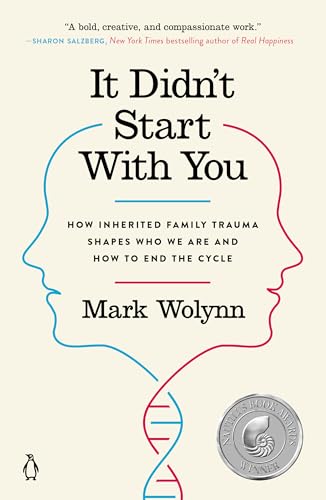
It Didn't Start with You: How Inherited Family Trauma Shapes Who We Are and How to End the Cycle - Softcover
Inhaltsangabe
“This groundbreaking book offers a compelling understanding of inherited trauma and fresh, powerful tools for relieving its suffering. Mark Wolynn is a wise and trustworthy guide on the journey toward healing.” —Tara Brach, PhD, author of Radical Acceptance and True Refuge
A groundbreaking approach to transforming traumatic legacies passed down in families over generations, by an acclaimed expert in the field
Depression. Anxiety. Chronic Pain. Phobias. Obsessive thoughts. The evidence is compelling: the roots of these difficulties may not reside in our immediate life experience or in chemical imbalances in our brains—but in the lives of our parents, grandparents, and even great-grandparents. The latest scientific research, now making headlines, supports what many have long intuited—that traumatic experience can be passed down through generations. It Didn’t Start with You builds on the work of leading experts in post-traumatic stress, including Mount Sinai School of Medicine neuroscientist Rachel Yehuda and psychiatrist Bessel van der Kolk, author of The Body Keeps the Score. Even if the person who suffered the original trauma has died, or the story has been forgotten or silenced, memory and feelings can live on. These emotional legacies are often hidden, encoded in everything from gene expression to everyday language, and they play a far greater role in our emotional and physical health than has ever before been understood.
As a pioneer in the field of inherited family trauma, Mark Wolynn has worked with individuals and groups on a therapeutic level for over twenty years. It Didn’t Start with You offers a pragmatic and prescriptive guide to his method, the Core Language Approach. Diagnostic self-inventories provide a way to uncover the fears and anxieties conveyed through everyday words, behaviors, and physical symptoms. Techniques for developing a genogram or extended family tree create a map of experiences going back through the generations. And visualization, active imagination, and direct dialogue create pathways to reconnection, integration, and reclaiming life and health. It Didn’t Start With You is a transformative approach to resolving longstanding difficulties that in many cases, traditional therapy, drugs, or other interventions have not had the capacity to touch.
Die Inhaltsangabe kann sich auf eine andere Ausgabe dieses Titels beziehen.
Über die Autorin bzw. den Autor
Mark Wolynn is a leading expert on inherited family trauma. He is the winner of the 2016 Silver Nautilus Award in Psychology. As the director of The Family Constellation Institute in San Francisco, he has trained thousands of clinicians and treated thousands more patients struggling with depression, anxiety, panic disorder, obsessive thoughts, self-injury, chronic pain, and illness. A sought-after lecturer, he leads workshops at hospitals, clinics, conferences, and teaching centers around the world. He has taught at the University of Pittsburgh, the Western Psychiatric Institute, Kripalu, The Omega Institute, The New York Open Center, and The California Institute of Integral Studies. His articles have appeared in Psychology Today, Mind Body Green, MariaShriver.com, Elephant Journal and Psych Central, and his poetry has been published in The New Yorker. www.markwolynn.com.
Von der hinteren Coverseite
Inherited family trauma is currently an area of growing interest, as science increasingly explores what we know intuitively: that the effects of trauma can pass from one generation to the next, and that the answers to some of our greatest life problems often lie not within our own story, but in the experiences of our parents, grandparents, great-grandparents and extended family. Here, pioneer Mark Wolyn shows readers how they can overcome inherited trauma and reclaim their lives.
Auszug. © Genehmigter Nachdruck. Alle Rechte vorbehalten.
Chapter 1
Traumas Lost and Found
The past is never dead. It's not even past.
-William Faulkner, Requiem for a Nun
A well-documented feature of trauma, one familiar to many, is our inability to articulate what happens to us. Not only do we lose our words, but something happens with our memory as well. During a traumatic incident, our thought processes can become scattered and disorganized in such a way that we no longer recognize the memories as belonging to the original event. Instead, fragments of memory, dispersed as images, body sensations, and words, are stored in our unconscious and can become activated later by anything even remotely reminiscent of the original experience. Once they are triggered, it is as if an invisible rewind button has been pressed, causing us to reenact aspects of the original trauma in our day-to-day lives. Unconsciously, we could find ourselves reacting to certain people, events, or situations in old, familiar ways that echo the past.
Sigmund Freud identified this pattern more than one hundred years ago. Traumatic reenactment, or "repetition compulsion," as Freud called it, is an attempt of the unconscious to replay what's unresolved, so we can "get it right." This unconscious drive to relive past events could be one of the mechanisms at work when families repeat unresolved traumas in future generations.
Freud's contemporary Carl Jung also believed that what remains unconscious does not dissolve but, rather, resurfaces in our lives as fate or fortune. Whatever is not conscious, he said, will be experienced as fate. In other words, we're likely to keep repeating our unconscious patterns until we bring them into the light of awareness. Both Jung and Freud noted that whatever is too difficult to process does not fade away on its own but, rather, is stored in our unconscious.
Freud and Jung each observed how fragments of previously blocked, suppressed, or repressed life experience would show up in the words, gestures, and behaviors of their patients. For decades to follow, therapists would see such clues as slips of the tongue, accident patterns, or dream images as messengers shining a light into the unspeakable and unthinkable regions of their clients' lives.
Recent advances in imaging technology have allowed researchers to unravel the brain and bodily functions that "misfire" or break down during overwhelming episodes. Bessel van der Kolk is a Dutch psychiatrist known for his research on posttraumatic stress. He explains that during a trauma, the speech center shuts down, as does the medial prefrontal cortex, the part of the brain responsible for experiencing the present moment. He describes the speechless terror of trauma as the experience of being at a loss for words, a common occurrence when brain pathways of remembering are hindered during periods of threat or danger. "When people relive their traumatic experiences," he says, "the frontal lobes become impaired and, as [a] result, they have trouble thinking and speaking. They no longer are capable of communicating to either themselves or to others precisely what's going on."
Still, all is not silent: words, images, and impulses that fragment following a traumatic event reemerge to form a secret language of our suffering we carry with us. Nothing is lost. The pieces have just been rerouted.
Emerging trends in psychotherapy are now beginning to point beyond the traumas of the individual to include traumatic events in the family and social history as a part of the whole picture. Tragedies varying in type and intensity-such as abandonment, suicide, and war, or the early death of a child, parent, or sibling-can send shock waves of distress cascading from one generation to the next. Recent developments in the fields of cellular biology, neuroscience, epigenetics, and developmental psychology underscore the importance of exploring at least three generations of family history in order to understand the mechanism behind patterns of trauma and suffering that repeat.
The following story offers a vivid example. When I first met Jesse, he hadn't had a full night's sleep in more than a year. His insomnia was evident in the dark shadows around his eyes, but the blankness of his stare suggested a deeper story. Though only twenty, Jesse looked at least ten years older. He sank onto my sofa as if his legs could no longer bear his weight.
Jesse explained that he had been a star athlete and a straight-A student, but that his persistent insomnia had initiated a downward spiral of depression and despair. As a result, he dropped out of college and had to forfeit the baseball scholarship he'd worked so hard to win. He desperately sought help to get his life back on track. Over the past year, he'd been to three doctors, two psychologists, a sleep clinic, and a naturopathic physician. Not one of them, he related in a monotone, was able to offer any real insight or help. Jesse, gazing mostly at the floor as he shared his story, told me he was at the end of his rope.
When I asked whether he had any ideas about what might have triggered his insomnia, he shook his head. Sleep had always come easily for Jesse. Then, one night just after his nineteenth birthday, he woke suddenly at 3:30 a.m. He was freezing, shivering, unable to get warm no matter what he tried. Three hours and several blankets later, Jesse was still wide awake. Not only was he cold and tired, he was seized by a strange fear he had never experienced before, a fear that something awful could happen if he let himself fall back to sleep. If I go to sleep, I'll never wake up. Every time he felt himself drifting off, the fear would jolt him back into wakefulness. The pattern repeated itself the next night, and the night after that. Soon insomnia became a nightly ordeal. Jesse knew his fear was irrational, yet he felt helpless to put an end to it.
I listened closely as Jesse spoke. What stood out for me was one unusual detail-he'd been extremely cold, "freezing," he said, just prior to the first episode. I began to explore this with Jesse, and asked him if anyone on either side of the family suffered a trauma that involved being cold, or being asleep, or being nineteen.
Jesse revealed that his mother had only recently told him about the tragic death of his father's older brother-an uncle he never knew he had. Uncle Colin was only nineteen when he froze to death checking power lines in a storm just north of Yellowknife in the Northwest Territories of Canada. Tracks in the snow revealed that he had been struggling to hang on. Eventually, he was found facedown in a blizzard, having lost consciousness from hypothermia. His death was such a tragic loss that the family never spoke his name again.
Now, three decades later, Jesse was unconsciously reliving aspects of Colin's death-specifically, the terror of letting go into unconsciousness. For Colin, letting go meant death. For Jesse, falling asleep must have felt the same.
Making the connection was a turning point for Jesse. Once he grasped that his insomnia had its origin in an event that had occurred thirty years earlier, he finally had an explanation for his fear of falling asleep. The process of healing could now begin. With tools Jesse learned in our work together, which will be detailed later in this book, he was able to disentangle...
„Über diesen Titel“ kann sich auf eine andere Ausgabe dieses Titels beziehen.
Suchergebnisse für It Didn't Start with You: How Inherited Family...

Beispielbild für diese ISBN
It Didn't Start with You: How Inherited Family Trauma Shapes Who We Are and How to End the Cycle
Verlag:
Penguin Life April 2017, 2017
ISBN 10: 1101980389
ISBN 13: 9781101980385
Gebraucht
Paper Back
Anbieter: Eagle Eye Books, Decatur, GA, USA
Verkäuferbewertung 4 von 5 Sternen

Paper Back. Zustand: Used. Artikel-Nr. 898634
Gebraucht kaufen
EUR 7,24
EUR 3,51 Versand
Versand innerhalb von USA
Versand innerhalb von USA
Anzahl: 1 verfügbar
Beispielbild für diese ISBN
It Didn't Start with You : How Inherited Family Trauma Shapes Who We Are and How to End the Cycle
Anbieter: Better World Books, Mishawaka, IN, USA
Verkäuferbewertung 5 von 5 Sternen

Zustand: Good. Pages intact with minimal writing/highlighting. The binding may be loose and creased. Dust jackets/supplements are not included. Stock photo provided. Product includes identifying sticker. Better World Books: Buy Books. Do Good. Artikel-Nr. 14147136-6
Gebraucht kaufen
EUR 11,49
Versand gratis
Versand innerhalb von USA
Versand innerhalb von USA
Anzahl: 1 verfügbar
Beispielbild für diese ISBN
It Didn't Start with You: How Inherited Family Trauma Shapes Who We Are and How to End the Cycle
Anbieter: Roundabout Books, Greenfield, MA, USA
Verkäuferbewertung 4 von 5 Sternen
paperback. Zustand: Near Fine. Condition Notes: Excellent, unmarked copy with little wear and tight binding. We ship in recyclable American-made mailers. 100% money-back guarantee on all orders. Artikel-Nr. 1780043
Gebraucht kaufen
EUR 11,50
Versand gratis
Versand innerhalb von USA
Versand innerhalb von USA
Anzahl: 1 verfügbar
Beispielbild für diese ISBN
It Didn't Start with You: How Inherited Family Trauma Shapes Who We Are and How to End the Cycle
Anbieter: Roundabout Books, Greenfield, MA, USA
Verkäuferbewertung 4 von 5 Sternen
paperback. Zustand: Near Fine. Condition Notes: Excellent, unmarked copy with little wear and tight binding. We ship in recyclable American-made mailers. 100% money-back guarantee on all orders. Artikel-Nr. 1780661
Gebraucht kaufen
EUR 11,50
Versand gratis
Versand innerhalb von USA
Versand innerhalb von USA
Anzahl: 1 verfügbar
Beispielbild für diese ISBN
It Didnt Start with You How In
Anbieter: World of Books (was SecondSale), Montgomery, IL, USA
Verkäuferbewertung 5 von 5 Sternen
Zustand: Very Good. Item in very good condition! Textbooks may not include supplemental items i.e. CDs, access codes etc. Artikel-Nr. 00108740276
Gebraucht kaufen
EUR 12,77
Versand gratis
Versand innerhalb von USA
Versand innerhalb von USA
Anzahl: 19 verfügbar
Beispielbild für diese ISBN
It Didn't Start With You: How Inherited Family Trauma Shapes Who We Are and How to End the Cycle
Anbieter: World of Books (was SecondSale), Montgomery, IL, USA
Verkäuferbewertung 5 von 5 Sternen
Paperback. Zustand: Fair. Inherited family trauma is currently an area of growing interest, as science increasingly explores what we know intuitively: that the effects of trauma can pass from one generation to the next, and that the answers to some of our greatest life problems often lie not within our own story, but in the experiences of our parents, grandparents, great-grandparents and extended family. Here, pioneer Mark Wolyn shows readers how they can overcome inherited trauma and reclaim their lives. Artikel-Nr. 00110750513
Gebraucht kaufen
EUR 12,77
Versand gratis
Versand innerhalb von USA
Versand innerhalb von USA
Anzahl: 2 verfügbar
Beispielbild für diese ISBN
It Didn't Start with You: How Inherited Family Trauma Shapes Who We Are and How to End the Cycle
Anbieter: Wonder Book, Frederick, MD, USA
Verkäuferbewertung 5 von 5 Sternen
Zustand: As New. Like New condition. A near perfect copy that may have very minor cosmetic defects. Artikel-Nr. P11J-01993
Gebraucht kaufen
EUR 12,85
Versand gratis
Versand innerhalb von USA
Versand innerhalb von USA
Anzahl: 1 verfügbar
Beispielbild für diese ISBN
It Didn't Start with You: How Inherited Family Trauma Shapes Who We Are and How to End the Cycle
Anbieter: WorldofBooks, Goring-By-Sea, WS, Vereinigtes Königreich
Verkäuferbewertung 5 von 5 Sternen
Paperback. Zustand: Very Good. The book has been read, but is in excellent condition. Pages are intact and not marred by notes or highlighting. The spine remains undamaged. Artikel-Nr. GOR009022033
Gebraucht kaufen
EUR 9,50
EUR 6,50 Versand
Versand von Vereinigtes Königreich nach USA
Versand von Vereinigtes Königreich nach USA
Anzahl: Mehr als 20 verfügbar
Beispielbild für diese ISBN
It Didn't Start with You: How Inherited Family Trauma Shapes Who We Are and How to End the Cycle
Anbieter: Magers and Quinn Booksellers, Minneapolis, MN, USA
Verkäuferbewertung 5 von 5 Sternen
paperback. Zustand: Very Good. May have light to moderate shelf wear and/or a remainder mark. Complete. Clean pages. Artikel-Nr. 1012364
Gebraucht kaufen
EUR 13,03
EUR 3,51 Versand
Versand innerhalb von USA
Versand innerhalb von USA
Anzahl: 2 verfügbar
Beispielbild für diese ISBN
It Didn't Start with You: How Inherited Family Trauma Shapes Who We Are and How to End the Cycle
Anbieter: Majestic Books, Hounslow, Vereinigtes Königreich
Verkäuferbewertung 4 von 5 Sternen
Zustand: New. pp. 256. Artikel-Nr. 371944277
Neu kaufen
EUR 15,05
EUR 7,55 Versand
Versand von Vereinigtes Königreich nach USA
Versand von Vereinigtes Königreich nach USA
Anzahl: 1 verfügbar