
Verwandte Artikel zu The Diversity Myth: Multiculturalism and Political...
Inhaltsangabe
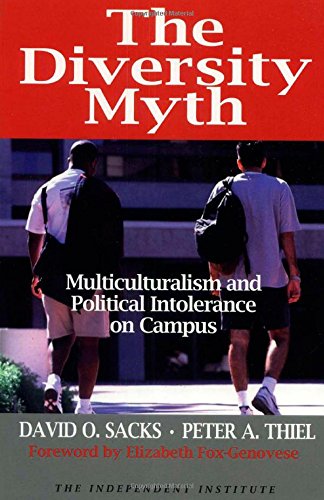
This is a powerful exploration of the debilitating impact that politically correct "multiculturalism" has had upon higher education and academic freedom in the United States.
In the name of diversity, many leading academic and cultural institutions are working to silence dissent and stifle intellectual life. This book exposes the real impact of multiculturalism on the institution most closely identified with the politically correct decline of higher education—Stanford University.
Authored by two Stanford graduates, this book is a compelling insider’s tour of a world of speech codes, "dumbed-down" admissions standards and curricula, campus witch hunts, and anti-Western zealotry that masquerades as legitimate scholarly inquiry. Sacks and Thiel use numerous primary sources—the Stanford Daily, class readings, official university publications—to reveal a pattern of politicized classes, housing, budget priorities, and more. They trace the connections between such disparate trends as political correctness, the gender wars, Generation X nihilism, and culture wars, showing how these have played a role in shaping multiculturalism at institutions like Stanford.
The authors convincingly show that multiculturalism is not about learning more; it is actually about learning less. They end their comprehensive study by detailing the changes necessary to reverse the tragic disintegration of American universities and restore true academic excellence.
Die Inhaltsangabe kann sich auf eine andere Ausgabe dieses Titels beziehen.
Über die Autorinnen und Autoren
David O. Sacks is vice president of product strategy at PayPal, Inc. He has worked as a legislative aide to U.S. Representative Christopher Cox and received his A.B. in economics from Stanford University. His articles have appeared in the Wall Street Journal, National Review, Policy Review, and Academic Questions.
Peter A. Thiel is chairman and CEO at PayPal, Inc. He has worked as a derivatives trader at Credit Suisse Financial Products, a securities lawyer for Sullivan & Cromwell, and a speechwriter for former education secretary William J. Bennett. He received his A.B. in philosophy and J.D. from Stanford University.
Elizabeth Fox-Genovese (1941–2007) was the Eleanore Raoul Professor of Humanities at Emory University. She received her Ph.D in history from Harvard University.
Auszug. © Genehmigter Nachdruck. Alle Rechte vorbehalten.
The Diversity Myth
Multiculturalism and Political Intolerance on Campus
By David O. Sacks, Peter A. ThielThe Independent Institute
Copyright © 1998 The Independent Institute
All rights reserved.
ISBN: 978-0-945999-76-8All rights reserved.
Contents
Foreword Elizabeth Fox-Genovese,
Preface to the Second Edition,
Acknowledgments,
Introduction: Christopher Columbus, The First Multiculturalist,
Part I: The New Academy World,
1 The West Rejected,
2 Multiculturalism: A New World for a New World,
3 Educating Generation X,
4 The Engineering of Souls,
Part II: The New Culture,
5 Stages of Oppression,
"Welcome to Salem",
7 The Egalitarian Elite,
8 Caliban's Kingdom,
About the Authors,
Index,
CHAPTER 1
The West Rejected
First, Stanford capitulated to separatist know-nothings and abandoned its "Western Civilization" course because of its bias toward white males (you know: narrow–minded ethnics like Socrates, Jesus, and Jefferson).
— Columnist Charles Krauthammer
In the beginning, before the creation of the multicultural world, Stanford was divided by demonstrations and protests. The most important of these rallies took place on January 15, 1987, when a throng of 500 indignant students and faculty gathered near the University's centrally located White Plaza to hear the Reverend Jesse Jackson.
This assembly was not concerned about founding a new "multicultural" state. In fact, the term "multiculturalism" had not yet entered common usage in early 1987, and most of the demonstrators probably had never heard of the word. Rather, the purpose of the rally was to show support for the "rainbow agenda," for minority set-asides in admissions and teaching, and for other causes popular with university activists. In short, it began as the sort of protest commonplace on today's college campuses. But on that day, events would be set in motion that would push Stanford towards becoming the nation's first multicultural academy.
As the crowd stomped across the manicured lawns to present a list of demands to a meeting of the Faculty Senate, it translated its grievances into a chant: "Hey hey, ho ho, Western Culture's got to go! Hey hey, ho ho, Western Culture's got to go!" This collective outpouring of anger, both spontaneous and intense, was reminiscent of protests in Teheran or Tripoli; however, the implausible source of these sentiments was not a mob of Islamic fundamentalists, but some of America's best and brightest students at a bucolic college campus, near sunny Palo Alto, California, an affluent suburban community.
Even at the time, campus observers were struck by the strange spectacle of some of America's elite students and faculty engaged in an unqualified denunciation of the West — the very civilization, after all, that had established universities like Stanford in the first place. Even Jesse Jackson, the leader of the march, was taken aback by the fury he had unleashed. Reverend Jackson actually tried to quiet the mob, but his admonitions were ignored. The angry chant could not be stopped — and would go on to become the unofficial motto of a revolution with implications far beyond Stanford — because it succinctly articulated exactly what important people in higher education had been saying for some time. Similar demonstrations followed in the tempestuous months ahead, and the slogan became synonymous with the university's growing identity crisis, as many of Stanford's leaders came to insist that the academy's mission needed a thorough overhaul.
The nominal target of these demonstrations and protests was Stanford's core curriculum, a required course called "Western Culture" in which freshmen surveyed the history and classics of the West. This course gave many students — especially engineering and science majors — their primary exposure to the humanities. But the real target was much broader. The "Hey hey, ho ho" chant resonated powerfully because the "Western culture" that "had to go" was a double entendre: It referred not just to a single class at Stanford, but to the West itself — to its history and achievements, to its institutions of free-market capitalism and constitutional democracy, to Christianity and Judaism, to the complex of values and judgments that help shape who we are.
These complaints about the West — present and past — would be repeated over the next several years in many different contexts at Stanford. Increasingly, they would also be heard beyond: at the universities for which Stanford is a model; in watered–down form in elementary and high school classes; and in the popular media and arts where graduates of schools like Stanford have influence. Quite arbitrarily, it seemed at the time, the university's required reading list, or canon, had symbolically come to represent deep grievances about an assortment of broader cultural issues. Somehow, the "Farm," as undergraduates affectionately call Leland Stanford's old plot, had been chosen as the pastoral site of an intellectual and cultural rebellion. Although nobody knew it then, this landmark skirmish — the Bull Run, so to speak, of America's ongoing "culture war" — would prove to be the labor pains of a nationwide multicultural movement.
As was well-reported at the time, this inchoate movement centered its complaints around the fact that most of the books studied in the Western Culture program had been written by "dead white males." This charge was new and extraordinary because it attacked not the quality or historical significance of the great books, but rather the authors themselves — for being of the wrong race, gender, or class. To the protestors, the reading list was perceived as a cross-cultural celebration, and their groups had not been invited to the party. Their exclusion had to end, and so Bill King, president of the Black Student Union (BSU), told Time Magazine, "We want the idea of a canon eliminated."
The protestors succeeded in exacting this demand, and in January 1988 Stanford's administration replaced the Western Culture program with a new requirement called "Cultures, Ideas, and Values" (CIV). As its name hinted, the new course was based on relativist notions of cultural parity, with a mandated emphasis on race, gender, and class. To ensure this emphasis, the CIV Committee, which was charged with overseeing the transition from Western Culture to CIV, immediately began recruiting minority faculty for the new course. One committee member, comparative literature professor Marjorie Perloff, resigned after finding that "the main role of the committee was to discuss issues of personnel rather than course content. It seemed to be taken as a given that literature dealing with minority issues must be taught by minority professors. This is a very problematic ghettoizing of knowledge."
According to the new thinking, upper-class white males may have been born with silver spoons in their mouths, but the minorities they oppressed were born with teaching credentials. This thinking would have profound implications for the entire university. As the late philosopher Sidney Hook aptly observed, if only minority professors were qualified to teach books authored by minorities, similar reasoning would dictate that only women could teach gynecology, only fat people obesity, only hungry people the physiology of starvation — or, for that matter, only Nazis could teach about the Third Reich. Whereas the Western Culture canon had been based upon a belief...
„Über diesen Titel“ kann sich auf eine andere Ausgabe dieses Titels beziehen.
Suchergebnisse für The Diversity Myth: Multiculturalism and Political...

Beispielbild für diese ISBN
The Diversity Myth: Multiculturalism and Political Intolerance on Campus
Verlag:
Independent Institute,U.S., 1999
ISBN 10: 0945999763
ISBN 13: 9780945999768
Gebraucht
Paperback
Anbieter: World of Books (was SecondSale), Montgomery, IL, USA
Verkäuferbewertung 5 von 5 Sternen

Paperback. Zustand: Very Good. This is a powerful exploration of the debilitating impact that politically correct "multiculturalism" has had upon higher education and academic freedom in the United States. In the name of diversity, many leading academic and cultural institutions are working to silence dissent and stifle intellectual life. This book exposes the real impact of multiculturalism on the institution most closely identified with the politically correct decline of higher education--Stanford University. Authored by two Stanford graduates, this book is a compelling insider's tour of a world of speech codes, "dumbed-down" admissions standards and curricula, campus witch hunts, and anti-Western zealotry that masquerades as legitimate scholarly inquiry. Sacks and Thiel use numerous primary sources--the Stanford Daily, class readings, official university publications--to reveal a pattern of politicized classes, housing, budget priorities, and more. They trace the connections between such disparate trends as political correctness, the gender wars, Generation X nihilism, and culture wars, showing how these have played a role in shaping multiculturalism at institutions like Stanford. The authors convincingly show that multiculturalism is not about learning more; it is actually about learning less. They end their comprehensive study by detailing the changes necessary to reverse the tragic disintegration of American universities and restore true academic excellence. Artikel-Nr. CIN0945999763VG
Gebraucht kaufen
EUR 13,78
Versand gratis
Versand innerhalb von USA
Versand innerhalb von USA
Anzahl: 1 verfügbar
Beispielbild für diese ISBN
The Diversity Myth : Multiculturalism and Political Intolerance on Campus
Verlag:
Independent Institute (edition Reprint), 1998
ISBN 10: 0945999763
ISBN 13: 9780945999768
Gebraucht
Paperback
Anbieter: BooksRun, Philadelphia, PA, USA
Verkäuferbewertung 5 von 5 Sternen
Paperback. Zustand: Very Good. Reprint. It's a well-cared-for item that has seen limited use. The item may show minor signs of wear. All the text is legible, with all pages included. It may have slight markings and/or highlighting. Artikel-Nr. 0945999763-11-1
Gebraucht kaufen
EUR 13,79
Versand gratis
Versand innerhalb von USA
Versand innerhalb von USA
Anzahl: 1 verfügbar
Beispielbild für diese ISBN
The Diversity Myth : Multiculturalism and Political Intolerance on Campus
Verlag:
Independent Institute, The, 1999
ISBN 10: 0945999763
ISBN 13: 9780945999768
Gebraucht
Softcover
Anbieter: Better World Books, Mishawaka, IN, USA
Verkäuferbewertung 5 von 5 Sternen
Zustand: Good. Former library copy. Pages intact with minimal writing/highlighting. The binding may be loose and creased. Dust jackets/supplements are not included. Includes library markings. Stock photo provided. Product includes identifying sticker. Better World Books: Buy Books. Do Good. Artikel-Nr. 4732621-6
Gebraucht kaufen
EUR 16,32
Versand gratis
Versand innerhalb von USA
Versand innerhalb von USA
Anzahl: 1 verfügbar
Beispielbild für diese ISBN
The Diversity Myth: Multiculturalism and Political Intolerance on Campus
Anbieter: Revaluation Books, Exeter, Vereinigtes Königreich
Verkäuferbewertung 5 von 5 Sternen
Paperback. Zustand: Brand New. 285 pages. 9.25x6.25x0.75 inches. In Stock. Artikel-Nr. x-0945999763
Neu kaufen
EUR 22,66
EUR 11,87 Versand
Versand von Vereinigtes Königreich nach USA
Versand von Vereinigtes Königreich nach USA
Anzahl: 2 verfügbar
Beispielbild für diese ISBN
Diversity Myth
Anbieter: Kennys Bookstore, Olney, MD, USA
Verkäuferbewertung 5 von 5 Sternen
Zustand: New. Num Pages: 320 pages. BIC Classification: JNM. Category: (P) Professional & Vocational. Dimension: 229 x 165 x 15. Weight in Grams: 440. . 1999. 0th Edition. Paperback. . . . . Books ship from the US and Ireland. Artikel-Nr. V9780945999768
Neu kaufen
EUR 28,97
EUR 9,36 Versand
Versand innerhalb von USA
Versand innerhalb von USA
Anzahl: Mehr als 20 verfügbar
Foto des Verkäufers
The Diversity Myth : Multiculturalism and Political Intolerance on Campus
Verlag:
Independent Institute Jan 1999, 1999
ISBN 10: 0945999763
ISBN 13: 9780945999768
Neu
Taschenbuch
Anbieter: AHA-BUCH GmbH, Einbeck, Deutschland
Verkäuferbewertung 5 von 5 Sternen
Taschenbuch. Zustand: Neu. Neuware - This is a powerful exploration of the debilitating impact that politically correct 'multiculturalism' has had upon higher education and academic freedom in the United States.> Authored by two Stanford graduates, this book is a compelling insider's tour of a world of speech codes, 'dumbed-down' admissions standards and curricula, campus witch hunts, and anti-Western zealotry that masquerades as legitimate scholarly inquiry. Sacks and Thiel use numerous primary sourcesthe Stanford Daily, class readings, official university publicationsto reveal a pattern of politicized classes, housing, budget priorities, and more. They trace the connections between such disparate trends as political correctness, the gender wars, Generation X nihilism, and culture wars, showing how these have played a role in shaping multiculturalism at institutions like Stanford. The authors convincingly show that multiculturalism is not about learning more; it is actually about learning less. They end their comprehensive study by detailing the changes necessary to reverse the tragic disintegration of American universities and restore true academic excellence. Artikel-Nr. 9780945999768
Neu kaufen
EUR 36,39
EUR 35,00 Versand
Versand von Deutschland nach USA
Versand von Deutschland nach USA
Anzahl: 2 verfügbar