
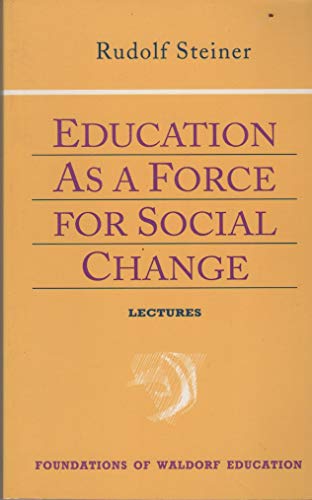
Education as a Force for Social Change: (Cw 296, 192, 330/331) Volume 4 (Foundations of Waldorf Education, 4) - Softcover
Inhaltsangabe
10 lectures, Dornach & Stuttgart, Apr. 23 - Aug. 17, 1919 (CW 296, 192, 330/331)
These illuminating lectures were given one month before the opening of the first Waldorf school, located in Stuttgart, following two years of intense preoccupation with the social situation in Germany as World War I ended and society sought to rebuild itself.
Well aware of the dangerous tendencies present in modern culture that undermine a true social life--psychic torpor and boredom, universal mechanization, and growing cynicism--Steiner recognized that any solution for society must address not only economic and legal issues but also that of a free spiritual life.
Steiner also saw the need to properly nurture in children the virtues of imitation, reverence, and love at the appropriate stages of development in order to create mature adults who are inwardly prepared to fulfill the demands of a truly healthy society--adults who are able to assume the responsibilities of freedom, equality, and brotherhood.
Relating these themes to an understanding of the human as a threefold being of thought, feeling, and volition, and against the background of historical forces at work in human consciousness, Steiner lays the ground for a profound revolution in the ways we think about education.
Also included here are three lectures on the social basis of education, a lecture to public school teachers, and a lecture to the workers of the Waldorf Astoria Cigarette Company, after which they asked him to form a school for their children.
German sources: Die Erziehungsfrage als soziale Frage (GA 296); lectures 4, 5, and 6, the "Volkspädagogik" lectures in Geisteswissenschaftliche Behandlung sozialer und pädagogischer Fragen (GA 192); lectures 2 and 11, Neugestaltung des sozialen Organismus (GA 330-331).
Die Inhaltsangabe kann sich auf eine andere Ausgabe dieses Titels beziehen.
Über die Autorin bzw. den Autor
Rudolf Steiner (b. Rudolf Joseph Lorenz Steiner, 1861-1925) was born in the small village of Kraljevec, Austro-Hungarian Empire (now in Croatia), where he grew up. As a young man, he lived in Weimar and Berlin, where he became a well-published scientific, literary, and philosophical scholar, known especially for his work with Goethe's scientific writings. Steiner termed his spiritual philosophy anthroposophy, meaning "wisdom of the human being." As an exceptionally developed seer, he based his work on direct knowledge and perception of spiritual dimensions. He initiated a modern, universal "spiritual science" that is accessible to anyone willing to exercise clear and unbiased thinking. From his spiritual investigations, Steiner provided suggestions for the renewal of numerous activities, including education (general and for special needs), agriculture, medicine, economics, architecture, science, philosophy, Christianity, and the arts. There are currently thousands of schools, clinics, farms, and initiatives in other fields that involve practical work based on the principles Steiner developed. His many published works feature his research into the spiritual nature of human beings, the evolution of the world and humanity, and methods for personal development. He wrote some thirty books and delivered more than six thousand lectures throughout much of Europe. In 1924, Steiner founded the General Anthroposophical Society, which today has branches around the world.
„Über diesen Titel“ kann sich auf eine andere Ausgabe dieses Titels beziehen.
Suchergebnisse für Education as a Force for Social Change: (Cw 296, 192,...

Beispielbild für diese ISBN
Education as a Force for Social Change: (Cw 296, 192, 330/331) Volume 4
Anbieter: ThriftBooks-Dallas, Dallas, TX, USA
Verkäuferbewertung 5 von 5 Sternen

Paperback. Zustand: Very Good. No Jacket. May have limited writing in cover pages. Pages are unmarked. ~ ThriftBooks: Read More, Spend Less. Artikel-Nr. G0880104112I4N00
Gebraucht kaufen
EUR 13,33
Versand gratis
Versand innerhalb von USA
Versand innerhalb von USA
Anzahl: 1 verfügbar
Beispielbild für diese ISBN
Education as a Force for Social Change: (Cw 296, 192, 330/331) Volume 4
Anbieter: ThriftBooks-Atlanta, AUSTELL, GA, USA
Verkäuferbewertung 5 von 5 Sternen
Paperback. Zustand: Very Good. No Jacket. May have limited writing in cover pages. Pages are unmarked. ~ ThriftBooks: Read More, Spend Less. Artikel-Nr. G0880104112I4N00
Gebraucht kaufen
EUR 13,33
Versand gratis
Versand innerhalb von USA
Versand innerhalb von USA
Anzahl: 1 verfügbar
Foto des Verkäufers
Education as a Force for Social Change
Verlag:
Anthroposophic Press, (Hudson, New York), 1997
ISBN 10: 0880104112
ISBN 13: 9780880104111
Gebraucht
Softcover
Erstausgabe
Anbieter: Between the Covers-Rare Books, Inc. ABAA, Gloucester City, NJ, USA
Verkäuferbewertung 5 von 5 Sternen
Softcover. Zustand: Near Fine. First edition. 241 [1]pp. Trade paperback. Translated by Robert F. Lathe and nancy Parsons Whittaker. Remainder mark, near fine. A title in the Foundations of Waldorf Education series. Artikel-Nr. 442938
Gebraucht kaufen
EUR 26,56
EUR 4,73 Versand
Versand innerhalb von USA
Versand innerhalb von USA
Anzahl: 1 verfügbar
Beispielbild für diese ISBN
Education as a Force for Social Change
Anbieter: PBShop.store UK, Fairford, GLOS, Vereinigtes Königreich
Verkäuferbewertung 5 von 5 Sternen
PAP. Zustand: New. New Book. Shipped from UK. Established seller since 2000. Artikel-Nr. BS-9780880104111
Neu kaufen
EUR 27,97
EUR 4,81 Versand
Versand von Vereinigtes Königreich nach USA
Versand von Vereinigtes Königreich nach USA
Anzahl: 4 verfügbar
Beispielbild für diese ISBN
Education as a Force for Social Change: (CW 296, 192, 330/331) (Volume 4) (Foundations of Waldorf Education)
Anbieter: Majestic Books, Hounslow, Vereinigtes Königreich
Verkäuferbewertung 4 von 5 Sternen

Zustand: New. Artikel-Nr. 4340974
Neu kaufen
EUR 26,47
EUR 7,52 Versand
Versand von Vereinigtes Königreich nach USA
Versand von Vereinigtes Königreich nach USA
Anzahl: 3 verfügbar
Beispielbild für diese ISBN
Education as a Force: (Cw 296, 192, 330/331) Volume 4: v. 4 (Foundations of Waldorf Education)
Anbieter: Homeless Books, Berlin, Deutschland
Verkäuferbewertung 5 von 5 Sternen
Softcover. Zustand: Gut. The book has been read, but remains in very good condition. No marks or notes from previous owner. Language: English. Ships from Berlin. Artikel-Nr. ABE-1757720234336
Gebraucht kaufen
EUR 16,00
EUR 19,95 Versand
Versand von Deutschland nach USA
Versand von Deutschland nach USA
Anzahl: 1 verfügbar
Beispielbild für diese ISBN
Education As a Force for Social Change (Foundations of Waldorf Education, 4)
Anbieter: Revaluation Books, Exeter, Vereinigtes Königreich
Verkäuferbewertung 5 von 5 Sternen
Paperback. Zustand: Brand New. 241 pages. 8.75x5.75x0.75 inches. In Stock. Artikel-Nr. x-0880104112
Neu kaufen
EUR 28,33
EUR 11,57 Versand
Versand von Vereinigtes Königreich nach USA
Versand von Vereinigtes Königreich nach USA
Anzahl: 2 verfügbar
Beispielbild für diese ISBN
Education as a Force for Social Change: (CW 296, 192, 330/331) (Volume 4) (Foundations of Waldorf Education)
Anbieter: Ria Christie Collections, Uxbridge, Vereinigtes Königreich
Verkäuferbewertung 5 von 5 Sternen
Zustand: New. In. Artikel-Nr. ria9780880104111_new
Neu kaufen
EUR 26,98
EUR 13,86 Versand
Versand von Vereinigtes Königreich nach USA
Versand von Vereinigtes Königreich nach USA
Anzahl: Mehr als 20 verfügbar
Foto des Verkäufers
Education as a Force for Social Change
Anbieter: moluna, Greven, Deutschland
Verkäuferbewertung 5 von 5 Sternen
Zustand: New. Über den AutorRudolf Steiner (b. Rudolf Joseph Lorenz Steiner, 1861-1925) was born in the small village of Kraljevec, Austro-Hungarian Empire (now in Croatia), where he grew up. As a young man, he lived in Weimar an. Artikel-Nr. 595123599
Neu kaufen
EUR 32,49
EUR 48,99 Versand
Versand von Deutschland nach USA
Versand von Deutschland nach USA
Anzahl: Mehr als 20 verfügbar
Foto des Verkäufers
Education as a Force for Social Change : (Cw 296, 192, 330/331) Volume 4
Anbieter: AHA-BUCH GmbH, Einbeck, Deutschland
Verkäuferbewertung 5 von 5 Sternen
Taschenbuch. Zustand: Neu. Neuware - These lectures were given one month before the opening of the first Waldorf School in September 1919, in the context of Germany's postwar social ferment. Steiner points to negative tendencies present in modern social life such as inner drowsiness, mechanization, and animalization. A true social solution must not only consider economics and legal rights but also the third element of the free spiritual life. 'The great problem of the future will be education', he announces, and goes on to explain how only a proper nurturing of imitation, reverence, and love in the three periods of child development can prepare adults who are ripe to live the three virtues of a healthy social order: cultural freedom, legal equality, and economic brotherhood. These ideas are then connected to Steiner's threefold pictures of the human soul, economics, higher knowledge, and 'physiognomic pedagogy'. This new translation also includes three lectures, 'The Social Basis of Public Education' (in German, the Volkspadagogik lectures), available in English for the first time. Artikel-Nr. 9780880104111
Neu kaufen
EUR 38,82
EUR 61,95 Versand
Versand von Deutschland nach USA
Versand von Deutschland nach USA
Anzahl: 1 verfügbar