
Verwandte Artikel zu Reading Colonial Japan: Text, Context, and Critique
Inhaltsangabe
By any measure, Japan's modern empire was formidable. The only major non-western colonial power in the 20th century, Japan controlled a vast area of Asia and numerous archipelagos in the Pacific Ocean. The massive extraction of resources and extensive cultural assimilation policies radically impacted the lives of millions of Asians and Micronesians, and the political, economic, and cultural ramifications of this era are still felt today.
The Japanese empire lasted from 1869-1945. During this time, how was the Japanese imperial project understood, imagined, and lived? Reading Colonial Japan is a unique anthology that aims to deepen knowledge of Japanese colonialism(s) by providing an eclectic selection of translated Japanese primary sources and analytical essays that illuminate Japan's many and varied colonial projects. The primary documents highlight how central cultural production and dissemination were to the colonial effort, while accentuating the myriad ways colonialism permeated every facet of life. The variety of genres the explored includes legal documents, children's literature, cookbooks, serialized comics, and literary texts by well-known authors of the time. These cultural works, produced by a broad spectrum of "ordinary" Japanese citizens (a housewife in Manchuria, settlers in Korea, manga artists and fiction writers in mainland Japan, and so on), functioned effectively to reinforce the official policies that controlled and violated the lives of the colonized throughout Japan's empire.
By making available and analyzing a wide-range of sources that represent "media" during the Japanese colonial period, Reading Colonial Japan draws attention to the powerful role that language and imagination played in producing the material realities of Japanese colonialism.
The Japanese empire lasted from 1869-1945. During this time, how was the Japanese imperial project understood, imagined, and lived? Reading Colonial Japan is a unique anthology that aims to deepen knowledge of Japanese colonialism(s) by providing an eclectic selection of translated Japanese primary sources and analytical essays that illuminate Japan's many and varied colonial projects. The primary documents highlight how central cultural production and dissemination were to the colonial effort, while accentuating the myriad ways colonialism permeated every facet of life. The variety of genres the explored includes legal documents, children's literature, cookbooks, serialized comics, and literary texts by well-known authors of the time. These cultural works, produced by a broad spectrum of "ordinary" Japanese citizens (a housewife in Manchuria, settlers in Korea, manga artists and fiction writers in mainland Japan, and so on), functioned effectively to reinforce the official policies that controlled and violated the lives of the colonized throughout Japan's empire.
By making available and analyzing a wide-range of sources that represent "media" during the Japanese colonial period, Reading Colonial Japan draws attention to the powerful role that language and imagination played in producing the material realities of Japanese colonialism.
Die Inhaltsangabe kann sich auf eine andere Ausgabe dieses Titels beziehen.
Über die Autorinnen und Autoren
Michele M. Mason is assistant professor of Japanese literature at the University of Maryland, College Park. She is also the co-producer and interpreter for the short documentary film Witness to Hiroshima (2010). Helen J.S. Lee is an assistant professor of Japanese studies at the Underwood International College, Yonsei University, Seoul, Korea.
Michele M. Mason is assistant professor of Japanese literature at the University of Maryland, College Park. She is also the co-producer and interpreter for the short documentary film Witness to Hiroshima (2010). Helen J.S. Lee is an assistant professor of Japanese studies at the Underwood International College, Yonsei University, Seoul, Korea.
Auszug. © Genehmigter Nachdruck. Alle Rechte vorbehalten.
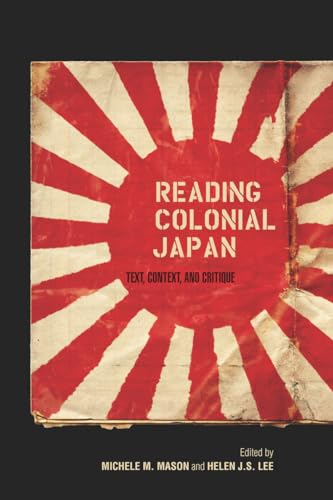
Reading Colonial Japan
TEXT, CONTEXT, AND CRITIQUESTANFORD UNIVERSITY PRESS
Copyright © 2012 Board of Trustees of the Leland Stanford Junior UniversityAll right reserved.
ISBN: 978-0-8047-7697-4
Contents
Contributors...........................................................xiAcknowledgments........................................................xiiiNote on Japanese Names.................................................xvINTRODUCTION MICHELE M. MASON AND HELEN J. S. LEE.....................1CHAPTER ONE............................................................19CHAPTER TWO............................................................55CHAPTER THREE..........................................................77CHAPTER FOUR...........................................................109CHAPTER FIVE...........................................................141CHAPTER SIX............................................................179CHAPTER SEVEN..........................................................209CHAPTER EIGHT..........................................................243Index..................................................................299
Chapter One
TEXT The Shores of the Sorachi River KUNIKIDA DOPPOCONTEXT Hokkaido
CRITIQUE Writing Ainu Out/Writing Japanese In: The "Nature" of Japanese Colonialism in Hokkaido MICHELE M. MASON
Kunikida Doppo (1871–1908) is widely regarded as having played a formative role in the creation of modern Japanese literature. A child born out of wedlock to a former samurai and a servant, Doppo grew up in rural southwestern Japan, which is said to have imbued him with a love of nature. He converted to Christianity in 1891 after he gave up his dream to be a politician. He studied English literature at university and was later active in various literary and poetic circles in Tokyo. He was a war correspondent for the journal The Nation's Companion (Kokumin no tomo) during the Russo-Japanese War (1904–1905). Doppo died at the age of 36 from tuberculosis.
Not unlike many of his contemporaries, Doppo, for a time, envisioned Hokkaido as a utopian space. He convinced his lover, Sasaki Nobuko, to elope and "escape" to Hokkaido where, it was imagined, the restrictions of Japanese traditions did not reach. The marriage and his stay in Hokkaido were short-lived. Doppo's "Unforgettable People" (Wasure'enu hitobito, 1898) and "Musashino" (Musashino, 1901) have attracted much scholarly attention, although later works, for instance those in his collection entitled Fate (Unmei, 1906), earned him critical acclaim during his life.
In "The Shores of the Sorachi River" (Sorachigawa no kishibe, 1902), the male protagonist travels to Hokkaido to buy some land. His endeavors to find local officials, who can advise him about property along the Sorachi River, force him to travel about the "newly opened" island. From his train and lodging windows, from atop a horse-drawn wagon, and during his walks in the mountains and through a rugged mining outpost, "I" observes the unfamiliar landscape of the northern island and muses on the relationship between humans and nature. The narrator's inner dialogue chronicles his mercurial moods, ranging from ecstatic to despondent according to the ever-changing weather, and reveals his sense of alienation from both society and nature.
The Shores of the Sorachi River KUNIKIDA DOPPO TRANSLATION BY MICHELE M. MASON
Part One
I stayed in Sapporo for five days. It was only five days, but in that time my fond feelings for Hokkaido multiplied many times over.
Even the wilderness of the northeast inspired devotion in me, a person who grew up in the densely populated central region of our country's mainland and was accustomed to scenery of mountains and fields that had been conquered by human power. Upon seeing Hokkaido, the northernmost part of the country, how could my heart not be moved?! Sapporo is said to be the Tokyo of Hokkaido, but I was all but bewitched by the many sights there.
I set out alone from Sapporo for the shores of the Sorachi River on the morning of September 25. Had it been Tokyo, it still would have been warm, but here I was wearing my Western winter clothing. Autumn was waning and the bare trees told me that winter was chasing close behind.
My goal was to meet a prefectural official who had surveyed the shores of the Sorachi River and to consult with him about choosing some land. However, I was completely in the dark about the geography. Also, since I didn't know where the prefectural official was stationed, and neither did any of my acquaintances in Sapporo, I boarded the train headed for Sorachibuto feeling disheartened.
The fields of Ishikari were lost in the low-lying clouds, and as I stared out from the train window onto the fields and mountains, I was overwhelmed by the frightening power of nature. Here there was no love, no compassion. To look out on this savage, lonely, heartless, and yet magnificent sight, it appeared to me all the more that nature scorns the powerlessness and fragility of humans.
I wondered what several people in the same train car were thinking about me, a young man silently sitting in the corner next to a window with his white face buried in the collar of his overcoat. The passengers' conversations included crops, forestry, the soil, and how to extract gold from the unlimited natural resources of the area. Some were talking loudly while they sipped alcohol, and others joked around as they smoked their pipes. Most of them had met for the first time on the train. I was the only one who didn't join in, and I kept myself apart from the rest, sinking into my own thoughts. I had never put any thought to the question of how you are supposed to get along in society. I simply went from moment to moment concentrating on how to make my own way. Therefore, my fellow passengers seemed to be of another world, and I could not help but feel that between them and me stretched an impassable, deep valley. I thought to myself that even today, with me isolated in a corner of this train car full of people passing through the Ishikari plain, was like any other day of my life. Ah, the loneliness! Even though I willingly walk outside of society, in the depths of my heart I cannot bear the loneliness.
If it had been a fine, fall day and clear on the high peaks, I could have escaped my gloomy mood and relaxed. But the clouds hung increasingly lower, and the forest was enveloped in the mist so that no matter where I looked there was not even a flicker of light. I fell into a nearly unbearable state of melancholy.
The train arrived at a certain stop that splits off to the coal mine at Utashinai, and most of the passengers disembarked to transfer to other trains, leaving behind just two others besides myself. The train ran on a straight line, piercing the huge forests in which not one person has tread since the beginning of time—thousands of years. Layer upon layer of ash-colored mist, appearing and then disappearing as if a living being, was silently wafting and floating.
All of a sudden a man asked me, "Where are you headed?" He was around forty years old, with a masculine build, long hair, a square face, sharp eyes, and a big nose—a man who seemed a rogue at a glance. His manners suggested he wasn't an official or a craftsman. He wasn't a farmer or a merchant either. In fact, he was the kind of man whom you would only see in a place like Hokkaido. He was the adventurer...
„Über diesen Titel“ kann sich auf eine andere Ausgabe dieses Titels beziehen.
Suchergebnisse für Reading Colonial Japan: Text, Context, and Critique

Beispielbild für diese ISBN
Reading Colonial Japan: Text, Context, and Critique
Verlag:
Stanford University Press, 2012
ISBN 10: 0804776970
ISBN 13: 9780804776974
Gebraucht
Paperback
Anbieter: World of Books (was SecondSale), Montgomery, IL, USA
Verkäuferbewertung 5 von 5 Sternen

Paperback. Zustand: Good. By any measure, Japan's modern empire was formidable. The only major non-western colonial power in the 20th century, Japan controlled a vast area of Asia and numerous archipelagos in the Pacific Ocean. The massive extraction of resources and extensive cultural assimilation policies radically impacted the lives of millions of Asians and Micronesians, and the political, economic, and cultural ramifications of this era are still felt today. The Japanese empire lasted from 1869-1945. During this time, how was the Japanese imperial project understood, imagined, and lived? Reading Colonial Japan is a unique anthology that aims to deepen knowledge of Japanese colonialism(s) by providing an eclectic selection of translated Japanese primary sources and analytical essays that illuminate Japan's many and varied colonial projects. The primary documents highlight how central cultural production and dissemination were to the colonial effort, while accentuating the myriad ways colonialism permeated every facet of life. The variety of genres the explored includes legal documents, children's literature, cookbooks, serialized comics, and literary texts by well-known authors of the time. These cultural works, produced by a broad spectrum of "ordinary" Japanese citizens (a housewife in Manchuria, settlers in Korea, manga artists and fiction writers in mainland Japan, and so on), functioned effectively to reinforce the official policies that controlled and violated the lives of the colonized throughout Japan's empire. By making available and analyzing a wide-range of sources that represent "media" during the Japanese colonial period, Reading Colonial Japan draws attention to the powerful role that language and imagination played in producing the material realities of Japanese colonialism. Artikel-Nr. CIN0804776970G
Gebraucht kaufen
EUR 4,12
Versand gratis
Versand innerhalb von USA
Versand innerhalb von USA
Anzahl: 1 verfügbar
Beispielbild für diese ISBN
Reading Colonial Japan: Text, Context, and Critique
Verlag:
Stanford University Press (edition 1), 2012
ISBN 10: 0804776970
ISBN 13: 9780804776974
Gebraucht
Paperback
Anbieter: BooksRun, Philadelphia, PA, USA
Verkäuferbewertung 5 von 5 Sternen
Paperback. Zustand: Very Good. 1. It's a well-cared-for item that has seen limited use. The item may show minor signs of wear. All the text is legible, with all pages included. It may have slight markings and/or highlighting. Artikel-Nr. 0804776970-11-1
Gebraucht kaufen
EUR 4,84
Versand gratis
Versand innerhalb von USA
Versand innerhalb von USA
Anzahl: 1 verfügbar
Beispielbild für diese ISBN
Reading Colonial Japan: Text, Context, and Critique
Verlag:
Stanford University Press, 2012
ISBN 10: 0804776970
ISBN 13: 9780804776974
Gebraucht
Paperback
Anbieter: ThriftBooks-Atlanta, AUSTELL, GA, USA
Verkäuferbewertung 5 von 5 Sternen
Paperback. Zustand: Good. No Jacket. Pages can have notes/highlighting. Spine may show signs of wear. ~ ThriftBooks: Read More, Spend Less. Artikel-Nr. G0804776970I3N00
Gebraucht kaufen
EUR 6,75
Versand gratis
Versand innerhalb von USA
Versand innerhalb von USA
Anzahl: 1 verfügbar
Beispielbild für diese ISBN
Reading Colonial Japan : Text, Context, and Critique
Verlag:
Stanford University Press, 2012
ISBN 10: 0804776970
ISBN 13: 9780804776974
Gebraucht
Softcover
Anbieter: Better World Books, Mishawaka, IN, USA
Verkäuferbewertung 5 von 5 Sternen
Zustand: Good. Pages intact with minimal writing/highlighting. The binding may be loose and creased. Dust jackets/supplements are not included. Stock photo provided. Product includes identifying sticker. Better World Books: Buy Books. Do Good. Artikel-Nr. 14969710-6
Gebraucht kaufen
EUR 7,01
Versand gratis
Versand innerhalb von USA
Versand innerhalb von USA
Anzahl: 1 verfügbar
Beispielbild für diese ISBN
Reading Colonial Japan : Text, Context, and Critique
Verlag:
Stanford University Press, 2012
ISBN 10: 0804776970
ISBN 13: 9780804776974
Gebraucht
Softcover
Anbieter: Better World Books, Mishawaka, IN, USA
Verkäuferbewertung 5 von 5 Sternen
Zustand: Very Good. Pages intact with possible writing/highlighting. Binding strong with minor wear. Dust jackets/supplements may not be included. Stock photo provided. Product includes identifying sticker. Better World Books: Buy Books. Do Good. Artikel-Nr. 5748043-75
Gebraucht kaufen
EUR 7,01
Versand gratis
Versand innerhalb von USA
Versand innerhalb von USA
Anzahl: 1 verfügbar
Beispielbild für diese ISBN
Reading Colonial Japan
Anbieter: PBShop.store UK, Fairford, GLOS, Vereinigtes Königreich
Verkäuferbewertung 5 von 5 Sternen
PAP. Zustand: New. New Book. Shipped from UK. Established seller since 2000. Artikel-Nr. FW-9780804776974
Neu kaufen
EUR 30,25
EUR 4,91 Versand
Versand von Vereinigtes Königreich nach USA
Versand von Vereinigtes Königreich nach USA
Anzahl: 1 verfügbar
Beispielbild für diese ISBN
Reading Colonial Japan: Text, Context, and Critique
Anbieter: Ria Christie Collections, Uxbridge, Vereinigtes Königreich
Verkäuferbewertung 5 von 5 Sternen
Zustand: New. In English. Artikel-Nr. ria9780804776974_new
Neu kaufen
EUR 31,49
EUR 13,32 Versand
Versand von Vereinigtes Königreich nach USA
Versand von Vereinigtes Königreich nach USA
Anzahl: 1 verfügbar
Beispielbild für diese ISBN
Reading Colonial Japan Text, Context, and Critique
Anbieter: Revaluation Books, Exeter, Vereinigtes Königreich
Verkäuferbewertung 5 von 5 Sternen
Paperback. Zustand: Brand New. 320 pages. 9.00x6.00x0.75 inches. In Stock. Artikel-Nr. x-0804776970
Neu kaufen
EUR 35,41
EUR 11,80 Versand
Versand von Vereinigtes Königreich nach USA
Versand von Vereinigtes Königreich nach USA
Anzahl: 2 verfügbar
Beispielbild für diese ISBN
Reading Colonial Japan: Text, Context, and Critique
Anbieter: Kennys Bookstore, Olney, MD, USA
Verkäuferbewertung 5 von 5 Sternen
Zustand: New. Editor(s): Mason, Michele M.; Lee, Helen. Num Pages: 320 pages, black & white illustrations, figures. BIC Classification: HBTQ. Category: (G) General (US: Trade). Dimension: 228 x 154 x 18. Weight in Grams: 438. . 2012. Paperback. . . . . Books ship from the US and Ireland. Artikel-Nr. V9780804776974
Neu kaufen
EUR 38,05
EUR 9,36 Versand
Versand innerhalb von USA
Versand innerhalb von USA
Anzahl: 1 verfügbar
Beispielbild für diese ISBN
Reading Colonial Japan
Anbieter: Majestic Books, Hounslow, Vereinigtes Königreich
Verkäuferbewertung 4 von 5 Sternen

Zustand: New. pp. 320. Artikel-Nr. 57969218
Neu kaufen
EUR 48,46
EUR 7,67 Versand
Versand von Vereinigtes Königreich nach USA
Versand von Vereinigtes Königreich nach USA
Anzahl: 1 verfügbar