
Verwandte Artikel zu Achieving Strategic Excellence: An Assessment of Human...
Inhaltsangabe
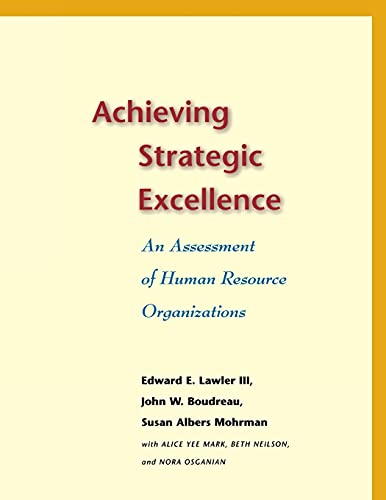
This is the Center for Effective Organizations's (CEO) fourth national study of the human resources (HR) function in large corporations. It is the only long-term national study of this important function. Like the previous studies, it focuses on measuring whether the HR function is changing and on gauging its effectiveness. The study focuses particularly on whether the HR function is changing to become an effective strategic partner. It also analyzes how organizations can more effectively manage their human capital. The present study compares data from earlier studies to data collected in 2004. The results show some important changes and indicate what HR needs to do to be effective. Practices are identified that enable HR functions to be high value-added strategic partners.
Die Inhaltsangabe kann sich auf eine andere Ausgabe dieses Titels beziehen.
Über die Autorinnen und Autoren
Edward E. Lawler III is Distinguished Professor of Business and Director of the Center for Effective Organizations in the Marshall School of Business at the University of Southern California. His most recent books include Creating a Strategic Human Resources Organization (Stanford University Press, 2003), and Human Resources Business Process Outsourcing (2004). John W. Boudreau is Professor of Management and Organization and Research Director of the Center for Effective Organizations, at the Marshall School of Business, University of Southern California. Susan Albers Mohrman is Senior Research Scientist at the Center for Effective Organizations at the Marshall School of Business, University of Southern California.
Edward E. Lawler III is Distinguished Professor of Business and Director of the Center for Effective Organizations in the Marshall School of Business at the University of Southern California. His most recent books include Creating a Strategic Human Resources Organization (Stanford University Press, 2003), and Human Resources Business Process Outsourcing (2004). John W. Boudreau is Professor of Management and Organization and Research Director of the Center for Effective Organizations, at the Marshall School of Business, University of Southern California. Susan Albers Mohrman is Senior Research Scientist at the Center for Effective Organizations at the Marshall School of Business, University of Southern California.
Von der hinteren Coverseite
“Achieving Strategic Excellence offers a unique and practical perspective based on solid research on how HR impacts business success. The inclusion of data from senior line managers adds a dose of reality to how the HR function has actually changed. This important work is a must-read for HR professionals as well as business leaders seeking to maximize human capital.”—Daryl D. David, Executive Vice President, Human Resources, Washington Mutual, Inc.
“This latest update of CEO's longitudinal HR study provides almost a decade of perspective on the challenges and changes in the HR function. HR leaders in all industries and stages of career experience will find Lawler, Mohrman, and Boudreau's conclusions insightful and provocative with some interesting twists. The strategic HR journey continues . . .”—Mary Eckenrod, Chair Elect, The Human Resource Planning Society; Vice President, Global Talent Management, Kraft Foods
“This latest update of CEO's longitudinal HR study provides almost a decade of perspective on the challenges and changes in the HR function. HR leaders in all industries and stages of career experience will find Lawler, Mohrman, and Boudreau's conclusions insightful and provocative with some interesting twists. The strategic HR journey continues . . .”—Mary Eckenrod, Chair Elect, The Human Resource Planning Society; Vice President, Global Talent Management, Kraft Foods
Aus dem Klappentext
This is the Center for Effective Organizations s (CEO) fourth national study of the human resources (HR) function in large corporations. It is the only long-term national study of this important function. Like the previous studies, it focuses on measuring whether the HR function is changing and on gauging its effectiveness. The study focuses particularly on whether the HR function is changing to become an effective strategic partner. It also analyzes how organizations can more effectively manage their human capital. The present study compares data from earlier studies to data collected in 2004. The results show some important changes and indicate what HR needs to do to be effective. Practices are identified that enable HR functions to be high value-added strategic partners.
Auszug. © Genehmigter Nachdruck. Alle Rechte vorbehalten.
Achieving Strategic Excellence
An Assessment of Human Resource OrganizationsBy Edward E. Lawler III John W. Boudreau Susan Albers Mohrman Alice Yee Mark Beth Neilson Nora OsganianSTANFORD UNIVERSITY PRESS
Copyright © 2006 Board of Trustees of the Leland Stanford Junior UniversityAll right reserved.
ISBN: 978-0-8047-5331-9
Contents
Tables and Exhibits.........................................viiPreface.....................................................ixThe Authors.................................................xi1 How HR Can Add Value......................................12 Research Design...........................................123 Role of Human Resources...................................204 Business Strategy.........................................245 HR Decision Science.......................................326 HR Organizational Design..................................417 Human Resources Activities................................488 Outsourcing...............................................529 Use of Information Technology.............................5910 Effectiveness of Information Systems.....................6411 HR Analytics and Metrics.................................7212 Human Resource Skills....................................8013 Effectiveness of the HR Organization.....................8714 Determinants of HR Effectiveness.........................9315 HR Excellence............................................104References..................................................119Appendixes..................................................123
Chapter One
How HR Can Add Value
Global competition, information technology, new knowledge, the increase in knowledge workers, and a host of other business environment changes are forcing organizations to constantly evaluate how they operate. In many cases they have embraced new strategic initiatives and significantly changed how they operate. They are utilizing new technologies, changing their structures, and improving their work processes to respond to an increasingly demanding and global customer base. These initiatives involve fundamental changes that have significant implications for their human capital and their human resources functions.
Human capital management should be an important part of the strategy of any corporation. The annual reports of many corporations argue that their human capital and intellectual property are their most important assets. In many organizations, compensation is one of the largest, if not the largest, cost. In service organizations compensation often represents 70 to 80 percent of the total cost of doing business. Adding the costs of training and other human resources management activities to the compensation costs, we can see that the human resources function often has responsibility for a large portion of an organization's total expenditures.
But the compensation cost of human capital is not the only, or even the most important, consideration. Even when compensation accounts for very little of the cost of doing business, human capital has a significant impact on the performance of an organization (Cascio, 2000). In essence, without effective human capital, organizations are likely to have little or no revenue. Even the most automated production facilities require skilled, motivated employees to operate them. Knowledge work organizations depend on employees to develop, use, and manage their most important asset, knowledge. Thus, although the human capital of a company does not appear on the balance sheet of corporations, it represents an increasingly large percentage of many organizations' market valuation (Lev, 2001).
A growing body of evidence affirms that HR practices can be a value-added function in an organization. The initial work on the relationship between a firm's performance and its HR practices was conducted by Becker and Huselid (1998). In their study of 740 corporations, they found that firms with the greatest intensity of HR practices that reinforce performance had the highest market value per employee. They argued that HR practices are critical in determining the market value of a corporation and that improvements in HR practices can lead to significant increases in the market value of corporations. They concluded that the best firms are able to achieve both operational and strategic excellence in their HR systems.
Role of the Human Resources Organization
The HR function can add value by adopting a control-and-audit role. But two other roles that it can take on allow it to add still greater value. Lawler (1995) has developed this line of thought by describing the three roles it can take on. The first is the familiar human resources management role (Exhibit 1.1).
The second is the role of business partner (Exhibit 1.2). It emphasizes developing systems and practices to ensure that a company's human resources have the needed competencies and motivation to perform effectively. In this approach, HR has a seat at the table when business issues are discussed and brings an HR perspective to these discussions. When it comes to designing HR systems and practices, this approach focuses on creating systems and practices that support the business strategy. HR also measures the effectiveness of the human capital management practices and focuses on process improvements.
The business partner approach positions the HR function as a value-added part of an organization. It is positioned to contribute to business performance by effectively managing what is the most important capital of most organizations, their human capital. But, this approach may not be one that enables the HR function to add the greatest value. By becoming a strategic partner, HR has the potential to add more value (see Exhibit 1.3).
In acting as a strategic partner, HR plays a role that includes helping the organization develop its strategy. Here, not only does HR have a seat at the strategy table, HR helps to set the table. Boudreau and Ramstad (2005a, 2005b) support this idea by suggesting that strategies can be shaped and enhanced by bringing a human capital decision science to HR's role in strategy.
In the knowledge economy, a firm's strategy must be closely linked to its human talent. Thus, the human resources function must be positioned and designed as a strategic partner that participates in both strategy formulation and implementation. Its expertise in attracting, retaining, developing, deploying, motivating, and organizing human capital is critical to both. Ideally, the HR function should be knowledgeable about the business and expert in organizational and work design issues so that it can help develop needed organizational capabilities and facilitate organizational change as new opportunities become available.
To be a strategic partner, HR executives need an expert understanding of business strategy, organizational design, and change management, and need to know how integrated human resources practices and strategies can support organizational designs and strategies. This role requires extending HR's focus beyond delivery of HR services and practices to a focus on the quality of decisions about talent, organization, and human capital.
As a strategic partner, HR brings to the table a perspective that is often missing in discussions of business strategy and change-a knowledge of the human capital factors and the organizational changes that are critical to determining whether a strategy can be implemented. Many more strategies fail in execution than in their conception.
Despite...
„Über diesen Titel“ kann sich auf eine andere Ausgabe dieses Titels beziehen.
Suchergebnisse für Achieving Strategic Excellence: An Assessment of Human...

Beispielbild für diese ISBN
Achieving Strategic Excellence : An Assessment of Human Resource Organizations
Verlag:
Stanford University Press, 2006
ISBN 10: 0804753318
ISBN 13: 9780804753319
Gebraucht
Softcover
Anbieter: Better World Books, Mishawaka, IN, USA
Verkäuferbewertung 5 von 5 Sternen

Zustand: Good. Former library copy. Pages intact with minimal writing/highlighting. The binding may be loose and creased. Dust jackets/supplements are not included. Includes library markings. Stock photo provided. Product includes identifying sticker. Better World Books: Buy Books. Do Good. Artikel-Nr. 936387-75
Gebraucht kaufen
EUR 10,07
Versand gratis
Versand innerhalb von USA
Versand innerhalb von USA
Anzahl: 1 verfügbar
Beispielbild für diese ISBN
Achieving Strategic Excellence
Anbieter: PBShop.store UK, Fairford, GLOS, Vereinigtes Königreich
Verkäuferbewertung 5 von 5 Sternen
PAP. Zustand: New. New Book. Shipped from UK. Established seller since 2000. Artikel-Nr. FW-9780804753319
Neu kaufen
EUR 45,88
EUR 4,89 Versand
Versand von Vereinigtes Königreich nach USA
Versand von Vereinigtes Königreich nach USA
Anzahl: 15 verfügbar
Beispielbild für diese ISBN
Achieving Strategic Excellence An Assessment of Human Resource Organizations
Anbieter: Revaluation Books, Exeter, Vereinigtes Königreich
Verkäuferbewertung 5 von 5 Sternen
Paperback. Zustand: Brand New. 1st edition. 143 pages. 10.75x8.50x0.50 inches. In Stock. Artikel-Nr. x-0804753318
Neu kaufen
EUR 55,36
EUR 11,77 Versand
Versand von Vereinigtes Königreich nach USA
Versand von Vereinigtes Königreich nach USA
Anzahl: 2 verfügbar
Beispielbild für diese ISBN
Achieving Strategic Excellence: An Assessment of Human Resource Organizations
Anbieter: Ria Christie Collections, Uxbridge, Vereinigtes Königreich
Verkäuferbewertung 5 von 5 Sternen
Zustand: New. In English. Artikel-Nr. ria9780804753319_new
Neu kaufen
EUR 56,54
EUR 11,03 Versand
Versand von Vereinigtes Königreich nach USA
Versand von Vereinigtes Königreich nach USA
Anzahl: Mehr als 20 verfügbar
Beispielbild für diese ISBN
Achieving Strategic Excellence
Anbieter: Majestic Books, Hounslow, Vereinigtes Königreich
Verkäuferbewertung 4 von 5 Sternen

Zustand: New. pp. xi + 143. Artikel-Nr. 7989857
Neu kaufen
EUR 61,67
EUR 7,65 Versand
Versand von Vereinigtes Königreich nach USA
Versand von Vereinigtes Königreich nach USA
Anzahl: 3 verfügbar
Beispielbild für diese ISBN
Achieving Strategic Excellence: An Assessment of Human Resource Organizations
Anbieter: Kennys Bookstore, Olney, MD, USA
Verkäuferbewertung 5 von 5 Sternen
Zustand: New. Presents the Center for Effective Organizations's (CEO) fourth national study of the human resources (HR) function in large corporations. It analyzes how organizations can effectively manage their human capital, and compares data from earlier studies to data collected in 2004. The results indicate what HR needs to do to be effective. Num Pages: 160 pages, 57 tables. BIC Classification: KJMV2. Category: (P) Professional & Vocational; (UP) Postgraduate, Research & Scholarly; (UU) Undergraduate. Dimension: 7112 x 5487 x 11. Weight in Grams: 376. . 2006. Paperback. . . . . Books ship from the US and Ireland. Artikel-Nr. V9780804753319
Neu kaufen
EUR 73,14
EUR 9,33 Versand
Versand innerhalb von USA
Versand innerhalb von USA
Anzahl: Mehr als 20 verfügbar
Foto des Verkäufers
Achieving Strategic Excellence : An Assessment of Human Resource Organizations
Verlag:
Stanford University Press Apr 2006, 2006
ISBN 10: 0804753318
ISBN 13: 9780804753319
Neu
Taschenbuch
Anbieter: AHA-BUCH GmbH, Einbeck, Deutschland
Verkäuferbewertung 5 von 5 Sternen
Taschenbuch. Zustand: Neu. Neuware - This is the Center for Effective Organizations's (CEO) fourth national study of the human resources (HR) function in large corporations. It is the only long-term national study of this important function. Like the previous studies, it focuses on measuring whether the HR function is changing and on gauging its effectiveness. The study focuses particularly on whether the HR function is changing to become an effective strategic partner. It also analyzes how organizations can more effectively manage their human capital. The present study compares data from earlier studies to data collected in 2004. The results show some important changes and indicate what HR needs to do to be effective. Practices are identified that enable HR functions to be high value-added strategic partners. Artikel-Nr. 9780804753319
Neu kaufen
EUR 56,67
EUR 35,00 Versand
Versand von Deutschland nach USA
Versand von Deutschland nach USA
Anzahl: 2 verfügbar
Foto des Verkäufers
Achieving Strategic Excellence: An Assessment of Human Resource Organizations
Anbieter: moluna, Greven, Deutschland
Verkäuferbewertung 5 von 5 Sternen
Zustand: New. Presents the Center for Effective Organizations s (CEO) fourth national study of the human resources (HR) function in large corporations. It analyzes how organizations can effectively manage their human capital, and compares data from earlier studies to dat. Artikel-Nr. 595015226
Neu kaufen
EUR 43,55
EUR 48,99 Versand
Versand von Deutschland nach USA
Versand von Deutschland nach USA
Anzahl: Mehr als 20 verfügbar