
Verwandte Artikel zu The Matrix of Visual Culture: Working with Deleuze...
The Matrix of Visual Culture: Working with Deleuze in Film Theory (Cultural Memory in the Present) - Hardcover
Buch 56 von 213: Cultural Memory in the Present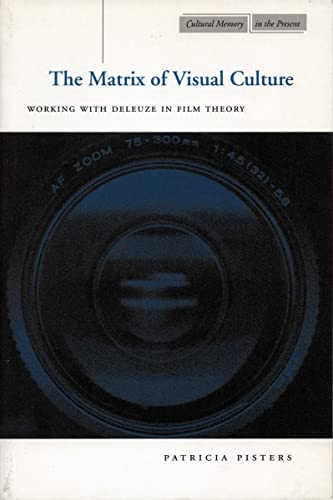
Inhaltsangabe
This book explores Gilles Deleuze's contribution to film theory. According to Deleuze, we have come to live in a universe that could be described as metacinematic. His conception of images implies a new kind of camera consciousness, one that determines our perceptions and sense of selves: aspects of our subjectivities are formed in, for instance, action-images, affection-images and time-images. We live in a matrix of visual culture that is always moving and changing. Each image is always connected to an assemblage of affects and forces. This book presents a model, as well as many concrete examples, of how to work with Deleuze in film theory. It asks questions about the universe as metacinema, subjectivity, violence, feminism, monstrosity, and music. Among the contemporary films it discusses within a Deleuzian framework are Strange Days, Fight Club, and Dancer in the Dark.
Die Inhaltsangabe kann sich auf eine andere Ausgabe dieses Titels beziehen.
Über die Autorinnen und Autoren
Patricia Pisters is Professor of Film at the University of Amsterdam.
Patricia Pisters is Professor of Film at the University of Amsterdam.
Von der hinteren Coverseite
This book explores Gilles Deleuze's contribution to film theory. According to Deleuze, we have come to live in a universe that could be described as metacinematic. His conception of images implies a new kind of camera consciousness, one that determines our perceptions and sense of selves: aspects of our subjectivities are formed in, for instance, action-images, affection-images and time-images. We live in a matrix of visual culture that is always moving and changing. Each image is always connected to an assemblage of affects and forces. This book presents a model, as well as many concrete examples, of how to work with Deleuze in film theory. It asks questions about the universe as metacinema, subjectivity, violence, feminism, monstrosity, and music. Among the contemporary films it discusses within a Deleuzian framework are Strange Days, Fight Club, and Dancer in the Dark.
Aus dem Klappentext
This book explores Gilles Deleuze's contribution to film theory. According to Deleuze, we have come to live in a universe that could be described as metacinematic. His conception of images implies a new kind of camera consciousness, one that determines our perceptions and sense of selves: aspects of our subjectivities are formed in, for instance, action-images, affection-images and time-images. We live in a matrix of visual culture that is always moving and changing. Each image is always connected to an assemblage of affects and forces. This book presents a model, as well as many concrete examples, of how to work with Deleuze in film theory. It asks questions about the universe as metacinema, subjectivity, violence, feminism, monstrosity, and music. Among the contemporary films it discusses within a Deleuzian framework are Strange Days, Fight Club, and Dancer in the Dark.
„Über diesen Titel“ kann sich auf eine andere Ausgabe dieses Titels beziehen.
Suchergebnisse für The Matrix of Visual Culture: Working with Deleuze...

Beispielbild für diese ISBN
The Matrix of Visual Culture : Working with Deleuze in Film Theory
Verlag:
Stanford University Press, 2003
ISBN 10: 0804740275
ISBN 13: 9780804740272
Gebraucht
Hardcover
Anbieter: Better World Books, Mishawaka, IN, USA
Verkäuferbewertung 5 von 5 Sternen

Zustand: Good. Former library copy. Pages intact with minimal writing/highlighting. The binding may be loose and creased. Dust jackets/supplements are not included. Includes library markings. Stock photo provided. Product includes identifying sticker. Better World Books: Buy Books. Do Good. Artikel-Nr. 67840925-6
Gebraucht kaufen
EUR 9,14
Versand gratis
Versand innerhalb von USA
Versand innerhalb von USA
Anzahl: 1 verfügbar
Foto des Verkäufers
The Matrix of Visual Culture: Working with Deleuze in Film Theory
Anbieter: moluna, Greven, Deutschland
Verkäuferbewertung 5 von 5 Sternen
Gebunden. Zustand: New. This work explores Gilles Deleuze s contribution to film theory. According to Deleuze, we have come to live in a new universe that could be described as metacinematic. His conception of images implies a new kind of camera consciousness, one that determines . Artikel-Nr. 867669819
Neu kaufen
EUR 144,17
EUR 48,99 Versand
Versand von Deutschland nach USA
Versand von Deutschland nach USA
Anzahl: Mehr als 20 verfügbar
Beispielbild für diese ISBN
The Matrix of Visual Culture Working with Deleuze in Film Theory
Anbieter: Revaluation Books, Exeter, Vereinigtes Königreich
Verkäuferbewertung 5 von 5 Sternen
Hardcover. Zustand: Brand New. 1st edition. 288 pages. 9.00x6.00x1.00 inches. In Stock. Artikel-Nr. x-0804740275
Neu kaufen
EUR 190,26
EUR 14,55 Versand
Versand von Vereinigtes Königreich nach USA
Versand von Vereinigtes Königreich nach USA
Anzahl: 2 verfügbar
Foto des Verkäufers
The Matrix of Visual Culture : Working with Deleuze in Film Theory
Verlag:
Stanford University Press Jul 2003, 2003
ISBN 10: 0804740275
ISBN 13: 9780804740272
Neu
Hardcover
Anbieter: AHA-BUCH GmbH, Einbeck, Deutschland
Verkäuferbewertung 5 von 5 Sternen
Buch. Zustand: Neu. Neuware - This book explores Gilles Deleuze's contribution to film theory. According to Deleuze, we have come to live in a universe that could be described as metacinematic. His conception of images implies a new kind of camera consciousness, one that determines our perceptions and sense of selves: aspects of our subjectivities are formed in, for instance, action-images, affection-images and time-images. We live in a matrix of visual culture that is always moving and changing. Each image is always connected to an assemblage of affects and forces. This book presents a model, as well as many concrete examples, of how to work with Deleuze in film theory. It asks questions about the universe as metacinema, subjectivity, violence, feminism, monstrosity, and music. Among the contemporary films it discusses within a Deleuzian framework are Strange Days, Fight Club, and Dancer in the Dark. Artikel-Nr. 9780804740272
Neu kaufen
EUR 199,36
EUR 30,50 Versand
Versand von Deutschland nach USA
Versand von Deutschland nach USA
Anzahl: 2 verfügbar