
Verwandte Artikel zu The Memory Bible: An Innovative Strategy for Keeping...
Inhaltsangabe
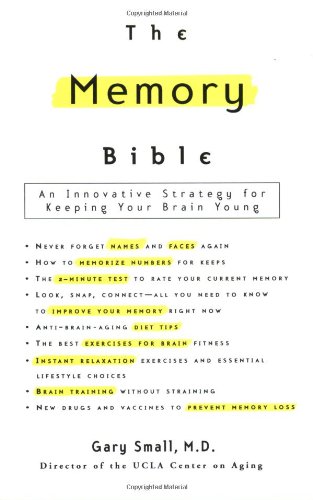
Clear, concise, prescriptive steps for improving memory loss and keeping the brain young—from one of the world's top memory experts.
Everybody forgets things sometimes—from your keys to your lunch date to the name of an acquaintance. According to Dr. Gary Small, the director of the UCLA Center on Aging, much of this forgetfulness can be eliminated easily through his innovative memory exercises and brain fitness program—now available for the first time in a book. Using Small's recent scientific discoveries, The Memory Bible can immediately improve your mental performance. One of the ten commandments that Dr. Small has pioneered to improve your memory immediately is LOOK, SNAP, CONNECT:
1: LOOK: actively observe what you want to learn
2: SNAP: create a vivid snapshot and memorable image
3: CONNECT: visualize a link to associate images
In addition, Dr. Small's comprehensive program includes a "brain diet" of memory-enhancing foods and a list of the most effective drugs, as well as a workbook with a weekly and daily calendar. Remember, as Dr. Small says, "Great memories are not born, they are made."
Die Inhaltsangabe kann sich auf eine andere Ausgabe dieses Titels beziehen.
Über die Autorin bzw. den Autor
Gary Small, MD, is Chair of Psychiatry at Hackensack University Medical Center, and Physician in Chief for Behavioral Health Services for Hackensack Meridian Health. Previously, he was Professor of Psychiatry and Biobehavioral Sciences and Parlow-Solomon Professor on Aging at the David Geffen School of Medicine at UCLA, where he was also Director of the UCLA Longevity Center.
He has authored more than 400 scientific publications, as well as the international bestseller, The Memory Bible. Small's research has been featured in the New York Times, Wall Street Journal, London Times, Washington Post, Time Magazine, and Newsweek, and numerous television programs (e.g., NBC's Today Show, CNN, PBS). Dr. Small is the recipient of many awards and honors, including the Jack Weinberg Award from the American Psychiatric Association and the Senior Investigator Award from the American Association for Geriatric Psychiatry.
Gigi Vorgan wrote, produced and appeared in numerous feature films and television shows before teaming up with her husband, Dr. Gary Small, to co-write The Memory Bible, The Memory Prescription, The Longevity Bible, iBrain, and more.
Auszug. © Genehmigter Nachdruck. Alle Rechte vorbehalten.
The Memory Bible
An Innovative Strategy for Keeping Your Brain YoungBy Gary SmallHyperion Books
Copyright © 2003 Gary SmallAll right reserved.
ISBN: 9780786887118
Chapter One
You Have More Control Than You Think
I have a photographic memory but once in a while I forget to take off the lens cap. -Milton Berle
Imagine struggling your way out the glass doors of a crowded mall in late December, loaded with shopping bags, packages, and presents. Your head is pounding and your feet hate you and the shoes you walked in on. You'd die of starvation this second if you weren't already dying of thirst. You manage to pull out your car keys and glance up at the humongous, jam-packed parking structure when it hits you-you've forgotten where you parked.
Could never happen to you, you say? Ever forgotten your purse, wallet, file, or phone at home, only to remember it while caught in rush hour traffic? Maybe you've struggled to remember the name of a movie you saw last night or that new neighbor you just met, not five minutes ago. Ring a bell?
Most of us laugh off these so-called middle-aged pauses, considering them just another normal annoyance of aging, not a true memory problem, and certainly not a sign of Alzheimer's disease-not at "our age." I hate to pop another "I could party all night and still get to work on time if I wanted to" baby-boomer bubble, but it's time for us all to wake up-we are all one day closer to Alzheimer's disease.
It Is Never Too Late or Too Early to Fight Brain Aging
Just as all of us inevitably get older, recent convincing scientific evidence shows that Alzheimer's disease is not simply an illness that some old people get. Alzheimer's disease or a related dementia may well be everybody's end result of brain aging-and it begins forming in our brains much earlier than anyone previously imagined, even in our twenties.
The subtle, gradual aging of the brain starts as tiny plaques and tangles that begin accumulating there, decades before a doctor can recognize any symptoms of the disease. In fact, these plaques and tangles begin forming so early in our adult lives that subtle memory and language changes go unnoticed and ignored for many years. Nonetheless, these minuscule spots of plaque in our otherwise healthy brains are the first signs of brain aging, and they will increase insidiously if we do nothing about them.
When I speak on this subject I am often asked: Will my brain already be irreversibly damaged by the time I reach middle age? Is it too late for me to try to head off this inevitable process? Is it too soon for me to start? Is my memory ability destined to decline no matter what I try to do about it?
My answer to these questions is no. It is never too late or too early to start beating the brain-aging game. Even if one day research finds a way to restore already lost brain cells, scientists agree that preventing the loss of memory will always be easier than restoring it. The sooner we rise to the challenge, the sooner we can intervene in the battle, like little neuron-gladiators, and, with luck, do so while our forgetfulness is minimal or even imperceptible.
Our Brains Aren't Getting Any Younger, but They Can Get Better
One of the biggest obstacles to starting a program to improve memory performance and protect our brains from Alzheimer's disease is denial that one's brain, as well as one's body, is aging. Many people struggle to accept the physical changes that come with passing years, yet coming to terms with mental changes is often an even greater challenge.
Beginning a program to improve memory and slow down brain aging requires accepting that we need such a program. A better understanding of what actually happens to our memory abilities and our brains as we age will help us keep our brains at their peak performance.
What Is Memory?
Normal memory performance involves both learning and recall (Figure 1.1) and requires intact functioning of several regions of the brain and the brain cells, or neurons, within them. We generally think of memory as an abstract concept-a thought, image, sensation, or feeling that is stored somewhere in our brain's filing cabinet, ready to be pulled out at will. However, because our brains are comprised of nerve cells, chemicals, and electrical impulses, our memories are actually encoded, stored, and retrieved as a result of minuscule chemical and electrical interactions.
Each nerve cell in the brain has a single axon that acts like a telephone line, conducting nerve impulses toward neighboring neurons. The friendly neuron next door receives the countless assortment of electrical impulses sent to it daily, through its dendrites-bunches of thin filaments extending out like little antennae, receiving and sending information. But the new info is not home free yet.
To allow all of our brain's neurons to communicate with the others, the axons and dendrites form thousands of branches, and each branch ends in a synapse, a specialized contact point or receptor that recognizes only extremely specific information being passed between neurons. Each neuron has approximately 100,000 synapses.
Electrical nerve impulses containing the new information, retrieved memories, or relayed messages shoot down the neuron's axon and slip through one of its skinny dendrites into a hyper-specific synapse, where a packet of chemicals, known as neurotransmitters, gets released. These neurotransmitters are the "carrier pigeons" that travel the minuscule space from one synapse to the next. Upon arrival, the correct chemical neurotransmitter binds with its corresponding receiver, and voil`! The message is received. In this way, thoughts and ideas are conveyed, information is learned, and memories are retrieved, all of which cause us to do, think, or act in different ways.
In any waking situation, our senses are bombarded by sights, sounds, and other stimuli that pass through our immediate memory and move into a holding area known as short-term memory. We usually lose most of these fleeting sensations in milliseconds, and of the few retained in our short-term memory, only a small percentage ever make it into long-term memory storage.
An essential key to retaining reformation longer is to organize and rehearse it, thus actively working it into our long-term memory. Some people require great effort to develop these skills, while others are born with a knack for memory techniques and "tricks" to reinforce new information and make it stick. They are often considered to have "photographic memories"-a myth we shall discuss later.
Once information is lodged in our long-term memory, it becomes relatively permanent and can be recalled years later-as long as our brains remain healthy. While short-term memory has only limited capacity, long-term memory has the potential to store tremendous amounts of information. Retrieving this information later, or pulling it out of memory storage, is known as recall. Even patients with advanced Alzheimer's disease, who may have difficulty remembering their morning meal, have been known to recall long-ago events, such as their...
„Über diesen Titel“ kann sich auf eine andere Ausgabe dieses Titels beziehen.
Suchergebnisse für The Memory Bible: An Innovative Strategy for Keeping...

Beispielbild für diese ISBN
The Memory Bible: An Innovative Strategy For Keeping Your Brain Young
Anbieter: World of Books (was SecondSale), Montgomery, IL, USA
Verkäuferbewertung 5 von 5 Sternen

Zustand: Very Good. Item in very good condition! Textbooks may not include supplemental items i.e. CDs, access codes etc. Artikel-Nr. 00108613398
Gebraucht kaufen
EUR 3,61
Versand gratis
Versand innerhalb von USA
Versand innerhalb von USA
Anzahl: 1 verfügbar
Beispielbild für diese ISBN
The Memory Bible: An Innovative Strategy For Keeping Your Brain Young
Anbieter: World of Books (was SecondSale), Montgomery, IL, USA
Verkäuferbewertung 5 von 5 Sternen
Zustand: Acceptable. Item in acceptable condition! Textbooks may not include supplemental items i.e. CDs, access codes etc. Artikel-Nr. 00084572163
Gebraucht kaufen
EUR 3,61
Versand gratis
Versand innerhalb von USA
Versand innerhalb von USA
Anzahl: 3 verfügbar
Beispielbild für diese ISBN
The Memory Bible: An Innovative Strategy For Keeping Your Brain Young
Anbieter: World of Books (was SecondSale), Montgomery, IL, USA
Verkäuferbewertung 5 von 5 Sternen
Zustand: Acceptable. Item in good condition. Textbooks may not include supplemental items i.e. CDs, access codes etc. Artikel-Nr. 00068059293
Gebraucht kaufen
EUR 3,61
Versand gratis
Versand innerhalb von USA
Versand innerhalb von USA
Anzahl: 1 verfügbar
Beispielbild für diese ISBN
The Memory Bible: An Innovative Strategy For Keeping Your Brain Young
Anbieter: World of Books (was SecondSale), Montgomery, IL, USA
Verkäuferbewertung 5 von 5 Sternen
Zustand: Good. Item in good condition. Textbooks may not include supplemental items i.e. CDs, access codes etc. Artikel-Nr. 00082226468
Gebraucht kaufen
EUR 3,61
Versand gratis
Versand innerhalb von USA
Versand innerhalb von USA
Anzahl: Mehr als 20 verfügbar
Beispielbild für diese ISBN
The Memory Bible: An Innovative Strategy For Keeping Your Brain Young
Verlag:
Hyperion (edition First Edition), 2003
ISBN 10: 0786887117
ISBN 13: 9780786887118
Gebraucht
Paperback
Erstausgabe
Anbieter: BooksRun, Philadelphia, PA, USA
Verkäuferbewertung 5 von 5 Sternen
Paperback. Zustand: Very Good. First Edition. It's a well-cared-for item that has seen limited use. The item may show minor signs of wear. All the text is legible, with all pages included. It may have slight markings and/or highlighting. Artikel-Nr. 0786887117-11-1
Gebraucht kaufen
EUR 5,03
Versand gratis
Versand innerhalb von USA
Versand innerhalb von USA
Anzahl: 1 verfügbar
Beispielbild für diese ISBN
The Memory Bible : An Innovative Strategy for Keeping Your Brain Young
Verlag:
Grand Central Publishing, 2003
ISBN 10: 0786887117
ISBN 13: 9780786887118
Gebraucht
Softcover
Anbieter: Better World Books: West, Reno, NV, USA
Verkäuferbewertung 5 von 5 Sternen
Zustand: Good. 1 Edition. Pages intact with minimal writing/highlighting. The binding may be loose and creased. Dust jackets/supplements are not included. Stock photo provided. Product includes identifying sticker. Better World Books: Buy Books. Do Good. Artikel-Nr. 3477865-75
Gebraucht kaufen
EUR 6,01
Versand gratis
Versand innerhalb von USA
Versand innerhalb von USA
Anzahl: 2 verfügbar
Beispielbild für diese ISBN
The Memory Bible : An Innovative Strategy for Keeping Your Brain Young
Verlag:
Grand Central Publishing, 2003
ISBN 10: 0786887117
ISBN 13: 9780786887118
Gebraucht
Softcover
Anbieter: Better World Books, Mishawaka, IN, USA
Verkäuferbewertung 5 von 5 Sternen
Zustand: Good. 1 Edition. Pages intact with minimal writing/highlighting. The binding may be loose and creased. Dust jackets/supplements are not included. Stock photo provided. Product includes identifying sticker. Better World Books: Buy Books. Do Good. Artikel-Nr. 3477865-75
Gebraucht kaufen
EUR 6,01
Versand gratis
Versand innerhalb von USA
Versand innerhalb von USA
Anzahl: 2 verfügbar
Beispielbild für diese ISBN
The Memory Bible : An Innovative Strategy for Keeping Your Brain Young
Verlag:
Grand Central Publishing, 2003
ISBN 10: 0786887117
ISBN 13: 9780786887118
Gebraucht
Softcover
Anbieter: Better World Books: West, Reno, NV, USA
Verkäuferbewertung 5 von 5 Sternen
Zustand: Very Good. 1 Edition. Pages intact with possible writing/highlighting. Binding strong with minor wear. Dust jackets/supplements may not be included. Stock photo provided. Product includes identifying sticker. Better World Books: Buy Books. Do Good. Artikel-Nr. 8062269-75
Gebraucht kaufen
EUR 6,01
Versand gratis
Versand innerhalb von USA
Versand innerhalb von USA
Anzahl: 1 verfügbar
Beispielbild für diese ISBN
The Memory Bible: An Innovative Strategy for Keeping Your Brain Young
Anbieter: Wonder Book, Frederick, MD, USA
Verkäuferbewertung 5 von 5 Sternen
Zustand: Good. Good condition. A copy that has been read but remains intact. May contain markings such as bookplates, stamps, limited notes and highlighting, or a few light stains. Artikel-Nr. K12Q-0008
Gebraucht kaufen
EUR 6,24
Versand gratis
Versand innerhalb von USA
Versand innerhalb von USA
Anzahl: 1 verfügbar
Beispielbild für diese ISBN
The Memory Bible: An Innovative Strategy for Keeping Your Brain Young
Anbieter: Wonder Book, Frederick, MD, USA
Verkäuferbewertung 5 von 5 Sternen
Zustand: Very Good. Very Good condition. A copy that may have a few cosmetic defects. May also contain light spine creasing or a few markings such as an owner's name, short gifter's inscription or light stamp. Artikel-Nr. J00B-02049
Gebraucht kaufen
EUR 6,24
Versand gratis
Versand innerhalb von USA
Versand innerhalb von USA
Anzahl: 4 verfügbar