
Verwandte Artikel zu Mere Possibilities: Metaphysical Foundations of Modal...
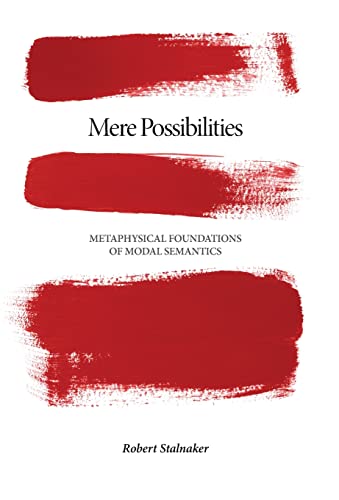
Mere Possibilities: Metaphysical Foundations of Modal Semantics (Carl G. Hempel Lecture) - Hardcover
Inhaltsangabe
It seems reasonable to believe that there might have existed things other than those that in fact exist, or have existed. But how should we understand such claims? Standard semantic theories exploit the Leibnizian metaphor of a set of all possible worlds: a proposition might or must be true if it is true in some or all possible worlds. The actualist, who believes that nothing exists except what actually exists, prefers to talk of possible states of the world, or of ways that a world might be. But even the actualist still faces the problem of explaining what we are talking about when we talk about the domains of other possible worlds. In Mere Possibilities, Robert Stalnaker develops a framework for clarifying this problem, and explores a number of actualist strategies for solving it.
Die Inhaltsangabe kann sich auf eine andere Ausgabe dieses Titels beziehen.
Über die Autorin bzw. den Autor
Robert Stalnaker is the Laurance S. Rockefeller Professor of Philosophy at Massachusetts Institute of Technology. He is the author of Our Knowledge of the Internal World,
Ways a World Might Be,
Context and Content, and Inquiry.
Von der hinteren Coverseite
"This is a subtle, nuanced exploration of the metaphysical basis for talk of possible worlds and its far from straightforward relation to the version of formal semantics known as 'possible worlds semantics,' both of which have been immensely influential in recent decades. Robert Stalnaker has been one of the major players in debates on these matters, and this book contains significant further developments of his ideas."--Timothy Williamson, University of Oxford
"This is a first-rate book and a model of the best kind of unfussy scholarly writing. Robert Stalnaker combines an admirable economy of presentation with clarity, rigor, and thoroughness in exposition and argument. This is a major contribution to the field, and one to which philosophers, logicians, and linguists with any serious interest in modality should attend."--Bob Hale, University of Sheffield
Aus dem Klappentext
"This is a subtle, nuanced exploration of the metaphysical basis for talk of possible worlds and its far from straightforward relation to the version of formal semantics known as 'possible worlds semantics,' both of which have been immensely influential in recent decades. Robert Stalnaker has been one of the major players in debates on these matters, and this book contains significant further developments of his ideas."--Timothy Williamson, University of Oxford
"This is a first-rate book and a model of the best kind of unfussy scholarly writing. Robert Stalnaker combines an admirable economy of presentation with clarity, rigor, and thoroughness in exposition and argument. This is a major contribution to the field, and one to which philosophers, logicians, and linguists with any serious interest in modality should attend."--Bob Hale, University of Sheffield
Auszug. © Genehmigter Nachdruck. Alle Rechte vorbehalten.
Mere Possibilities
Metaphysical Foundations of Modal SemanticsBy Robert StalnakerPrinceton University Press
Copyright © 2012 Princeton University PressAll right reserved.
ISBN: 978-0-691-14712-3
Contents
Preface.........................................................................ix1 On What There Isn't (But Might Have Been)....................................12 Merely Possible Possible Worlds..............................................223 What Is Haecceitism, and Is It True?.........................................524 Disentangling Semantics from Metaphysics.....................................895 Modal Realism, Modal Rationalism, Modal Naturalism...........................126Appendix A Modeling Contingently Existing Propositions.........................136Appendix B Propositional Functions and Properties..............................139Appendix C A Model for a Mighty Language.......................................149Appendix D Counterpart Semantics for the Cheap Haecceitist.....................154References......................................................................157Index...........................................................................161
Chapter One
On What There Isn't (But Might Have Been)
The problem of ontology, Quine told us in his classic essay "On what there is," can be put in a simple question, "what is there?" and answered in a word: "everything." My question should be equally simple, and its answer should follow from Quine's: there is nothing that isn't. But of course as Quine went on to say, the problem gets harder when one tries to be more specific about what there is and what there isn't. Quine's concern was mainly with the problem of expressing disagreement about ontology—if I believe there are more things in Heaven and Earth than are dreamt of in your philosophy, how can you talk about what it is that I believe in, but you do not? But even when we agree about what there is, we may want to acknowledge that things might have been different—not just that things might have been differently arranged but that there might have been different things than there actually are. If we ask not just "what is there" but "what might there have been," the answer "everything" does not seem sufficiently inclusive. But what else is there that might be included?
The problem is sufficiently daunting to have driven many philosophers, in different ways, to deny there could have been anything other than what in fact exists, or that anything that exists could have failed to exist. (Three examples of philosophers who develop this idea in very different ways: Wittgenstein of the Tractatus, David Lewis, and Timothy Williamson.) Others have hypothesized actual surrogates for the nonexistent things—individual essences that are themselves necessary existents and that correspond one-to-one with all the "things" (as we are inclined to put it) that might exist. Still others think that because taking modality seriously forces us to such metaphysical extravagance, we should reject modal discourse as anything more than a façon de parler. But I think modal concepts are central to our understanding of the world—the actual world—and that understanding them should not require extravagant metaphysical commitments. My aim in this book is to sketch a framework that allows us to avoid extravagant metaphysical commitments and that is also compatible with intuitively natural beliefs about the way things might have been.
There are some philosophers who want to take modality seriously, and seek a theoretical account of modal discourse, but who think that we cannot take possible-worlds semantics, as an account of modality, seriously without making extravagant metaphysical commitments. Christopher Peacocke, for example, holds that "it is an unstable, indeed incoherent, position to think that you can at the same time use the Kripke-style semantics in the metalanguage to give absolute truth-conditions for modal sentences, count ... [the proposition that there could have been something that doesn't actually exist] as true, yet avoid commitment to the existence of nonactual objects." But I want to defend the metaphysical innocence not only of modal concepts but also of a theoretical account of them in terms of possible worlds. Whether my construal of possible-worlds semantics counts as a realistic one or not is open to debate, and I will concede that on one of the several ways of construing the term "possible world," the possible worlds posited by these semantic models are artifacts of the model and not entities whose existence is affirmed. But I will argue that on another way of understanding the term, we can affirm the existence of possible worlds, as well as the claim that the semantic theory provides "absolute truth conditions for modal sentences" and "avoids commitment to the existence of nonactual objects."
Here is my plan for this chapter: I will start, in section 1, with some preliminary methodological remarks—about the aim and value of reduction in philosophical analysis, about thinking of the evaluation of philosophical theses in terms of costs and benefits, and about the contrast between realistic and anti-realistic accounts of a philosophical theory. In section 2, I will say what I take possible worlds to be, and what, from the perspective of this account of possible worlds, the problem is about merely possible individuals. Possible worlds, on the account I want to defend, are (to a first approximation) properties, and the main point I want to make in this section is that properties (and so possible worlds) are not representations. In section 3, I take an extended look at some examples of properties that are simpler and easier to think about than possible worlds but that share some of the features of possible worlds, construed as properties. In this section and section 4, I will use the analogy I develop to motivate what I hope is a metaphysically innocent account of the domains of other possible worlds.
The view I will be defending is committed to making sense of the contingent existence of individuals and properties, of propositions, and even of possible worlds themselves. I will conclude, in section 4, by sketching a problem that an account of this kind faces, a problem that I will respond to in chapter 2.
1. Methodological Preliminaries
According to John Divers in his useful survey of the range of alternative philosophical accounts of possible worlds, "the primary question of conceptual application of the species of AR [actualist realism] is whether any affords a thoroughly non-modal analysis of the family of modal and intensional concepts." Divers acknowledges that "the proponents of AR typically do not claim that the favored version of AR affords thoroughly nonmodal analysis of the modal concepts," but he seems to assume that it would be a benefit (in the cost-benefit evaluation of the general view) if it did provide such an analysis. But my view is that if an account of modality were to meet this condition, that would be a sure sign that it was on the wrong track. Necessity and possibility are fundamental concepts, like truth and existence. What would you say to a philosopher who was seeking a thoroughly nonexistential analysis of quantificational concepts, or a thoroughly non-alethic analysis of truth, and related concepts? It is not that philosophers have not proposed such analyses (substitutional quantification,...
„Über diesen Titel“ kann sich auf eine andere Ausgabe dieses Titels beziehen.
Suchergebnisse für Mere Possibilities: Metaphysical Foundations of Modal...

Beispielbild für diese ISBN
Mere Possibilities: Metaphysical Foundations of Modal Semantics (Carl G. Hempel Lecture Series)
Anbieter: Revaluation Books, Exeter, Vereinigtes Königreich
Verkäuferbewertung 5 von 5 Sternen

Hardcover. Zustand: Brand New. 184 pages. 8.50x5.60x1.00 inches. In Stock. Artikel-Nr. x-0691147124
Neu kaufen
EUR 112,41
EUR 11,82 Versand
Versand von Vereinigtes Königreich nach USA
Versand von Vereinigtes Königreich nach USA
Anzahl: 2 verfügbar
Foto des Verkäufers
Mere Possibilities
Anbieter: moluna, Greven, Deutschland
Verkäuferbewertung 5 von 5 Sternen
Zustand: New. It seems reasonable to believe that there might have existed things other than those that in fact exist, or have existed. This title develops a framework for clarifying this problem, and explores a number of actualist strategies for solving it.It seems . Artikel-Nr. 5948331
Neu kaufen
EUR 84,83
EUR 48,99 Versand
Versand von Deutschland nach USA
Versand von Deutschland nach USA
Anzahl: Mehr als 20 verfügbar
Beispielbild für diese ISBN
Mere Possibilities Metaphysical Foundations of Modal Semantics
Verlag:
Princeton University Press, 2012
ISBN 10: 0691147124
ISBN 13: 9780691147123
Gebraucht
Hardcover
Anbieter: Mooney's bookstore, Den Helder, Niederlande
Verkäuferbewertung 4 von 5 Sternen

Zustand: Very Good. Artikel-Nr. AAAC0376A38046A
Gebraucht kaufen
EUR 120,74
EUR 14,95 Versand
Versand von Niederlande nach USA
Versand von Niederlande nach USA
Anzahl: 1 verfügbar
Foto des Verkäufers
Mere Possibilities : Metaphysical Foundations of Modal Semantics
Verlag:
Princeton University Press Mai 2012, 2012
ISBN 10: 0691147124
ISBN 13: 9780691147123
Neu
Hardcover
Anbieter: AHA-BUCH GmbH, Einbeck, Deutschland
Verkäuferbewertung 5 von 5 Sternen
Buch. Zustand: Neu. Neuware - It seems reasonable to believe that there might have existed things other than those that in fact exist, or have existed. But how should we understand such claims Standard semantic theories exploit the Leibnizian metaphor of a set of all possible worlds: a proposition might or must be true if it is true in some or all possible worlds. The actualist, who believes that nothing exists except what actually exists, prefers to talk of possible states of the world, or of ways that a world might be. But even the actualist still faces the problem of explaining what we are talking about when we talk about the domains of other possible worlds. In Mere Possibilities, Robert Stalnaker develops a framework for clarifying this problem, and explores a number of actualist strategies for solving it. Artikel-Nr. 9780691147123
Neu kaufen
EUR 143,29
EUR 35,00 Versand
Versand von Deutschland nach USA
Versand von Deutschland nach USA
Anzahl: 1 verfügbar