
Verwandte Artikel zu Driving Customer Equity: How Customer Lifetime Value...
Inhaltsangabe
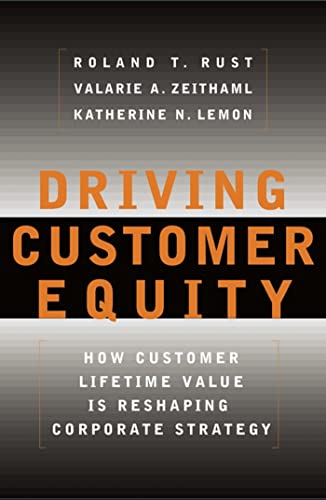
In their efforts to become more customer-focused, companies everywhere find themselves entangled in outmoded systems, metrics, and strategies rooted in their product-centered view of the world. Now, to ease this shift to a customer focus, marketing strategy experts Roland T. Rust, Valarie A. Zeithaml, and Katherine N. Lemon have created a dynamic new model they call "Customer Equity", a strategic framework designed to maximize every firm's most important asset, the total lifetime value of its customer base. The authors' Customer Equity Framework yields powerful insights that will help any business increase the value of its customer base. Rust, Zeithaml, and Lemon introduce the three drivers of customer equity - Value Equity, Brand Equity, and Retention Equity - and explain in clear, nontechnical language how managers can base their strategies on one or a combination of these drivers. The authors demonstrate in this breakthrough book how managers can build and employ competitive metrics that reveal their company's Customer Equity relative to their competitors. Based on these metrics, they show how managers can determine which drivers are most important in their industry, how they can make efficient strategic trade-offs between expenditures on these drivers, and how to project a financial return from these expenditures. The final section devotes two chapters to the Customer Pyramid, an approach that segments customers based on their long-term profitability, and an especially important chapter examines the Internet as the ultimate Customer Equity tool. Here the authors show how companies such as Intuit.com, Schwab.com, and Priceline.com have used more than one or all three drivers to increase Customer Equity. In this age of one-to-one marketing, understanding how to drive Customer Equity is central to the success of any firm. In particular, Driving Customer Equity will be essential reading for any marketing manager
Die Inhaltsangabe kann sich auf eine andere Ausgabe dieses Titels beziehen.
Über die Autorin bzw. den Autor
Roland T. Rust is the Madison S. Wigginton Professor of Management and Director of the Center for Service Marketing at the Owen Graduate School of Management of Vanderbilt University.
Auszug. © Genehmigter Nachdruck. Alle Rechte vorbehalten.
Chapter One: Beyond Brand Equity
The business world is increasingly organizing itself around customers rather than products. This is an inevitable reaction to a series of historical trends. Customer focus requires a new approach: managing according to Customer Equity (the value of a firm's customers), rather than Brand Equity (the value of a firm's brands), and focusing on customer profitability instead of product profitability. In fact, as we will see in Chapter 2, a slavish devotion to product profitability can be hazardous to a company's health.
From Brand Equity to Customer Equity
Our Argentinian friend Marcos was involved with launching a popular American consumer products brand in Argentina. The brand was already a top brand in the United States, Europe, and most of the world. It was number one in the market in terms of market share, although its quality was only equivalent to that of its competition, and its price was similar to most competing brands and greater than that of the discount brands. The brand was known worldwide, even in countries in which the brand was not available. By any measure this brand had outstanding Brand Equity. Everyone expected that such a powerful brand would quickly assume a dominant market position in Argentina, and subsequently in the rest of Latin America.
What actually happened came as a complete shock. When the brand was rolled out, it failed to gain much of a foothold. Its market share remained anemic, and the local brands continued their market superiority, in spite of the fact that their quality and price were no better than the American brand. How could such a thing happen to such a powerful brand, with its superior level of Brand Equity?
In retrospect, what happened was clear. The American brand had superior Brand Equity, but the domestic brands owned the customers. The American brand had more Brand Equity, but that was not enough. Customer Equity, not Brand Equity, was the key to market success.
What Is Customer Equity?
The long-term value of the company is largely determined by the value of the company's customer relationships, which we call the firm's Customer Equity. The term was introduced, in a somewhat different context, by Robert Blattberg and John Deighton.
To clarify our use of the term, we define Customer Equity as follows:
A firm's Customer Equity is the total of the discounted lifetime values of all of its customers.
In other words we view the value of the customer not only in terms of that customer's current profitability, but also with respect to the net discounted contribution stream that the firm will realize from the customer over time. Summing these up gives the total value of the customers of the firm, which we call Customer Equity.
It is easy to see that for most firms, Customer Equity is certain to be the most important component of the value of the firm. While the value of a firm's customers cannot be the entire value of the firm (for example, the firm's physical assets, competencies, and intellectual property also lend value), a firm's existing customers provide its surest and most reliable source of future revenues. Thus, figuring out how to drive Customer Equity is central to the decision making of any firm. Coherently formulating how to do this can give a firm an important competitive advantage.
The Inevitable Shift to Customer Equity
Several broad interrelated trends that are currently shaping economic change in every developed economy make it inevitable that management will shift its focus from Brand Equity to Customer Equity. The central implication of all of these trends is a shift from a product focus to a customer focus.
From Goods to Services. The underlying basis for all of the trends is the dramatic long-term shift of every developed economy from goods to services. For example, in 1900, the percentage of workers in the United States in the service sector was approximately 30%. By 1970 that figure had risen to 64%, and by 1995 that figure was about 77%. Other developed economies lag behind the United States by a few years, but all show the same trend toward service, and similar percentages.
From Transactions to Relationships. Let us consider, first, the "old" goods economy. Consider a customer of a typical consumer good -- breakfast cereal. A customer might buy Kellogg's Corn Flakes this time, then switch brands the next time, and then switch the next time to something else. The goods economy tends to be relatively transaction-oriented. Management's attention is naturally drawn to the constant battle for attracting (rather than retaining) customers, and it is on that battlefield that Brand Equity reigns supreme.
Now consider the "new" service economy. Services work differently in the marketplace than goods. Think about a typical service -- retail banking. A bank customer opens an account, and has dealings with the bank over time. The customer does not reconsider his/her choice of bank at every transaction, although a bad experience might trigger thoughts of switching. This has led to a shift from a focus on consumer transactions to a focus on long-term, one-to-one customer relationships, fostered by much work by Don Peppers and Martha Rogers.
From Customer Attraction to Customer Retention. For the bank, keeping or retaining customers is very important to the bank's success. Managing the relationship with the customer is very important and is central to the bank's thinking. While the bank still worries about attracting new customers, that issue must compete for management's attention with issues such as customer retention and cross-selling. On this battlefield, Customer Equity reigns, and Brand Equity plays a lesser role.
From Product Focus to Customer Focus. In general the increasing emphasis on customers and relationship management coincides with a decreasing emphasis on products. It is not as though products are unimportant. It is just that they are secondary to satisfying the customer. Another way of thinking about this is that in a rapidly changing technological environment, products come and go, but customers remain. The secret to success is maintaining a profitable relationship with the customer, regardless of what products are involved, or how the products needed may change over time. Just as an automobile customer's needs and wants may shift over time from a Plymouth to a Chrysler to a Mercedes-Benz, a customer's brand preferences may change over time. The job of the modern company is to maintain the customer relationship (with DaimlerChrysler in this case) even while the individual customer's brand loyalty becomes irrelevant.
The Shift to Customer Equity. The continuing shift toward a service economy, thus, leads inexorably toward a shift in emphasis from Brand Equity to Customer Equity. However, unlike Brand Equity, which has been extensively studied by both business people and academics, little has been done at this point to understand Customer Equity. This book provides a framework for understanding Customer Equity and shows how this framework can help management focus its resources to maximize long-term profitability, through the successful cultivation of profitable customer relationships.
Where Do Profits Come From?
Almost every business carefully accounts for the profitability of its products. Detailed financial reports show the revenues and costs associated with each product, and each product's contribution to the company's bottom line. Profitable products are maintained or spun off into multiple, related products. For example, regular potato chips spin off into barbecue-flavored potato chips and low-fat potato chips. Unprofitable products are jettisoned. The seldom-questioned underlying assumption is that the product...
„Über diesen Titel“ kann sich auf eine andere Ausgabe dieses Titels beziehen.
Suchergebnisse für Driving Customer Equity: How Customer Lifetime Value...

Beispielbild für diese ISBN
Driving Customer Equity : How Customer Lifetime Value is Reshaping Corporate Strategy
Anbieter: World of Books (was SecondSale), Montgomery, IL, USA
Verkäuferbewertung 5 von 5 Sternen

Zustand: Very Good. Item in very good condition! Textbooks may not include supplemental items i.e. CDs, access codes etc. Artikel-Nr. 00084365166
Gebraucht kaufen
EUR 4,92
Versand gratis
Versand innerhalb von USA
Versand innerhalb von USA
Anzahl: 1 verfügbar
Beispielbild für diese ISBN
Driving Customer Equity : How Customer Lifetime Value is Reshaping Corporate Strategy
Anbieter: World of Books (was SecondSale), Montgomery, IL, USA
Verkäuferbewertung 5 von 5 Sternen
Zustand: Acceptable. Item in acceptable condition! Textbooks may not include supplemental items i.e. CDs, access codes etc. Artikel-Nr. 00104596008
Gebraucht kaufen
EUR 4,92
Versand gratis
Versand innerhalb von USA
Versand innerhalb von USA
Anzahl: 1 verfügbar
Beispielbild für diese ISBN
Driving Customer Equity : How Customer Lifetime Value is Reshaping Corporate Strategy
Verlag:
Free Press (edition First Edition), 2000
ISBN 10: 0684864665
ISBN 13: 9780684864662
Gebraucht
Paperback
Erstausgabe
Anbieter: BooksRun, Philadelphia, PA, USA
Verkäuferbewertung 5 von 5 Sternen
Paperback. Zustand: Very Good. First Edition. With dust jacket. It's a well-cared-for item that has seen limited use. The item may show minor signs of wear. All the text is legible, with all pages included. It may have slight markings and/or highlighting. Artikel-Nr. 0684864665-8-1-29
Gebraucht kaufen
EUR 5,46
Versand gratis
Versand innerhalb von USA
Versand innerhalb von USA
Anzahl: 1 verfügbar
Beispielbild für diese ISBN
Driving Customer Equity : How Customer Lifetime Value is Reshaping Corporate Strategy
Anbieter: World of Books (was SecondSale), Montgomery, IL, USA
Verkäuferbewertung 5 von 5 Sternen
Zustand: Good. Item in good condition. Textbooks may not include supplemental items i.e. CDs, access codes etc. Artikel-Nr. 00085522513
Gebraucht kaufen
EUR 5,56
Versand gratis
Versand innerhalb von USA
Versand innerhalb von USA
Anzahl: 2 verfügbar
Beispielbild für diese ISBN
Driving Customer Equity
Anbieter: ThriftBooks-Dallas, Dallas, TX, USA
Verkäuferbewertung 5 von 5 Sternen
Hardcover. Zustand: Very Good. No Jacket. Former library book; May have limited writing in cover pages. Pages are unmarked. ~ ThriftBooks: Read More, Spend Less. Artikel-Nr. G0684864665I4N10
Gebraucht kaufen
EUR 5,88
Versand gratis
Versand innerhalb von USA
Versand innerhalb von USA
Anzahl: 1 verfügbar
Beispielbild für diese ISBN
Driving Customer Equity
Anbieter: ThriftBooks-Dallas, Dallas, TX, USA
Verkäuferbewertung 5 von 5 Sternen
Hardcover. Zustand: Very Good. No Jacket. May have limited writing in cover pages. Pages are unmarked. ~ ThriftBooks: Read More, Spend Less. Artikel-Nr. G0684864665I4N00
Gebraucht kaufen
EUR 5,88
Versand gratis
Versand innerhalb von USA
Versand innerhalb von USA
Anzahl: 1 verfügbar
Beispielbild für diese ISBN
Driving Customer Equity : How Customer Lifetime Value Is Reshaping Corporate Strategy
Anbieter: Better World Books, Mishawaka, IN, USA
Verkäuferbewertung 5 von 5 Sternen
Zustand: Good. Former library copy. Pages intact with minimal writing/highlighting. The binding may be loose and creased. Dust jackets/supplements are not included. Includes library markings. Stock photo provided. Product includes identifying sticker. Better World Books: Buy Books. Do Good. Artikel-Nr. 3393652-6
Gebraucht kaufen
EUR 9,19
Versand gratis
Versand innerhalb von USA
Versand innerhalb von USA
Anzahl: 1 verfügbar
Beispielbild für diese ISBN
Driving Customer Equity : How Customer Lifetime Value is Reshaping Corporate Strategy
Anbieter: Robinson Street Books, IOBA, Binghamton, NY, USA
Verkäuferbewertung 4 von 5 Sternen

Hardcover. Zustand: As New. Prompt Shipment, shipped in Boxes, Tracking PROVIDEDFine in Fine dust jacket. First edition. Artikel-Nr. bing49021
Gebraucht kaufen
EUR 12,05
EUR 8,23 Versand
Versand innerhalb von USA
Versand innerhalb von USA
Anzahl: 1 verfügbar
Beispielbild für diese ISBN
Driving Customer Equity : How Customer Lifetime Value is Reshaping Corporate Strategy
Anbieter: Robinson Street Books, IOBA, Binghamton, NY, USA
Verkäuferbewertung 4 von 5 Sternen
Hardcover. Zustand: As New. Prompt Shipment, shipped in Boxes, Tracking PROVIDED* Fine in Fine dust jacket. First edition. Artikel-Nr. ware107960
Gebraucht kaufen
EUR 12,05
EUR 8,23 Versand
Versand innerhalb von USA
Versand innerhalb von USA
Anzahl: 1 verfügbar
Beispielbild für diese ISBN
Driving Customer Equity : How Customer Lifetime Value is Reshaping Corporate Strategy
Anbieter: Robinson Street Books, IOBA, Binghamton, NY, USA
Verkäuferbewertung 4 von 5 Sternen
Hardcover. Zustand: As New. Prompt Shipment, shipped in Boxes, Tracking PROVIDED* Fine in Fine dust jacket. First edition. Artikel-Nr. under457ma4938
Gebraucht kaufen
EUR 12,05
EUR 8,23 Versand
Versand innerhalb von USA
Versand innerhalb von USA
Anzahl: 1 verfügbar