Inhaltsangabe
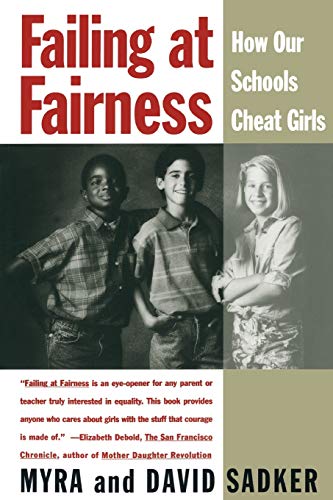
Failing at Fairness, the result of two decades of research, shows how gender bias makes it impossible for girls to receive an education equal to that given to boys. Girls' learning problems are not identified as often as boys' are Boys receive more of their teachers' attention Girls start school testing higher in every academic subject, yet graduate from high school scoring 50 points lower than boys on the SAT Hard-hitting and eye-opening, Failing at Fairness should be read by every parent, especially those with daughters.
Die Inhaltsangabe kann sich auf eine andere Ausgabe dieses Titels beziehen.
Über die Autorin bzw. den Autor
David Sadker is professor emeritus at American University (Washington, DC) and, along with his late wife Myra Sadker, gained a national reputation for work in confronting gender bias and sexual harassment. David Sadker has directed more than a dozen federal education grants, and authored or co-authored seven books, including the bestselling introductory teacher education textbook, Teachers, Schools and Society, (McGraw Hill, 2008). The American Educational Research Association’s (AERA) honored the Sadkers for “the best review of research” published in 1991, for their professional service in 1995, and for “scholarship, activism, and community building on behalf of women and education” in 2004. The American Association of University Women awarded the Sadkers’ their Eleanor Roosevelt Award in 1995, and the American Association of Colleges of Teacher Education recognized their work with the Gender Architect Award in 2001. David Sadker has received two honorary doctorates. He currently teaches at the University of Arizona.
Auszug. © Genehmigter Nachdruck. Alle Rechte vorbehalten.
Chapter 1
Hidden Lessons
Sitting in the same classroom, reading the same textbook, listening to the same teacher, boys and girls receive very different educations. From grade school through graduate school female students are more likely to be invisible members of classrooms. Teachers interact with males more frequently, ask them better questions, and give them more precise and helpful feedback. Over the course of years the uneven distribution of teacher time, energy, attention, and talent, with boys getting the lion's share, takes its toll on girls. Since gender bias is not a noisy problem, most people are unaware of the secret sexist lessons and the quiet losses they engender.
Girls are the majority of our nation's schoolchildren, yet they are second-class educational citizens. The problems they face -- loss of selfesteem, decline in achievement, and elimination of career options -- are at the heart of the educational process. Until educational sexism is eradicated, more than half our children will be shortchanged and their gifts lost to society.
Award-winning author Susan Faludi discovered that backlash "is most powerful when it goes private, when it lodges inside a woman's mind and turns her vision inward, until she imagines the pressure is all in her head, until she begins to enforce the backlash too -- on herself." Psychological backlash internalized by adult women is a frightening concept, but what is even more terrifying is a curriculum of sexist school lessons becoming secret mind games played against female children, our daughters, tomorrow's women.
After almost two decades of research grants and thousands of hours of classroom observation, we remain amazed at the stubborn persistence of these hidden sexist lessons. When we began our investigation of gender bias, we looked first in the classrooms of one of Washington, D.C.'s elite and expensive private schools. Uncertain of exactly what to look for, we wrote nothing down; we just observed. The classroom was a whirlwind of activity, so fast paced we could easily miss the quick but vital phrase or gesture, the insidious incident, the tiny inequity that held a world of meaning. As we watched, we had to push ourselves beyond the blind spots of socialization and gradually focus on the nature of the interaction between teacher and student. On the second day we saw our first example of sexism, a quick, jarring flash within the hectic pace of the school day:
Two second graders are kneeling beside a large box. They whisper excitedly to each other as they pull out wooden blocks, colored balls, counting sticks. So absorbed are these two small children in examining and sorting the materials, they are visibly startled by the teacher's impatient voice as she hovers over them. "Ann! Julia! Get your cotton-pickin' hands out of the math box. Move over so the boys can get in there and do their work."
Isolated here on the page of a book, this incident is not difficult to interpret. It becomes even more disturbing if you think of it with the teacher making a racial distinction. Picture Ann and Julia as AfricanAmerican children moved away so white children can gain access to the math materials. If Ann and Julia's parents had observed this exchange, they might justifiably wonder whether their tuition dollars were well spent. But few parents actually watch teachers in action, and fewer still have learned to interpret the meaning behind fast-paced classroom events.
The incident unsettles, but it must be considered within the context of numerous interactions this harried teacher had that day. While she talked to the two girls, she was also keeping a wary eye on fourteen other active children. Unless you actually shadowed the teacher, stood right next to her as we did, you might not have seen or heard the event. After all, it lasted only a few seconds.
It took us almost a year to develop an observation system that would register the hundreds of daily classroom interactions, teasing out the gender bias embedded in them. Trained raters coded classrooms in math, reading, English, and social studies. They observed students from different racial and ethnic backgrounds. They saw lessons taught by women and by men, by teachers of different races. In short, they analyzed America's classrooms. By the end of the year we had thousands of observation sheets, and after another year of statistical analysis, we discovered a syntax of sexism so elusive that most teachers and students were completely unaware of its influence?
Recently a producer of NBC's "Dateline" contacted us to learn more about our discovery that girls don't receive their fair share of education. Jane Pauley, the show's anchorwoman, wanted to visit classrooms, capture these covert sexist lessons on videotape, and expose them before a television audience. The task was to extricate sound bites of sexism from a fifth-grade classroom where the teacher, chosen to be the subject of the exposé, was aware she was being scrutinized for sex bias.
"Dateline" had been taping in her class for two days when we received a concerned phone call. "This is a fair teacher," the producer said. "How can we show sexism on our show when there's no gender bias in this teacher's class?" We drove to the NBC studio in Washington, D.C., and found two "Dateline" staffers, intelligent women concerned about fair treatment in school, sitting on the floor in a darkened room staring at the videotape of a fifth-grade class. "We've been playing this over and over. The teacher is terrific. There's no bias in her teaching. Come watch."
After about twenty minutes of viewing, we realized it was a case of déjà vu: The episodal sexist themes and recurring incidents were all too familiar. The teacher was terrific, but she was more effective for half of the students than she was for the other. She was, in fact, a classic example of the hundreds of skillful well-intentioned professionals we have seen who inadvertently teach boys better than girls.
We had forgotten how difficult it was to recognize subtle sexism before you learn how to look. It was as if the "Dateline" staff members were wearing blinders. We halted the tape, pointed out the sexist behaviors, related them to incidents in our research, and played the tape again. There is a classic "aha!" effect in education when people finally "get it." Once the hidden lessons of unconscious bias are understood, classrooms never look the same again to the trained observer.
Much of the unintentional gender bias in that fifth-grade class could not be shown in the short time allowed by television, but the sound bites of sexism were also there. "Dateline" chose to show a segregated math group: boys sitting on the teacher's right side and girls on her left. After giving the math book to a girl to hold open at the page of examples, the teacher turned her back to the girls and focused on the boys, teaching them actively and directly. Occasionally she turned to the girls' side, but only to read the examples in the book. This teacher, although aware that she was being observed for sexism, had unwittingly transformed the girls into passive spectators, an audience for the boys. All but one, that is: The girl holding the math book had become a prop.
"Dateline" also showed a lively discussion in the school library. With both girls' hands and boys' hands waving for attention, the librarian chose boy after boy to speak. In one interaction she peered through the forest of girls' hands waving directly in front of her to acknowledge the raised hand of a boy in the back of the room. Startled by the teacher's attention, the boy muttered, "I was just stretching."
The next day we discussed the show with future teachers, our students at The American University. They were bewildered. "Those teachers really were sexist. They didn't...
„Über diesen Titel“ kann sich auf eine andere Ausgabe dieses Titels beziehen.
Weitere beliebte Ausgaben desselben Titels

Suchergebnisse für Failing at Fairness: How Our Schools Cheat Girls: How...

Beispielbild für diese ISBN
Failing At Fairness: How Our Schools Cheat Girls
Anbieter: Wonder Book, Frederick, MD, USA
Verkäuferbewertung 5 von 5 Sternen

Zustand: Good. Good condition. A copy that has been read but remains intact. May contain markings such as bookplates, stamps, limited notes and highlighting, or a few light stains. Artikel-Nr. R06A-04294
Beispielbild für diese ISBN
Failing at Fairness : How America's Schools Cheat Girls
Anbieter: Better World Books, Mishawaka, IN, USA
Verkäuferbewertung 5 von 5 Sternen
Zustand: Good. Used book that is in clean, average condition without any missing pages. Artikel-Nr. 738664-6
Beispielbild für diese ISBN
Failing at Fairness: How America's Schools Cheat Girls
Anbieter: ThriftBooks-Atlanta, AUSTELL, GA, USA
Verkäuferbewertung 5 von 5 Sternen
Paperback. Zustand: Good. No Jacket. Pages can have notes/highlighting. Spine may show signs of wear. ~ ThriftBooks: Read More, Spend Less. Artikel-Nr. G068480073XI3N00
Beispielbild für diese ISBN
Failing At Fairness: How Our Schools Cheat Girls
Anbieter: Robinson Street Books, IOBA, Binghamton, NY, USA
Verkäuferbewertung 4 von 5 Sternen

Paperback. Zustand: As New. Prompt Shipment, shipped in Boxes, Tracking PROVIDED9th printing. Fine. Artikel-Nr. Bing61347
Beispielbild für diese ISBN
Failing At Fairness: How Our Schools Cheat Girls
Anbieter: Robinson Street Books, IOBA, Binghamton, NY, USA
Verkäuferbewertung 4 von 5 Sternen
Paperback. Zustand: Very Good. Prompt Shipment, shipped in Boxes, Tracking PROVIDED9th printing. Very good. Artikel-Nr. Bing64706
Beispielbild für diese ISBN
Failing At Fairness: How Our Schools Cheat Girls
Anbieter: Robinson Street Books, IOBA, Binghamton, NY, USA
Verkäuferbewertung 4 von 5 Sternen
Paperback. Zustand: Very Good. Prompt Shipment, shipped in Boxes, Tracking PROVIDEDVery good. Clean text. Email for further information. Artikel-Nr. bingx86712876
Beispielbild für diese ISBN
Failing At Fairness: How Our Schools Cheat Girls
Anbieter: Robinson Street Books, IOBA, Binghamton, NY, USA
Verkäuferbewertung 4 von 5 Sternen
Trade Paperbac. Zustand: Used: Good. Prompt Shipment, shipped in Boxes, Tracking PROVIDEDTeaching Resources & Education; good tradepaperback; slight crease to cover; remainder mark and stamp bottom edge; tanned pages; holepunch thru back cover; tips bumped; clean pagess; prompt shipping with tracking. Artikel-Nr. Ware883NP143
Beispielbild für diese ISBN
Failing At Fairness: How Our Schools Cheat Girls
Anbieter: Robinson Street Books, IOBA, Binghamton, NY, USA
Verkäuferbewertung 4 von 5 Sternen
Paperback. Zustand: Very Good. Prompt Shipment, shipped in Boxes, Tracking PROVIDEDEducation. Very good. Artikel-Nr. bing91815988
Beispielbild für diese ISBN
Failing At Fairness: How Our Schools Cheat Girls
Anbieter: Robinson Street Books, IOBA, Binghamton, NY, USA
Verkäuferbewertung 4 von 5 Sternen
Paperback. Zustand: Very Good. Prompt Shipment, shipped in Boxes, Tracking PROVIDEDVery good paperback, minor creasing. Artikel-Nr. bing89513389
Beispielbild für diese ISBN
Failing At Fairness: How Our Schools Cheat Girls
Anbieter: Robinson Street Books, IOBA, Binghamton, NY, USA
Verkäuferbewertung 4 von 5 Sternen
Paperback. Zustand: Very Good. Prompt Shipment, shipped in Boxes, Tracking PROVIDEDVery good*. Artikel-Nr. corner2ma5175