
Inhaltsangabe
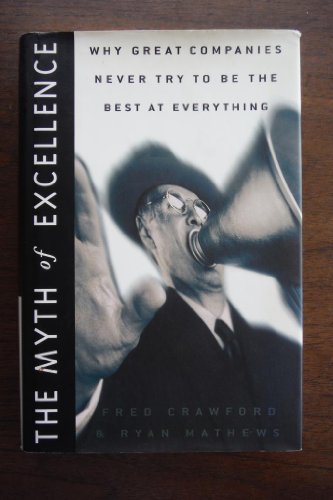
Explaining why "universal excellence" can be a mistake in the business world, the authors offer a compelling argument that a corporation should focus its resources and energy on targeted goals in order to dominate in one important area, differentiate in another, and be industry par in the others. 40,000 first printing.
Die Inhaltsangabe kann sich auf eine andere Ausgabe dieses Titels beziehen.
Über die Autorin bzw. den Autor
FRED CRAWFORD is executive vice president and global sector leader of Cap Gemini Ernst & Young's consumer products, retail, and distribution consulting practice. From his base in New York City he travels the globe working with senior executives on how to reach today's elusive consumer.
RYAN MATHEWS is a principal at FirstMatter LLC, a leading futurist firm that works with companies such as Procter & Gamble, Unilever, Grey Advertising, General Motors, Georgia-Pacific, and Coca-Cola to anticipate the trends shaping corporate America, global business, and e-commerce.
Aus dem Klappentext
The Undiscovered Consumer . . .and the Mistake of Universal Excellence
What do customers really want? And how can companies best serve them? Fred Crawford and Ryan Mathews set off on what they describe as an "expedition into the commercial wilderness" to find the answers. What they discovered was a new consumer -- one whom very few companies understand, much less manufacture products for or sell products or services to. These consumers are desperately searching for values, a scarce resource in our rapidly changing and challenging world. And increasingly they are turning to business to reaffirm these values. As one consumer put it: "I can find value everywhere but can't find values anywhere."
Crawford and Mathews's initial inquiries eventually grew into a major research study involving more than 10,000 consumers, interviews with executives from scores of leading companies around the world, and dozens of international client engagements. Their conclusion: Most companies priding themselves on how well they "know" their customers aren't really listening to them at all. Consumers are fed up with all the fuss about "world-class performance" and "excellence." What they are aggressively demanding is recognition, respect, trust, fairness, and honesty.
Believing that they are still in a position to dictate the terms of commercial engagement, businesses have bought into the myth of excellence -- the clearly false and destructive theory that a company ought to be great at everything it does, that is, all the components of every commercial transaction: price, product, access, experience, and service. This is always a mistake because "the predictable outcome [is] that the company ends up world-class at nothing; not well-differentiated and therefore not thought of by consumers at the moment of need."
Instead, Crawford and Mathews suggest that companies engage in Consumer Relevancy, a strategy of dominating in one element of a transaction, differentiating on a second, and being at industry par (i.e., average) on the remaining three. It's not necessary for businesses to equally invest time and money on all five attributes, and their customers don't want them to. Imagine the confusion if Tiffany & Co. started offering deep discounts on diamonds and McDonald's began selling free-range chicken and tofu.
The Myth of Excellence provides a blueprint for companies seeking to offer values-based products and services and shows how to realize the commercial opportunities that exist just beyond their current grasp -- opportunities to reduce operating costs, boost bottom-line profitability, and, most important, begin to engage in a meaningful dialogue with customers.
Auszug. © Genehmigter Nachdruck. Alle Rechte vorbehalten.
Field Notes from the Commercial Wilderness
This book is really the diary of a journey -- field notes from an expedition into the commercial wilderness, if you will. Our trek began with a survey, fairly modest in conception although broad in scope. After all, we thought we knew how consumers felt. Understanding consumer dynamics, analyzing marketplaces and market spaces, anticipating the impact of technological change on businesses and consumers, and looking into the future are all significant elements of our day-to-day business and personal lives. In retrospect, it is incredible how naive we really were -- naive, but not unlike a lot of other businesspeople. Since we knew what we were looking for, we wanted the data to provide verification of our brilliant insights. Like a company polling its customers and rationalizing any negative comments, we expected the survey results to support our entrenched assumptions.
We assumed, for example, that consumers wanted the absolute lowest prices, the very best products, and lots of value-added services. We also expected them to tell us that they wanted shopping to be fun and entertaining. We were in for a shock.
Our real journey started when the data came back. We were sitting in the conference room of a restored Victorian home in Westport, Connecticut, marveling at how it was possible for 5,000 Americans to be so wrong. Our initial research included more than 4,000 consumer telephone surveys and 1,000 additional Internet polls, covering a wide range of questions about various facets of the consumer/business relationship and the "average" shopping experience, followed up by hundreds of additional one-on-one conversations with consumers.
We had asked consumers some basic questions about relatively simple business transactions, or so we thought, and they'd blown it. They didn't get it. What had gotten into them? Slowly, the grim truth began to dawn on us: They weren't wrong. We were.
The survey results told us that consumers are looking for values, not just value. They wanted recognition as individual human beings, not just a 30 percent discount. While we had started asking questions about retail, we quickly began to see retail as a metaphor for something much broader. Life apparently wasn't too satisfying, and our initial respondents expected somebody or something -- apparently business -- to set things right.
We began to totally reevaluate our work. The survey tool we had developed was an excellent diagnostic, applicable to any business. But what did the results mean? We had thought about the notion of business simply in terms of the successful transfer of goods and services -- basic buying and selling. Yet suddenly we felt more like social workers, wrestling with intangible issues like respect and trust. Like teenagers out for a joyride in a Ferrari Testarossa, we found ourselves behind the wheel of a vehicle whose power was much greater than we had initially anticipated. So we eased the clutch down, gingerly downshifted, and gently applied the brakes. We concentrated on understanding the tool, fine-tuned it and ran limited tests in real companies until we were sure the new insights that kept pouring in were correct. Then we spent a year focusing on in-depth analysis, conferring with our colleagues, conducting thousands of one-on-one consumer interviews and dozens of interviews with business leaders.
Gradually things became clearer. Over and over again, the responses of our pilot 5,000 respondents kept echoing back to us. The critical elements of a transaction, business-to-consumer or business-to-business, weren't capital, goods, and services -- they were the human qualities of the people or companies exchanging those elements. It didn't seem to matter what business we were talking about. The lessons we first learned in the retail sector applied to any and all of the businesses we looked at, whether it was airlines, banks, auto companies, high-tech, insurance, or entertainment. Consumers' expectations had changed and changed radically. Unfortunately, not enough people in business had noticed. Some had, of course-the successful always do.
But even the most successful companies are often overspending and only partially achieving their aims. What led us to that conclusion? Our research caused us to see that every business transaction -- from the simplest sale of goods to the most complex service offering -- can be broken down to five attributes: price, service, access, experience, and product. We found that many companies tried to be "excellent" in all of these areas. This misguided strategy, which we've come to term the myth of excellence, had several failings: First, it's impossible for one company to be great at everything. Even Wal-Mart, arguably the most successful retailer in history, doesn't dominate its competitors on every attribute.
Second, even assuming a company could excel in all five areas, it would have difficulty communicating a clear value proposition to consumers. Imagine the confusion if Tiffany suddenly began advertising deep discount prices on emeralds, or McDonald's began offering free-range chicken and tofu. In selecting the attribute that defines their primary field of competition (the one on which a company seeks to dominate), the most successful consumer businesses hone the one that their target consumers value the most.
This seems simple enough, but it's surprising how often companies try to be the best at something their consumers don't want. Several years ago, for example, Kmart embarked on a campaign to make its line of clothing more upscale. As part of that campaign, the retailer began offering higher-priced Gitano designer jeans. The move, not surprisingly, was a resounding flop-the retailer's customers didn't believe designer clothes could be sold at Kmart prices. At the same time, Gitano hurt itself on the other end of its business, because upscale shoppers didn't believe that any brand sold by Kmart could still carry sufficient high-fashion cachet. On the other hand, the Martha Stewart line has been a great success, apparently because Kmart consumers believe that somebody who can make a candelabra out of wild gourds shares a sense of values with them. High fashion put the shoppers off. High craft seemed a bit more accessible. It wasn't that the Gitano jeans weren't a good value, it's that Kmart shoppers said to themselves that low cost, high fashion must somehow also mean low quality.
Finally, we found that even the most successful companies tended to be right for the wrong reasons -- they weren't paying enough attention to what we came to recognize as a desperate cry for basic human values. It became increasingly clear to us that this was at the heart of the myth of excellence.
But if universal commercial excellence was a myth, what was the reality? We found the answer inside our original consumer data. There was, in fact, a way for businesses to answer consumers' demand for values on terms that the consumers could recognize, a way of speaking to customers in their own language. We call this Consumer Relevancy, a way of appropriately framing an offering that enhances its value to a customer. Again, we stopped. If we were right, how could we explain the longest uninterrupted period of prosperity in human history? What could be wrong? The answer, we found, is, Plenty.
The Eye of the Storm: The Forces Driving Change in Consumer Values
Something is wrong in industrialized societies across the globe -- really, really wrong. Measured in historical terms, these are truly still the best of times. Yet despite all the material prosperity that surrounds us, we are living in some of the worst of personal times. There is a huge difference between economic and psychic well-being, between being able to afford physical comforts and feeling whole, between...
„Über diesen Titel“ kann sich auf eine andere Ausgabe dieses Titels beziehen.
Weitere beliebte Ausgaben desselben Titels

Suchergebnisse für The Myth of Excellence: Why Great Companies Never Try...

Beispielbild für diese ISBN
The Myth of Excellence: Why Great Companies Never Try to Be the Best at Everything
Anbieter: World of Books (was SecondSale), Montgomery, IL, USA
Verkäuferbewertung 5 von 5 Sternen

Zustand: Good. Item in good condition. Textbooks may not include supplemental items i.e. CDs, access codes etc. Artikel-Nr. 00058222300
Gebraucht kaufen
EUR 3,44
Versand gratis
Versand innerhalb von USA
Versand innerhalb von USA
Anzahl: 3 verfügbar
Beispielbild für diese ISBN
The Myth of Excellence: Why Great Companies Never Try to Be the Best at Everything
Anbieter: World of Books (was SecondSale), Montgomery, IL, USA
Verkäuferbewertung 5 von 5 Sternen
Zustand: Very Good. Item in very good condition! Textbooks may not include supplemental items i.e. CDs, access codes etc. Artikel-Nr. 00098570999
Gebraucht kaufen
EUR 4,59
Versand gratis
Versand innerhalb von USA
Versand innerhalb von USA
Anzahl: 6 verfügbar
Beispielbild für diese ISBN
The Myth of Excellence: Why Great Companies Never Try to Be the Best at Everything
Anbieter: World of Books (was SecondSale), Montgomery, IL, USA
Verkäuferbewertung 5 von 5 Sternen
Zustand: Acceptable. Item in acceptable condition! Textbooks may not include supplemental items i.e. CDs, access codes etc. Artikel-Nr. 00098881819
Gebraucht kaufen
EUR 4,59
Versand gratis
Versand innerhalb von USA
Versand innerhalb von USA
Anzahl: 1 verfügbar
Beispielbild für diese ISBN
The Myth of Excellence: Why Great Companies Never Try to Be the Best at Everything
Anbieter: World of Books (was SecondSale), Montgomery, IL, USA
Verkäuferbewertung 5 von 5 Sternen
Zustand: Good. Item in good condition. Textbooks may not include supplemental items i.e. CDs, access codes etc. Artikel-Nr. 00104545952
Gebraucht kaufen
EUR 4,59
Versand gratis
Versand innerhalb von USA
Versand innerhalb von USA
Anzahl: 1 verfügbar
Beispielbild für diese ISBN
The Myth of Excellence: Why Great Companies Never Try to Be the Best at Everything
Anbieter: ThriftBooks-Dallas, Dallas, TX, USA
Verkäuferbewertung 5 von 5 Sternen
Hardcover. Zustand: Fair. No Jacket. Readable copy. Pages may have considerable notes/highlighting. ~ ThriftBooks: Read More, Spend Less. Artikel-Nr. G0609608207I5N00
Gebraucht kaufen
EUR 5,84
Versand gratis
Versand innerhalb von USA
Versand innerhalb von USA
Anzahl: 1 verfügbar
Beispielbild für diese ISBN
The Myth of Excellence: Why Great Companies Never Try to Be the Best at Everything
Verlag:
Crown Business (edition 1), 2001
ISBN 10: 0609608207
ISBN 13: 9780609608203
Gebraucht
Hardcover
Anbieter: BooksRun, Philadelphia, PA, USA
Verkäuferbewertung 5 von 5 Sternen
Hardcover. Zustand: Very Good. 1. With dust jacket. It's a well-cared-for item that has seen limited use. The item may show minor signs of wear. All the text is legible, with all pages included. It may have slight markings and/or highlighting. Artikel-Nr. 0609608207-8-1-29
Gebraucht kaufen
EUR 6,09
Versand gratis
Versand innerhalb von USA
Versand innerhalb von USA
Anzahl: 1 verfügbar
Beispielbild für diese ISBN
The Myth of Excellence : Why Great Companies Never Try to Be the Best at Everything
Verlag:
Crown Publishing Group, The, 2001
ISBN 10: 0609608207
ISBN 13: 9780609608203
Gebraucht
Hardcover
Erstausgabe
Anbieter: Better World Books, Mishawaka, IN, USA
Verkäuferbewertung 5 von 5 Sternen
Zustand: Very Good. 1st Edition. Pages intact with possible writing/highlighting. Binding strong with minor wear. Dust jackets/supplements may not be included. Stock photo provided. Product includes identifying sticker. Better World Books: Buy Books. Do Good. Artikel-Nr. 52057202-6
Gebraucht kaufen
EUR 6,40
Versand gratis
Versand innerhalb von USA
Versand innerhalb von USA
Anzahl: 1 verfügbar
Beispielbild für diese ISBN
The Myth of Excellence : Why Great Companies Never Try to Be the Best at Everything
Verlag:
Crown Publishing Group, The, 2001
ISBN 10: 0609608207
ISBN 13: 9780609608203
Gebraucht
Hardcover
Erstausgabe
Anbieter: Better World Books, Mishawaka, IN, USA
Verkäuferbewertung 5 von 5 Sternen
Zustand: Good. 1st Edition. Former library copy. Pages intact with minimal writing/highlighting. The binding may be loose and creased. Dust jackets/supplements are not included. Includes library markings. Stock photo provided. Product includes identifying sticker. Better World Books: Buy Books. Do Good. Artikel-Nr. GRP64967028
Gebraucht kaufen
EUR 6,40
Versand gratis
Versand innerhalb von USA
Versand innerhalb von USA
Anzahl: 1 verfügbar
Beispielbild für diese ISBN
The Myth of Excellence: Why Great Companies Never Try to Be the Best at Everything
Anbieter: Wonder Book, Frederick, MD, USA
Verkäuferbewertung 5 von 5 Sternen
Zustand: Very Good. Very Good condition. Good dust jacket. A copy that may have a few cosmetic defects. May also contain light spine creasing or a few markings such as an owner's name, short gifter's inscription or light stamp. Artikel-Nr. C06C-06888
Gebraucht kaufen
EUR 6,74
Versand gratis
Versand innerhalb von USA
Versand innerhalb von USA
Anzahl: 1 verfügbar
Beispielbild für diese ISBN
The Myth of Excellence
Anbieter: AwesomeBooks, Wallingford, Vereinigtes Königreich
Verkäuferbewertung 5 von 5 Sternen
Hardcover. Zustand: Very Good. The Myth of Excellence This book is in very good condition and will be shipped within 24 hours of ordering. The cover may have some limited signs of wear but the pages are clean, intact and the spine remains undamaged. This book has clearly been well maintained and looked after thus far. Money back guarantee if you are not satisfied. See all our books here, order more than 1 book and get discounted shipping. . Artikel-Nr. 7719-9780609608203
Gebraucht kaufen
EUR 4,83
EUR 4,84 Versand
Versand von Vereinigtes Königreich nach USA
Versand von Vereinigtes Königreich nach USA
Anzahl: 2 verfügbar