
Verwandte Artikel zu The Power of a Positive No: How to Say No and Still...
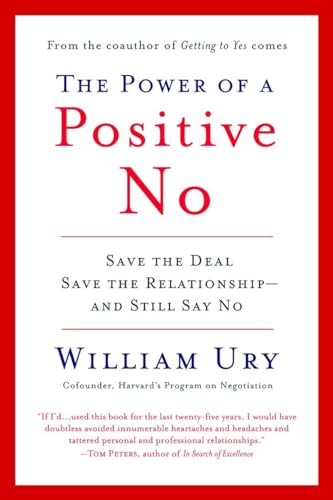
Inhaltsangabe
“William Ury brings a marvelous blend of experience, insight, integrity and warmth to his work. In this wonderful book he teaches us how to say No—with grace and effect—so that we might create an even better Yes.” —Jim Collins, author of Good to Great
No is perhaps the most important and certainly the most powerful word in the language. Every day we find ourselves in situations where we need to say No–to people at work, at home, and in our communities–because No is the word we must use to protect ourselves and to stand up for everything and everyone that matters to us.
But as we all know, the wrong No can also destroy what we most value by alienating and angering people. That’s why saying No the right way is crucial. The secret to saying No without destroying relationships lies in the art of the Positive No, a proven technique that anyone can learn.
This indispensable book gives you a simple three-step method for saying a Positive No. It will show you how to assert and defend your key interests; how to make your No firm and strong; how to resist the other side’s aggression and manipulation; and how to do all this while still getting to Yes. In the end, the Positive No will help you get not just to any Yes but to the right Yes, the one that truly serves your interests.
Based on William Ury’s celebrated Harvard University course for managers and professionals, The Power of a Positive No offers concrete advice and practical examples for saying No in virtually any situation. Whether you need to say No to your customer or your coworker, your employee or your CEO, your child or your spouse, you will find in this book the secret to saying No clearly, respectfully, and effectively.
In today’s world of high stress and limitless choices, the pressure to give in and say Yes grows greater every day, producing overload and overwork, expanding e-mail and eroding ethics. Never has No been more needed. A Positive No has the power to profoundly transform our lives by enabling us to say Yes to what counts–our own needs, values, and priorities.
Understood this way, No is the new Yes. And the Positive No may be the most valuable life skill you’ll ever learn.
Die Inhaltsangabe kann sich auf eine andere Ausgabe dieses Titels beziehen.
Über die Autorin bzw. den Autor
A world-renowned negotiator, mediator, and bestselling author, William Ury directs the Global Negotiation Project at Harvard University. Over the last thirty years he has helped millions of people, hundreds of organizations, and numerous countries at war reach satisfying agreements.
Auszug. © Genehmigter Nachdruck. Alle Rechte vorbehalten.
Chapter One
Uncover Your Yes
“In creating, the only hard thing’s to begin; a grass-blade’s no easier to make than an oak.” –James Russell Lowell
Perhaps the single biggest mistake we make when we say No is to start from No. We derive our No from what we are against–the other’s demand or behavior. A Positive No calls on us to do the exact opposite and base our No on what we are for. Instead of starting from No, start from Yes. Root your No in a deeper Yes–a Yes to your core interests and to what truly matters.
Nowhere did I learn this more clearly than from a relative of mine who suffered from a serious addiction to alcohol that nearly cost him and others their lives in a car accident. He tried many times to give up the habit but always failed. Then at the age of sixty, just when all hope seemed lost, he found in him- self the will to say No and stop drinking. The secret? “When my first grandchild was born,” he says, “I wanted more than anything to live long enough to see him grow up. It was his birth that motivated me to get treatment and stop drinking. Since then, for over fifteen years now, I have not touched a drop.” His Yes to being present for his grandchildren–to be able to play with them and see them grow–motivated his powerful No to alcohol.
His story serves to illustrate an everyday paradoxical truth: the power of your No comes directly from the power of your Yes.
Your Yes is the underlying purpose for which you are saying No. The first step in the method is to uncover the Yes that lies behind your No. The deeper you go into your core motivation, the more powerful your Yes will be and thus the more powerful your No.
From Reactive to Proactive
The biggest obstacle to saying No successfully is not the other, however difficult they might be. It is ourselves. It is our all-too-human tendency to react–to act with intense emotion but without clear purpose. We humans are reaction machines. And our Nos tend to be reactive. We accommodate out of fear and guilt. We attack out of anger. We avoid out of fear. To get ourselves out of this three-A trap, we need to become proactive, forward-looking, and purposeful.
This challenge is vividly captured in an old Japanese story about a samurai and a fisherman. One day, the samurai went to collect a debt from the fisherman. “I’m sorry,” the fisherman said, “but this last year has been a very bad one for me, and I regret to say I do not have the money to repay you.” Quick to anger, the samurai drew his sword and prepared to kill the fisherman on the spot. Thinking fast, the fisherman boldly said, “I have been studying martial arts and my master teaches that you should never strike out of anger.”
The samurai looked at him for a minute, then slowly lowered his sword. “Your master is wise,” he said quietly. “My master used to teach the same lesson. Sometimes my anger gets the better of me. I will give you one more year to repay your debt, but if you fail by even a penny, I will surely kill you.”
The samurai returned to his house, arriving late at night. He crept in quietly, not wishing to wake his wife, but to his shock, he found two people in the bed, his wife and a stranger dressed in samurai clothing. With a surge of jealousy and anger, he raised his sword to slay them both, but suddenly the fisherman’s words came back to him: “Do not strike out of anger.” The samurai stopped for a moment, took a deep breath, and then deliberately made a loud noise. His wife instantly woke up, as did the “stranger,” who turned out to be his mother.
“What is the meaning of this?” he yelled. “I almost killed you both!”
“We were afraid of robbers,” his wife explained. “So I dressed your mother up in your samurai clothes to scare them off.”
A year passed and the fisherman came to see the samurai. “I had an excellent year, so here is your money back and with interest,” the fisherman said happily to him.
“Keep your money,” replied the samurai. “You repaid your debt long ago.”
When you want to say No, remember the samurai’s lesson: do not react out of anger–or indeed out of any negative emotion such as fear or guilt. Take a deep breath and focus on your purpose–your Yes–in this situation. Ask yourself what you really want and what is really important here. In other words, shift from being reactive focused on No, to being proactive focused on Yes.
This chapter outlines a process that can help you. As the samurai did, you start by stopping and collecting your wits. You then proceed to ask yourself why. Why do you want to say No? What are your underlying interests, needs, and values? Once you have answered this question, you can then crystallize your Yes!–your intention to protect what matters most to you.
Stop: Go to the Balcony
We do not have a chance of being able to influence the other unless we are first able to control our own natural reactions and emotions.
When we want to say No to an offensive behavior or inappropriate demand, it is only natural to feel angry. But anger can blind us. In the rush to say No, angrily and sometimes vengefully, it is all too easy to lose sight of the prize–advancing our interests. Fear too can prevent us from pursuing our objectives. We imagine in advance the other’s reaction to our No. What will they think of us or do to us? What will happen to our relationship, to the deal, and thus to our interests? Paralyzed, we accommodate, giving up on our needs. Guilt has a similar effect. “Who am I to say No?” “I don’t deserve the time to myself.” “Their needs are more important than mine.”
Anger can blind, fear can paralyze, and guilt can weaken.
The first challenge we face, therefore, is internal. Recall the example of the man who said No to his domineering father, who was also his boss. In John’s own words, “I didn’t stand up to my dad, I stood up to my fears!” As John recognized, the real obstacle to getting what he wanted was not his father; it was his own fears. “All the action was basically over by the time I spoke to him.” That is the key point. The real action of standing up for yourself takes place inside you before you say No.
This internal action starts with stopping. Stopping is all- important because it interrupts your natural reaction, buys you time to think, and thus allows you to uncover your Yes. You may stop for a second, an hour, a day, or however long is required. What matters is to stop and get some perspective on the situation before proceeding with your No.
I like to use the metaphor of “going to the balcony.” The balcony is a detached state of mind you can access anytime you choose. Imagine yourself for a moment as an actor on a stage about to speak your lines–your No. Now picture yourself up on a balcony overlooking the stage, a place where you can see the scene clearly from afar. The balcony is a place of perspective, calm, and clarity. From a balcony perspective, it is much easier to uncover the Yes behind your No.
I came to truly appreciate this lesson when I was asked to facilitate a difficult discussion in the mid-1990s between Russian and Chechen leaders about how to end the tragic war in Chechnya. This discussion took place at the Peace Palace in The Hague in the very same conference room used for the international tribunal on war crimes in the former Yugoslavia. The Chechen vice president began his...
„Über diesen Titel“ kann sich auf eine andere Ausgabe dieses Titels beziehen.
Suchergebnisse für The Power of a Positive No: How to Say No and Still...

Beispielbild für diese ISBN
The Power of a Positive No How
Anbieter: World of Books (was SecondSale), Montgomery, IL, USA
Verkäuferbewertung 5 von 5 Sternen

Zustand: Acceptable. Item in acceptable condition! Textbooks may not include supplemental items i.e. CDs, access codes etc. Artikel-Nr. 00096434271
Gebraucht kaufen
EUR 3,66
Versand gratis
Versand innerhalb von USA
Versand innerhalb von USA
Anzahl: 3 verfügbar
Beispielbild für diese ISBN
The Power of a Positive No How
Anbieter: World of Books (was SecondSale), Montgomery, IL, USA
Verkäuferbewertung 5 von 5 Sternen
Zustand: Very Good. Item in very good condition! Textbooks may not include supplemental items i.e. CDs, access codes etc. Artikel-Nr. 00110305445
Gebraucht kaufen
EUR 3,66
Versand gratis
Versand innerhalb von USA
Versand innerhalb von USA
Anzahl: 1 verfügbar
Beispielbild für diese ISBN
The Power of a Positive No: How to Say No and Still Get to Yes
Anbieter: World of Books (was SecondSale), Montgomery, IL, USA
Verkäuferbewertung 5 von 5 Sternen
Paperback. Zustand: Good. A practical three-step method for saying no in any situation--without losing the deal or the relationship, from the author of Possible and Getting Past No "In this wonderful book, William Ury teaches us how to say No--with grace and effect--so that we might create an even better Yes."--Jim Collins, author of Good to Great In The Power of a Positive No, William Ury of Harvard Law School's Program on Negotiation teaches you how to take the next step toward getting what you want. It all begins with the most powerful and perhaps most important word in any situation: No. But saying the wrong kind of No can destroy what we value and alienate others. That's why saying No the right way--to people at work, at home, and in our communities--is crucial. You'll learn how to: * Assert your own interests while respecting the other side's * Use power effectively * Defuse the other side's attack, manipulation, and guilt tactics * Reduce stress and anxiety * Develop healthier relationships * Stand up for yourself without stepping on the other person's toes In today's world of high stress and limitless choices, the pressure to give in and say Yes grows greater every day, producing overload and overwork, expanding e-mail and eroding ethics. Never has No been more needed. And with The Power of a Positive No, we can learn how to use No to profoundly transform our lives by enabling us to say Yes to what counts--our own needs, values, and priorities. Artikel-Nr. 00087295985
Gebraucht kaufen
EUR 3,66
Versand gratis
Versand innerhalb von USA
Versand innerhalb von USA
Anzahl: Mehr als 20 verfügbar
Beispielbild für diese ISBN
The Power of a Positive No: How to Say No and Still Get to Yes
Anbieter: ThriftBooks-Atlanta, AUSTELL, GA, USA
Verkäuferbewertung 5 von 5 Sternen
Paperback. Zustand: Very Good. No Jacket. May have limited writing in cover pages. Pages are unmarked. ~ ThriftBooks: Read More, Spend Less. Artikel-Nr. G0553384260I4N00
Gebraucht kaufen
EUR 5,87
Versand gratis
Versand innerhalb von USA
Versand innerhalb von USA
Anzahl: 2 verfügbar
Beispielbild für diese ISBN
The Power of a Positive No: How to Say No and Still Get to Yes
Anbieter: ThriftBooks-Reno, Reno, NV, USA
Verkäuferbewertung 5 von 5 Sternen
Paperback. Zustand: Very Good. No Jacket. May have limited writing in cover pages. Pages are unmarked. ~ ThriftBooks: Read More, Spend Less. Artikel-Nr. G0553384260I4N00
Gebraucht kaufen
EUR 5,87
Versand gratis
Versand innerhalb von USA
Versand innerhalb von USA
Anzahl: 2 verfügbar
Beispielbild für diese ISBN
The Power of a Positive No: How to Say No and Still Get to Yes
Anbieter: ThriftBooks-Dallas, Dallas, TX, USA
Verkäuferbewertung 5 von 5 Sternen
Paperback. Zustand: Very Good. No Jacket. May have limited writing in cover pages. Pages are unmarked. ~ ThriftBooks: Read More, Spend Less. Artikel-Nr. G0553384260I4N00
Gebraucht kaufen
EUR 5,87
Versand gratis
Versand innerhalb von USA
Versand innerhalb von USA
Anzahl: 2 verfügbar
Beispielbild für diese ISBN
The Power of a Positive No: How to Say No and Still Get to Yes
Anbieter: ThriftBooks-Phoenix, Phoenix, AZ, USA
Verkäuferbewertung 5 von 5 Sternen
Paperback. Zustand: Very Good. No Jacket. May have limited writing in cover pages. Pages are unmarked. ~ ThriftBooks: Read More, Spend Less. Artikel-Nr. G0553384260I4N00
Gebraucht kaufen
EUR 5,87
Versand gratis
Versand innerhalb von USA
Versand innerhalb von USA
Anzahl: 1 verfügbar
Beispielbild für diese ISBN
The Power of a Positive No : How to Say No and Still Get to Yes
Verlag:
Random House Publishing Group, 2007
ISBN 10: 0553384260
ISBN 13: 9780553384260
Gebraucht
Softcover
Anbieter: Better World Books: West, Reno, NV, USA
Verkäuferbewertung 5 von 5 Sternen
Zustand: Good. Former library copy. Pages intact with minimal writing/highlighting. The binding may be loose and creased. Dust jackets/supplements are not included. Includes library markings. Stock photo provided. Product includes identifying sticker. Better World Books: Buy Books. Do Good. Artikel-Nr. 6162148-6
Gebraucht kaufen
EUR 6,09
Versand gratis
Versand innerhalb von USA
Versand innerhalb von USA
Anzahl: 1 verfügbar
Beispielbild für diese ISBN
The Power of a Positive No : How to Say No and Still Get to Yes
Verlag:
Random House Publishing Group, 2007
ISBN 10: 0553384260
ISBN 13: 9780553384260
Gebraucht
Softcover
Anbieter: Better World Books: West, Reno, NV, USA
Verkäuferbewertung 5 von 5 Sternen
Zustand: Good. Pages intact with minimal writing/highlighting. The binding may be loose and creased. Dust jackets/supplements are not included. Stock photo provided. Product includes identifying sticker. Better World Books: Buy Books. Do Good. Artikel-Nr. 4289527-6
Gebraucht kaufen
EUR 6,09
Versand gratis
Versand innerhalb von USA
Versand innerhalb von USA
Anzahl: 3 verfügbar
Beispielbild für diese ISBN
The Power of a Positive No : How to Say No and Still Get to Yes
Verlag:
Random House Publishing Group, 2007
ISBN 10: 0553384260
ISBN 13: 9780553384260
Gebraucht
Softcover
Anbieter: Better World Books, Mishawaka, IN, USA
Verkäuferbewertung 5 von 5 Sternen
Zustand: Very Good. Former library copy. Pages intact with possible writing/highlighting. Binding strong with minor wear. Dust jackets/supplements may not be included. Includes library markings. Stock photo provided. Product includes identifying sticker. Better World Books: Buy Books. Do Good. Artikel-Nr. 11727887-75
Gebraucht kaufen
EUR 6,09
Versand gratis
Versand innerhalb von USA
Versand innerhalb von USA
Anzahl: 1 verfügbar