
Verwandte Artikel zu Curried Cultures: Globalization, Food, and South Asia...
Curried Cultures: Globalization, Food, and South Asia (California Studies in Food and Culture) (California Studies in Food and Culture, 34, Band 34) - Softcover
Buch 34 von 83: California Studies in Food and Culture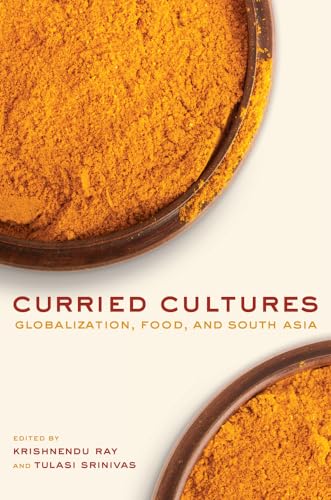
Inhaltsangabe
Although South Asian cookery and gastronomy has transformed contemporary urban foodscape all over the world, social scientists have paid scant attention to this phenomenon. Curried Cultures-a wide-ranging collection of essays-explores the relationship between globalization and South Asia through food, covering the cuisine of the colonial period to the contemporary era, investigating its material and symbolic meanings. Curried Cultures challenges disciplinary boundaries in considering South Asian gastronomy by assuming a proximity to dishes and diets that is often missing when food is a lens to investigate other topics. The book's established scholarly contributors examine food to comment on a range of cultural activities as they argue that the practice of cooking and eating matter as an important way of knowing the world and acting on it.
Die Inhaltsangabe kann sich auf eine andere Ausgabe dieses Titels beziehen.
Über die Autorin bzw. den Autor
Tulasi Srinivas is Assistant Professor in the Department of Communication Studies and the Institute for Liberal Arts and Interdisciplinary Studies at Emerson College and author of Winged Faith: Rethinking Religion and Globalization through the Sathya Sai Movement (Columbia, 2009). Krishnendu Ray is Assistant Professor of Nutrition and Food Studies at New York University and author of The Migrant's Table: Meals and Memories in Bengali-American Households (Temple University, 2004).
Auszug. © Genehmigter Nachdruck. Alle Rechte vorbehalten.
Curried Cultures
Globalization, Food, and South Asia
By Krishnendu Ray, Tulasi SrinivasUNIVERSITY OF CALIFORNIA PRESS
Copyright © 2012 The Regents of the University of California
All rights reserved.
ISBN: 978-0-520-27012-1All rights reserved.
Contents
PART ONE OPENING THE ISSUES,
1 • Introduction Krishnendu Ray and Tulasi Srinivas, 3,
2 • A Different History of the Present: The Movement of Crops, Cuisines, and Globalization Akhil Gupta, 29,
PART TWO THE PRINCELY-COLONIAL ENCOUNTER AND THE NATIONALIST RESPONSE,
3 • Cosmopolitan Kitchens: Cooking for Princely Zenanas in Late Colonial India Angma D. Jhala, 49,
4 • Nation on a Platter: The Culture and Politics of Food and Cuisine in Colonial Bengal Jayanta Sengupta, 73,
PART THREE CITIES, MIDDLE CLASSES, AND PUBLIC CULTURES OF EATING,
5 • Udupi Hotels: Entrepreneurship, Reform, and Revival Stig Toft Madsen and Geoffrey Gardella, 91,
6 • Dum Pukht: A Pseudo-Historical Cuisine Holly Shaffer, 110,
7 • "Teaching Modern India How to Eat": "Authentic" Foodways and Regimes of Exclusion in Affluent Mumbai Susan Dewey, 126,
8 • "Going for an Indian": South Asian Restaurants and the Limits of Multiculturalism in Britain Elizabeth Buettner, 143,
9 • Global Flows, Local Bodies: Dreams of Pakistani Grill in Manhattan Krishnendu Ray, 175,
10 • From Curry Mahals to Chaat Cafés: Spatialities of the South Asian Culinary Landscape Arijit Sen, 196,
11 • Masala Matters: Globalization, Female Food Entrepreneurs, and the Changing Politics of Provisioning Tulasi Srinivas, 219,
Postscript • Globalizing South Asian Food Cultures: Earlier Stops to New Horizons R.S. Khare, 237,
References, 255,
Contributors, 299,
Index, 303,
CHAPTER 1
Introduction
Krishnendu Ray and Tulasi Srinivas
SOUTH ASIA IS A NEW HUB of intersecting global networks nourished by proliferating material and symbolic transactions propelling bodies, things, and conceptions across national boundaries. In this book, traversing national boundaries is the contingent operational definition of globalization. That implies at least two things: globalization becomes more visible after national boundaries crystallize; and we witness a new kind of self-consciousness about the connections between various locales and between the local and the supralocal in this phase of globalization. Furthermore, the affiliation of food to the body makes comestibles intensely local, in spite of their long history of distant circulation. Thus food is a particularly productive site to interrogate a new iteration of something old, because it links not only the global to the local, but the mind to the body and beyond. By weaving densely local stories, this book draws attention to processes of globalization as they play out at particular places and on specific peoples' conceptions of themselves and their world.
In the last quarter of the twentieth century, new nodes in the global traffic in capital and culture joined previous flows of the capitalist world-economy from the edges of the Mediterranean and the Atlantic. Works such as The Globalization of Chinese Food (Wu & Cheung 2004), Asian Food: The Global and the Local (Cwiertka & Walraven 2001), The Globalization of Food (Inglis & Gimlin 2009) and Globalization, Food and Social Identities in the Asia Pacific Region (Farrer 2010) bear witness to those transformations. Until now there has been no comparable work centering on the South Asian wellspring of unconventional flows of bodies, edible commodities, and cultural conceptions. Although South Asian cookery is transforming the everyday world of urbanites everywhere, there has been little attention given to this process. Curried Cultures closes that gap in our knowledge about South Asia, its connections to the larger world, and to the cultural environment that urban middle classes almost everywhere face with increasing potency. It draws attention to timeless processes of creolization and conservation, flow and counter-flow, and transvaluation of the old and production of the new in the food cultures of globalizing middle classes. The title, Curried Cultures, is ironic, self-consciously playing on a stereotype, and earnest enough to appropriate the curry as a sign for the people it talks about. These are people who are born of the transaction between India and elsewhere, no different from the genealogies of Chicken Tikka Masala or Curry Raisu, not wholly belonging to the subcontinent and yet oddly defined by it.
Partly what is new about the current conjuncture that is marked by the term globalization is that numerous spatially distributed urban middle classes have been dramatically pulled into transnational transactions in taste, and they have left a legible imprint of their experience, often in multilingual mediums. Paying attention to this practical-linguistic ecumene is important here so as to redress excessive attention to nation, religion, and commodity in the literatures on the global-cultural link. In addition, numerous chapters in this volume are written by scholars who are themselves of the middle class and who often write about people who belong to that class to whom English is available, at least as one in a bilingual or multilingual world. The anglophone middle class comes with a location in a social hierarchy with a shared feeling of middleness, either precariously or assuredly so. Some of the brash assertion of middleness of this class is a product of the novelty of their location in an emerging economic and cultural powerhouse such as India (Dickey 2010, 2000; Fernandes 2006; Deshpande 2003; Fernandes & Heller 2006; Dwyer 2000; Derné 2008; Harriss 2006; and Fuller & Narasimhan 2007).
This book is neither about globalization from above, nor is it about globalization from below. Instead it is mostly about globalization from the middle, with its derivative and deviant relationship to neoliberal globalization (that Bhabha characterizes as "performative, deformative" translation—1994: 241), and the imaginative reconstitution of the global elsewhere. This book is about that middle class precisely because it is a class that has emerged as a major player in the conceptualization of globalization and counterpositions to globalization. Much has been written about globalization from above, but very little from elsewhere. A subaltern history of globalization that Akhil Gupta challenges us to conceive in the next chapter is yet to be born. We see the field of cultural globalization as constituted both by questions of the perimeter, marked by the nation-state, and of hierarchy, in terms of class and profession.
Curried Cultures joins an array of work that interrogates culinary cultures (separate from agricultural food production) to address issues of globalization, nation-making, nation-breaking, and beyond. In particular, we develop what is suggested in Warren Belasco and Philip Scranton's Food Nations (2002) and James L. Watson and Melissa L. Caldwell's The Cultural Politics of Food and Eating (2005) about the relationship between place, power, and comestibles. These issues have been developed further in studies such as Jeffrey Pilcher's Que vivan los tamales! (1998) on Mexico and Richard Wilk's Home Cooking in the Global Village (2006b) about Belize. We draw on their work to argue that in some ways globalization makes national boundaries porous as people,...
„Über diesen Titel“ kann sich auf eine andere Ausgabe dieses Titels beziehen.
Suchergebnisse für Curried Cultures: Globalization, Food, and South Asia...

Beispielbild für diese ISBN
Curried Cultures
Anbieter: PBShop.store US, Wood Dale, IL, USA
Verkäuferbewertung 5 von 5 Sternen

PAP. Zustand: New. New Book. Shipped from UK. Established seller since 2000. Artikel-Nr. WF-9780520270121
Beispielbild für diese ISBN
Curried Cultures
Anbieter: PBShop.store UK, Fairford, GLOS, Vereinigtes Königreich
Verkäuferbewertung 5 von 5 Sternen
PAP. Zustand: New. New Book. Shipped from UK. Established seller since 2000. Artikel-Nr. WF-9780520270121
Neu kaufen
EUR 35,07
EUR 5,96 Versand
Versand von Vereinigtes Königreich nach USA
Versand von Vereinigtes Königreich nach USA
Anzahl: 1 verfügbar
Beispielbild für diese ISBN
Curried Cultures: Globalization, Food, and South Asia
Verlag:
University of California Press, 2012
ISBN 10: 0520270126
ISBN 13: 9780520270121
Neu
Softcover
Anbieter: Kennys Bookstore, Olney, MD, USA
Verkäuferbewertung 5 von 5 Sternen
Zustand: New. Explores the relationship between globalization and South Asia through food, covering the cuisine of the colonial period to the contemporary era, investigating its material and symbolic meanings. Editor(s): Ray, Krishnendu; Srinivas, Tulasi. Series: California Studies in Food and Culture. Num Pages: 320 pages, 5 b/w photographs, 4 line illustrations. BIC Classification: JFCV; JHB. Category: (P) Professional & Vocational. Dimension: 152 x 229 x 20. Weight in Grams: 468. . 2012. 1st Edition. Paperback. . . . . Books ship from the US and Ireland. Artikel-Nr. V9780520270121
Neu kaufen
EUR 41,89
EUR 9,36 Versand
Versand innerhalb von USA
Versand innerhalb von USA
Anzahl: 1 verfügbar
Beispielbild für diese ISBN
Curried Cultures: Globalization, Food, and South Asia (California Studies in Food and Culture) (Volume 34)
Verlag:
University of California Press, 2012
ISBN 10: 0520270126
ISBN 13: 9780520270121
Neu
Softcover
Anbieter: Ria Christie Collections, Uxbridge, Vereinigtes Königreich
Verkäuferbewertung 5 von 5 Sternen
Zustand: New. In English. Artikel-Nr. ria9780520270121_new
Neu kaufen
EUR 42,55
EUR 13,40 Versand
Versand von Vereinigtes Königreich nach USA
Versand von Vereinigtes Königreich nach USA
Anzahl: Mehr als 20 verfügbar
Beispielbild für diese ISBN
Curried Cultures Globalization, Food, and South Asia
Anbieter: Revaluation Books, Exeter, Vereinigtes Königreich
Verkäuferbewertung 5 von 5 Sternen
Paperback. Zustand: Brand New. 1st edition. 320 pages. 9.25x6.00x0.75 inches. In Stock. Artikel-Nr. x-0520270126
Neu kaufen
EUR 59,05
EUR 11,87 Versand
Versand von Vereinigtes Königreich nach USA
Versand von Vereinigtes Königreich nach USA
Anzahl: 2 verfügbar
Foto des Verkäufers
Ray, K: Curried Cultures - Globalization, Food, and South As
Verlag:
University of California Press, 2012
ISBN 10: 0520270126
ISBN 13: 9780520270121
Neu
Softcover
Anbieter: moluna, Greven, Deutschland
Verkäuferbewertung 5 von 5 Sternen
Zustand: New. Explores the relationship between globalization and South Asia through food, covering the cuisine of the colonial period to the contemporary era, investigating its material and symbolic meanings.A group of essays that collectively explore the relati. Artikel-Nr. 594723345
Neu kaufen
EUR 46,11
EUR 48,99 Versand
Versand von Deutschland nach USA
Versand von Deutschland nach USA
Anzahl: Mehr als 20 verfügbar
Foto des Verkäufers
Curried Cultures : Globalization, Food, and South Asia
Anbieter: AHA-BUCH GmbH, Einbeck, Deutschland
Verkäuferbewertung 5 von 5 Sternen
Taschenbuch. Zustand: Neu. Neuware - A group of essays that collectively explore the relationship between globalization and South Asian history through food. The essays are divided into three sections, covering cuisine and colonialism, contemporary urban food consumption, and food of the South Asian diaspora. The volume even includes an ethnographic study of Viks Chaat Corner in Berkeley. The book will be a welcome resource for courses on cultural anthropology, food, globalization, and South Asian studies. Artikel-Nr. 9780520270121
Neu kaufen
EUR 63,38
EUR 35,00 Versand
Versand von Deutschland nach USA
Versand von Deutschland nach USA
Anzahl: 1 verfügbar